Quick Overview: This in-depth guide explains prompt engineering, its importance in AI communication, core techniques, technical skills, real-world applications, and future trends, showing how well-designed prompts improve accuracy, efficiency, and business outcomes across industries.
Artificial intelligence is not an idea for the future. People use AI to these use cases are part of modern generative AI development, where AI systems create text, code, and insights at scale. Tools like ChatGPT, Claude, and Gemini are now part of many workflows. However, without effective prompt engineering, many users still struggle to get results that are accurate and truly helpful.
The reason is simple. AI output depends on the quality of the input.
This is where prompt engineering matters. Prompt engineering decides whether AI gives general answers or clear, useful results. Still, many people have problems finding results that are useful and correct. In fact, recent data shows that 40–45% of small and medium businesses already use generative AI for marketing, content creation, and improved customer service, helping them streamline tasks, reduce costs, and gain a competitive edge.
In this blog, you will learn what prompt engineering is and how it works. You will also explore prompting techniques, real-world uses, careers, and future trends. Most significantly, you’ll find out why prompt engineering is such a vital ability for AI.
What Is Prompt Engineering?
Prompt engineering plays a key role in generative AI development solutions by shaping how AI models understand tasks, context, and desired outcomes. In professional AI consulting services, this process ensures AI systems align with business goals and use cases. A prompt tells the AI what to do and how to do it. It can be a question, an instruction, an example, or a structured input.
AI models do not follow strict rules like software programs. Instead, they predict responses based on patterns and context. Because of this, small wording changes can lead to very different answers.
Prompt engineering focuses on:
- Removing confusion
- Making intent clear
- Organizing information
- Guiding thinking and creativity
In simple terms, prompt engineering is how humans talk clearly to AI systems.
Why Prompt Engineering Is So Important
AI systems do not understand meaning like humans do. They only react to what is written in the prompt. Because of this, unclear prompts lead to weak results.
With AI prompt engineering, this problem can be fixed. It gives more details, background, and limits. This is why AI answers are better and more useful. AI prompt engineering is no longer a choice for businesses. It provides practical prompt engineering solutions that improve accuracy and reduce wasted effort.
Prompt engineering also helps non-technical users. People can use AI well without coding skills. As AI use grows, clear communication becomes essential. In short, prompt engineering turns AI into a reliable assistant.
Fundamental Elements of Prompt Engineering
Prompt engineering is not about writing more words. It is about using the right structure. Clear structure helps AI respond better.
Not every prompt needs all elements. However, knowing them helps you design better prompts.
| Element | Purpose | Example |
| Instruction | Defines the task | “Write a beginner’s explanation of prompt engineering.” |
| Context | Adds background | “This is for non-technical users.” |
| Input Data | Gives reference | “Use this outline and keywords.” |
| Constraints | Sets limits | “Limit to 300 words.” |
| Output Format | Controls layout | “Use bullet points.” |
| Role / Persona | Sets expertise | “You are an AI educator.” |
| Examples | Shows quality | “Here is an example.” |
These elements reduce errors and improve results.
How Prompt Engineering Works Behind the Scenes
Large Language Models create text by predicting the next word. They do not search the internet. Instead, they generate responses from patterns.
Prompt engineering works by:
- Adding clear context
- Guiding response direction
- Encouraging step-by-step thinking
- Reducing off-topic answers
Key concepts include:
- Context window: how much text AI can read
- Tokenization: how text is split
- Temperature: how creative responses are
While prompt engineering does not require deep coding, it complements machine learning solutions by improving how models are used in real-world systems.
Technical Skills for Prompt Engineering
Many companies now invest in AI prompt engineering services to apply these skills at scale.
1. Understanding Large Language Models (LLMs)
Prompt engineers must understand how large language models work. AI predicts text based on patterns and context. It does not think or reason like humans. Because of this, clear instructions are essential for good results.
2. Token and Context Awareness
Every AI model has limits on how much information it can process at once. Understanding token and context limits helps prevent important instructions from being ignored. For best results, key details should appear early in the prompt.
3. Structured Prompt Design
Structured prompt design focuses on organizing tasks into clear, logical steps. Breaking complex requests into smaller parts improves accuracy and gives better control over the output.
4. Few-Shot and Example-Based Prompting
Providing examples shows the AI what a good response looks like. Few-shot prompting helps control format, tone, and structure. As a result, outputs become more consistent and predictable.
5. Prompt Testing and Iteration
Prompt engineering is an iterative process. Testing different prompt versions helps identify what works best. This approach is similar to debugging in AI software development.
6.Familiarity with AI Tools and Platforms
Each AI platform handles prompts in a different way. Tools like ChatGPT, Claude, and Gemini are now part of many workflows, often through direct expert ChatGPT integration in business systems.
7. Basic Automation and Workflow Integration
Advanced prompt engineers often connect prompts to workflows using templates, APIs, or automation tools. While coding skills can help, they are not always required.
Read More About: Best AI Coding Assistants Compared: ChatGPT vs Copilot vs Claude
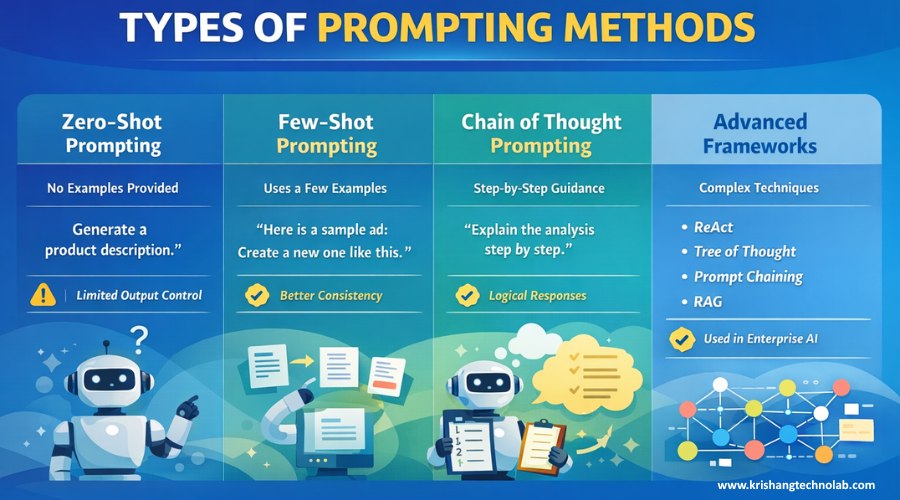
Different Types of Prompting Methods
1. Zero-Shot Prompting
This method asks the AI to respond without providing any examples.
Limitation: It provides less control over the format of the output.
2. One-Shot and Few-Shot Prompting
Few-shot prompting includes examples.
How it works: Examples show what you can expect.
Best for: Consistent building.
3. Prompting a Chain of Thought
This technique asks the AI to guide you through the process one step at a time.
For example, you might say, “Explain each step before you respond.” This approach improves tasks involving logic and reasoning.
Using role-based prompts helps set the tone and expertise level. For instance, saying, “You are a senior data analyst,” makes the response more relevant.
4. Advanced Prompting Frameworks
- ReAct
- Tree of Thought
- Prompt Chaining
- RAG
These methods are common in enterprise AI.
Advanced Prompt Engineering Techniques
Simple tasks will still work with basic prompts. But today’s AI workflows employ sophisticated prompt engineering techniques to tackle complex tasks, large documents, and multi-step business processes. The following techniques help teams get more accurate and consistent results from large language models (LLMs).
1. Prompt Chaining
Prompt chaining is a way of breaking a big task into a series of smaller prompts, where the output of one step becomes the input of the next. E.g., you want to make a white paper, so you chain these prompts. Research the outline, write each section, edit for tone, and write a summary.
Best for: Long content, multi-step analysis, and workflows that need quality checks between steps. Chaining reduces errors because each prompt has one clear job.
2. Structured Prompting
Structured prompting is the process of structuring instructions into labeled sections like Role, Task, Context, Rules, and Output Format. Several teams will demarcate these sections with markdown headings or XML-style tags.
Role: Financial analyst Task: Summarize the quarterly report Rules: Use only the provided data Output: 5 bullet points + 1 risk
Best for: Reusable prompt templates, team collaboration, and prompts that must work the same way every time. If your team lacks the skills, you can hire prompt engineers to build and maintain these templates.
3. Iterative Prompt Refinement
Iterative prompt refinement is a step-by-step prompt improvement based on the AI’s output. You run the prompt, find what’s wrong or missing, then build on it with more detail, examples, or limitations. A simple form of refinement is a follow-up like “make it shorter and more technical.”
Best for: Finding the right tone, format, and depth. Save the final version as a reusable prompt template.
4. Constrained Output Prompting
Constrained output prompting is where AI output is constrained with strict borders like word counts, JSON schema, fixed table columns, or a list of allowed values. For example: “Only return valid JSON with the keys: title, summary, and sentiment. Sentiment can be positive, neutral, or negative.”
Best for: Apps, APIs, and automation inside a custom web application, where another system needs to read the AI response without errors.
5. Self-Consistency and Multiple-Answer Evaluation
With self-consistency, you ask the AI to solve the same problem multiple times, or in multiple ways, then compare the answers. The most supported or most common answer is selected. You can also ask the AI to provide you with three solutions and then assess which is the most powerful solution and why.
Best for: Math, logic, risk analysis, and any high-stakes task where a single answer may be wrong. It improves reliability but uses more tokens and time.
6. Retrieval-Augmented Prompting
Retrieval-augmented prompting adds relevant information from your own documents, database, or knowledge base into the prompt before the AI answers. The model then responds using that supplied context instead of relying only on its training data. A prompt may say: “Answer only from the policy text below. If the answer is not there, say you don’t know.”
Best for: Company chatbots, internal knowledge assistants in enterprise software, and up-to-date answers. It lowers hallucinations and keeps answers tied to trusted sources. Before you start, plan your budget with our guide to AI development cost in the USA. Businesses often combine it with RAG pipelines built by an AI development company.
Applications of AI Prompt Engineering
Many organizations now rely on prompt engineering services to apply AI accurately across different industries.
1. Content Creation and SEO
It can be faster and easier to write blogs, articles, ads, and social media posts when AI prompt engineering is used. If you are clear about the tone, audience, keywords, and structure, the content will better reflect the voice of your brand and meet searchers’ needs. This saves time on edits and makes sure that your message is the same on all platforms.
2. Software Development and Coding
People who work as developers use prompts to write code, fix bugs, and explain complicated logic. Clear prompts let AI write better code, suggest improvements, and speed up the development process without lowering the quality.
3. Marketing and Sales
People who work in sales and marketing use prompts to make landing pages, email campaigns, and product descriptions. AI prompt engineer makes messages more relevant to specific groups, increasing engagement and conversion rates.
4. Data Analysis and Research
AI can summarize datasets, find trends, and explain insights in simple terms thanks to prompt engineering. Step-by-step prompts simplify complex data for faster decision-making. Data science consulting teams rely on clear prompts to transform complex data into decisions.
5. Customer Support and Chatbots
AI-powered chatbots depend on quick engineering to give correct and consistent answers. Clearly prompts Reduce wrong answers and ensure brand-compliant support interactions.
6. Education and Learning
Lesson planning, quizzes, and personalized learning materials are possible with prompt engineering. It’s easier and more fun for students to learn when they can change the prompts to fit their skill levels.
7. Business Strategy and Decision Support
Leaders and analysts use AI to read reports, consider possibilities, and summarize what they’ve learned. Clear prompts help business people make smarter decisions and align their work with company goals.
10 Practical Prompt Engineering Examples
The best way to learn prompt engineering is to see how a weak prompt becomes a strong one. The 10 prompt engineering examples below show real business use cases, a trend that recent AI statistics confirm. Each one includes a basic prompt, an improved prompt, and a short explanation of why the improved version produces better AI output.
1. Prompt Engineering for Content Writing
Basic prompt:
Write a blog about cloud computing.
Improved prompt:
You are a senior B2B content writer. Write a 900-word blog post on “Benefits of cloud computing for mid-sized businesses” for IT managers. Use a professional but friendly tone, include an introduction, 4 H2 sections, and a conclusion with a call to action. Naturally include the keywords “cloud migration” and “cloud cost optimization.”
Why it works: The improved prompt defines a role, audience, length, tone, structure, and keywords. The AI no longer guesses what you want, so the first draft needs far fewer edits.
2. Prompt Engineering for SEO
Basic prompt:
Give me SEO keywords for my website.
Improved prompt:
Act as an SEO strategist. My website offers WordPress development services in the UK. Suggest 20 long-tail keywords grouped by search intent (informational, commercial, transactional). For each keyword, add a suggested content type (blog, service page, or landing page). Present the result in a table.
Why it works: Business context, location, intent grouping, and a table format turn a vague keyword list into a usable SEO content plan. This is the core of effective AI prompts for SEO, and it works best alongside professional SEO services.
3. Prompt Engineering for Software Development
Basic prompt:
Write a login API.
Improved prompt:
You are a senior Node.js developer. Write a secure login REST API using Express and JWT. Include password hashing with bcrypt, input validation, error handling, and rate limiting. Add comments explaining each step and list any security risks I should review before production.
Why it works: Specifying the language, framework, security requirements, and expected extras produces production-minded code instead of a generic snippet. Asking for risks also surfaces issues early, which helps when you hire Node.js developers to review and ship the code.
4. Prompt Engineering for Data Analysis
Basic prompt:
Analyze this sales data.
Improved prompt:
You are a data analyst. Analyze the attached monthly sales data for 2025. Identify the top 3 revenue-driving products, month-over-month growth trends, and any unusual drops. Explain your findings in simple language for a non-technical manager, then suggest 3 actions. Show the key numbers in a table.
Why it works: The improved prompt states the exact questions, the audience, and the output format. The AI focuses on decisions rather than describing the data back to you. For deeper analytics, data science consulting can turn these prompts into repeatable reports.
5. Prompt Engineering for Marketing
Basic prompt:
Write an email for my product launch.
Improved prompt:
You are an email marketing specialist. Write a product launch email for a project management SaaS tool aimed at startup founders. Goal: get recipients to book a demo. Tone: confident and concise. Include a subject line (give 3 options), a 120-word body, one clear call-to-action button text, and a short P.S.
Why it works: A clear goal, audience, tone, word count, and elements list help the AI write copy that supports conversions, not just generic announcement text. Combine it with digital marketing services to turn AI copy into full campaigns.
6. Prompt Engineering for Customer Support
Basic prompt:
Reply to this customer complaint.
Improved prompt:
You are a customer support agent for an online software company. Reply to the complaint below. Start by acknowledging the issue, apologize once, explain the next steps in 3 short bullet points, and offer a realistic resolution time. Keep the tone calm and empathetic. Do not promise refunds. If the issue needs escalation, say so clearly.
Complaint: [paste customer message]
Why it works: Rules such as “do not promise refunds” and a set structure keep replies consistent and brand-safe. This is how teams reduce wrong answers in AI chatbots and support tools, especially after a ChatGPT integration into their helpdesk.
7. Prompt Engineering for Business Strategy
Basic prompt:
Give me a business strategy.
Improved prompt:
Act as a business strategy consultant. Our company is a 50-person SaaS firm planning to enter the US healthcare market. Create a go-to-market strategy covering target segments, competitor positioning, pricing options, key risks, and a 12-month roadmap. State your assumptions clearly and present the roadmap as a table.
Why it works: Company size, market, and required components give the AI a real problem to solve. Asking it to state assumptions makes the answer easier to verify and challenge. Companies planning a larger AI roadmap can get expert help from AI consulting services.
8. Prompt Engineering for Research
Basic prompt:
Tell me about renewable energy trends.
Improved prompt:
You are a research analyst. Summarize the 5 most important renewable energy trends for 2026 in under 400 words. For each trend, give a one-line explanation, one business impact, and one risk. Clearly separate facts from your own interpretation, and flag any claim that needs a source check.
Why it works: Separating facts from interpretation and flagging claims for verification reduces the risk of AI hallucinations in research work.
9. Prompt Engineering for AI Agents
Basic prompt:
Help customers with orders.
Improved prompt:
You are an order-support AI agent for an online store. Your goal is to resolve order-status questions. Steps: (1) ask for the order ID, (2) call the get_order_status tool, (3) explain the status in plain language, (4) if the order is delayed more than 5 days, create a support ticket using create_ticket. Never share another customer’s data. If a tool fails, apologize and escalate to a human agent.
Why it works: AI agent prompts need a goal, ordered steps, tool names, limits, and a fallback plan. This turns a chatbot into a reliable, controlled workflow that dedicated AI developers can connect to your systems.
10. Prompt Engineering for E-commerce
Basic prompt:
Write a product description for running shoes.
Improved prompt:
You are an e-commerce copywriter. Write a product description for lightweight trail running shoes for beginner runners. Include a 10-word headline, a 70-word description, 5 benefit-focused bullet points, and a meta description under 155 characters. Use the keywords “trail running shoes” and “lightweight running shoes.” Avoid unproven claims such as “best in the world.”
Why it works: The prompt covers audience, format, SEO keywords, and compliance limits at once, so the output is ready to publish on a product page with little rewriting. It suits any eCommerce development project, whether the store runs on Shopify or WooCommerce.
Prompt Engineering for AI Agents
AI agents are one of the fastest-growing uses of generative AI. Unlike a simple chatbot, an agent can plan, use tools, and complete tasks with little human input. The quality of an agent depends heavily on its prompts, which is why prompt engineering for AI agents is now a key skill for teams building AI automation.
What Are AI Agents?
An AI agent is a software system built on a large language model that can understand a goal, decide what actions to take, use external tools, and act on the results. Examples include a support agent checking order status, a research agent gathering and summarizing sources, and a coding agent writing and testing code.
How Do Prompts Control AI Agents?
Prompts act as the “operating instructions” of an agent. The system prompt defines the agent’s role, goal, rules, tone, and limits. Task prompts then tell it what to do right now. A strong agent prompt usually includes:
- Role and goal: what the agent is responsible for
- Allowed tools: what it can use and when
- Rules and guardrails: what it must never do
- Output format: how results should be returned
- Escalation rules: when to hand over to a human
Clear boundaries keep agents safe, predictable, and aligned with business policies. If you are building agents for the first time, learn how to choose the right AI development partner.
Tool Calling and Function Calling
Tool calling (also called function calling) lets an AI model request an action from an external system, such as searching a database, sending an email, calling an API, or running code. The prompt describes each tool: its name, purpose, inputs, and when to use it.
“Use search_orders only when the customer provides an order ID. Use create_ticket only if the issue cannot be resolved in chat.”
Well-written tool descriptions reduce wrong tool choices and failed calls. Always tell the agent what to do if a tool returns an error or empty result.
Planning and Task Execution
Good agents plan before they act. Prompts can ask the agent to break a goal into steps, complete them in order, check each result, and adjust the plan if something fails. Patterns such as ReAct (reason, then act) and plan-and-execute help agents handle multi-step tasks like market research, report generation, or data cleanup.
Tip: Ask the agent to state its plan first and to confirm before taking any irreversible action, such as deleting data or sending payments.
Memory and Context Management
Agents can only use the information inside their context window, so memory design matters. Teams usually combine:
- Short-term memory: the current conversation and task state
- Long-term memory: saved user preferences or past results, stored in a database or vector store
- Summaries: condensed history that keeps important details without filling the context window
Prompts should tell the agent what to remember, what to ignore, and when to retrieve stored information.
How to Test and Optimize AI Prompts
A prompt that works once may fail the next time. Prompt testing and optimization make AI output reliable, especially in business applications. Follow this simple process to improve your prompts over time.
1. Define the Expected Output
Before you test, decide what a good answer looks like. Please write down the required format, length, tone, facts, and rules. A clear success checklist, e.g., “under 150 words, has a call to action, no unsupported claims,” makes it easy to evaluate results.
2. Create Different Prompt Variations
Write two or three versions of the same prompt. Change one thing at a time, such as the role, the amount of context, the examples, or the output format. This shows which change actually improves the result.
3. Test Prompts Across Different Models
The same prompt can elicit different responses from different AI models. Try out your prompt on the models you plan to use: ChatGPT, Claude, Gemini, etc. Try out your prompt across model versions. A prompt that works well on one model may require a slight adjustment to work on another, and an experienced developer of the language model can help tune it for production.
4. Evaluate Accuracy and Consistency
Run the same prompt several times with different sample inputs. And verify that answers are correct, complete and of similar quality each time. Test with a set of 10 to 20 realistic inputs including difficult edge cases and score each output against your checklist.
5. Identify Errors and Improve Instructions
Check out the bad results. Are they missing details? Is the format wrong? The facts are made up? The rules ignored? Then improve the instructions by adding examples, tightening constraints, or clarifying the task. What should the AI do when it doesn’t know? It should say it is unsure of the answer.
6. Monitor Prompt Performance
Measure results after the launch. Accuracy, user feedback, cost, response time, error rates, and watch. Update: When your product, data, or AI model changes. Keep a version history so you can roll back if quality drops. If you don’t have the in-house expertise, learn how to select an AI software development company to do the work for you.
The Future of Prompt Engineering
Prompt engineering is changing fast. It’s no longer just text. In the future, businesses will increasingly demand custom prompt engineering solutions tailored to specific workflows and goals.
1. Multimodal Prompts
Multimodal prompts represent the next step in AI prompt engineering. Instead of relying only on text, AI systems will understand and respond to multiple input types at the same time.
- Text-Based Prompting: Text-based prompting uses written instructions, context, and examples to tell the AI what to do. It also guides how the model treats any image, audio, or file you add.
- Image Prompting: Image prompting means giving the AI an image to analyze, such as a screenshot to review, or describing an image you want it to create. Clear details on subject, style, and purpose also help when you brief a website design team.
- Audio Prompting: Audio prompting uses speech or recordings for transcription, summaries, and voice assistants. For example, you can ask the AI to transcribe a sales call and list the follow-up actions.
- Video Prompting: Video prompting asks the AI to summarize a recording with timestamps or to generate a short clip from a scene description. Describe the action, camera movement, lighting, and duration for the best result.
- Document and Data Prompting: Document and data prompting feeds PDFs, spreadsheets, or CSV files to the AI and states exactly what to extract and in what format. Teams that process documents at scale often build custom machine learning solutions on top of these prompts.
Impact: Better understanding.
2. Autonomous AI Agents
Autonomous AI agents are systems that can create, test, and improve prompts without constant human input. These agents will manage complex tasks by learning from their own outputs.
AI will improve its own prompts.
- Self-testing
- Collaboration
- Optimization
Impact: Engineers guide systems.
3. Ethical and Responsible Prompting
As AI becomes more involved in decision-making, ethical prompting will become essential. Prompts will be designed to reduce risk and promote responsible use.
Prompts will reduce bias and errors.
Impact: Safer, more trustworthy AI systems.
4. Integration Across Industries
Prompt engineering will no longer be limited to technical teams. Instead, it will become a core skill across industries and job roles.
Prompt skills will matter in every role.
Impact: Professionals who master prompts will work faster and make better decisions.
The Key Takeaway
The future of prompt engineering is not about control. It is about collaboration between humans and AI.
Prompt engineering is about teamwork with AI.
- Today → AI reacts
- Tomorrow → AI adapts
Why Hire Prompt Engineer from Krishang Technolab for AI Recommendation Optimization?
Krishang Technolab helps businesses hire people by offering full AI recommendation optimization services that are based on real-world knowledge. Instead of having to coordinate a lot of different resources, companies hire a team whose only job is to make recommendations more useful, relevant, and personal.
We offers:
- Expert prompt engineer for AI-powered recommendation systems
- Optimization of ranking, relevance, and user-intent understanding
- LLM-driven personalization strategies tailored to business goals
- Ethical AI implementation with bias reduction and monitoring
- Seamless integration with existing platforms and data pipelines
Conclusion
Prompt engineering strengthens overall expert AI development by improving consistency and output quality. As AI adoption grows, many businesses choose to hire prompt engineers to ensure consistent, high-quality AI output.
Found this post helpful? Don't forget to share it with your network!