Quick Overview: Discover how IT staff augmentation helps businesses scale software teams faster, access global developers, reduce hiring costs, and accelerate digital transformation with flexible hiring models. Learn the benefits, process, challenges, and future trends of IT staff augmentation for modern software development and AI-driven projects.
Modern businesses are constantly pushed to innovate faster and roll out products quicker than ever before. At the same time, attracting and retaining quality IT employees has become an increasing challenge for most companies due to a shortage of talented people, increased costs associated with recruiting, and the growing demand for new technologies. That’s when IT staff augmentation comes into play.
Companies also look for this solution under various names, such as IT resource augmentation, software development staff augmentation, hiring dedicated developers, expanding a remote development team, offshoring development resources, and IT staff augmentation services. The employment of such flexible labor models allows businesses to grow their engineering capacity while avoiding permanent hiring decisions.
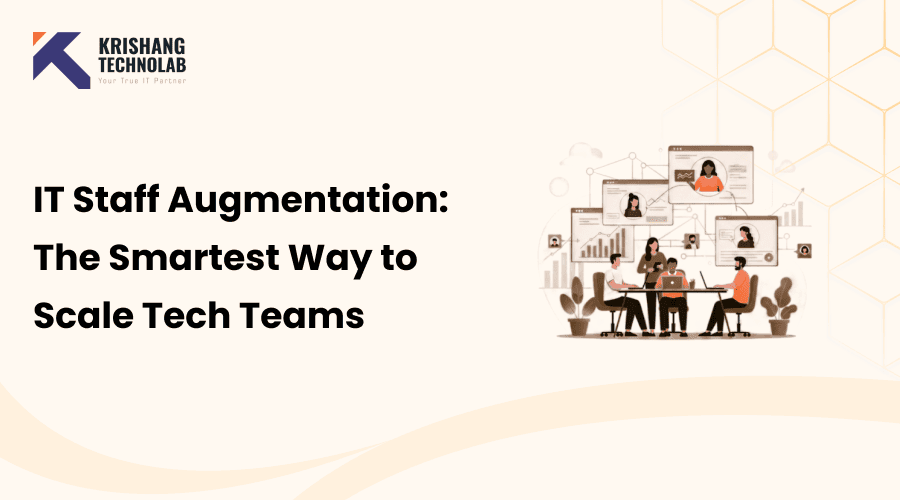
IT staff augmentation is an approach to recruiting that involves temporarily expanding your existing internal team with external IT workers to meet specific requirements or advance your project. Team augmentation is not like other hiring. They allows companies to easily and quickly find experienced developers, engineers, designers, testers and other tech specialists.
IT staff augmentation companies can help all types be more flexible, hire people faster, and get access to hard-to-find talent, whether they are a startup working on an MVP or a large company transforming themselves digitally.
In this blog, we’ll discuss all the things related to IT augmentation, its concept, advantages, risks, types, best practices, and differences from outsourcing.
What Is IT Staff Augmentation?
As companies grow and change it becomes harder and harder to hire talented software developers on time to keep up with the increasing demands of their projects. Hiring specialists in the traditional way can be expensive and time-consuming, especially if you need specific expertise.
IT Staff Augmentation provides the perfect solution to grow your business and to quickly and easily onboard professionals to your internal team. This enables companies to hire the best technical talents on a flexible contract basis for a short period or specific projects.
In brief, IT staff augmentation is a software outsourcing service that lets businesses hire external technology professionals for a temporary or project-based cooperation with an internal team.
Unlike the conventional hiring model, staff augmentation enables organizations to recruit skilled specialists and onboard them instantly. In other words, the staff augmentation professionals will join the internal team as an extended limb.
Companies can use IT staff augmentation for:
- Filling skill gaps temporarily
- Speed up software development
- Rapid scaling of the engineering team
- Saving recruitment expenses
- Gaining access to special knowledge and skills
- Implementing digital transformation projects
For instance, a SaaS startup needs professional React developers to work on its project before the product release, but it doesn’t plan to recruit people yet. Staff augmentation means you can onboard remote React developers in days, not months.
Companies that want to hire IT staff augmentation software developers prefer this service over other outsourcing options for the following reasons.
Popular IT staff augmentation agency include:
- Hiring dedicated developers
- Augmentation of remote engineering teams
- Offshore Development Center
- Development team extension using agile methodologies
- Developer staffing on a contractual basis
- Temporary software engineering
- Managed IT staffing services
- Technology consulting & software development assistance
Key Characteristics of IT Staff Augmentation
1. Flexible Team Scaling
Teams can be scaled up or down depending on the project.
2. Access to Specialized Talent
Companies are linked to experts in AI, cloud computing, cyber security, DevOps, blockchain and mobile development.
3. Faster Hiring Process
Staff augmentation significantly cuts recruitment timelines.
4. Temporary or Project-Based Engagement
You can hire professionals for seasonal workloads, short-term projects or long-term cooperation.
5. Direct Team Collaboration
Augmented staff collaborate with internal teams using the company’s preferred workflows and tools.
How IT Staff Augmentation Works
Staff augmentation through information technology aims at assisting organizations in accessing professionals while retaining total control over the projects being implemented.
Contrary to the conventional outsourcing model, professionals in the IT staff augmentation model become part of the organization’s internal team members and work hand-in-hand with the rest of the organization’s staff.
It is important for organizations to understand the process involved in staff augmentation through information technology.
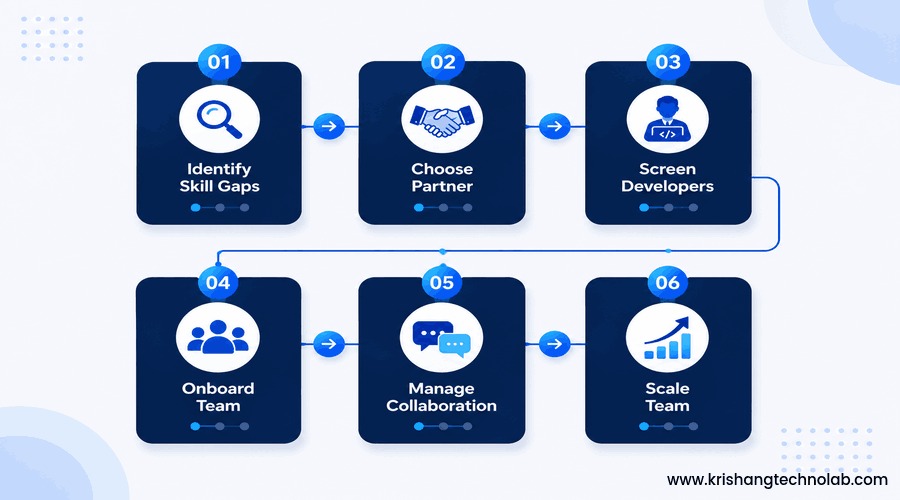
1. Identify Skill Gaps
The first step is to identify any technical gaps within the current team. Businesses consider:
- Technical skillset deficiencies
- Project deadline
- Team capacity
- Development bottlenecks
- Resource limitations
Companies, for instance, that are moving their business to AWS need certified cloud engineers. When organizations transform their infrastructure, they also budget for AI Consulting services.
2. Choose an IT Staff Augmentation Partner
Then companies choose a trusted IT staff augmentation company, software staffing agency or technology workforce partner.
Important evaluation criteria include:
- Technical expertise
- Industry experience
- Communication process
- Developer screening standards
- Security practices
- Scalability capabilities
The right partner choice has a direct impact on the quality and speed of delivery. A reliable software dev company can also provide experienced developers and technical expertise to complement an organization’s existing team.
3. Screen and Select Developers
Once the requirements are finalized, the vendor recommends suitable candidates. The client typically evaluates:
- Technical skills
- Experience level
- Portfolio
- Communication abilities
- Cultural fit
This process is significantly more expedient than traditional hiring.
4. Onboard the Augmented Team
Selected professionals are integrated into the company’s workflow.
This includes:
- Access setup
- Communication channels
- Project documentation
- Agile workflows
- Development tools
- Team introductions
The augmented staff begin working alongside the internal team almost immediately.
5. Manage Collaboration and Performance
The client manages the augmented professionals directly. Teams usually collaborate through:
- Slack
- Jira
- GitHub
- Microsoft Teams
- Zoom
- Agile sprint meetings
With regular communication you ensure alignment and productivity.
6. Scale the Team as Needed
One of the main benefits of staff augmentation is the flexibility it offers.
Organizations can:
- Hire more developers rapidly
- Decrease team numbers after completing the project
- Extend contracts as required
- Recruit experts to work on emerging technologies
Types of IT Staff Augmentation
All businesses do not have identical technical demands. Some businesses require temporary developers for their short-term projects, while some may demand highly specialized professionals or remote teams to work for their long-term collaborations.
For meeting the differing demands of businesses, staff augmentation services can be provided to them in various forms according to the requirements of the project.
Staff augmentation can take different forms according to the complexity of the project and other factors.
1. Commodity-Based Staff Augmentation
The model emphasizes staffing for general technical positions that demand rudimentary or standard skills.
These positions include:
- Data entry operators
- Junior programmers
- Technical support personnel
- Quality assurance testers
Commodity-based augmentation can be economical in cases involving repetitive or procedural tasks.
2. Skill-Based Staff Augmentation
This model provides professionals with specialized technical expertise.
Examples include:
- React developers
- Node.js developers
- Angular developers
- Python developers
- DevOps engineers
- UI/UX designers
- Mobile app developers
- Cloud architects
Skill-based augmentation is one of the most commonly used models in software development.
3. Highly Skilled Staff Augmentation
The model is used by the businesses for their advanced or strategic technical needs, enterprise software engineering services and their digital transformation projects. Generative AI Development services are usually utilized by companies that are developing intelligent applications for improving automation and efficiency.
Examples are:
- AI Engineers
- Cybersecurity experts
- Enterprise Architects
- Blockchain Developers
- Machine learning experts
4. Dedicated Development Teams
In this model, companies can have a full remote team that will work only on their tasks.
Typical software development teams consist of:
- Programmers
- Project managers
- Designers
- QA engineers
- DevOps engineers
This method is a great fit for long term software development projects and companies that want to scale dedicated engineering capacity.
Benefits of IT Staff Augmentation
Another great advantage of IT staff augmentation is the flexibility and efficiency of managing technology teams. Organizations can easily adapt to changes in the market, project requirements and customers’ needs without waiting until they hire new employees using traditional methods.
Staff augmentation helps small businesses and large companies to increase productivity, decrease expenses and speed up software development.
There are several advantages that come with IT staff augmentation for today’s companies.
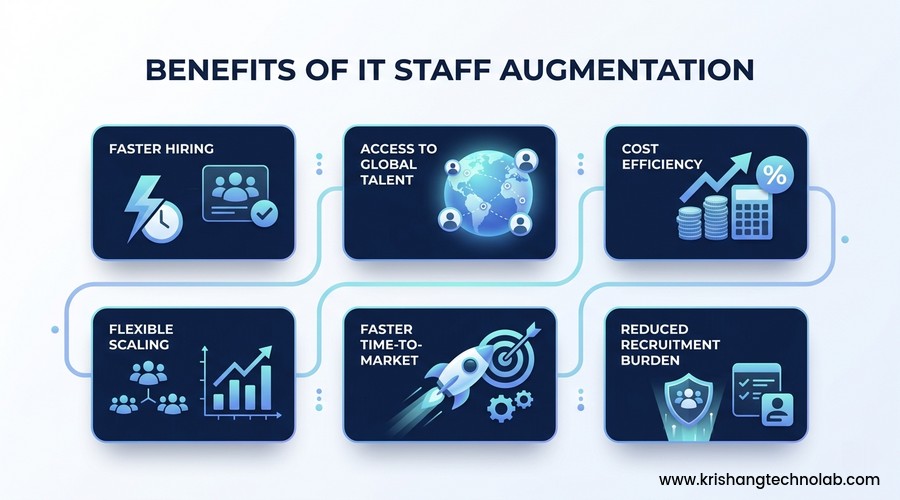
1. Faster Hiring and Onboarding
This process usually takes a couple of months.
IT staffing and augmentation services already have the talent pool of pre-screened software developers, engineers, cloud architects, UI/UX designers, QA specialists, and DevOps engineers, and that’s why you can hire talent immediately, in just a few days.
Which becomes especially evident when it comes to:
- Time-critical projects
- Product launches
- Digital transformation initiatives
- Increased workloads
There are many cases when companies choose to Hire AI Developers when they need to create intelligent automation, advanced AI software platforms and analytics solutions.
It is common practice for startups to Hire Remote Developers in order to quickly expand their engineering teams without being bound by traditional recruitment procedures.
Companies that specialize in conversational AI software development tend to Hire ChatGPT Developers in order to build AI assistants, customer support chatbots, and enterprise chat.
For software as a service companies it is recommended to Hire Software Developers through IT staffing and augmentation services in order to speed up development and become more agile.
The digital transformation projects are usually carried out by companies that hire Dedicated Developers to make sure of the continuity and cooperation between software development processes.
In case you are implementing your AI workflows, you might consider Hiring Prompt Engineers in order to boost AI performance and automate business processes.
Read About: How to Choose the Right AI Software Development Partner
Access to Global Talent
Firms are not anymore bound by the constraints set by hiring only locally or even through recruitment agencies.
Using the staff augmentation approach, businesses can benefit from the expertise of professionals in international labor markets.
Thus, they will be able to hire:
- Specialized expertise
- Senior developers
- Cost-effective talent
- Emerging technology experts
Cost Efficiency
Full-time employees are hired including: Recruitment costs
- Employee benefits
- Infrastructure expenses
- Training investments
- Long-term commitments
Staff augmentation eliminates many of these overhead costs. Businesses only pay for the software development services, technical expertise and the time they truly require.
Scalability and Flexibility
This makes it easy for companies to scale teams up or down as needed for projects.
This flexibility supports:
- Seasonal projects
- Startup growth
- Rapid expansion
- Product scaling
- Technology upgrades
Faster Time-to-Market
Quick access to dedicated developers and remote engineering teams speeds up software development, product delivery and enterprise digital transformation projects.
Businesses can:
- Reduce development bottlenecks
- Speed up releases
- Improve agility
- Meet competitive deadlines
Reduced Recruitment Burden
The augmentation provider handles:
- Talent sourcing
- Initial screening
- Technical evaluation
- Administrative processes
This allows internal HR teams to focus on strategic hiring priorities.
Better Focus on Core Business Goals
By outsourcing resource management challenges, businesses can focus more on:
- Product innovation
- Customer experience
- Market expansion
- Revenue growth

Challenges of IT Staff Augmentation
While there are many advantages to IT staff augmentation, the existence of an external team can lead to operational and managerial difficulties for companies. If not properly addressed, communication, security and integration problems could affect productivity.
Companies that know about these challenges in advance will be better prepared to create procedures.
Despite the many benefits of IT staff augmentation, there are also some challenges that businesses need to know about.
1. Communication Gaps
Working remotely, especially with people in different time zones, can make communication difficult.
Solution:
- Use collaboration tools
- Schedule regular meetings
- Establish clear communication guidelines
- Maintain transparent workflows
2. Time Zone Differences
Distributed teams can be slower to coordinate and make decisions.
Solution:
- Create overlapping work hours
- Use asynchronous communication
- Define response expectations
3. Security and Data Privacy Risks
External professionals may need access to sensitive systems and data.
Solution:
- Sign NDAs
- Implement role-based access controls
- Use secure infrastructure
- Follow compliance standards
4. Team Integration Challenges
Temporary team members may initially struggle to adapt to the company culture or workflows.
Solution:
- Conduct proper onboarding
- Encourage collaboration
- Assign mentors
- Share documentation clearly
5. Dependency on External Vendors
Poor-quality vendors can negatively impact project delivery.
Solution:
- Vet vendors carefully
- Review portfolios and case studies
- Start with trial engagements
- Monitor performance regularly
IT Staff Augmentation vs Outsourcing
Organizations frequently confuse staff augmentation with outsourcing because both utilize outside technologists. But there are important differences between the two approaches in terms of project management, communication, teamwork and flexibility.
Knowing the difference between these 2 approaches, businesses will be able to choose the most appropriate one depending on their project needs.
Staff augmentation and outsourcing may seem similar; however, in reality, they are completely different business approaches.
| Feature | IT Staff Augmentation | Outsourcing |
| Team Control | High | Low |
| Management Responsibility | Client-managed | Vendor-managed |
| Flexibility | High | Medium |
| Communication | Direct collaboration | Indirect communication |
| Team Integration | Works with internal team | Separate external team |
| Scalability | Highly flexible | Depends on contract |
| Best For | Team extension | Complete project delegation |
When to Choose IT Staff Augmentation
Businesses should consider staff augmentation when they:
- Need temporary technical expertise
- Want direct control over projects
- Require flexible team scaling
- Already have an internal development team
- Need fast hiring solutions
When to Choose Outsourcing
Outsourcing may be a better option when businesses:
- Want complete project ownership handled externally
- Lack internal technical management
- Need end-to-end project execution
- Prefer fixed-cost delivery models
Both models have advantages depending on business goals and operational requirements.
When Should Businesses Use IT Staff Augmentation?
IT staff augmentation is not just for big companies or tech companies. This is how all sorts of businesses operate when they need extra technical skills or fast project delivery or workforce scaling flexibility.
It is especially useful if the costs or the time needed to get regular employees are too high or not relevant for short-term assignments.
IT staff augmentation can be used in any business situation.
Scaling Engineering Teams Quickly
Fast-growing companies often need to scale their development capacity quickly and without long recruiting cycles.
Launching New Products
Companies preparing for product launches may require a temporary influx of technical talent.
Filling Skill Gaps
Organizations often use IT resource augmentation for niche technologies and advanced software engineering services like:
- Artificial intelligence
- Cloud computing
- Cybersecurity
- Blockchain
- DevOps
Supporting Digital Transformation
Augmented teams help large enterprises modernize legacy systems and innovate.
Managing Temporary Workloads
Staff augmentation helps businesses to cope with seasonal demand spikes and short-term projects.
Building MVPs for Startups
Augmented teams help startups cut hiring costs and speed up product development.
Industries That Use IT Staff Augmentation
As the world continues to transition into the digital era, an increasing number of organizations are seeking talent from industries beyond the IT sector in order to improve operational efficiencies and foster innovation. IT staff augmentation is becoming increasingly popular amongst many organizations that are engaged in developing software, upgrading their infrastructure, or implementing digital platforms.
Many organizations are using IT staff augmentation regardless of their field. IT staff augmentation is commonly used by all industries.
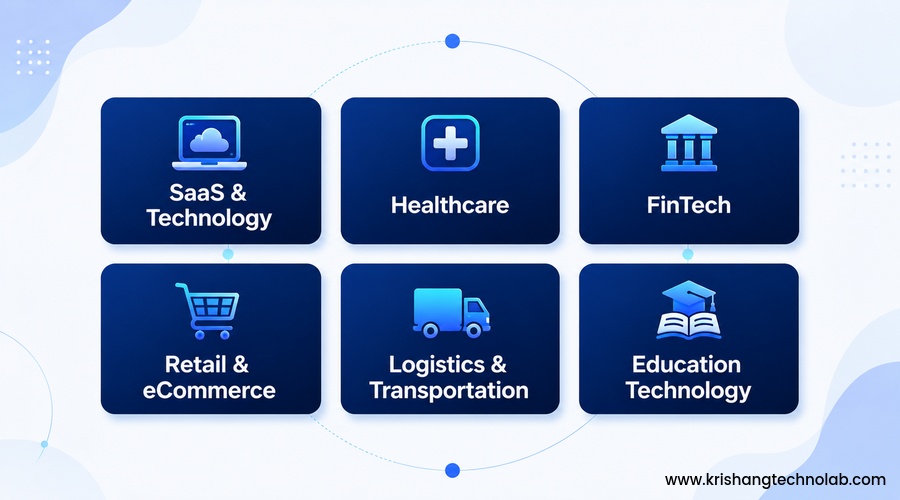
SaaS and Technology
IT team augmentation services help software companies accelerate product development, modernize applications and efficiently expand engineering teams.
Healthcare
Healthcare organizations hire augmented teams for:
- Telemedicine platforms
- Healthcare apps
- Data security systems
- Compliance-focused development
FinTech
Fintech startups usually need developers with a specific skill set to build secure digital products.
Retail and E-commerce
Retail and eCommerce businesses use software staff augmentation services for:
- Mobile apps
- Inventory systems
- Customer experience platforms
- Payment integrations
Logistics and Transportation
Companies build augmented teams to build supply chain management systems, real-time tracking platforms.
Education Technology
EdTech companies quickly scale remote learning platforms with help from external developers.
Best Practices for Successful IT Staff Augmentation
It is not enough just to bring in the external software developers because the organization will need to create a whole process for working together successfully with augmented teams.
Following best practices can help companies increase productivity, reduce operational risks and improve remote collaboration. Staff augmentation requires careful planning and collaboration.
1. Define Project Requirements Clearly
Businesses should document:
- Technical requirements
- Project scope
- Expected deliverables
- Timeline expectations
Clear requirements improve hiring accuracy.
2. Choose the Right Partner
Businesses evaluating IT staffing companies and software development partners should assess providers based on:
- Technical expertise
- Communication standards
- Industry experience
- Client reviews
- Scalability capabilities
3. Prioritize Communication
Effective communication is essential for remote collaboration.
Use:
- Daily standups
- Sprint reviews
- Project management tools
- Documentation systems
4. Implement Strong Security Policies
Protect sensitive business information through:
- Access controls
- VPNs
- Secure repositories
- NDAs
- Compliance audits
5. Integrate Augmented Staff Into Company Culture
Encourage collaboration between internal and external teams.
This improves:
- Productivity
- Knowledge sharing
- Team morale
- Project alignment
6. Track Performance Metrics
Monitor:
- Development velocity
- Code quality
- Delivery timelines
- Productivity metrics
- Team collaboration
Data-driven evaluation helps optimize project outcomes.
Future of IT Staff Augmentation in the AI Era
The global IT talent pool is undergoing a lot of changes due to emerging trends like artificial intelligence, automation, cloud computing, and collaboration software. With the adoption of new digital trends by organizations, there will be more need for flexible and qualified IT talent.
Talent acquisition in the IT field is undergoing some transformation too as it becomes more strategic, analytical, and interrelated globally.
The IT talent acquisition industry continues changing constantly due to artificial intelligence, telecommuting, and digital transformation. Global Capability Center service providers help organizations establish, run, and grow offshore centers.
1. AI-Assisted Hiring
AI-powered recruitment tools help vendors:
- Match candidates faster
- Screen technical skills efficiently
- Improve hiring accuracy
- Reduce recruitment time
The modern organizations are also looking into alternative ways of building their workforce like Hire Vibe Coding Developers for enabling quick product development through artificial intelligence.
2. Growing Demand for Specialized Talent
Businesses increasingly seek experts in:
- Artificial intelligence
- Machine learning
- Cybersecurity
- Cloud computing
- Data engineering
This development creates the need for very specific augmentation services. Companies that have adopted the AI-based customer experience technology also emphasize the ChatGPT Integration technology.
Businesses looking for specialized AI expertise may also consider AI software development services to support the development and integration of AI-powered solutions.
3. Remote-First Workforce Models
Collaboration technologies have made distributed engineering teams very efficient.
Companies can employ people from all around the globe irrespective of geographical constraints. Companies that run complex analytics and reporting systems can also take help from Data Science Consulting to make better decisions.
4. Hybrid Workforce Strategies
Apart from Big Data development and management, there are many companies that also allocate their funds in the area of Machine Learning development.
Modern organizations combine:
- Full-time employees
- Freelancers
- Outsourced teams
- Augmented professionals
This hybrid approach improves flexibility and scalability.
5. Increased Focus on Security and Compliance
As remote collaboration grows, businesses prioritize:
- Data security
- Compliance standards
- Access management
- Cybersecurity protocols
Security-focused augmentation providers will gain competitive advantages.
Wrapping Up
IT Staff Augmentation has turned out to be one of the most efficient means of hiring and scaling up for businesses in modern times.
Through providing opportunities to rapidly acquire specialized professionals, lowering costs related to hiring and making it easier to expand engineering staff, staff augmentation contributes significantly towards quickening processes associated with software development and keeping pace with fast changing times.
For startups seeking to create their MVP, for SAAS firms requiring to scale up their product development efforts, and for enterprises going through the process of digital transformation, IT staff augmentation provides the flexibility needed to accomplish the task at hand more effectively.
As technological developments continue and the concept of remote working becomes the norm worldwide, businesses will definitely benefit from adopting a more agile approach towards workforce management like IT staff augmentation.
In many cases, staff augmentation is used in conjunction with digital transformation initiatives by organizations to enhance their processes, scalability, and innovation potential.
For any enterprise that requires rapid expansion of its development teams in an efficient manner, IT staff augmentation is worth considering as a strategy.
Found this post helpful? Don't forget to share it with your network!