Quick Overview: Shopify development in the USA costs about $2,000 to $6,000 for a theme-based store, $6,000 to $18,000 for a custom D2C build, and $15,000 to $150,000+ for B2B, migration, Shopify Plus or headless projects in 2026. However, the final figure depends on store type, custom features, integrations, and who builds it. Because Shopify development cost USA projects vary so widely, treat each range as a starting point.
Shopify has become the default choice for US brands that want to sell online without managing servers. However, budgets vary widely, so this table breaks the typical price and timeline into project types. Use it, then explore each range below.
| Project type | Typical US budget | Typical timeline |
| Lean launch on a ready-made theme | $2,000 to $6,000 | 2 to 4 weeks |
| Growing D2C store with custom sections | $6,000 to $18,000 | 4 to 8 weeks |
| Large-catalog retail store | $15,000 to $40,000 | 8 to 14 weeks |
| Subscription or membership store | $12,000 to $30,000 | 8 to 12 weeks |
| B2B or wholesale store | $15,000 to $50,000 | 10 to 18 weeks |
| International multi-market store | $15,000 to $45,000 | 8 to 16 weeks |
| Migration to Shopify | $5,000 to $30,000 | 4 to 12 weeks |
| Shopify Plus, headless or enterprise build | $40,000 to $150,000+ | 4 to 8 months |
These are planning ranges for full projects at US agency pricing. Therefore, use them to sanity-check a Shopify development cost estimate instead of treating them as a fixed quote. Also, remember that the Shopify development cost USA buyers see in proposals changes with scope far more than with page count.
What a Shopify development quote usually includes
- Discovery and requirements work, followed by UX planning and wireframes
- Theme setup or custom theme development, depending on the budget
- Product, collection and page templates
- Payment, shipping and tax configuration
- App setup and third-party integrations, because most stores need several
- Data migration and SEO redirects when you are changing platforms
- Quality assurance, launch support, and a short warranty period
Initial build cost vs. total ownership cost
The build fee is only the first line of your Shopify store costs. In addition, total ownership covers the Shopify subscription, paid themes, app subscriptions, payment processing, maintenance, and ongoing SEO and conversion work. For many stores, therefore, the second-year running cost matters as much as the original build. Later in this article, the first-year budget scenarios show how the two add up.
Shopify Development Cost in the USA: What Businesses Should Budget in 2026
Most US businesses should budget $6,000 to $18,000 for a professionally built Shopify store, and $2,000 to $6,000 if a ready-made theme is enough. However, the Shopify development cost USA merchants pay quickly once custom design, subscriptions, wholesale pricing, ERP integrations or Shopify Plus enter the project.
That range is wide on purpose. For example, the Shopify website development cost for two stores can differ tenfold even when both are “just a Shopify store.” Therefore, a single headline number rarely helps.
Key factors behind price differences
- Scope and features: A theme with your branding is a different project from a store with custom product builders or customer-specific pricing.
- Catalog size and data quality: 50 clean products are a small job, whereas 5,000 products with variants and inconsistent data are not.
- Integrations: ERP, CRM, inventory, shipping and email connections often add the most hours, so list them early.
- Migration: Moving products, customers, orders and URLs from another platform adds data work and SEO risk.
- Team and location: US agencies, freelancers, hybrid teams and offshore teams charge very different hourly rates for the same hours.
- Compliance and quality: Accessibility, speed and QA add time, but they reduce rework later.
Why there is no single price for every Shopify store
In practice, Shopify development cost USA is hours multiplied by a rate, plus the recurring costs of running the store. First, hours depend on what the store must do. Second, rates depend on who builds it. As a result, a quote that ignores either one cannot be compared with another quote.
So instead of searching for one number, match your store to a store type in the next section. Then check that any Shopify website cost USA quote describes the same scope. Finally, use the Shopify development cost USA ranges as a filter, not as a promise.
Choose Your Shopify Budget: Which Store Are You Building?
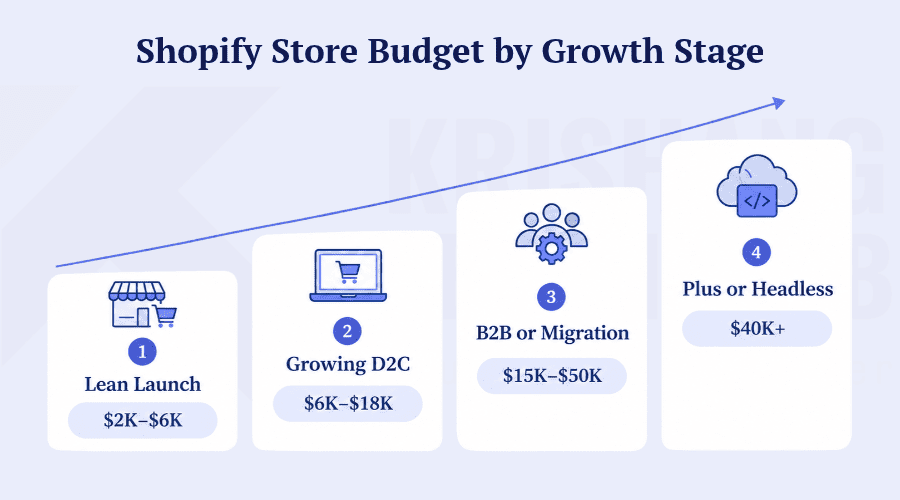
Begin by identifying the profile that best aligns with your business needs. Then check what drives the range, because each profile lists the typical Shopify store setup cost or build range along with common exclusions.
The Lean Launch: Starting With a Ready-Made Theme
- Budget: $2,000 to $6,000.
- Timeline: 2 to 4 weeks.
- Best for new brands testing demand with a small catalog, and standard shopping flows.
Expect theme installation, and styling, product, and collection setup, navigation, payments, shipping, legal pages, analytics and basic SEO settings. However, custom sections, copywriting, photography and advanced integrations are usually not included. Overall, this is the lowest Shopify store development cost and it works well when your merchandising is conventional.
The Growing D2C Brand: Custom Design and Conversion-Focused Sections
- Budget: $6,000 to $18,000.
- Timeline: 4 to 8 weeks.
- Best for established D2C brands that need the store to look and sell differently from a template.
A premium theme is usually the base, with three to six custom sections, a tailored product page, collection merchandising, tracking and a small, well-configured app stack. In contrast, subscription logic, bundle builders and multi-market selling are normally extra. Consequently, this band sets the Shopify development cost USA brands plan around, and it is also the most common Shopify ecommerce development cost range.
The Established Retailer: Large Catalogs and Advanced Product Logic
- Budget: $15,000 to $40,000.
- Timeline: 8 to 14 weeks.
- Best for stores with hundreds or thousands of SKUs, many variants and detailed filtering.
The work shifts from design to structure: collection architecture, search and filtering, variant and inventory logic, several product templates, and redirect planning. Moreover, cleaning and structuring product data often takes more time than building the templates that display it. When the project also touches surrounding systems, broader ecommerce development support can cover them.
The Recurring-Revenue Store: Subscription and Membership Features
- Budget: $12,000 to $30,000.
- Timeline: 8 to 12 weeks.
- Best for brands selling replenishment, boxes or memberships.
This covers Shopify subscription store development: a subscription app setup, customer portal, skip and pause flows, upgrade and downgrade paths, and failed-payment handling. Because a broken billing flow quietly loses revenue every cycle, plan extra testing time. Likewise, test every renewal scenario before launch.
The B2B Business: Wholesale Pricing and Customer-Specific Catalogs
- Budget: $15,000 to $50,000.
- Timeline: 10 to 18 weeks./li>
- Best for manufacturers and distributors selling to trade buyers.
The Shopify B2B development cost usually includes company accounts, buyer permissions, price lists, quantity rules, net payment terms, quote requests and reorder flows. Implementing a complete ERP system requires a dedicated project of its own. Nevertheless, the Shopify side of an ERP integration is in scope. Also, Shopify wholesale store development is cheaper when it is planned from day one rather than bolted onto a finished D2C store.
The International Brand: Multiple Markets, Currencies, and Languages
- Budget: $15,000 to $45,000.
- Timeline: 8 to 16 weeks.
- Best for brands selling across borders.
The Shopify international store setup cost covers market configuration, multi-currency and language setup, regional pricing, duties and taxes and translated content. Meanwhile, the biggest cost swing is whether you need one storefront serving many markets or separate stores per region. In other words, one approach is mostly configuration, while the other is closer to several builds.
The Platform Switch: Migrating From WooCommerce, Magento, or BigCommerce
- Budget: $5,000 to $30,000.
- Timeline: 4 to 12 weeks.
- Best for merchants replatforming to Shopify.
The Shopify migration cost depends on data volume and URL history more than on design. For instance, budget for product, customer and order migration, 301 redirect mapping, app replacements and SEO checks. Specialist Shopify data migration services lower the risk of lost orders, and experienced website migration services also protect existing rankings. Rebuilding your current look is one job, whereas redesigning it is another. As a result, combining them is how migration budgets double.
The Enterprise Build: Shopify Plus, Headless Commerce, and Complex Integrations
- Budget: $40,000 to $150,000+.
- Timeline: 4 to 8 months.
- Best for high-volume brands with complex checkout, automation or multiple storefronts.
The Shopify Plus development cost includes checkout customization, Shopify functions, private apps, deep integrations and load testing. Shopify headless commerce development cost is the largest multiplier, because the custom front end must be built and maintained separately from the theme, often as a Next.js storefront written by React developers. Therefore, the Shopify ERP integration cost and Shopify CRM integration cost are typically scoped as their phases. Since this is the top tier, the Shopify development cost USA enterprise teams plan for should also include a phased roadmap.
Where Does Your Shopify Development Budget Actually Go?
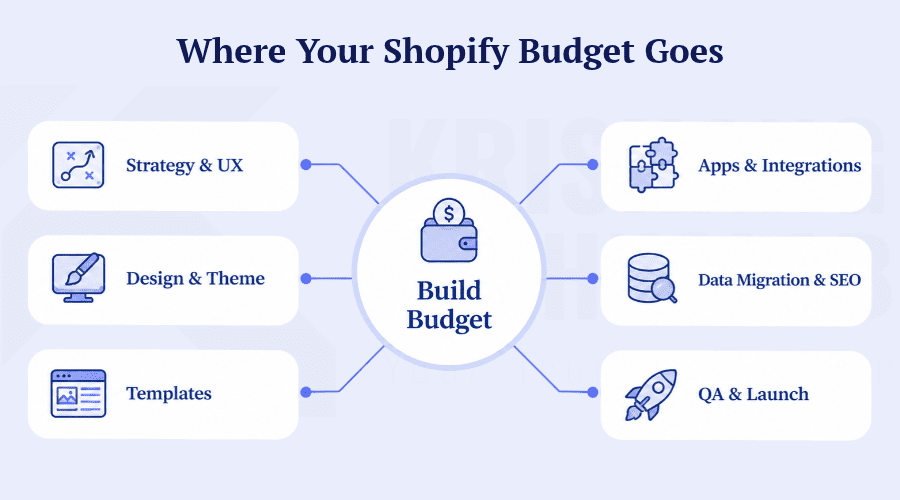
Most of a Shopify development budget goes to design, theme work, integrations and testing, with strategy and data preparation taking a smaller but decisive share. The table shows an illustrative split for a custom D2C build; your proposal will differ.
| Cost area | Illustrative share of build budget |
| Strategy, requirements and UX planning | 8% to 12% |
| Web design and custom theme development | 25% to 35% |
| Product pages, collections and templates | 10% to 15% |
| App development and integrations | 15% to 25% |
| Payments, shipping, tax and system setup | 5% to 10% |
| Data migration and SEO preservation | 5% to 10% |
| QA, accessibility and launch testing | 8% to 12% |
A Shopify development budget covers more than building a visually appealing online store. It includes planning, design, functionality, integrations, data migration and testing to ensure the store performs reliably. Understanding these cost areas helps businesses allocate resources effectively, compare development proposals accurately and avoid unexpected expenses during the project.
Store Strategy, Requirements, and UX Planning
This is where scope gets defined: user flows, sitemap, feature list, integration map and wireframes. Because it is the cheapest place to fix a mistake, skipping it is risky. In fact, it is the most common reason a project’s final cost drifts above its quote.
Shopify Web Design and Custom Theme Development
Shopify website design cost depends on how much of the experience is created from scratch. For example, styling a premium theme costs far less than designing and coding every screen, and teams offering Shopify web design usually price by the number of unique layouts. Custom Shopify development costs also rise with the number of unique sections, animations and mobile layouts. Because most store traffic arrives on phones, mobile design deserves real budget.
Product Pages, Collections, and Custom Templates
Each extra template adds design, development and testing time. One product template is simple. However, separate templates for bundles, subscriptions, sale items and configurable products multiply the surface area to build and check. Therefore, count templates before you compare quotes.
Shopify App Development and Third-Party Integrations
Shopify app development cost covers custom or private apps for needs that no existing app meets, such as custom pricing logic or inventory tools. Meanwhile, integrations connect Shopify to email, reviews, loyalty, shipping and accounting tools. Before commissioning custom work, compare it with an existing app’s monthly fee. Remember, too, that an app’s cost recurs, whereas custom code is mostly one-time plus upkeep.
Payment, Shipping, Tax, ERP, and CRM Configuration
Payments, shipping zones and tax rules are quick for a simple store but slow for a complex one. Likewise, ERP and CRM connections take longer because someone must decide which system owns inventory, customer and order data. Settle that before development starts, or the integration gets rebuilt mid-project.
Product Data Migration and SEO Preservation
Clean product data is often the hidden cost center. For instance, duplicated titles, inconsistent attributes and missing images take real hours to fix. On a replatform, URL mapping, 301 redirects, metadata and structured data protect the organic traffic you already have, and the process behind moving from Magento to Shopify shows how those steps fit together. Also, the Shopify development cost USA teams quote should list this data as its line.
Quality Assurance, Accessibility, and Launch Testing
Testing covers devices and browsers, checkout, discount and shipping rules, speed, and accessibility. For US stores, building to WCAG standards during the project costs far less than retrofitting later. Consequently, a quote with no line for QA is probably thin.
Shopify Theme Customization vs. Custom Development: Which Offers Better Value?
A customized theme is better value when your product structure and shopping flow are conventional; custom Shopify development is better value when the store needs functionality a theme cannot deliver cleanly. However, Shopify theme customization cost is lower upfront, and the Shopify development cost USA owners see in year two can still reverse that advantage.
| Factor | Theme customization | Custom development |
| Typical upfront cost | $2,000 to $8,000 | $10,000 to $35,000 |
| Timeline | 2 to 6 weeks | 8 to 16 weeks |
| Design control | Limited to theme settings and light edits | Full |
| Reliance on paid apps | Higher | Lower |
| Cost of changes later | Tends to rise | Tends to fall |
| Best for | New catalogs, standard UX | Specific merchandising or workflows |
When a Premium Shopify Theme Is Enough
Choose a premium theme when you sell conventional products, want to launch quickly, and your team is comfortable with layouts shoppers already know. Also, it is the right call when you are still validating demand. Investing a significant amount in custom design before understanding market demand can lead to unnecessary risks.
When Custom Shopify Development Makes Financial Sense
Custom work pays off when three apps are patching one gap, when merchandising is unusual (configurators, bundles, complex filtering), when your marketing team needs to build landing pages without developer tickets, or when speed and conversion are measurable revenue levers. In that case, a planned store redesign can replace app patches with native sections. Therefore, custom Shopify development cost is easier to justify when the store already drives meaningful revenue.
The Long-Term Trade-Off Between Lower Upfront Costs and Flexibility
Compare year two, not just year one. For instance, a theme propped up by four paid apps and a standing developer retainer can match a custom build’s total cost sooner than the original quotes suggest. On the other hand, a custom build needs a team that can maintain it. The practical middle path is to launch on a customized theme, then phase in custom sections where analytics show the biggest gains.
Shopify Developer Rates in the USA: Freelancer, Agency, or Offshore Team?
Shopify developer rates in the USA run from about $60 to $130 an hour for freelancers and $100 to $200 an hour for agencies, with senior Shopify Plus specialists at the top of that range. However, offshore and hybrid teams cost less per hour, and the cheapest rate is not always the cheapest project. That is why Shopify development cost USA comparisons should always include hours as well as rates.
| Team type | Typical hourly rate | Best for |
| US-based agency | $100 to $200 | Multi-discipline projects, integrations, accountability |
| US freelancer | $60 to $130 | Theme edits, small builds, isolated tasks |
| Senior Shopify Plus specialist | $120 to $200+ | Checkout, Functions, enterprise architecture |
| Hybrid US and offshore team | $40 to $90 | Cost-conscious projects needing US-facing management |
| Offshore agency | $20 to $50 | Well-defined builds with strong project management |
Rates are market ranges and vary by experience, specialty and platform fees. Therefore, treat them as a starting point for negotiation rather than a fixed price list.
How Much Does It Cost to Hire a Shopify Developer in the US?
Hiring a Shopify developer in the US typically costs $60 to $200 an hour or $3,000 to $15,000 for a small to mid-size project. The hourly figure depends on seniority and engagement model, whereas project pricing bundles design, development, QA and project management into one number. If you plan to hire Shopify developer USA professionals for ongoing work, a monthly retainer of $500 to $2,000 is a common model for light support, and some businesses prefer dedicated Shopify developers for steady work. In addition, a fixed project price keeps the budget predictable.
Freelance Shopify Developer Rates and Project-Based Pricing
Freelancers suit narrow tasks, such as a homepage update, a theme fix, or a small app configuration. Moreover, project pricing is more predictable than hourly billing for defined work. However, one person is a single point of failure on a larger build, and availability can change quickly.
Shopify Development Agency Pricing and Team Structure
A Shopify development agency in USA typically provides a project manager, designer, developers and QA under one contract. As a result, the structure costs more per hour but tends to produce more predictable outcomes on projects with integrations, migrations or tight deadlines. Shopify agency pricing in the USA is most often fixed-price per phase, hourly, or a monthly retainer.
US-Based vs. Offshore vs. Hybrid Development Teams
US teams give you time-zone overlap, US contracts and easier communication. In contrast, offshore teams offer lower rates and strong technical depth when management is good. Meanwhile, hybrid teams pair a US strategist or project lead with offshore developers. For instance, a 150-hour project could cost $18,000 at an hourly rate of $120 or $6,000 at $40, making it essential to evaluate the workflow and value behind the pricing. Consequently, the Shopify development cost USA total depends on hours and process together.
If your project requires custom applications, complex integrations, or a headless storefront, you may need to hire software developers with experience in Shopify APIs, frontend frameworks, and ecommerce architecture. Choose specialists according to your actual technical requirements rather than hourly rates alone.
What to Evaluate Beyond the Hourly Rate
- Evaluate the overall project scope and estimated hours alongside the hourly rate, as an experienced developer may complete the work faster and reduce the total cost.
- Who reviews the code, and how builds are tested before launch.
- Relevant Shopify experience with your store type, such as B2B, subscriptions, Plus, or migration.
- Communication, and handover are documentation, training, and who owns the code.
- Post-launch support, and how quickly bugs are fixed.
Shopify Plan Costs in 2026: Subscription, Themes, Apps and Other Expenses
Shopify plans cost $29 to 299amonthonannualbilling(39 to $399 month to month) and Shopify Plus starts at $2,300 a month. Importantly, these recurring fees are separate from your development agency’s invoice. Therefore, add them to any Shopify development cost USA estimate.
Shopify Subscription Plans and Their Intended Use Cases
| Plan | Monthly billing | Annual billing (per month) | Online card rate (Shopify Payments) | Best for |
| Basic | $39 | $29 | 2.9% + 30¢ | New and small stores |
| Grow | $105 | $79 | 2.7% + 30¢ | Growing stores with a team |
| Advanced | $399 | $299 | 2.5% + 30¢ | High-volume stores, custom reports |
| Plus | From $2,300 | Custom contract | 2.15% + 30¢ | Enterprise and complex commerce |
Annual billing saves about 25% on the standard plans. Shopify’s middle plan was renamed Grow in 2026. In addition, new merchants have recently been offered the first three months at $1 a month on Basic, Grow and Advanced. Because promotions change, confirm the current offer on Shopify’s pricing page before you commit. Likewise, verify plan prices at the time you buy.
Paid Themes, Apps, and Recurring Software Fees
- Paid themes: Roughly $100 to $450 as a one-time license, while free themes cost nothing.
- Apps: Once essential tools for reviews, email marketing, search, upselling, and subscriptions are added, most stores spend around $50–$350 per month on app subscriptions. Large stores can spend much more, so review the stack every quarter and remove tools nobody uses.
Hosting Costs: What Shopify Includes and What May Cost Extra
Shopify’s subscription includes hosting, security updates, SSL and uptime, so you do not pay separate hosting costs for a standard store. However, extra hosting costs appear when you run custom middleware, a headless front end or external services. Also, a domain typically costs about $10 to $30 a year.
Payment Processing and Transaction-Related Expenses
Transaction fees are often the largest ongoing cost for busy stores. For example, Shopify Payments charges the card rates shown in the table. If you use an outside gateway, Shopify adds an extra transaction fee on top of the processor’s charges, such as 2% on Basic. Because higher plans lower these rates, upgrade when the savings exceed the extra monthly fee.
Shopify Maintenance Services Cost and Ongoing Support
A live store needs updates, bug fixes, app conflict checks, campaign pages and quick fixes. Consequently, the Shopify maintenance cost per month is typically:
- Small store: $150 to $500
- Growing brand: $500 to $1,500
- Enterprise or Plus store: $1,500 to $5,000
Planned Shopify maintenance and support services cost less than the same hours bought reactively, because emergency work carries a premium. A regular website maintenance plan helps ensure that updates, backups, and bug fixes are handled consistently and on time.
Shopify SEO, Conversion Optimization, and Post-Launch Improvements
A new store does not rank by itself. Therefore, plan for search engine optimization and Shopify conversion rate optimization services after launch, usually $500 to $3,000 a month depending on catalog size and competition. Classify these expenses as growth investments and allocate them a dedicated budget separate from ongoing website maintenance costs. That way, support tickets do not eat the improvement work.
Your First-Year Shopify Budget: Three Practical Cost Scenarios
A realistic first-year Shopify budget runs about $4,000 to $13,100 for a small first store, $24,700 to $60,900 for a growing D2C brand, and $67,600 to $187,600 for an established retailer with integrations. Because each scenario adds the build fee to a year of recurring costs, the Shopify development cost USA total looks very different from the build quote alone. Figures are planning estimates built from the ranges earlier in this article.
1. Small Business Launching Its First Online Store
| Line item | Low | High |
| Development (theme-led build) | $3,000 | $8,000 |
| Shopify Basic plan (annual vs. monthly billing) | $348 | $468 |
| Theme license | $0 | $400 |
| Apps ($50 to $200 a month) | $600 | $2,400 |
| Domain | $15 | $30 |
| Light maintenance (up to $150 a month) | $0 | $1,800 |
| First-year total | $3,963 | $13,098 |
2. D2C Brand Investing in Custom Design and Growth
| Line item | Low | High |
| Development (custom design and sections) | $10,000 | $25,000 |
| Shopify Grow plan (annual vs monthly billing) | $948 | $1,260 |
| Theme license | $0 | $450 |
| Maintenance ($500 to $1,000 a month) | $6,000 | $12,000 |
| SEO and conversion work ($500 to $1,500 a month) | $6,000 | $18,000 |
| First-year total | $24,748 | $60,910 |
3. Established Retailer With Complex Integrations
| Line item | Low | High |
| Development (migration, ERP and CRM integrations) | $40,000 | $100,000 |
| Shopify plan (Advanced at the low end, Plus at the high end) | $3,588 | $27,600 |
| Apps ($300 to $1,000 a month) | $3,600 | $12,000 |
| Integration and connector subscriptions ($200 to $1,000 a month) | $2,400 | $12,000 |
| Maintenance and support ($1,500 to $3,000 a month) | $18,000 | $36,000 |
| First-year total | $67,588 | $187,600 |
One-Time Development Fees vs. Recurring Annual Costs
One-time: design, development, migration, integrations, QA and launch. Recurring: the Shopify plan, apps, payment processing, maintenance, and SEO and conversion work. However, payment processing fees scale with sales, so they are left out of the tables. To accurately estimate Shopify development cost USA forecasts, calculate these expenses separately from projected revenue to establish a realistic budget.
How to Calculate Your Total First-Year Shopify Investment
- First, take the development quote and confirm it lists hours, rate and deliverables.
- Next, add 12 months of the Shopify plan, using the billing option you will actually choose.
- Then add 12 months of paid apps and any integration subscriptions.
- After that, add one-time extras such as the theme license, domain, photography, and copywriting.
- Also add 12 months of maintenance, plus SEO, or conversion work if planned.
- Furthermore, add a 10% to 15% contingency for scope changes.
- Finally, model payment processing separately as a percentage of expected sales.
How to Evaluate a Shopify Development Quote Before Signing
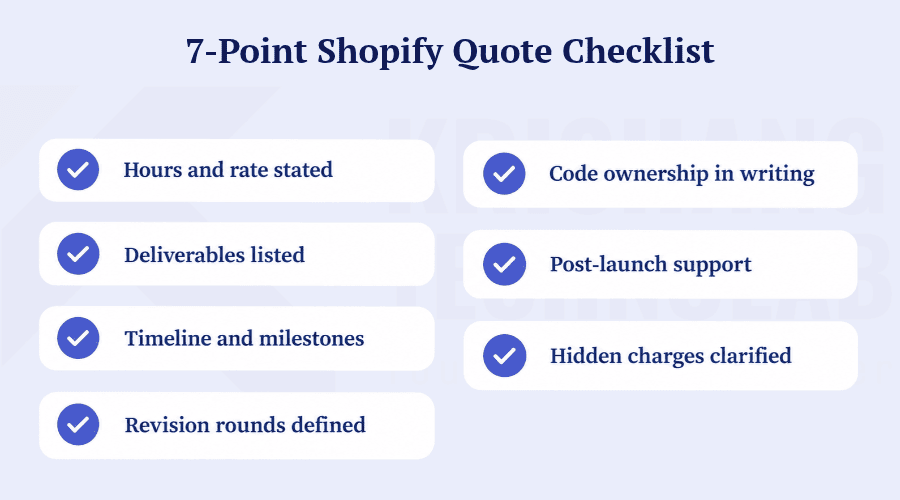
A good Shopify website development quote states hours, rate, deliverables, timeline, ownership and support in writing. If any of these is vague, ask for it before you sign. In fact, two quotes for the same brief can differ by thousands of dollars simply because they describe different projects. Therefore, a reliable Shopify development cost USA check starts with identical scope.
Deliverables Every Shopify Development Proposal Should Define
- Number of custom templates, and sections, not just “custom design”
- Product count, and what data work is included
- Integrations listed by name, such as ERP, CRM, shipping, and email
- Migration scope, with products, customers, orders, and redirects counted separately
- Accessibility and testing scope, including devices, and browsers
- Training, and documentation at handover
Timeline, Milestones, Revisions, and Payment Terms
Look for dated milestones, a defined number of revision rounds and payment tied to delivery stages. Notably, unlimited revisions usually mean an unlimited timeline. Typical terms split payment across kickoff, design approval and launch.
Code Ownership, Theme Access, and Store Account Ownership
You should have the store account, the domain, the custom theme code and any private app built for you. Therefore, make sure you are the account owner and the agency has staff access, not the other way around. Finally, ask for repository access at handover.
Warranty, Bug Fixes, Maintenance, and Ongoing Support
Ask how many days of post-launch bug fixing are included and what it covers. Then ask what the monthly rate is afterward. A 30 to 60 day warranty on defects is common, but new features and design changes are usually billed separately.
Hidden Charges and Scope Changes to Clarify Before Work Begins
- Theme licenses, and app subscriptions, which are normally billed to you directly
- Content creation, including photography, copywriting, and video
- Extra revision rounds, and out-of-scope requests
- Third-party connector, or API fees
- Rush fees if the launch date moves up
- How change requests are priced, and approved
How to Reduce Shopify Development Costs Without Limiting Growth
The biggest savings come from locking scope early, launching with essentials, and delivering clean product data. However, cutting quality to save money usually costs more after launch. For that reason, a lower Shopify development cost USA figure should never come from skipping testing.
Launch With Essential Features and Phase Advanced Functionality
Split requirements into must-have, should-have and later. Then launch the first group, and let real sales data decide what to build next. Phasing also spreads the budget across several quarters.
Choose Apps Carefully to Avoid Unnecessary Subscription Costs
Before installing an app, ask whether it replaces manual work, lifts conversion or supports a process your team runs. Moreover, if Shopify already offers the feature natively, use it. As a result, you get fewer apps, faster pages and fewer conflicts.
Prepare Content and Product Data Before Development Starts
Final logos, brand guidelines, product titles, descriptions, images, policies and navigation structure save developer hours. Because agency time spent fixing spreadsheets is the most expensive time you can buy, gather this material before kickoff.
Prioritize High-Impact Customizations Over Cosmetic Changes
Spend on what moves revenue: product pages, search and filtering, checkout friction and mobile experience. Meanwhile, skip animations and decorative sections until the core store converts. Once it does, paid advertising campaigns can send qualified traffic to pages that are already working.
Plan for Scalability Without Overengineering Your First Store
Choose clean data structures, a flexible theme and documented integrations so you can grow. However, do not build for traffic you do not have. After all, a store that is easy to extend beats a store that is built for every possible future feature.
How to Choose the Right Shopify Development Agency in the USA
The best Shopify development agency in the USA for you is the one that has built stores like yours, can name who does the work and gives a scoped, written proposal. Although price matters, a low quote that leaves out integrations, QA or migration is not a saving. Whether you want an affordable Shopify development agency or a premium partner, apply the same checks. In short, the lowest Shopify development cost USA quote is not automatically the best value.
Portfolio, Relevant Industry Experience, and Case Studies
Look for live stores in your category and at your complexity, such as B2B, subscriptions, large catalogs or Shopify Plus. Next, ask what the agency actually handled on each project. Finally, check the speed and mobile experience of the finished sites, not just screenshots.
Shopify Development Services, Technical Expertise, and Team Capabilities
A capable Shopify development company USA buyers can trust covers these in-house or through named partners, and many brands also work with independent Shopify experts for specialized tasks:
- Store design and custom theme development
- Shopify Plus, functions and checkout customization
- Shopify app development services and integrations
- Shopify migration services and SEO redirects
- Maintenance and support services
- Conversion optimization and technical SEO
Questions to Ask Before Hiring a Shopify Development Company
Before you hire a Shopify expert, review their experience with your store type, custom integrations, theme development, and post-launch support. Ask for relevant case studies, a clear project estimate, and ownership terms before making your decision.
- Which similar projects has your custom Shopify development company in USA delivered, and can I speak with a past client?
- Who will design and develop my store, and who reviews the code before launch?
- How does your Shopify development agency pricing handle integrations, data migration and extra revisions?
- Are accessibility, speed, and checkout testing included before the store goes live?
- What happens to the cost for Shopify development estimate if requirements change mid-project?
- Who owns the code, theme and store account, and will I get repository access if I later hire a Shopify expert for upkeep?
- Which post-launch support, warranty and Shopify maintenance and support services are included in the proposal?
Comparing Agency Proposals, Communication, and Delivery Processes
Compare proposals line by line, using the quote checklist from the previous section. In addition, note how fast and clearly each agency replies, whether they ask smart questions about your business, and whether they share a project plan and a single point of contact. Because an agency that asks hard questions during the sales process usually delivers fewer surprises later, treat curiosity as a good sign.
Before you hire Shopify expert talent for your project, compare the provider’s relevant portfolio, communication process, technical expertise, and post-launch support. A well-defined scope and transparent pricing can help you avoid unexpected development expenses.
Shopify Development Services for Growing Ecommerce Businesses
Our team builds, migrates and optimizes Shopify and Shopify Plus stores for ecommerce brands. Because each engagement starts with a written scope, the quote matches the work. In addition, the cost of Shopify development USA clients see is tied to listed hours and deliverables.
Shopify Store Design and Development
Custom Shopify website development services cover UX planning, store design and development, product and collection templates, app setup, and QA through launch. As a result, the team’s Shopify development services span the whole build, from the first wireframe to the final test.
Custom Shopify Theme and Shopify Plus Development
Custom theme builds come first, followed by Shopify Plus checkout and functions work. Advanced stores can also incorporate B2B and wholesale capabilities, subscription management, and headless commerce to support more complex business requirements.
Shopify Migration, Integrations and Store Optimization
Shopify migration services cover WooCommerce, Magento, and BigCommerce moves, along with ERP, and CRM integrations and SEO-safe redirects. Afterward, ongoing maintenance, and support, plus conversion rate optimization, keep the store improving.
Request a Shopify Development Cost Estimate
For a Shopify development quote you can plan around, first share your catalog size, current platform, must-have features, required integrations, and target launch date. Then send your project details so the team can map the scope. Finally, expect a written Shopify development cost estimate with hours, deliverables and timeline.
Final Verdict: How Much Should You Invest in Shopify Development?
Invest enough to match your store type: roughly $2,000 to $6,000 for a lean launch, $6,000 to $18,000 for a custom D2C store and $40,000, or more for Shopify Plus, and enterprise builds. Ultimately, the right Shopify development cost USA budget is the one that covers your real requirements without paying for features you do not need yet.
To make the decision, follow these steps:
- First, match your business to a store type, and its budget range.
- Next, check that every quote lists hours, deliverables, integrations, and ownership.
- Then add the Shopify plan, apps, maintenance, and SEO to see the true first-year cost.
- Finally, launch with essentials, and phase in custom features as sales data supports them.
However, if you want a figure for your store rather than a range, request a Shopify development cost estimate with your catalog size, platform and feature list.
Frequently Asked Questions About Shopify Development Cost
How much does Shopify website development cost in the USA?
The Shopify development cost USA businesses can expect ranges from $2,000 to $6,000 for a theme-based store, $6,000 to $18,000 for a custom D2C store, and $40,000 to $150,000+ for Shopify Plus or enterprise projects. Meanwhile, B2B, migration and integration-heavy builds usually fall between $15,000 and $50,000. Ultimately, the final price depends on scope, integrations, and team.
What is the average Shopify development cost for a small business?
A small business launching its first store usually spends $3,000 to $8,000 on development. Adding the Shopify plan, apps, a domain and optional maintenance brings the first-year total to roughly $4,000 to $13,000. Therefore, starting with a ready-made theme keeps the cost at the low end.
How much does it cost to hire a Shopify developer in the US?
US Shopify developers charge about $60 to $130 an hour as freelancers and $100 to $200 an hour at agencies. Moreover, senior Shopify Plus specialists can reach $200 an hour or more. Small projects often run $3,000 to $15,000, and light ongoing support is commonly $500 to $2,000 a month. Businesses with ongoing development requirements may prefer to hire dedicated developers instead of paying for separate project engagements. This model can provide consistent technical support, ongoing store improvements, and greater continuity across development tasks.
Is Shopify cheaper than building a custom ecommerce website?
Usually, yes. Because Shopify includes hosting, security, checkout and payments, you pay a monthly plan instead of building, and maintaining those systems. Custom builds can still make sense for highly unusual requirements, but most stores reach their goals on Shopify at a lower upfront, and ongoing cost.
Can I launch with a theme and upgrade to custom development later?
Yes, and it is often a smart sequence. First, launch on a customized theme and keep your product data and content structure clean. Introduce custom sections and features gradually, guided by sales performance, while maintaining clean, organized data to minimize the cost of future redevelopment.
How much does Shopify maintenance cost per month?
Shopify maintenance typically costs $150 to $500 a month for a small store, $500 to $1,500 for a growing brand and $1,500 to $5,000 for enterprise stores. The price depends on how often you need updates, bug fixes, new pages and app management.
Do I pay Shopify subscription fees while my store is being developed?
Often only a little. Agencies commonly build on a development store or a trial and move to a paid plan when you launch or when the trial ends. However, long builds may need one to three months of plan fees before launch. Because promotions change, check Shopify’s current offer.
Who owns the Shopify theme, custom code and store assets after launch?
Absolutely, and this requirement should be explicitly documented in the contract. The store account, domain, custom theme code, private apps and design files belong to you, whereas purchased theme and app licenses stay tied to the license terms. Therefore, ask for repository access and admin ownership at handover.
What happens to my project budget if I change development agencies?
Expect extra cost. A new team must audit existing code, and undocumented work is often rebuilt. As a rough rule, plan a 15% to 30% contingency on the remaining scope. In addition, keep documentation and repository access current so a handover is possible.
Found this post helpful? Don't forget to share it with your network!