Quick Overview: This guide explains the agent development lifecycle in plain language, covering every stage from discovery and design to deployment, monitoring, and retirement. Business leaders get a practical framework for building reliable, secure, and cost-effective AI agents that deliver measurable results.
An AI agent is an ongoing journey of learning, refinement, and growth. It requires planning, testing, supervision and eventual retirement, much like any other business asset. The agent development lifecycle is the path that transforms an idea from a business problem to a working, monitored agent. For business leaders, this lifecycle is the difference between a pilot who dies in three months and an AI agent that keeps paying off for years. This guide breaks down the ADLC (Agent Development Lifecycle) into eight easy-to-follow stages. It also examines ROI, risk, and the pitfalls that sink most agent projects.
What Is the Agent Development Lifecycle?
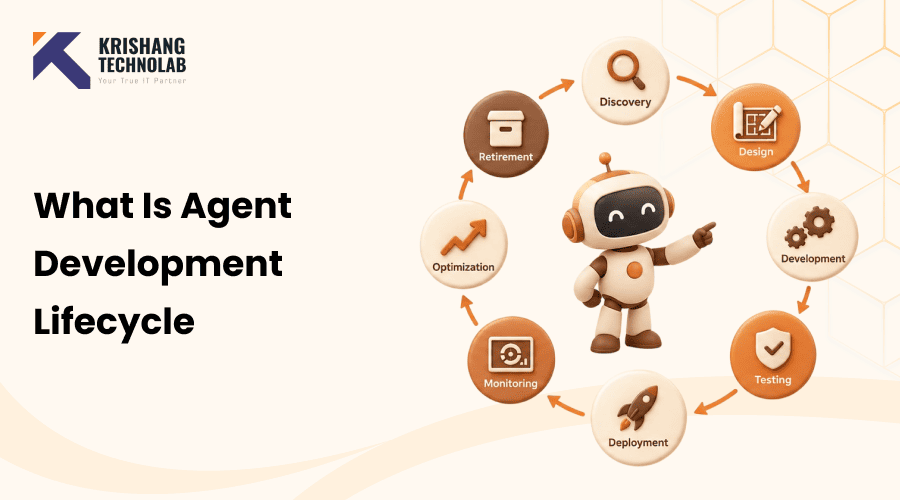
The ADLC (agent development lifecycle) is the full set of stages an AI agent moves through. It begins with a vision and evolves into a lifetime of achievement. The stages are discovery, design, development, testing, deployment, monitoring, optimization, and retirement. A normal app ships once and has small updates. An AI agent continuously learns about its environment and reacts to new data. So it needs continuous watching long after it is launched.
Think of the AI agent life cycle as a loop, not a line. Once a support agent is live, it is not finished improving. Its answers are reviewed. It updates its knowledge base. It refines prompts. Their performance is monitored weekly. That’s the difference between real agent development lifecycle management and just building a bot and hoping it works. Companies that want to build enterprise AI agents through an AI development company typically build this feedback loop from day one.
Here is the simple flow:
Discovery → Design → Development → Testing → Deployment → Monitoring → Optimization → Retirement (then back to Discovery for the next use case)This loop is repeated for every agent a company develops. Mature companies run multiple loops at the same time, across support, sales, HR, and finance. This is where AI agent lifecycle management can help. Dozens of agents running in concert need one set of rules for testing, security and ownership.
Why Is the Agent Development Lifecycle Important for Businesses?
Skipping a formal ADLC (agent development lifecycle) is a major reason AI agent projects fail. A structured approach to agentic AI development helps control costs, clarify business value, and strengthen governance. Gartner predicts that 40% of agentic AI initiatives could be discontinued by 2027 due to rising costs, unclear value, and weak risk controls.
- Reliability: Every agent passes through standardized testing gates before accessing real data or interacting with customers. Teams test agents for accuracy, edge cases, tool failures, and desired outcomes before launch.
- Scalability: Possible with a repeatable AI agent development process. Once there are templates for the discovery, design and testing steps, the fifth agent is much less work than the first.
- Security: Gets built in at the design stage, not added later. Permissions, data access, and guardrails are set before development begins.
- Cost management: Improves as the lifecycle forces teams to estimate infrastructure, modelling and maintenance costs up front. This approach avoids the shock of finding out later that an agent is much more expensive to run than expected.
- Business ROI: Teams define KPIs during discovery and track them in monitoring, thus making them measurable. Leaders always know if the agent pays for itself.
- Continuous improvement: Happens by design. The optimization phase is there to find failures, and improve workflows based on actual data of use, not assumptions.
The global AI agent market is expected to reach about $10.9 billion by 2026 and potentially exceed $50 billion by 2030. Artificial intelligence adoption statistics reflect this rapid growth. To turn adoption into business value, companies need a structured agent development lifecycle and effective AI agent development. Many businesses partner with an AI agent development company to build scalable, reliable agents from the start.
Agent Development Lifecycle vs. Traditional Software Development
Often business leaders think of building an AI agent as just building a mobile app or a web dashboard. It is not. This gap explains why an AI agent development framework needs its own lifecycle stages, metrics, and controls, separate from the old software playbook.
Traditional software follows predictable rules: the same input consistently leads to the same result. Once it passes testing, it keeps working the same way until someone changes the code. An AI agent relies on probabilistic models, and outside data sources. Its behavior can shift even without a code change, simply because a data source or the model behind it changed.
This creates AI-specific issues that a traditional software lifecycle was never designed to solve. These include risks of hallucination, model drift, and prompt sensitivity. A traditional app that passes its test suite is “done.” Even if an AI agent passes its test suite, it still needs to be checked on an ongoing basis because its data, its model, and its environment can all change after launch.
| Aspect | Traditional Software Development | ADLC (Agent Development Lifecycle) |
| Behavior | Fixed and predictable | Can vary with the same input |
| Testing | One-time QA before release | Ongoing checks, even after launch |
| Change driver | Code updates | Code, data, model, and prompt changes |
| Maintenance | Bug fixes and feature updates | Retraining, prompt tuning, drift fixes |
| Risk profile | Mostly functional bugs | Hallucination, bias, security, compliance risk |
| Ownership | Engineering team | Business, engineering, security, and data teams together |
| End state | Deprecated or replaced | Retired, decommissioned, and access revoked |
That’s exactly why an ADLC needs its stages, metrics, and rules; it should not be managed like a normal software release.
What Are the 8 Stages of the ADLC (Agent Development Lifecycle)?
Whether they originate from Microsoft, IBM, Salesforce, or an internal playbook, most mature AI agent lifecycle framework models follow a similar arc, even if the names are different. Together, these stages form an AI agent development lifecycle framework that businesses can use to plan, build, evaluate, deploy, and continuously improve their agents.
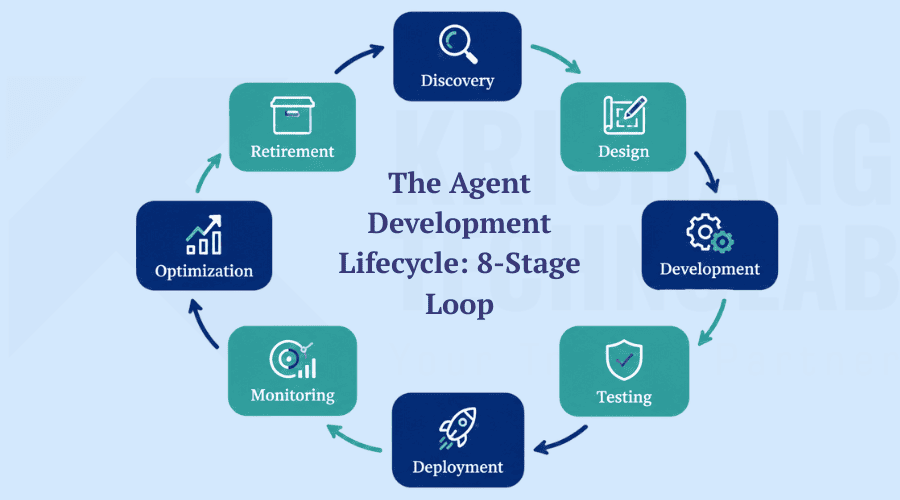
These AI agent development lifecycle phases provide a structured path from identifying a business problem to eventually scaling or retiring the agent.
1. Discovery and Business Use-Case Identification
A successful agent always starts with a clear business problem, not a choice of technology. This stage answers one question: What task is costing the business time, money or accuracy right now? Teams identify the users, whether customers, staff or analysts. They also assess whether an AI agent is in fact appropriate for the problem, since not all tasks are automatable.
Leaders set clear goals and KPIs during discovery. A goal could be to reduce the average handling time by some percentage. Here, teams also calculate ROI, weighing the costs of development, infrastructure, and maintenance against the anticipated value. This process is a step many teams take as a quick AI consulting review before writing code. This approach is the number one way to build agents without a clear goal, which in the end becomes one of the most expensive mistakes in the entire lifecycle.
2. AI Agent Design and Architecture
After establishing the business case, the next step is to define the agent’s operational framework. This means getting the goals of the agent right, picking the right large language model, and figuring out which sources of knowledge it should draw on. That knowledge source could be a product catalogue, a policy file or a live database. Many of these draw on the same skills as broader machine learning development services, because the choice of model determines everything that comes next.
Good AI agent architecture also defines the set of tools and APIs that the agent can invoke. It governs how the agent handles memory and context and what guardrails prevent it from acting outside its role. The architecture also defines human-in-the-loop checkpoints to determine which actions require human approval, such as issuing refunds. This stage also includes early prompt engineering, as the way you word an agent’s instructions directly affects how well it performs.
3. AI Agent Development and Integration
The development process is where the building really exists. They write and polish prompts, connect retrieval-augmented generation (RAG) systems so the agent can access real-time data, and connect it to the necessary APIs. This step often overlaps with more general generative AI development work, as the retrieval layer and the language model need to work as one system.
Real value is usually the one associated with systems already in place, like a CRM, an ERP tool or internal databases. An agent that can’t see real customer data is much less useful than one that can. This is the kind of custom web application development work that takes a demo and turns it into something a team can actually use. Again, authentication and permissions are set up to only reach the data and actions the agent was built for. This stage is what people often refer to as AI agent development as a service, as it involves the hands-on work of turning a design into a working system.
4. AI Agent Testing and Evaluation
An agent has to pass tests far more stringent than the usual tests for software before it gets to talk to real users. Functional testing ensures the agent does its job at all. AI agent evaluation goes further by measuring accuracy, task completion, reliability, and whether the agent produces the intended outcome rather than simply a quick answer.
Hallucination testing searches for confident yet incorrect answers, a danger unique to language-model systems. Tool-use testing ensures the agent calls the right function with the right inputs. Security testing looks for prompt injection and data leaks. Edge-case testing forces the agent to confront weird or incomplete inputs. Regression testing is used to verify that a recent fix has not broken a feature that formerly worked. Some of this work will require the same rigor that data science consulting requires, because to test an agent well means testing the data that underlies it as well. Teams that skip real AI agent testing for a quick demo are the ones most likely to face public failures once real users start typing.
5. AI Agent Deployment
Deployment is not just a switch being flipped. The first step is to verify production readiness, which means that the agent has passed its tests, and the infrastructure can support real traffic. Access control is strictly controlled so that only the appropriate people and systems can access the agent’s sensitive functions.
Versioning is also important here. Teams need a clear record of which version of the agent, its prompts and its model is live at any time. Human approval gates often stay in place early, and you should always have a rollback plan if something misbehaves in production. Staged rollouts with a small group testing the agent before launch reduces the risk of a bad release affecting the entire business all at once.
6. AI Agent Monitoring and Observability
Deployment marks the start of an agent’s journey, not the end. AI agent monitoring tracks accuracy, speed, and cost per task, so the business always knows if the agent is still worth running. Error and tool failure rates are recorded so that teams can detect patterns at an early stage.
User feedback is also important because real users often find problems that automated tests would not. Security monitoring also occurs post-launch for strange access patterns or signs that the agent is being fooled. Strong AI agent observability turns a black-box system into something a team can trust, trace, and defend if something goes wrong.
7. AI Agent Optimization and Continuous Improvement
No agent is perfect at launch. This stage means studying failures by type, not patching each one alone. Teams update prompts with actual conversation logs, fill in missing information to the knowledge base, and switch models if a different one performs better or is less expensive. This is a core part of most machine learning development services engagements, as a model is rarely optimal without regular tuning.
Workflow fixes are often just as important as technical tuning. A little redesign of the human handoff can solve more issues than a prompt rewrite. Sometimes retraining a model is worth the effort once you have enough real-world data. The checks need to be ongoing, happening in the background all the time, not an annual audit. So the agent keeps improving rather than slowly degrading.
8. Scaling, Retirement, and Decommissioning of AI Agents
Every agent will come to a fork in the road: scale, replace or retire. If the agent continues to show its value, it can expand to new teams or more responsibilities. If even after tuning a model performs poorly, it may need a different model or design.
Retirement needs as much care as the launch. When a team abandons an agent, they must fully remove the agent’s data access, and credentials, rather than simply pausing them. An unused agent with live access is still a security risk. There should be a clear AI agent decommissioning process, capturing the reason for retirement, what happened to the data, and how any linked workflows were dealt with. Teams that first tested their idea through AI MVP development usually find this final step easier, since the scope was narrow from the start. This last stage often gets skipped, yet it closes the loop on the entire ADLC (agent development lifecycle) and protects the business from forgotten systems still quietly running in the background.
How to Measure AI Agent Performance
Judging an agent purely on speed misses the point. A quick answer that is wrong, or that creates extra work for a person, is not a win. Effective measurement is about mixing technical and business metrics side-by-side. Many companies fold this tracking work into ongoing outsourced engineering support, since someone needs to own the dashboards long after launch, not just during the first month.
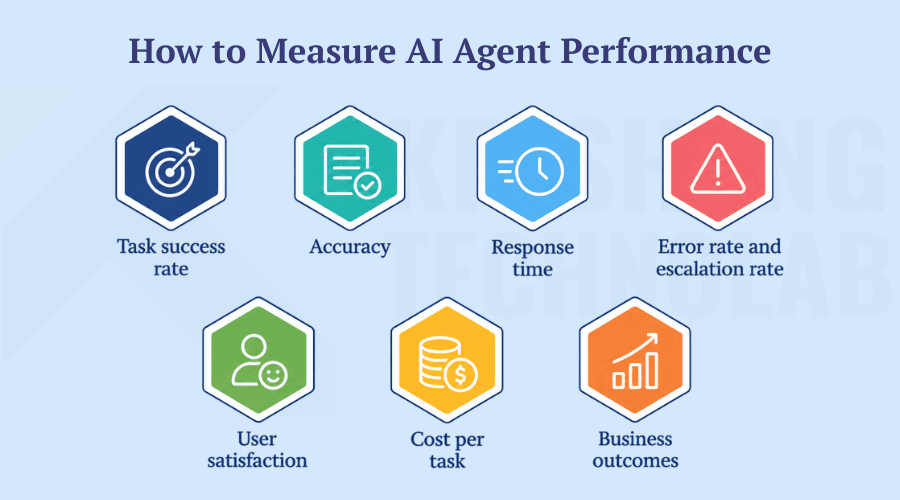
- Task success rate: The percentage of requests successfully completed by the agent without human intervention.
- Accuracy: Frequency of the agent’s answer matching the approved answer.
- Response time: How fast an agent is compared to the old manual process.
- Error rate and escalation rate: How often does the agent fail or escalate to a person.
- User satisfaction: Feedback from the people using the agent.
- Cost per task: Total cost divided by tasks completed.
- Business outcomes: Real impact on revenue, retention or operating cost.
Tracking all seven together, not just one, provides a far more honest view of whether the agent is truly working.
How to Calculate AI Agent ROI
Working out AI agent ROI starts with an honest look at total cost, not just the build bill. The main cost groups are:
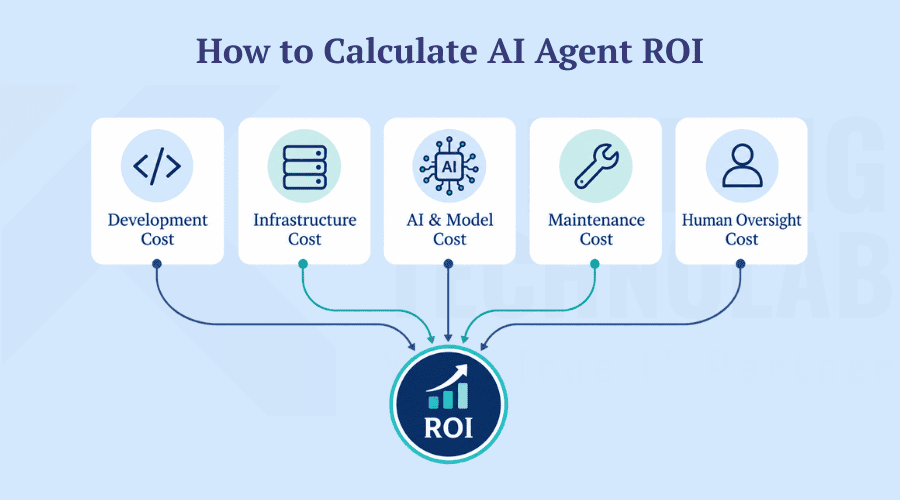
- Development costs – The initial build, design and integration work.
- Infrastructure costs – Cloud hosting, storage and compute to run the agent at scale.
- AI and model costs – Ongoing API, or hosting fees for the model, which can grow fast as use increases.
- Maintenance Costs – Updates, retraining, and fixes over the life of the agent.
- Human oversight costs – Staff time spent reviewing, approving, or correcting the agent’s work.
A simple ROI method consists of comparing the total business value (i.e., hours saved or fewer errors) with these five cost groups, over a period of time, say, twelve months. Some businesses fold this cost tracking into the work of a dedicated development team that already manages their other AI systems, so the numbers stay in one place instead of scattered across departments. Unfortunately, companies that focus only on development cost and early time savings tend to overestimate ROI because there are often model and maintenance costs that quietly accumulate post-launch.
AI Agent Governance and Security
Governance cannot be an afterthought to a finished agent. It has to be built into the lifecycle from the design phase on. AI agent security is therefore a lifecycle concern, not a final checklist item. AI agent permissions should follow the principle of least privilege, granting an agent only the data and actions it needs for its one task. Data privacy rules apply at training time, where sensitive fields should never be included in a training set without review, and at runtime, where customer, financial, and health records require strict control over access. Companies often hire software developers who already understand these controls, rather than trying to retrofit them into an agent after it’s live.
Guardrails set the limits an agent cannot cross, regardless of what a user asks. High-risk actions such as issuing payments, or deleting records always require a sign-off from a person first to provide for human monitoring. Audit logs should include the entire agent path, not just the final answer. This includes what data the agent pulled, and what tools it called. That trail is important in any compliance review or security incident. Strong AI agent governance also means checking permissions whenever an agent gets a new tool, and keeping compliance records updated as rules around autonomous systems keep changing.
Common AI Agent Lifecycle Mistakes
Most agent failures trace back to a small, repeating set of mistakes, not rare technical problems. Teams that set up an offshore development center for their AI work often notice the same pattern: skipping planning steps to move faster ends up costing more time later.
- Building an agent with no clear business goal, or success metric.
- Giving the agent too much freedom before it has proven itself on smaller tasks.
- Skipping real testing in favor of a quick demo.
- Ignoring security and access controls until after something goes wrong.
- Feeding the agent poor, or outdated data, which leads to poor answers no matter how good the model is.
- No human escalation path for cases the agent doesn’t handle well.
- Launched without production monitoring, so failures remain hidden until customers complain.
- Measuring activity, like the number of chats handled, instead of real business outcomes.
- Treating launch as the finish line instead of building in continuous improvement from day one.
All failures can be linked to a lifecycle stage that was omitted or hurried. These AI agent development best practices all point to the same principle: follow the end to end agent life cycle end to end rather than rushing through any one stage.
AI Agent Lifecycle Example: Customer Support AI Agent
A real example makes the lifecycle easier to picture. Picture a mid-sized online store struggling with slow replies to order status and return questions. Many stores now get this kind of flow built by choosing to hire ChatGPT developers who specialize in support automation rather than building the retrieval and approval logic from scratch.
- Business problem: Support staff spend hours answering repetitive questions that require no real judgement.
- Discovery: The team selects order tracking and return eligibility as high-volume, low-complexity tasks and sets a goal to solve 60% of these without a human. And that’s the trend many stores are following now, as more small teams deploy AI agents to run parts of their store day-to-day.
- Design: The agent is scoped to read order data and return policy files, with a strict rule that it cannot issue refunds itself, only suggest them for a person to approve.
- Development: The engineers attach the agent to the order system, and build a retrieval layer over the return policy pages.
- Testing: The team runs the agent through hundreds of past support tickets, checking accuracy, hallucination and how it handles edge cases like damaged items.
- Deployment: The agent launches to a small slice of traffic first, with a human checking every suggested refund for the first month.
- Monitoring: The team monitors resolution rate, escalation rate and satisfaction on a weekly basis.
- Optimization: The team updates its knowledge base and retrains its retrieval sources when it realises that shipping questions confuse the agent.
- Scaling: When performance is above the original goal, the agent will begin to expand into more support categories.
This one example covers all stages of the ADLC (agent development lifecycle), and this pattern is repeated in sales, HR, finance and IT, with just the data and tools being different.
How Krishang Technolab Helps Businesses Build and Scale AI Agents
A full agent development lifecycle requires a mix of skills that most internal teams don’t have to run it well: AI strategy, model choice, secure integration, and long-term monitoring. Krishang Technolab collaborates with business leaders through each of these phases, beginning with AI consulting services to identify which workflows are worth automating.
Custom AI agent development services are tailored around each business’s own tools, data, and compliance needs instead of a one-size-fits-all template. For teams looking at deeper use cases, generative AI development, and chatbot or copilot integration work go beyond simple task automation of what an agent can do. Businesses interested in bringing AI skills in-house can also hire AI developers or hire prompt engineers to support the build directly. Support does not stop at launch either; ongoing tuning and optimization keep agents accurate and cost-efficient as use grows.
Conclusion
The ADLC (Agent Development Lifecycle) is what separates a promising demo from a system that keeps delivering real value year after year. Every stage protects against a certain type of failure, from discovery and design to development, testing, deployment, monitoring, optimization, and finally retirement. That could mean building the wrong thing, launching something unsafe, or letting a once-useful agent quietly become a security risk. Treating agent development as an ongoing lifecycle management process, rather than a one-time build, is the biggest factor separating companies that achieve lasting value from AI agents from those that shelve their projects within a year.
If you’re researching how to build an AI agent, or looking to test and scale one the right way, request a quote and design a lifecycle that corresponds to your business goals, data and risk comfort.
Frequently Asked Questions About AI Agent Lifecycle
What is the agent development lifecycle?
The ADLC (agent development lifecycle) is the full journey an AI agent follows from planning, design, development, testing, deployment, and monitoring to retirement. It sees the agent as a system that is constantly evolving, not a single release.
What are the stages of the agent development lifecycle?
The main stages are discovery, design, development, testing, deployment, monitoring, optimisation and retirement. From early on, you will define the business problem and ultimately remove the agent’s data access when it is no longer needed.
What is AI agent lifecycle management?
AI agent lifecycle management is the ongoing work of governing, monitoring and improving an agent after it has gone live. It includes permissions, data access, performance monitoring and security review to ensure the agent is safe and useful as its world evolves.
How is AI agent development different from traditional software development?
AI agent development includes behaviour that can change and a dependency on outside data, compared to normal software that acts the same way after testing. Agents, unlike regular apps, have to be monitored for hallucination and model drift and other problems all the time.
How do you test an AI agent?
Testing an AI agent involves functional testing, accuracy testing, hallucination testing, tool-use testing, security testing, edge-case testing and regression testing. Each type checks a different kind of risk, because language-model agents can fail in ways that normal software rarely does.
How do you monitor an AI agent?
After an AI agent has launched, monitoring it is all about keeping track of accuracy, speed, cost per task, error rates, and user feedback all the time. Security monitoring also watches for unusual access patterns or indications that the agent is being nudged toward unsafe behaviour.
How do you measure AI agent ROI?
AI agent ROI is determined by comparing total business value (e.g., time saved or fewer errors) with total development, infrastructure, model, upkeep and oversight costs over a period of time (typically 12 months).
What are the risks of AI agents?
The big risks are agents that hallucinate or provide wrong answers, agents that have too much freedom without supervision, privacy concerns, security issues such as prompt injection, and a negative ROI if agents are built without a clear goal or ongoing oversight.
How much does it cost to develop an AI agent?
Costs vary widely depending on complexity but typically include development, model or API fees, hosting, integration work and maintenance. Simple single task agents are far cheaper than multi-agent systems connected to several business platforms.
When should an AI agent be retired?
An AI agent should be retired when it keeps underperforming despite tuning, if the workflow it supports is no longer relevant, or if it can be replaced by a superior model or design. Always, retirement means total removal of its data access and credentials.
Found this post helpful? Don't forget to share it with your network!