Quick Overview: Explore the ideal AI tech stack for startups using Python, Node.js, and Next.js. Learn how this powerful combination enables scalable AI development, real-time APIs, high-performance frontends, and future-ready architecture for building fast-growing, AI-first products.
Now, choosing the best AI tech stack for a startup isn’t just a technical choice; it’s also a strategic one. AI isn’t something you add at the last minute. This is what modern startups do for the core of their product.
Python is now the most popular language for building AI, and most data science and machine learning projects around the world use it. Millions of developers use Node.js to create scalable, real-time apps on the back end. On the front end, Next.js is one of the React frameworks that is growing the fastest and is widely used to make quick, production-ready web apps.
All of these pieces work together to let AI startups ship quickly, grow easily, and keep trying new things without slowing down performance.
Your tech stack isn’t just infrastructure; it’s your competitive edge in a market where speed and flexibility are what make the difference.
What is the AI tech stack ?
An AI tech stack is the set of tools and technologies that are used to make, train, deploy, and grow AI systems. It’s like a set of tools that you can use to make smart products out of raw data. In contrast to a typical software stack, which is made up of a front end, a back end, and a database, an AI stack includes learning systems, data pipelines, and model infrastructure.
Why is the AI tech stack important in 2026 ?
These days, AI isn’t just a feature; it’s often what makes a business work. The AI tech stack is important because of this. The best tech stack for AI combines Python for building and training models, Node.js for scalable backend APIs, and Next.js for high-performance frontends.
Here’s the simple version:
- It keeps costs down: Running models like GPT-4 or Llama can be costly. A smart stack helps you save money.
- It affects speed: The right tools, like PyTorch, help teams build and improve AI more quickly.
- It affects quality: AI works better with better data systems.
- It lowers risk: Good infrastructure keeps you from relying too much on services like Amazon Web Services.
- It helps with scaling: A strong stack makes it easy for your AI product to grow.
How fast you grow, how much you spend, and how strong your AI gets depend on your AI tech stack.
For startups that need strategy and guidance, partnering with an experienced AI consulting expertise team can accelerate your model deployment and product roadmap.
Top 3 Tech stack for AI startup
For most startups, the best AI tech stack includes Python for AI logic, Node.js for real-time backend services, and Next.js for fast, interactive web applications. It allows quick MVP development while staying ready for long-term growth.
1. Python: The Core Intelligence Layer of AI Startups
Most new AI companies start with a strong Python AI tech stack. Python is the best language for making machine learning, deep learning, and AI products because it is easy to use, can grow with your needs, and has a huge ecosystem.
Here’s how a typical Python AI stack is structured:
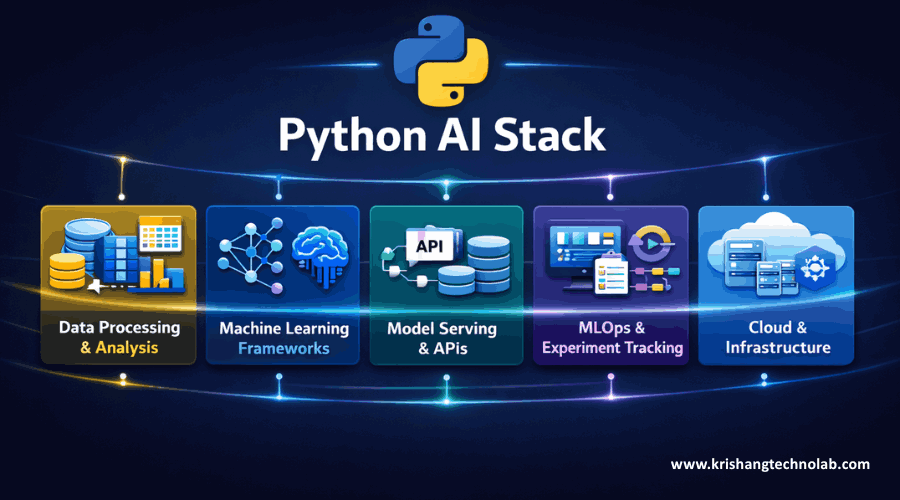
1. Data Processing & Analysis
Before training any model, startups must clean and process data.
- NumPy – Numerical computing
- Pandas – Data manipulation and analysis
- Matplotlib – Data visualization
These tools allow teams to prepare datasets efficiently for modeling.
2. Machine Learning Frameworks
For traditional ML models:
- scikit-learn – Classification, regression, clustering
deep learning:
- TensorFlow – Scalable production ML
- PyTorch – Flexible and research-friendly
NLP & LLMs:
- Hugging Face Transformers – Pretrained transformer models
3. Model Serving & APIs
Once models are trained, they need to be deployed.
- FastAPI – High-performance API development
- Flask – Lightweight web services
- Uvicorn/Gunicorn – ASGI/WSGI servers
This layer connects AI models to frontend apps or external services.
4. MLOps & Experiment Tracking
To manage experimentation and scaling:
- MLflow – Experiment tracking
- Docker – Containerization
- Kubernetes – Scalable orchestration
These tools help startups move from prototype to production reliably.
5. Cloud & Infrastructure
Python integrates seamlessly with major cloud providers like AWS, GCP, and Azure for:
- GPU-based model training
- Serverless inference
- Scalable storage solutions
Why Python AI Tech Stack Wins
- Rapid prototyping
- Massive AI ecosystem
- Strong community support
- Production-ready scalability
Python is more than just a part of the stack for AI startups; it’s what makes intelligence, experimentation, and growth possible. For startups building AI tools, it’s essential to hire dedicated Python developers who can build and maintain robust backend services.
2. Node.js: The Scalable Backend Powering AI Applications
A strong Node.js tech stack helps AI startups build APIs that can grow, communicate in real time, and connect front-end apps to AI services. Python trains models and makes predictions with them, and Node.js runs the part of the app that gives users AI features.
Here’s how a typical Node.js stack looks:
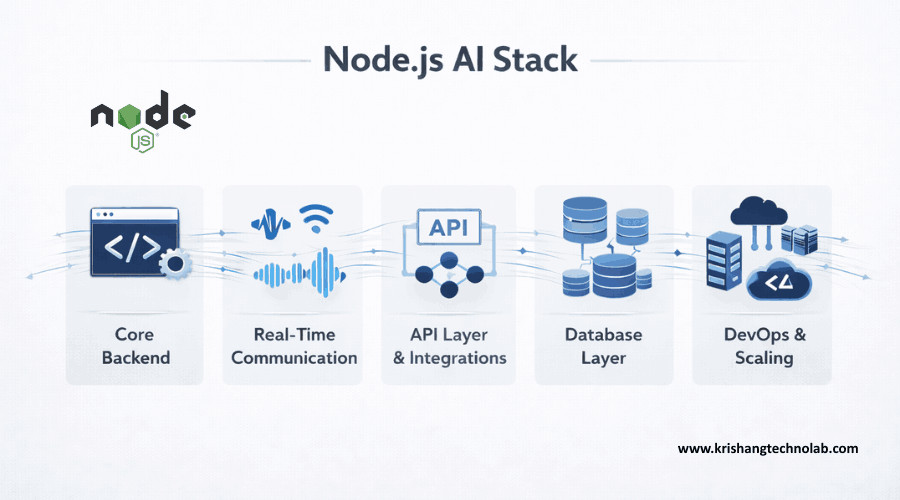
1. Core Backend Frameworks
- Express.js – Minimal and flexible API development
- NestJS – Scalable, enterprise-ready architecture
- Fastify – High-performance alternative for APIs
These frameworks help structure REST or GraphQL APIs efficiently.
2. Real-Time Communication
AI apps often require streaming responses (e.g., chatbots, copilots).
- Socket.IO – WebSocket-based real-time communication
- Native WebSockets – Lightweight streaming
This is essential for delivering live AI-generated responses.
3. API Layer & Integrations
- GraphQL – Flexible data querying
- Axios / Fetch – API communication
- Middleware for authentication (JWT, OAuth)
Node.js acts as the bridge between:
Frontend (Next.js) → Backend API → Python AI services
4. Database Layer
Common database choices include:
- MongoDB – Flexible document database
- PostgreSQL – Reliable relational databas
- Redis – Caching AI responses
5. DevOps & Scaling
- Docker – Containerization
- Kubernetes – Orchestration
- PM2 – Process management
Why Node.js Works for AI Startups
- Event-driven, non-blocking architecture
- Excellent for real-time AI applications
- Unified JavaScript ecosystem (frontend + backend)
- Highly scalable for growing workloads
Node.js is an important part of a modern tech stack for AI startups because it makes sure that AI intelligence can grow reliably and reach users right away. It’s important for startups that make AI tools to hire Nodejs developers who can build and keep strong backend services running.
3. Next.js: Building High-Performance Frontends for AI Products
A modern Next.js tech stack helps AI startups make frontends that are quick, interactive, and scalable. Next.js runs user interfaces that give AI responses in real time and is an important part of a strong tech stack for AI startups.
Here’s how a typical Next.js stack is structured:
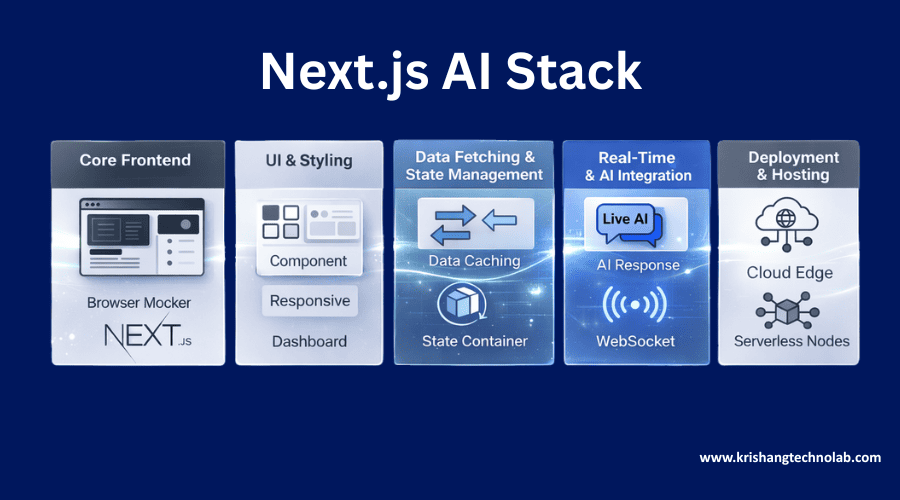
1. Core Frontend Layer
- React – Component-based UI architecture
- TypeScript – Type-safe development
- App Router / Pages Router – Routing and layouts
This foundation enables modular, maintainable frontend development.
2. UI & Styling
- Tailwind CSS – Utility-first styling
- ShadCN / Chakra UI – Prebuilt UI components
- Framer Motion – Smooth animations
These tools help create clean, responsive AI dashboards and chat interfaces.
3. Data Fetching & State Management
- Server-Side Rendering (SSR) – Dynamic AI content
- Static Site Generation (SSG) – Performance optimization
- React Query / SWR – Data synchronization
- Context API / Zustand – State management
This ensures fast and consistent AI-driven UI updates.
4. Real-Time & AI Integration
- WebSockets – Streaming AI responses
- API routes – Lightweight backend logic
- Integration with Node.js and Python AI services
Perfect for chatbots, copilots, AI dashboards, and SaaS tools.
5. Deployment & Hosting
- Vercel – Native Next.js deployment
- Docker – Containerized deployment
- Edge functions – Low-latency AI interactions
Why Next.js Works for AI Startups
- Optimized performance and SEO
- Seamless full-stack capabilities
- Real-time streaming support
- Easy deployment and scaling
In a world where AI comes first, Next.js development makes complicated AI systems into fast, easy-to-use, and scalable user experiences.
To ensure your AI product delivers fast and intuitive interfaces, hire Next.js developers with expertise in modern frameworks like Next.js and React.
Related to Read: The Most Popular Backend Frameworks
How the Stack Works Together
A modern tech stack for AI startups is made up of Python, Node.js, and Next.js, which work together in a modular, scalable way where each layer has a clear job.
1. Frontend Layer – User Interaction
Built with Next.js, the frontend handles:
- User inputs (chat prompts, uploads, commands)
- Real-time streaming responses
- Dashboards and AI-generated outputs
It communicates with the backend via secure API calls or WebSockets.
2. Backend/API Layer – Business Logic & Orchestration
Powered by Node.js, this layer:
- Manages authentication and user session
- Handles request validation
- Connects to AI services
- Streams responses back to the frontend
Node.js acts as the bridge between the UI and the AI engine.
3. AI Engine – Model Training & Inference
Built with Python, this layer:
- Processes data
- Runs machine learning models
- Performs inference
- Returns AI-generated results
It typically uses frameworks like PyTorch or TensorFlow.
4. End-to-End Flow Example
- User submits a prompt in the Next.js app
- Node.js API receives the request
- Python AI service processes the prompt
- Model generates a response
- Node.js streams the result back
- Next.js updates the UI in real time
Why This Architecture Works
- Clear separation of concerns
- Independent scaling of each layer
- Faster experimentation without system-wide rewrites
- Real-time, production-ready performance
Python, Node.js, and Next.js work together to make a flexible, scalable base that lets AI startups come up with new ideas quickly and be ready for growth.
Programming tech stack for AI startup
A complete programming stack typically includes:
- Python for machine learning and data pipelines
- Node.js for APIs and orchestration
- Next.js for frontend applications
- Databases like MongoDB or PostgreSQL
- Docker and Kubernetes for deployment
Also Read About: NodeJS vs Python; Which backend framework works great for your business?
Scaling an AI Startup
It’s not enough to just get more users for an AI startup to be scalable. You also need to be able to handle more data, more model requests, and higher performance expectations without breaking your system. This growth can be handled with a well-thought-out tech stack for AI startups.
1. Scaling the AI Layer (Python)
With Python powering your AI engine, scaling typically involves:
- GPU-based model training
- Optimizing inference speed
- Using model quantization or distillation
- Separating training and inference environments
Frameworks such as PyTorch and TensorFlow allow for large-scale distributed training and production deployment.
2. Scaling the Backend (Node.js)
Your Node.js-based API layer needs to be able to handle more traffic and AI requests at the same time.
Key strategies:
- Load balancing across multiple instances
- Horizontal scaling with containers
- Caching frequent AI responses
- Rate limiting and queue systems
This ensures stable performance even under heavy demand.
3. Scaling the Frontend (Next.js)
The user experience must remain fast and responsive. With Next.js, you can:
- Use server-side rendering for dynamic AI content
- Deploy edge functions for low-latency responses
- Optimize static assets for faster load times
When it comes to AI products, where responsiveness is important, a fast front end builds trust.
4. Infrastructure & DevOps
As your startup grows, infrastructure becomes critical:
- Docker for containerization
- Kubernetes for orchestration
- Cloud providers for GPU scaling
- Monitoring tools for observability
Automation and CI/CD pipelines make it easy and safe to release new model updates on a regular basis.
5. Cost Optimization
AI workloads can become expensive. Scaling smartly includes:
- Monitoring inference costs
- Using smaller optimized models when possible
- Implementing usage-based pricing
- Caching or batching model requests
Strong models aren’t enough for an AI startup to grow. An AI startup also requires a flexible stack that allows each layer to expand independently.
Startups can grow without worrying about constant rewrites or system failures when Python handles intelligence, Node.js handles orchestration, and Next.js handles seamless user experiences.
Read About: Dedicated Development Team VS Outsourcing
Future Trends in AI Startup Stacks
As more products and systems integrate AI, the tech stack for AI startups is rapidly evolving. The following factors will shape the next generation of AI architectures:
1. AI-Native Infrastructure
Infrastructure is being built with AI workloads in mind. Instead of adding on to old systems, startups will use tools that already support
- Model versioning and lifecycle management
- Feature stores and metadata tracking
- Automatic scaling of GPU clusters
This reduces operational overhead and accelerates model deployment.
2. Serverless AI & Edge Computing
Serverless platforms and edge functions are gaining traction for low-latency AI experiences:
- Inference at the edge (closer to users)
- Cost-effective serverless execution for sporadic workloads
- Reduced bandwidth and cloud costs
Edge AI will be used more and more by startups for real-time apps like AR/VR assistants, IoT intelligence, and personalization in devices.
3. Modular & Composable Stacks
Monolithic backend systems are giving way to composable architectures:
- Independent services for data, models, APIs, and UI
- Event-driven communication between components
- Reusable AI capabilities across products
This increases flexibility, makes testing safer, and lets scaling happen on its own.
Read About: Monolithic vs Microservices Choosing the Right Architecture
4. AI Abstraction Layers & Low-Code Tools
Higher-level abstraction layers are emerging to simplify AI development:
- Low-code model builders
- AutoML and hyperparameter tuning services
- Plug-and-play integrations with major LLM providers
These tools make it possible for people who aren’t experts in machine learning to start using AI features.
5. Unified Full-Stack Languages & Frameworks
While Python, Node.js, and Next.js are dominant today, expect growth in:
- TypeScript-first AI tooling
- Backend frameworks with native AI support
- Frontend libraries optimized for responsive, real-time AI UI
This speeds up development and cuts down on switching between languages.
6. Responsible & Secure AI by Design
As regulations and user expectations rise, AI stacks will embed:
- Privacy-preserving computation
- Explainability tools
- Secure model access and monitoring
Responsible AI won’t be an extra; it will be a part of the whole stack.
7. Standardized MLOps Practices
MLOps will continue maturing, with standards emerging for:
- Continuous training and deployment
- Automated testing of model outputs
- Reproducibility and audit trails
Startups that use strong MLOps from the start will be able to make changes faster and have fewer problems in production.
The future stack is all about being flexible, scalable, and easy to try new things, so startups can build smarter, faster, and with more confidence. This is true for edge deployment, AI-native infrastructure, and responsible AI tools.
One of the most popular tech stacks for AI startups today is Python for AI development, Node.js for backend systems, and Next.js for frontend applications. This stack is widely adopted because of its flexibility, scalability, and large developer communities. If your team needs help implementing Node.js APIs or Python infrastructure, leveraging professional software development outsourcing services can complement in-house efforts efficiently.
Which Is the Right Choice for a Tech Startup?
The right stack depends on the type of product you’re making, the skills of your team, and your growth goals. For most AI-driven businesses, however, a modern tech stack for AI startups made up of Python, Node.js, and Next.js is a good choice.
When This Stack Is the Right Fit
You’re building an AI-first product: Python gives you access to the largest AI/ML ecosystem for fast experimentation and model deployment.
You need real-time or scalable APIs: Node.js handles concurrent requests efficiently, ideal for chat apps, SaaS platforms, and AI copilots.
User experience matters: Next.js delivers fast, SEO-friendly, and interactive interfaces critical for AI tools where responsiveness builds trust.
An AI startup should use a stack that supports rapid experimentation, independent scaling, strong ecosystem support, and cost control. Python + Node.js + Next.js is a practical and future-ready choice for most AI-first products.
To build scalable AI products, you can explore professional AI development services like those offered by Krishang Technolab to implement Python-powered machine learning and custom models.
Conclusion: Building the Modern AI Startup Stack
A strong tech stack is the most important thing for any AI-first company to have. Using Python for AI development, Node.js for scalable backend APIs, and Next.js for high-performance frontends makes an architecture that works now and in the future.
Python is in charge of intelligence, Node.js is in charge of logic and communication, and Next.js is in charge of the user experience. This separation facilitates growth, testing, and improvement without necessitating a complete rebuild.
The right stack for AI startups isn’t just the infrastructure. It’s the base that makes faster innovation, smoother growth, and long-term success possible.
Found this post helpful? Don't forget to share it with your network!