Quick Overview: Application Modernization Services help businesses upgrade legacy applications for better scalability, security, performance and agility. This guide covers application modernization strategies, cloud modernization, AI integration, application migration, modernization benefits, common challenges, ROI and best practices for building future-ready applications.
Apps are the lifeblood of a business. They power their business, serve their customers and they fuel growth. But legacy systems can kill innovation, increase maintenance costs and stifle scalability. They can also open security holes and make it harder to upgrade the technology. Therefore, companies prefer Application Modernization Services to upgrade their legacy technology and develop flexible, secure, scalable and high performing application environments.
Cloud, AI, automation, and rich analytics are all used by modern apps. These capabilities help companies work more efficiently, while delivering better digital experiences to their customers. But modernising right takes planning ahead, and a solid plan for how to modernise your applications. This company needs to look at its goals, its systems, the tech risks it’s facing, and what it’s going to need going forward.
Refreshing core applications allows enterprises to reduce technical debt and improve the agility of their business operations. This makes them more successful in the long run as they can react faster to changes in the market. Modern applications also make it easier to integrate emerging technologies and streamline workflows. They provide a stronger foundation for sustainable growth and continuous innovation.
What Are Application Modernization Services?
Application Modernization Services help organisations modernise legacy applications by refactoring code, moving to the cloud, testing, integrating and changing architectures. But modernisation doesn’t always mean rebuilding applications. Companies can select approaches that suit their goals, funds and risks. For example, they can rehost, refactor or rearchitect the systems, while Custom Software Development Services can support tailored solutions for evolving business needs. So modernisation offers flexible paths for better performance and scalability.
Why Application Modernization Is Essential for Business Growth
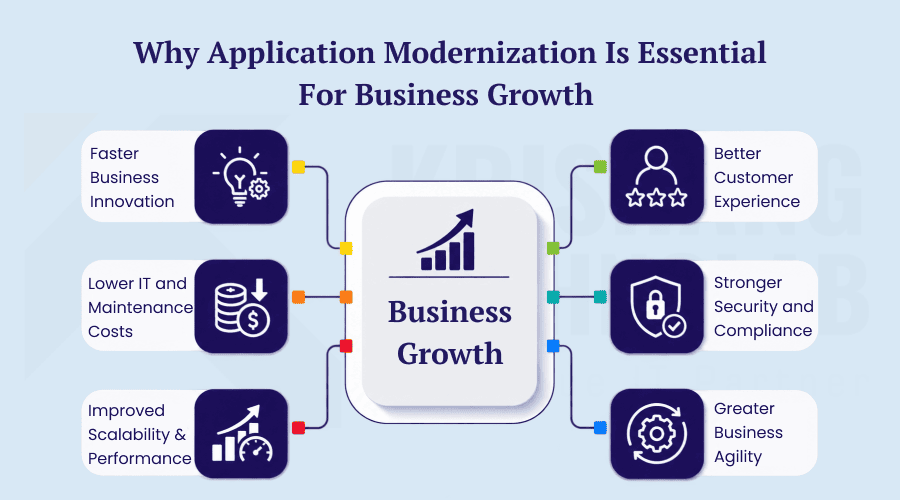
Modernising applications frees organisations from the chains of legacy technology. It improves application performance, scalability, security and flexibility and meets changing business requirements. Today’s applications enable teams to innovate more quickly and deliver better experiences to their customers. It allows companies to tear down technical barriers, improve operational efficiency, and lay a better foundation for long-term success.
1. Faster Business Innovation
Legacy applications can bog down and complicate feature development. Today’s systems allow teams to build, test and release improvements more quickly. Modern architectures are also APIs, micro-services and automation. This will enable companies to respond more quickly to customer needs, experiment with new ideas and deliver innovative digital services more efficiently.
2. Lower IT and Maintenance Costs
Legacy systems are costly to maintain and may require specialist skills. Ageing infrastructure can also increase infrastructure costs. Application modernization services lower these costs through automation and efficient architectures, while Software Development Outsourcing Company offers access to skilled development resources without increasing internal overhead. This enables organisations to direct budgets toward innovation and allows teams to spend less time maintaining legacy systems and more time enhancing business capabilities.
3. Improved Scalability and Performance
As business grows the workload grows and it needs applications to handle that. But legacy systems can struggle with traffic spikes and increased data needs. Modern applications can grow resources based on business needs. Cloud technologies, therefore, enhance performance, drive growth and help businesses provide seamless digital experiences during peak demand.
4. Better Customer Experience
Customers want fast, reliable and convenient digital experiences. But legacy apps can cause delays and user frustration. Modern apps increase the response time and make the digital journeys easier. They also enable personalised services resulting in higher customer satisfaction, increased brand loyalty and help companies stay abreast of the evolving customer expectations.
5. Stronger Security and Compliance
Legacy applications may have old parts and security vulnerabilities. Regulatory compliance can also be a problem with older systems. Modernisation also means new technologies and more security controls. This allows organisations to govern access, encrypt and monitor data continuously, reducing vulnerabilities, improving compliance and data security.
6. Greater Business Agility
Today, companies must react quickly to changes in customer needs and competition. But such changes are difficult and expensive with legacy technology. New architectures are more flexible, so businesses can update applications faster. This speeds up the process of improving operations, launching new products and adapting to market changes. Greater flexibility also allows teams to respond to emerging opportunities without major technology disruptions.
How AI Is Transforming Application Modernization
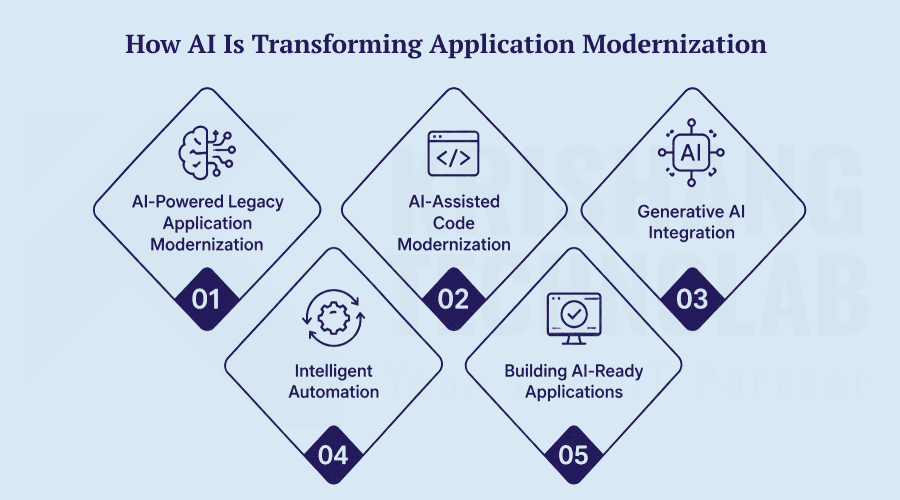
Artificial intelligence is changing how companies approach application modernisation. Teams can use AI to analyse code, uncover dependencies, automate testing and improve development workflows. A Professional AI Development Company can bring these capabilities into modernisation initiatives, making complex development processes more efficient while supporting the adoption of AI-driven technologies.
1. AI-Powered Legacy Application Modernization
Modernisation teams can use AI to examine extensive legacy codebases, map complex dependencies and identify outdated components. With Machine Learning Development Solutions, organisations can gain deeper insights into older applications and identify areas that are ready for modernisation. This reduces the time spent on manual analysis while making legacy application assessment and documentation more efficient, especially when existing technical records are limited.
2. AI-Assisted Code Modernization
Legacy application modernisation often involves complex code conversion, testing, documentation and optimisation. With the option to Hire Expert AI Developers, businesses can bring specialised skills into these projects and handle older languages and frameworks more efficiently. AI can reduce repetitive development work, but human expertise remains essential for validating generated code and protecting the reliability of mission-critical applications.
3. Generative AI Integration
LLM vs Gen AI is an important distinction when businesses explore intelligent features for modern applications. Modern applications can incorporate AI assistants, content generation, intelligent search and personalised recommendations through Generative AI Development Services. Modernisation creates the technical foundation for AI-powered customer experiences, while APIs and cloud platforms make it easier to integrate AI services and emerging technologies.
4. Intelligent Automation
AI is able to automate repetitive operational and development tasks. Intelligent automation can also help to identify errors and enable faster decision-making. By using standard artificial intelligence together with automated workflows, manual labour can be reduced. That, in turn, helps teams to be more productive, make fewer mistakes, and spend their time on more valuable business activities.
5. Building AI-Ready Applications
Modern architectures create a stronger foundation for AI integration, but businesses need to account for data access, APIs, scalability, governance and security from the outset. AI Strategy Consulting Services bring a structured approach to identifying AI opportunities and aligning them with technology goals. An effective application modernization strategy can prepare existing applications for evolving AI requirements, allowing businesses to adopt new capabilities without rebuilding them from scratch.
Key Benefits of Application Modernization Services
Application Modernization Services enable organisations to prepare applications for the cloud and modern infrastructure. Cloud-ready applications are scalable and can scale resources based on demand and improve overall application performance. Modern development tools can automate testing, deployment and monitoring too. This allows developers to be more productive and spend more time on important business initiatives.
Modernised applications improve data availability across business systems. “This way teams get the right information faster, and make better decisions.” Modern architectures can also accelerate development cycles and time to market. And they can deliver new features faster and react faster to changing customer expectations.
Finally, modernisation helps to reduce technical debt from legacy code and dependencies. This simplifies maintaining, updating and integrating the applications with modern technologies. This helps companies to streamline their business and build a stronger foundation for sustainable development and innovation.
Common Application Modernization Strategies
Every application requires the right application modernisation strategy for businesses. It is driven by business values, technical complexity, risk, budget and future requirements. Rehosting moves apps with minimal changes; replatforming includes selective improvements. Therefore, both methods can support cloud adoption with minimal architecture changes.
Refactoring modernises the existing codebase without changing what the application does, while rearchitecting reshapes its underlying structure to accommodate newer technologies. Organisations can apply Microservices Architecture Best Practices to create loosely coupled, scalable and easier-to-maintain systems. When the existing application cannot support evolving business requirements, rebuilding offers an opportunity to create a fresh solution designed around current needs and future growth.
Replacement means “moving to a modern solution” instead of keeping the existing application. Retiring removes applications that are no longer providing business value. Thus organisations can reduce unnecessary costs, technical complexity, maintenance requirements and technology risks and focus resources on higher-value systems.
Application Modernization vs Application Migration: What’s the Difference?
Application migration means moving an application to a new environment, while modernisation focuses on improving its architecture, functionality, technology and maintainability. Businesses moving their websites or digital platforms can turn to Professional Website Migration Services for a smoother transition with less disruption. Rehosting usually involves minimal changes, while refactoring and rearchitecting can create a more flexible and reliable foundation. In this way, migration can be part of a wider modernisation strategy, depending on the business’s goals and requirements.
| Comparison Area | Application Migration | Application Modernization |
| Primary Goal | Move an application to a new environment | Improve and transform the application |
| Main Focus | Infrastructure and environment changes | Architecture, code, performance, and functionality |
| Application Changes | Usually minimal | Can involve significant changes |
| Technology Adoption | May use existing technologies | Supports modern technologies and architectures |
| Cloud Adoption | Often focuses on moving to cloud | Can optimize applications for cloud environments |
| Common Approaches | Rehost and basic migration | Rehost, replatform, refactor, re-architect, rebuild, replace, or retire |
| Business Impact | Improves infrastructure flexibility | Supports innovation, scalability, agility, and efficiency |
| Long-Term Goal | Relocate the application | Create a stronger and more sustainable application foundation |
Therefore, migration can form part of a broader modernization program. Businesses should select the approach based on their goals, application condition, budget, and future technology requirements.
The Application Modernization Process: A Step-by-Step Guide
Modernisation can help organisations to mitigate risk through a structured process. This is why companies need to follow a defined approach of application modernisation from assessment to deployment. Applications, dependencies, technical debt, performance, and business value need to be examined by teams and then, prioritise the applications based on business impact, risk, cost and complexity. Once priorities are established, companies should create a roadmap with timelines, resources, budgets, responsibilities, and measurable goals.
Then teams should choose the right modernisation path. Options include: rehosting, replatforming, refactoring, rearchitecting, rebuilding, replacing, or retiring. Then architects need to design the target environment around application architecture, technology, security, integrations, data and scalability. The modernisation stage should be a controlled implementation process. Teams should use automation to cut down on manual effort and boost consistency.
Tests should include functionality, performance, security, integrations and user experience. “That allows teams to catch bugs before the application goes to production.” And finally, the implementation and constant monitoring of modernised applications has to be handled carefully. Regular monitoring helps teams see problems, understand how they are doing and improve over time.
How Cloud Computing Supports Application Modernization
Cloud platforms provide a flexible foundation for modern applications, giving businesses access to scalable infrastructure and advanced technologies without significant upfront investment. Containers, APIs, microservices and automated deployment further strengthen cloud-based environments. When planning these environments, organisations can refer to the AWS Well-Architected Framework to consider factors such as security, reliability, performance and cost efficiency.
How Application Modernization Enables AI and Digital Transformation
Applications must support emerging technologies for Digital Transformation. It offers a stronger base for AI, analytics, automation and connected services. APIs are also connecting applications, data platforms and artificial intelligence services to provide new digital capabilities to businesses, faster.
New tools also make it quicker to experiment with new things and come up with new ideas. Old technology does not slow down companies from coming up with new ideas, improving digital experiences and adjusting to market change.
Common Challenges of Legacy Application Modernization
Technical debt & legacy dependencies make modernisation complex & costly. Legacy code can have years of fixes, workarounds and system dependencies. Older databases, operating systems and third-party integrations can also be more difficult. Hence, teams should analyse these challenges before starting legacy app modernisation.
You need to plan the data migration and validate it thoroughly. On transition business one needs to ensure data quality, security, availability and integrity. Modernisation can also introduce security risks as teams change applications, integrations or infrastructure. Organisations therefore need to have strong security controls in place through the development, testing, migration and deployment processes.
Modern technologies require specialised expertise and skills gaps can slow modernisation programs. Also, major changes in applications may interfere with critical operations. So businesses should go with phased rollouts, training staff, doing lots of testing and having controlled releases. And finally, having a clear application modernisation strategy allows you to control costs and focus on the high-value improvements.
How to Choose the Right Application Modernization Services Provider
A good provider can make a big difference in modernisation results. So, it’s important to consider their technical expertise, industry experience, security capabilities and delivery methods. An IT Staff Augmentation Company can bring skilled professionals into your team when additional expertise is needed. It is also important to check their experience with architecture, cloud adoption, testing, integration and long-term support.
The right partner should offer transparent planning and measurable results. Businesses should clearly understand project milestones, expected benefits, risks and responsibilities before implementation begins. Experienced providers should also be able to create a practical application modernisation plan that aligns technology decisions with business objectives and long-term growth.
How to Measure Application Modernization ROI
Before beginning a modernisation, businesses need to establish measurable objectives. The goals may be lower technology costs, faster releases, better performance or higher customer satisfaction. And companies can also measure infrastructure savings, developer productivity, downtime, application performance, technical debt and operational efficiency.
Thus, ROI should encompass direct financial benefits and wider business improvements. A comprehensive measurement framework allows leadership to see the value of modernisation. These findings can also help organisations to fine-tune their application modernisation strategy, and plan future investments.
Best Practices for a Successful Application Modernization Strategy
A successful application modernisation strategy begins with clear business objectives. Technology choices should be made based on measurable results, not based on modernisation for modernisation’s sake. Start with high-value applications and manageable workloads. Of course, slow modernisation can also reduce risks compared to simultaneous conversion of all systems.
The process should be done with business and technical teams from organisations. Ongoing communication can also help to lower levels of resistance and improve adoption across departments. Companies need to build security, testing, monitoring and governance into every step of modernisation. This is a good basis for sustainable technological improvement.
Modernisation results should be reviewed regularly by organisations. This allows teams to track progress, change priorities and grow applications as business needs change. Ongoing assessment helps too to ensure that investments in modernisation continue to drive business value.
Future Trends in Application Modernization
For example, companies will keep modernising legacy applications with AI-led modernisation. AI is able to assist in code analysis, testing, documentation and finding dependencies. Generative artificial intelligence can also help developers improve their code and add intelligent features to their applications. It helps businesses to accelerate application modernisation and reduce manual efforts.
Cloud native applications will become ever more important for modern businesses. Microservices can also help organisations to create flexible and scalable application environments. Intelligent automation can help reduce complexity in development, deployment, monitoring and routine operations. This allows companies to be more efficient and to respond more quickly to changes in technology requirements.
Platform engineering will also play a role in modernisation programs in the future. It can provide developers with standard tools, workflows and reusable infrastructure. This improves the productivity of development teams while maintaining consistency in technology environments. All these trends will help companies build more agile, scalable and AI-ready apps.
Why Businesses Should Start Application Modernization Now
Legacy technology can also be more expensive and more difficult to maintain over time. Therefore, delaying modernisation can lead to growing technical debt, security problems and operational issues. Start with a focused assessment and build a practical roadmap for critical systems. In addition, acting early helps organisations to modernise in an incremental way and to lay stronger foundations for long-term success.
Frequently Asked Questions About Application Modernization Services
What are Application Modernization Services?
Application Modernization Services enables businesses to modernise their legacy applications and technology foundation. These may include cloud adoption, refactoring, re-architecting, testing, integration and application replacement.
Why is application modernization important?
Application modernisation helps organisations improve performance, security, scalability and agility. It can therefore support growth, while reducing the limitations created by old technology.
What is legacy application modernization?
Updating or transforming older applications is the process of legacy application modernisation. Modernisation in different ways can improve the architecture, technology, security and maintainability of businesses.
How does AI support application modernization?
AI is able to review code, find dependencies, generate documentation, and help with testing. This can help reduce manual work and help teams to modernise applications in a more efficient way.
How long does application modernization take?
The length of the project will be determined by the complexity of the application, scope, dependencies and business requirements. For small applications it might take less time than large enterprise platforms.
How much does application modernization cost?
Cost depends on application size, architecture, technology needs, data complexity, and modernisation goals. Therefore, a business should perform an assessment before costing projects.
Is application modernization the same as cloud migration?
No. Cloud migration is mainly concerned with migration of applications or workloads to other environment. Modernisation can also include architecture improvements, code changes, automation, security, and technology transformation.
Conclusion: Turning Legacy Applications Into a Foundation for Business Growth
Legacy applications should not hold businesses back from growth. The right Application Modernisation Services allow organisations to advance their technology while protecting critical business functions, improving operational efficiency and creating a stronger foundation for innovation and changing business needs.
A practical approach to application modernisation can deliver measurable value while reducing technical risks. It also prepares businesses to adopt cloud computing, AI, automation and emerging digital technologies without disrupting essential operations or compromising application performance.
Modernisation should therefore be treated as a strategic business initiative, not simply a technical project. With careful planning and execution, organisations can build stronger, more agile technology foundations that support innovation, adaptability, efficiency and sustainable long-term business growth.
Found this post helpful? Don't forget to share it with your network!