Quick Overview: This blog cuts through the noise. We’ve compared the top 10 enterprise headless CMS platforms on real criteria: API performance, AI readiness, governance, pricing, scalability, and developer experience so you can make a confident decision for your team.
Enterprise content teams in 2026 are no longer asking whether to go headless they’re asking which platform to trust at scale. With the emterprise headless CMS market projected to surge from $3.94 billion to $22.28 billion by 2034, the decision has never been more consequential or more competitive.
What Is a Headless CMS? (And Why Enterprises Are Switching in 2026)
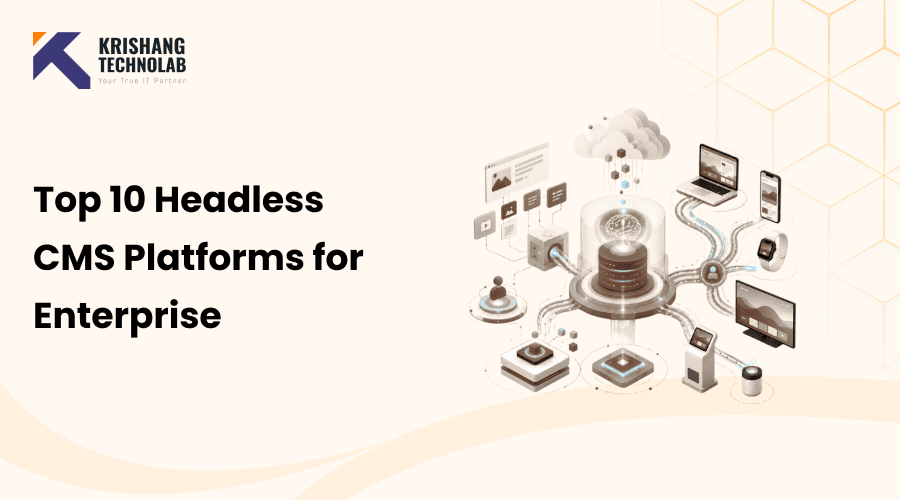
A headless CMS is a content platform in the cloud that splits the back-end content repository from the front-end presentation layer. Instead of tying your content to a specific website or template, it delivers structured content via API (REST or GraphQL) to any front-end: websites, mobile apps, digital signage, AI assistants, IoT devices, and more.
The “head” – the visual presentation is split. Your content is published once and everywhere.
Why enterprises are switching now:
- Legacy monolithic CMS solutions can’t keep up with multi-channel content needs
- AI workflows need structured, API-accessible content at scale
- Global teams require real time collaboration, no version conflicts
- Core Web Vitals and page speed have a direct influence on search rankings and revenue
Examples include traditional web-first CMSs such as Drupal and WordPress. The enterprise landscape of 2026 is web, mobile, voice, AI chat interfaces and channels yet to be invented. Headless architecture is the infrastructure answer to that reality.
Why Headless CMS Is Now Critical Enterprise Infrastructure
The change is not gradual anymore; it is obligatory. There are three drivers of enterprise adoption:
1. AI Content Workflows
Enterprises need CMS platforms with AI agents capable of bulk content generation, automated tagging, translation, and migration. A CMS that can’t integrate with AI pipelines is already behind. This is where partnering with an experienced AI development team can meaningfully accelerate your content automation roadmap.
2. Multi-Channel Delivery at Speed
A website just isn’t enough. Enterprise brands are serving content to mobile apps, AI assistants, connected devices, and personalized experiences in milliseconds. This feat is only operationally possible using an API-first architecture.
3. Composable Architecture
The era of monolithic CMS is over. Enterprise teams are adopting composable stacks of best-of-breed tools sewn together via APIs, and the CMS is a foundational piece of that architecture. A headless CMS works. A traditional CMS doesn’t.
What to Look for in an Enterprise Headless CMS
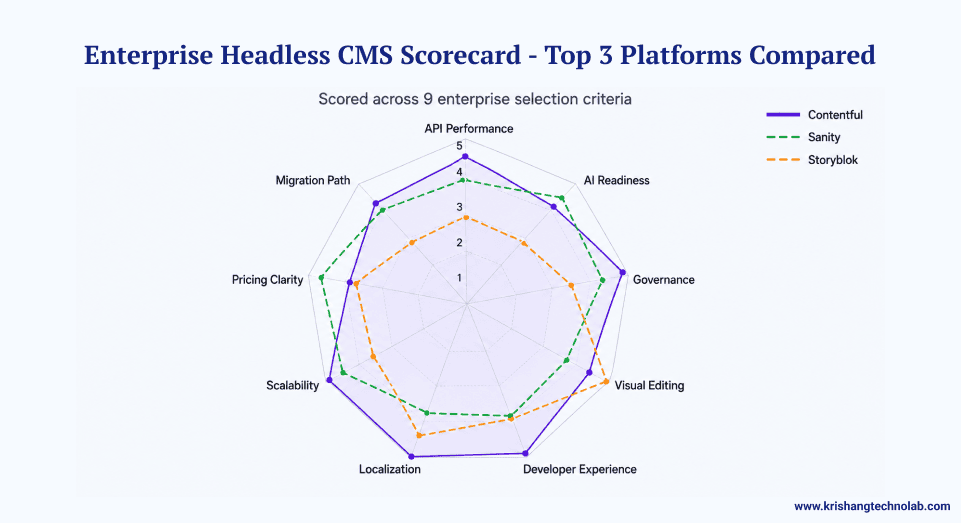
Before diving into the platforms, here are the criteria that actually matter at enterprise scale:
- API Performance: Sub-100ms response times, global CDN delivery, REST and GraphQL support
- Content Modeling Flexibility: Structured, reusable content types that scale across brands and regions
- Governance & Compliance: Role-based access control, audit logs, approval workflows, SOC 2 / GDPR readiness
- AI Readiness: Native AI tools for content creation, tagging, translation and workflow automation. If your organization is still trying to figure out where to start, AI consulting can help you chart a realistic integration roadmap before you choose a platform.
- Localization: Multi-language, multi-region content management without duplication
- Developer Experience: TypeScript SDKs, well-documented APIs, CI/CD integration
- Scalability: Handle millions of content entries, thousands of concurrent editors, global delivery
- Pricing Transparency: Predictable costs that scale without penalty at enterprise volume
- Migration Path: Data portability, standard export formats, migration tooling
Top 10 Headless CMS Platforms for Enterprise in 2026
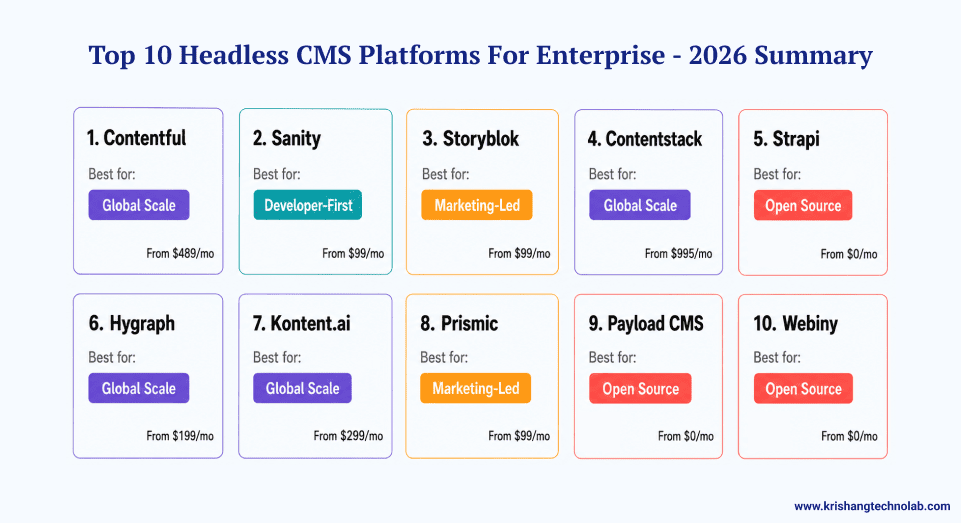
1. Contentful — Best Overall Enterprise Headless CMS
Best for: Global enterprises that manage multi-brand, multi-region content operations at massive scale.
Contentful is the enterprise headless CMS industry standard. When content operations span dozens of markets, hundreds of editors, and millions of content entries, it’s the platform Fortune 500s rely on. Contentful has transitioned from an “API-first CMS” to a full Digital Experience Platform (DXP) in 2026 with the addition of Contentful Studio for visual editing in headless environments.
Key strengths:
- Comprehensive documentation and client libraries in all major languages for mature REST and GraphQL APIs
- Enterprise localization with hundreds of languages and locale-specific workflows
- Federation features that flow structured data from external systems to a common content layer
- A huge marketplace of integrations across eCommerce, analytics, AI and personalization tools.
- Rock solid reliability Contentful manages content at a scale few platforms can match
Pricing: Starter free tier available. Team plans from ~$300/month. Enterprise pricing is custom.
2. Sanity — Best for Real-Time Collaboration & AI Workflows
Best for: Fully customisable content studio, controlled AI, real-time collaborative editing for enterprise teams.
The community is super engaged and Sanity is still topping the G2 headless CMS charts in 2026. With Studio v4, the platform has evolved into what Sanity calls a “Content Operating System,” managing creation, governance, distribution, and optimization end-to-end.
What separates Sanity from competitors is its approach to the editing environment. Sanity Studio is an open-source, fully customizable React application. Your content team gets a purpose-built interface rather than a generic CMS dashboard. Teams that also want to extend content workflows with conversational interfaces will find value in ChatGPT integration alongside Sanity’s governed AI features.
Key strengths:
- Zero-downtime workflows for real-time collaborative editing like Google Docs but for structured content
- The GROQ query language provides developers with precise, flexible content queries beyond what GraphQL offers out of the box.
- Live Content API updates the content in real time without refreshing the page. So you can have real-time personalization.
- Governed AI capabilities empower teams to harness AI to create content within guardrails.
- Sanity’s pricing is transparent and not usage-trap heavy, leading to predictable TCO.
Pricing: Free tier available. Growth plan from $99/month. Enterprise pricing custom.
3. Storyblok — Best Visual Editing Experience for Enterprise Teams
Best for: Marketing-driven businesses that need non-technical content editors to see precisely what they’re building without any developer involvement.
The USP of Storyblok is the Visual Editor, a live preview of content updates in the context of the actual page layout as it’s being edited. No more “publish and pray.” This is a game-changer for enterprise marketing teams running high-velocity campaign content.
The platform is steadily eating Contentful’s lunch in the mid-enterprise level because it solves the core friction point: the gap between technical headless architecture and the editorial experience marketers expect.
Key strengths:
- Live visual editor with real-time page preview best editing experience in headless CMS space
- Content architecture, such as a block library, easily assembled by non-developers with components
- Strong localization and multi-site management for global brand portfolios
- Enterprise feature set with SSO, advanced permissions and audit logs.
- Fast development speed Storyblok releases features faster than most competitors
Pricing: Free tier available. Business plan from $90/month. Enterprise pricing custom.
4. Contentstack — Best Composable Content Platform for Large Enterprises
Best for: Large enterprises on the path to composable architecture needing a CMS to be the central nervous system of a best-of-breed technology stack.
Contentstack coined the term “composable DXP” and built its entire product philosophy around it. The platform is explicitly designed to integrate with, not replace, the rest of your enterprise technology stack: your CDP, your personalization engine, your eCommerce platform, and your DAM. Enterprises undergoing digital transformation at this scale often benefit from software development outsourcing to supplement internal teams during the integration phase.
Key strengths:
- Composability that leads the market – prebuilt integrations with Salesforce, SAP, Shopify, and many others
- Workflow automation and approvals for the most complex editorial processes
- Compliance: SOC 2 Type II, ISO 27001 certifications, and HIPAA-compliant setups
- Customer success & implementation services for enterprise-level clients
- Automation Hub to create workflows for your content without code
Pricing: Enterprise-only pricing; typically starts at $995/month. Custom contracts for large deployments.
5. Strapi — Best Open-Source Headless CMS for Full Code Control
Best for: Enterprise teams with strong backend engineering capacity, wanting full control of the infrastructure, customization at the code level, and no vendor lock-in.
Strapi is the world’s most popular open source headless CMS. It’s self-hosted, fully customizable, and supported by a huge developer community. For companies with some compliance needs (data sovereignty, on-premises deployment, air gapped environments), Strapi is most often the only way to go.
Version 5, released in 2024, brought a rebuilt plugin API, improved TypeScript support, and a cleaner content modeling interface, closing many of the gaps between Strapi and commercial alternatives. Organizations that want to hire full-stack developers for Strapi implementations will find the talent pool wide and well-versed in the framework.
Key strengths:
- Full code-level control over every aspect of the CMS
- Self-hosted by default deploy on your own infrastructure, any cloud or on-premises
- No per-seat pricing or usage limits pricing scales with your infrastructure, not Strapi’s pricing plans
- Large active open source community with thousands of plugins
- Strapi Cloud now available as a managed hosting option for teams wanting SaaS convenience without sacrificing open-source
Pricing: Open-source (free, self-hosted). Strapi Cloud from $29/month. Enterprise support contracts custom.
6. Hygraph — Best for Content Federation & GraphQL-First Teams
Best for: Enterprises that need to unify content from different sources (CMS, PIM, ERP, custom APIs) into a single, queryable GraphQL layer.
Hygraph’s standout capability is content federation: the ability to pull structured data from external systems and expose it through a single GraphQL endpoint, alongside your own CMS content. Instead of building custom middleware, Hygraph becomes the unified content mesh. If your team needs specialised engineers for this architecture, working with a provider to hire MERN-Stack developersis a practical path to building the GraphQL expertise the platform demands.
If your enterprise content strategy requires you to aggregate product data from a PIM, customer data from a CRM, and editorial content from the CMS into a single API layer, Hygraph is architected for this.
Key strengths:
- Native content federation: query external APIs using Hygraph’s built-in GraphQL API
- A flexible content modeling framework based on GraphQL types, with a schema-first design.
- Field-level permissions permission model
- Asset management with transform API for images and other media.
- Typescript SDK with full documentation
Pricing: Community free tier. Professional from $299/month. Enterprise pricing custom.
7. Kontent.ai — Best for Governance, Compliance & Workflow Automation
Best for: Enterprise teams in regulated industries (finance, healthcare, legal) that require strict governance, compliance certification and editorial workflow controls.
Kontent.ai (formerly Kentico Kontent) has carved out its own niche in the headless CMS world: enterprise-grade governance. Compliance and workflow automation are first-class features of the platform, not add-ons.
For companies managing content across multiple brands, regions, and regulatory environments Kontent.ai gives editorial operations teams the control infrastructure they need: approval chains, content staging environments, role hierarchies and content audit capabilities.
Key strengths:
- Robust workflow engine, multi-level approvals and configurable workflow states
- SOC 2 Type II and ISO 27001 certified and natively GDPR compliant for a compliance-first approach
- Content Collections Manage multi-brand and multi-space content from one place
- Limits on AI-generated content in governance
- Motorpoint Case Study Article views +600% Top-3 Google search ranking +400%
Pricing: Developer free tier. Business from $1,690/month. Enterprise custom.
8. Prismic — Best for SEO, GEO & AI Search Visibility
Best for: Marketing teams looking to scale organic search, AI search visibility, and scalable content publishing without developer bottlenecks.
Prismic is the headless CMS most deliberately engineered for search performance, both traditional SEO and the emerging practice of Generative Engine Optimization (GEO): optimizing for AI platforms like ChatGPT, Perplexity, Claude, and Google AI Overviews. Enterprises serious about GEO often pair Prismic with a focused generative AI development engagement to build proprietary content pipelines that compound their search advantage.
Its Slice-based architecture means that developers can build reusable page components once, and then marketing teams can assemble and publish pages on their own. Throw in its SEO Landing Page Builder, which can spit out hundreds of optimized pages from a keyword CSV, and Prismic is capable of content marketing at a scale traditional CMS workflows just can’t compete with.
Key strengths:
- Architecture of Slice Machine: reusable parts that can be combined freely by non-programmers
- Built-in SEO Landing Page Builder to scale pages on a keyword basis
- GEO tracking: Prismic observes its clients’ brand mentions within popular LLMs
- Compatibility with Next.js to achieve best possible Core Web Vitals
- Excellent editorial control – marketing teams able to deploy landing pages independently
Pricing: Free tier available. Small team plans from $100/month. Enterprise pricing custom.
9. Payload CMS — Best Developer-First Open-Source CMS
Best for: Engineering-led enterprise teams who want an open-source, TypeScript-native CMS with maximum flexibility and no legacy technical debt.
Payload CMS is the newest platform on this list, and arguably the most technically ambitious. Payload is a generational leap over older open-source alternatives, built from the ground up in TypeScript, with a React-based admin panel and a code-first configuration model.
For teams scaling this approach, the ability to hire MEAN stack developers with strong Node.js and TypeScript backgrounds directly accelerates Payload implementations, since the platform’s configuration model is pure code.
Key strengths:
- Code-first, TypeScript-based schemas your content models are under version control
- Built-in Next.js support since v3 deploy the CMS and frontend as one app
- In-process API for low-latency content searches using local APIs
- Highly extensible admin interface allowing customization via components and plugins
- Designed to be self-hosted with the option of Payload Cloud deployments
Pricing: Open-source (free, self-hosted). Payload Cloud from $20/month. Enterprise plans custom.
10. Webiny — Best Serverless Headless CMS for AWS Enterprises
Best for: Enterprises committed to AWS infrastructure who want a self-hosted, serverless-native CMS with enterprise security controls and no per-request pricing.
Webiny is the only headless CMS in this list built specifically for serverless architecture. It deploys directly to your AWS account using Lambda, DynamoDB, and S3, meaning your content infrastructure runs inside your own security perimeter, with no data leaving your cloud environment. Teams setting up a dedicated delivery center for this kind of infrastructure find that a well-structured offshore development center model works particularly well for Webiny’s ongoing AWS operations and maintenance.
Key strengths:
- Runs entirely on your AWS account – you have total data sovereignty
- No server management, serverless approach, automatic scaling to traffic
- Multi-tenant with environment separation to support multiple brands or business units
- Enterprise grade security controls (integration with VPC, AWS IAM, etc.)
- Page Builder, Form Builder, File Manager, Headless CMS
Pricing: Open-source (free, self-hosted on AWS). Enterprise plan from $833/month.
Head-to-Head Comparison: Top 10 Enterprise Headless CMS Platforms (2026)
| Platform | Best For | API | Visual Editor | AI Features | Open Source | Starting Price |
| Contentful | Global enterprise scale | REST + GraphQL | ✓ (Studio) | ✓ | ✗ | Custom |
| Sanity | Real-time collaboration | REST + GROQ | ✓ | ✓ (Governed) | Studio only | $99/mo |
| Storyblok | Marketing-led editorial | REST + GraphQL | ✓ (Best-in-class) | ✓ | ✗ | $90/mo |
| Contentstack | Composable DXP | REST + GraphQL | ✓ | ✓ | ✗ | ~$995/mo |
| Strapi | Full code control | REST + GraphQL | ✗ | Plugin-based | ✓ | Free |
| Hygraph | Content federation | GraphQL-native | ✗ | ✓ | ✗ | $299/mo |
| Kontent.ai | Governance & compliance | REST + GraphQL | ✗ | ✓ | ✗ | $1,690/mo |
| Prismic | SEO & GEO visibility | REST + GraphQL | ✓ (Slices) | ✓ | ✗ | $100/mo |
| Payload CMS | TypeScript-native dev | REST + GraphQL | ✓ | Plugin-based | ✓ | Free |
| Webiny | AWS data sovereignty | REST + GraphQL | ✓ | ✓ | ✓ | $833/mo |
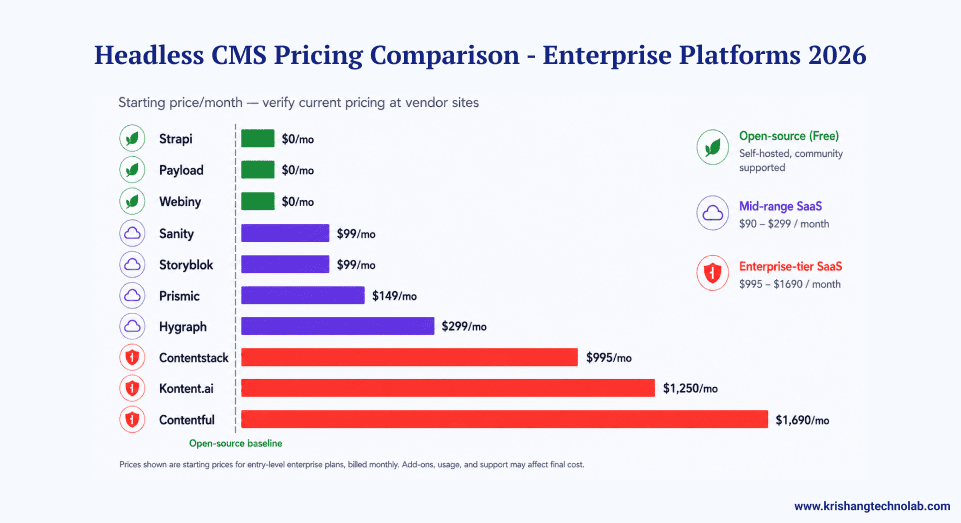
Headless CMS Pricing Breakdown for Enterprise in 2026
The true cost of ownership goes well beyond the headline price. Look at it this way:
SaaS Commercial Platforms (Contentful, Sanity, Storyblok, Contentstack, Hygraph, Kontent.ai, Prismic) Pricing typically scales in three dimensions: seats/users, API calls/bandwidth, and content records/environments. Watch for steep overages at scale, a platform that seems affordable at 10,000 monthly API calls might become expensive at 10 million.
Open Source Platforms (Payload, Strapi, Webiny) There is no licensing fee, but the costs of infrastructure, hosting, security and maintenance are real. Enterprise scale managed hosting, budget $500-$2000/month Plus engineering time for upgrades and custom development. That’s why so many enterprises turn to IT staff augmentation adding platform-specific engineers to their core team rather than adding permanent headcount.
True TCO Factors to Model:
- Implementation and migration costs (typically 3–6x first-year license cost)
- Ongoing developer maintenance hours
- CDN and API delivery costs
- Support contract costs
- Training and onboarding overhead
Source: marketresearchfuture
Headless CMS vs Traditional CMS vs DXP: Which Is Right for Your Enterprise?
Traditional CMS (WordPress, Drupal)
Content and presentation are tightly coupled. Fast to get started but architecturally limited for multi-channel delivery. Still applies to organizations publishing to a single website without complex integrations. Scaling something to enterprise level takes a lot of engineering work.
Headless CMS
Content is de-coupled and is delivered through API. Maximum flexibility for multi-channel publishing Modern Frontend Frameworks and AI Integration. Need investment in front end engineering. The right choice for enterprises with varied content delivery requirements.
Digital Experience Platform (DXP)
A Headless CMS with personalization, analytics, A/B testing and campaign orchestration all in one platform. It’s more expensive and complex, but it provides integrated experiences without custom middleware. This space includes Contentful and Contentstack.
The 2026 verdict:
For most enterprises with meaningful digital presence, headless is no longer experimental; it’s the default. The question is SaaS vs. open-source, and commercial DXP vs. best-of-breed composable stack. If you’re evaluating this decision for the first time, understanding what custom software development actually entails first will help you frame the right questions during CMS procurement.
Key Headless CMS Trends Shaping Enterprise Decisions in 2026
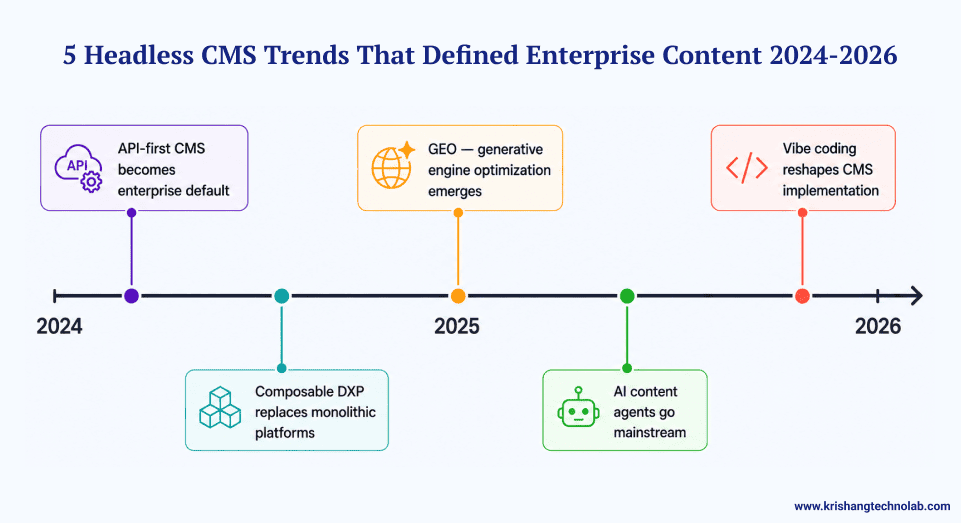
AI-Native Content Workflows
The leading platforms have moved beyond “add AI button” to genuinely agentic content operations: auto-tagging, bulk migration, autonomous content drafting, and governed AI that keeps brand voice consistent at scale. Enterprises investing in this space often engage machine learning development teams to build proprietary models that sit on top of their headless CMS infrastructure.
GEO — Generative Engine Optimization
AI search visibility is the new frontier. Today companies optimize content for Google, but also for ChatGPT, Perplexity, Claude and Google AI Overviews. Headless CMSs with clean structured data, schema markup support, server-rendered HTML are more ready for AI citation patterns.
Composable Content Architecture
Composable stacks, where the CMS is one of the modules, along with a CDP, personalization engine and DAM, replace monolithic CMS. Corporate procurement decisions go to platforms that work well together.
Multi-Agent Orchestration
Multi-agent system inquiries increased by 1,445% from 2024 to 2025, according to industry data. Companies are building content pipelines, with AI agents that automatically enrich, translate and distribute content.To know where your organization stands in AI maturity today, you need to work with data science consulting partners who can turn raw content data into actionable intelligence.
Visual Editing for Headless
Increasingly, the teams implementing and customizing headless CMS platforms are using AI-first development workflows. Knowing how to hire developers who understand vibe coding is becoming a competitive advantage for enterprises standing up complex CMS integrations faster than their peers.
How to Choose the Best Headless CMS for Your Enterprise (Decision Framework)
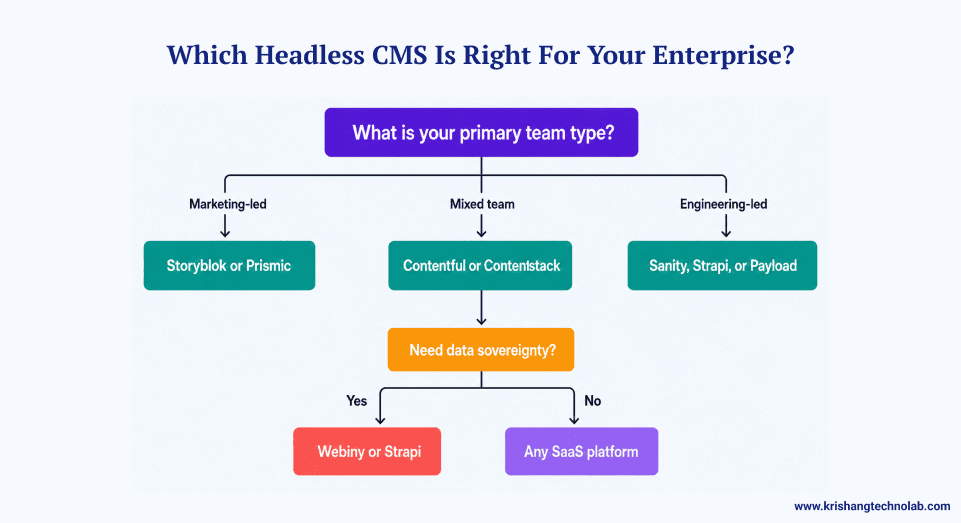
Use this framework to narrow your selection:
Step 1: Define Your Primary Content Challenge
- Multi-channel publishing at global scale → Contentful, Contentstack
- Real-time collaboration and editorial velocity → Sanity, Storyblok
- SEO and AI search visibility → Prismic, Sanity
- Data sovereignty and compliance → Webiny, Strapi, Kontent.ai
- Full code control → Strapi, Payload CMS
- Content federation across systems → Hygraph
Step 2: Assess Your Team Composition
- Marketing-heavy team that needs editorial independence → Storyblok, Prismic
- Engineering-heavy team comfortable with code → Payload, Strapi, Sanity
- Mixed team needing both → Contentful, Storyblok, Contentstack
If your engineering team is thin, it’s worth exploring options to hire remote developers with CMS-specific experience rather than stretching existing capacity across an unfamiliar platform.
Step 3: Evaluate Budget Constraints
- Open-source preferred → Strapi, Payload, Webiny
- Mid-market enterprise budget → Sanity, Storyblok, Prismic, Hygraph
- Enterprise-no-limits budget → Contentful, Contentstack, Kontent.ai
For teams weighing the build-vs-buy question, it helps to first understand what’s realistic. See why 68% of startups choose to hire a dedicated development team. The same logic applies to enterprises evaluating whether to staff a headless CMS implementation internally or engage external specialists.
Step 4: Run a Proof of Concept
Every platform on this list offers a free tier or trial. Test your most complex content model, your core API integration, and your editorial workflow before signing an enterprise contract. Consider working with a global capability center model if you need a dedicated team to run POCs across multiple platforms in parallel.
Final Verdict — The Best Enterprise Headless CMS for Your Use Case
There is no ‘best’ headless CMS, but there is a best one for your context. Here’s the summary verdict:
- Overall enterprise platform: Contentful
- Developer experience + AI workflows: Sanity
- Marketing editorial teams: Storyblok
- Composable DXP: Contentstack
- Open-source + code control: Strapi
- Content federation: Hygraph
- Regulated industries: Kontent.ai
- SEO/GEO visibility: Prismic
- TypeScript-native open-source: Payload CMS
- AWS data sovereignty: Webiny
Going headless is a 3-5 year infrastructure commitment. Spend time running a proof of concept against your real content model, and involve both engineering and editorial stakeholders in evaluation and the true cost of ownership of the model beyond the headline license price.
Whether you’re staffing this internally, working through an offshore development centre, or choosing Shopify’s headless commerce solution as your eCommerce entry point into headless architecture, the platforms in this guide represent the best the market has to offer in 2026. The question is which one serves your team best.
Found this post helpful? Don't forget to share it with your network!