Quick Overview: Explore the machine learning lifecycle, from data preparation and model training to deployment and monitoring. Learn how AI development companies, machine learning consulting services, and enterprise software development agencies build reliable, scalable AI solutions.
Many machine learning projects fail for simple reasons. In most cases, teams rush the data work, skip proper testing, or ignore the model after launch. A clear machine learning lifecycle prevents these problems. As a result, every stage connects to the next one.
This guide will take you through each step of gathering and preparing your data to deploying your model. First, you will learn the basics. Then, you will explore seven practical stages, plus the tools and habits behind them. Along the way, you will see how the life cycle machine learning teams follow turns ideas into products.
Each phase of the machine learning lifecycle has its own goals, risks, and best practices. For instance, even the smartest model can be destroyed by bad data quality. Likewise, a great model fails if nobody monitors it. Understanding the full journey saves time, money, and effort.
Whether you build in-house or hire a machine learning company, the same steps apply. Additionally, you will find advice on MLOps, common risks, and future trends. Each section stays short, practical, and easy to scan. So it’s accessible to business leaders, product managers, and technical teams.
What Is the Machine Learning Lifecycle?
The machine learning lifecycle is the full process of building, launching, and maintaining a machine learning model. Starts with a business problem. Ends with a system that is tracked and improving. Fundamentally, the life cycle of machine learning includes data, training, testing, deployment and maintenance.
Why the ML Lifecycle Matters for Businesses
Budgets protected. Speed to delivery. Structured approach. Each step has a clear purpose to avoid expensive re-work by the team. Strong machine learning lifecycle management also gives leaders clear checkpoints and measurable results.
ML model lifecycle management builds trust, too. Buyers and auditors expect evidence that a model treats people fairly. As a result, written records and logged data make those reviews far simpler.
ML Lifecycle vs Traditional Software Lifecycle
Traditional software follows fixed rules written by developers. In contrast, a model learns its rules from data. Therefore, the machine learning development life cycle includes data work and constant retraining that standard projects never need.
Testing also differs. Software tests test for exact outputs. Model tests test for accuracy and fairness. Meanwhile, software bugs stay fixed, but model quality can fade as real-world data changes.
Key Stages of the Machine Learning Lifecycle
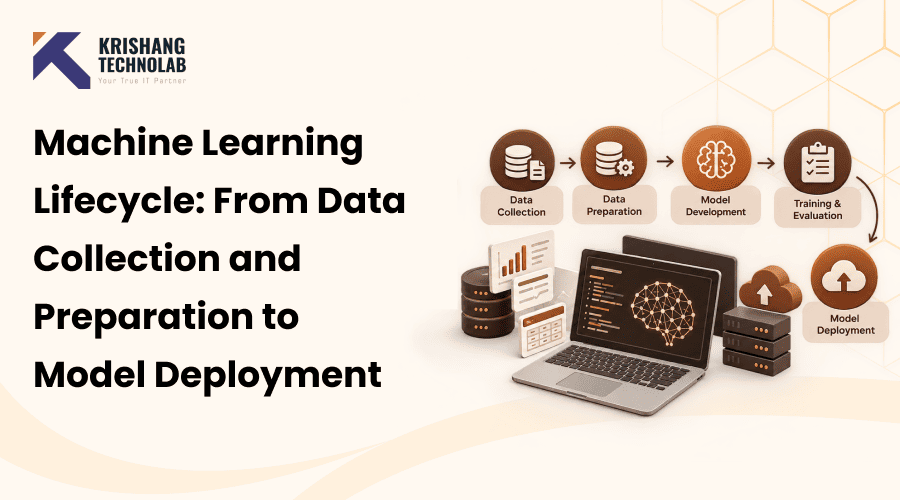
The lifecycle has seven connected stages. Each stage produces an output that feeds the next one. Below is a quick overview, and the sections that follow explain every stage in plain language with practical examples.
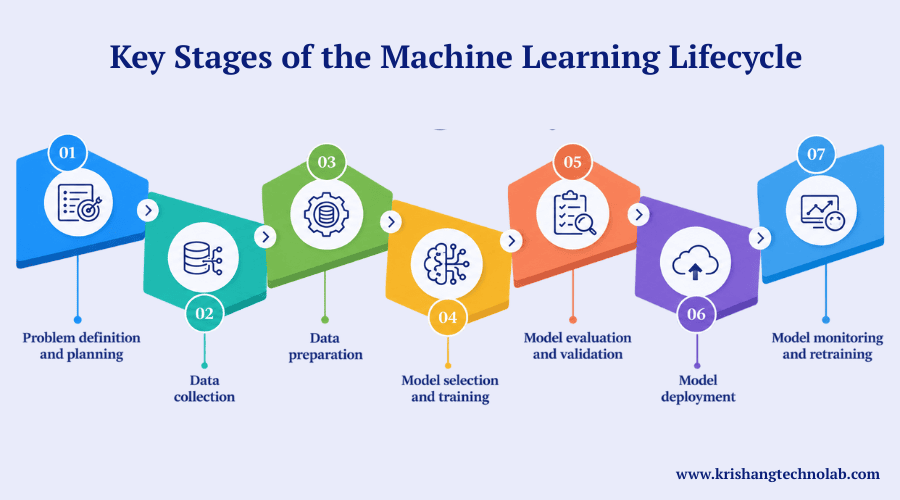
- Problem definition and planning
- Data collection
- Data preparation
- Model selection and training
- Model evaluation and validation
- Model deployment
- Model monitoring and retraining
Seen this way, the machine learning lifecycle works like a relay race. Each stage hands a clean baton to the next, so the following runner starts strong. Likewise, the broader AI development lifecycle follows the same relay logic.
A machine learning life cycle diagram shows these seven stages as a loop. The arrow from monitoring back to data collection matters most. In practice, this loop keeps the ML life cycle alive after launch.
Stage 1: Problem Definition and Planning
Strong projects begin by naming the problem to solve. Clear goals keep the machine learning development life cycle focused from day one. This helps teams build reliable solutions that align with business needs.
Setting Business Goals and Success Metrics
State the purpose in plain business language. Then select success metrics like less churn or faster approvals. Then work with all parties to come up with a target figure that all agree on so everyone is judging the results the same.
Checking Feasibility and Data Readiness
Secondly, test whether the project is feasible. Ask if you have enough data, if the law allows you to use it, and if you have the skills.If skills are lacking, machine learning consulting services can also review feasibility early.
Also, a trusted professional AI development company can predict the cost and effort before you take the plunge.
Stage 2: Data Collection
Data fuels every model. During the life cycle of ML models, data quality shapes nearly every later result. So, teams plan collection carefully before writing any training code. Well-organized data also helps teams build more reliable and effective models.
Common Data Sources for Machine Learning
Data can come from many places, and each source has trade-offs in cost, quality, and privacy. Below, you will find the sources teams use most. Most projects combine several sources to build a balanced and useful training set.
- Internal databases and business apps
- Sensors, devices, and application logs
- Public datasets and open APIs
- Purchased third-party data
- Synthetic data for rare events
Data Collection Methods
Teams pull data from exports, APIs, surveys, web scraping, and live event streams. In addition, AI software development companies can build reliable collection pipelines faster. Similarly, a machine learning agency can audit your sources before training begins.
Data Collection Challenges
Collection brings real hurdles. Data often sits in separate systems, arrives in different formats, or lacks proper labels.To reduce risk, document every source and its owner. Then, check for bias early, because a skewed sample creates a skewed model. Many machine learning development services also automate these checks.
Stage 3: Data Preparation
Raw data often contains missing values, duplicates, errors, and inconsistent formats. Data preparation cleans, transforms, labels, and organizes information so models can learn accurate patterns and produce reliable results.
Data Cleaning and Preprocessing
Cleaning fixes missing values, duplicates, and obvious errors. Next, preprocessing scales numbers, encodes categories, and formats text for the model. Also, automated checks catch problems before they reach training.
For that reason, many businesses hire experienced AI developers or buy machine learning development services for pipeline work. A skilled machine learning company also documents every cleaning rule.
Data Labeling and Annotation
Supervised models need labeled examples. For example a spam filter needs e-mails to be marked as spam or safe. And, clear labelling rules make different annotators consistent. Accurate labels help models learn meaningful patterns from the training data.
Feature Engineering
Features are the signals a model learns from. For example, days since last purchase can predict churn better than a raw date. Thus, good features often beat fancier algorithms. Well-designed features can improve model accuracy and make predictions more useful.
Data Splitting and Versioning
Before you start modelling, divide your data into training, validation, and test sets. Additionally, version every dataset so you can reproduce any result later. This approach helps teams compare models consistently and maintain reliable experiments.
Stage 4: Model Selection and Training
Now the lifecycle machine learning teams follow reaches its creative core. Here, teams pick an approach, train it, and compare results. This stage helps teams refine models and select solutions that deliver reliable results for real-world applications.
Choosing the Right Algorithm
Start simple. A basic regression or decision tree often sets a useful baseline. Business needs matter too. A regulated bank for example, might value explainability over a marginal improvement in accuracy. If standard models can’t handle odd data and goals, custom machine learning solutions are better suited.
Training and Hyperparameter Tuning
During the training process, the model learns the patterns of the training set. Hyper-parameter tuning refers to tuning hyper-parameters such as learning rate, tree depth etc. Experiment tracking records each run, so that teams can compare results fairly.
Large models need strong computing power. Therefore, a skilled machine learning development company often plans cloud usage and AI development cost early.
Stage 5: Model Evaluation and Validation
Evaluation proves whether the model solves the original problem. Therefore, every candidate model faces tests on data it has never seen. These results help teams identify weaknesses and confirm whether the model performs reliably.
Key Evaluation Metrics
Different problems need different yardsticks. The list below shows common metrics for classification and prediction tasks. Choose the few that match your goal, because tracking too many numbers can hide the real signal that matters.
- Accuracy, precision, and recall for classification
- F1 score and AUC for balanced comparisons
- RMSE and MAE for numeric predictions
- Business metrics such as revenue or cost savings
Testing for Bias and Robustness
Then think about how fair it is for differences in age or location. Put the model to the test with strange or noisy data. It is a standard procedure for many machine learning development services to perform these checks.
In addition, run A/B tests when possible. Real users reveal problems that lab tests miss. Likewise, an independent machine learning development company or data science consulting services can audit results objectively.
Stage 6: Model Deployment
Deployment moves the model from a notebook into real systems. However, this step trips up many teams. Strong machine learning lifecycle implementation plans for release from the first week, not the last. That habit keeps the ML life cycle moving after the first launch.
Cloud, Edge and On-Premise Deployment
Cloud hosting scales easily and suits most web products. Edge deployment runs models on devices, which cuts delay and protects privacy. The right deployment option depends on performance, security, scalability, and business requirements.
Batch vs Real-Time Inference
Batch inference scores many records on a schedule, say nightly sales forecasts. Real time inference is immediate like a fraud check at the time of making a payment. Thus, match the method with how fast the business needs answers.
CI/CD and Deployment Best Practices
Automated CI/CD pipelines safely test and release each version of the model. This way if something breaks teams can roll back quickly. Containers help to keep the environment consistent. This way the model behaves the same in production and testing.
A skilled machine learning development agency can develop this pipeline. Machine Learning Development Services Make Routine Releases.
Stage 7: Model Monitoring and Retraining
Launch is not the finish line. Data and customer behaviour are always changing, so models slowly lose accuracy. Therefore, the life cycle of ML keeps running long after release. Continuous monitoring helps teams detect issues and maintain reliable model performance.
Data Drift and Concept Drift
Data drift happens when incoming data changes, such as new customer age groups. Concept drift is when the relationship between the inputs and outputs changes, for example, changes in buying behaviour.
Dashboards and alerts catch drift, early. For example, every day track prediction trends, error rates and input quality. A machine learning agency can also set thresholds that trigger a review.
When to Retrain a Model
Retrain on a schedule, after a clear performance drop, or when major data changes arrive. Next, validate the new version before it replaces the old one.
This loop connects back to the start. Any machine learning life cycle diagram shows an arrow from monitoring to data collection for this reason. Within the MLOps lifecycle, automation makes that loop fast and repeatable.
Common Machine Learning Lifecycle Challenges and Fixes
Every machine learning lifecycle has weak spots. Poor data, unclear goals, and missing monitoring cause most delays. Luckily, each of these has a solution. The five points below explain the biggest challenges and show simple, proven ways to solve them.
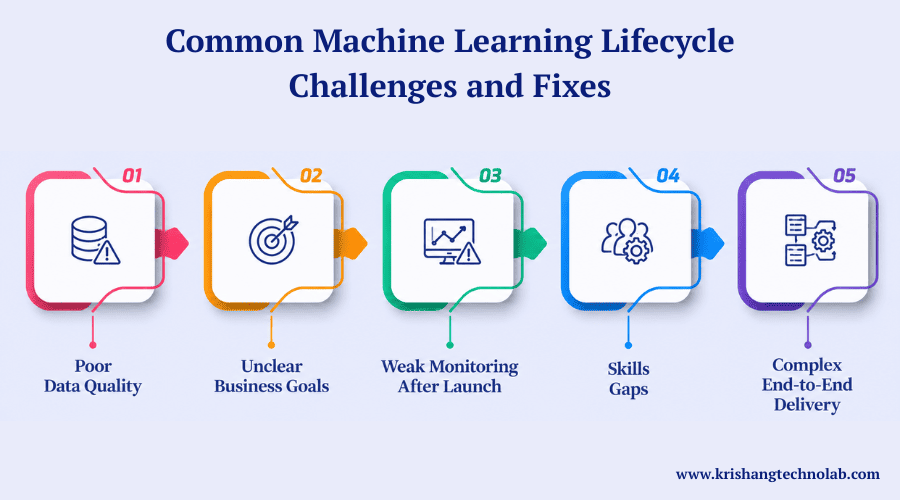
1. Poor Data Quality
Bad inputs always give bad outputs. So audit your data early and look for gaps, duplicates and hidden bias. And likewise, keep a shared log of every step of the ML model lifecycle. Each change is therefore visible and easy to trace.
2. Unclear Business Goals
Vague goals waste time and budget. First, write one measurable target and share it with every stakeholder. You’ll need to set a baseline to measure progress fairly. This way, the team only builds what the business really needs.
3. Weak Monitoring After Launch
Live data keeps shifting, so model accuracy slowly fades. So, create dashboards and alerts for drift, errors and input quality. Then do periodic reviews and scheduled retraining. This way, small problems seldom explode into costly failures or angry customers.
4. Skills Gaps
Skills gaps also slow progress. In that case, you can hire machine learning developers for focused tasks. Alternatively, machine learning consulting services can shape strategy. A machine learning consulting firm also brings tested templates, fresh eyes, and much faster decisions.
5. Complex End-to-End Delivery
Managing every stage at once overwhelms many teams. For end-to-end needs, a machine learning development company can own the full build. Meanwhile, machine learning lifecycle consulting specifies roles, tools, and the AI development timeline before any work begins. Thus, delivery stays clear and steady.
Machine Learning Lifecycle Tools and Technologies
Good tools eliminate the manual work for every stage. For example Pandas and SQL do data prep, and scikit-learn, TensorFlow and PyTorch do training.
Docker and Kubernetes package and scale models for deployment. Many steps are combined in cloud platforms like AWS SageMaker and Google Vertex AI.
Tools will be dictated by team size, budget and skills. Hence, a lot of firms outsource machine learning services to specialists to choose the right stack. Some also buy machine learning lifecycle services covering tooling, training, and governance.
A reliable machine learning company compares options without vendor bias. Similarly, a machine learning solutions company can integrate AI into existing software smoothly. The machine learning services together reduce the setup time.
The Role of MLOps in the Machine Learning Lifecycle
MLOps applies DevOps habits to machine learning. Automates testing, deployment and monitoring, getting models to users faster. MLOps connects data teams, engineers and operations in the machine learning lifecycle.
The MLOps lifecycle adds practices such as data versioning, automated pipelines, and drift alerts. As a result, teams ship updates weekly instead of quarterly. Also, the MLOps lifecycle gives auditors a clear trail of every change.
Smaller companies often lack MLOps skills in-house. In that case, MLOps services provide ready-made pipelines and monitoring. An experienced MLOps agency can also train your staff to run them.
A professional software development agency can integrate model building and operations into one plan for delivery at scale. The other option is to hire a machine learning consulting company to analyse your current setup and make recommendations.
Future of the Machine Learning Lifecycle
The lifecycle keeps evolving. AutoML tools now automate feature selection and tuning. Meanwhile, generative AI adds new stages, such as prompt design and output review.
Responsible AI will also carry weight. What regulators are demanding is more and more documented data sources, bias checks and oversight by humans. Consequently, governance will move from an afterthought to a core stage.
Because change is constant, many firms work with an AI and machine learning agency for ongoing advice. In addition, they hire machine learning developers for projects and use machine learning development services for pilots. Either way, a good AI and machine learning agency keeps strategy current.
Conclusion
A strong machine learning lifecycle turns scattered experiments into dependable business results. Each stage, from planning to monitoring, adds value and lowers risk. Moreover, the loop never stops, because data and goals keep changing.
Success rarely depends on one tool. Instead, it comes from clear ownership, steady habits and honest measurement. Teams that document decisions learn faster Teams that review results get better faster.
Remember the key lessons. Have clear goals and time for collecting and preparing data. And test the models properly before deployment. Finally monitor and retrain continuously.
Together, these habits define the life cycle of machine learning done right. Each cycle also teaches your team something new. Therefore, treat every launch as a starting point, not a finish.
If your team needs expert hands, choosing the right AI development company matters. A proven brings experience across every stage. In addition, a long-term machine learning development partner keeps your models accurate as the business grows. Likewise, an established machine learning company can document each decision and train your staff.
Now apply the machine learning lifecycle one stage at a time. Start small, track results, and improve in each iteration. Expect rough edges in version one, because every team starts there.
Frequently Asked Questions About the Machine Learning Lifecycle
1. What Is the Life Cycle of Machine Learning?
Think of the life cycle of machine learning as a loop a team walks again and again. You frame a problem, gather data, train a model, ship it, then watch it. Because data shifts, each lap starts with fresh lessons.
2. What Are the Stages of the ML Life Cycle?
Expect seven stages in the ML life cycle: scoping, data collection, data preparation, training, evaluation, deployment, and monitoring. Some teams merge two steps, and others split one. Even so, every version ends by feeding what it learned back into scoping.
3. Why Is the ML Model Lifecycle Important?
A clear ML model lifecycle keeps every single task tied to a business goal. Otherwise, teams often build impressive models that nobody ever uses. With it, risks surface early, audits go faster, and monitoring protects model accuracy long after launch.
4. How Does the Machine Learning Development Life Cycle Differ From Software Development?
The machine learning development life cycle treats data as a core ingredient, not an input. Rules are written by developers and implemented in software but models learn rules from examples. Therefore, testing checks fairness and accuracy, and quality can quietly drift after release.
5. What Is the MLOps Lifecycle?
The MLOps lifecycle extends the well-established DevOps practices to standard models for machine learning. Pipelines test, release and retrain automatically, meaning users get updates much sooner. Meanwhile, versioned data and drift alerts leave a clear, searchable trail for every audit.
6. How Does Deployment Fit Into the Life Cycle of ML?
Deployment puts a tested model in front of real users and real data. In the life cycle of ML, it marks the midpoint, not the finish line. The estimates stay correct because we keep an eye on the model and retrain it as the real world changes.
7. What Is the Difference Between the ML Lifecycle and the Data Science Lifecycle?
At the core of the ML lifecycle is the construction, deployment and operation of predictive models based on machine learning. There is a lot more in the data science lifecycle, including analysis, reporting, sharing insights. But both are founded on data prep, so in daily work many teams combine them.
Found this post helpful? Don't forget to share it with your network!