Artificial intelligence or AI is advancing at a rate we have never seen before. Just a few years ago, people were learning Prompt Engineering, which is the skill of writing clear instructions to get better answers from AI tools like ChatGPT. Now, there is a new concept gaining attention: Loop Engineering.
Don’t worry if the term sounds technical. The idea is actually simple.
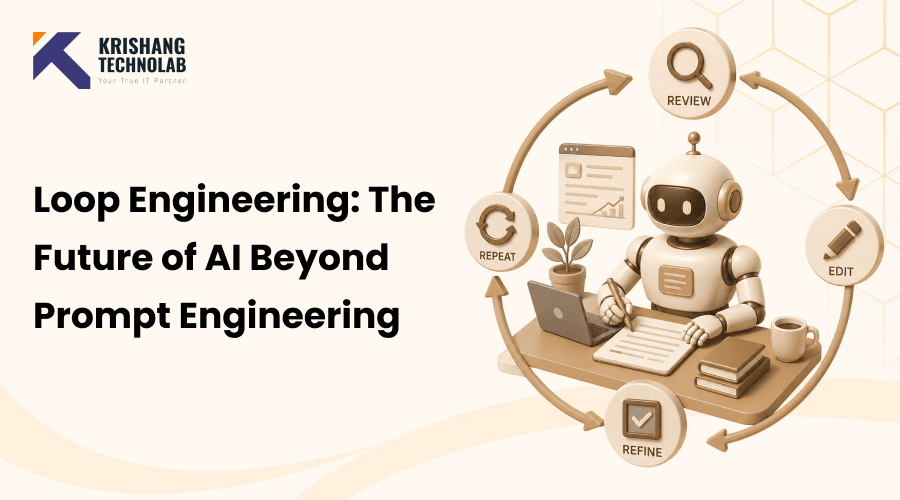
Loop Engineering doesn’t give the AI one prompt and take the first answer; it lets the AI think, check, improve, and repeat until a better result is achieved.
Now a new term has taken over the conversation: Loop Engineering. Instead of meticulously crafting a single prompt and relying on chance, loop engineering involves creating a system where the AI autonomously plans, acts, evaluates its own work, and continuously enhances it until the outcome meets the required standards for use.
The idea has caught on fastest among developers working with AI coding agents, where Loop Engineering for AI coding agents is quickly becoming the standard way to get reliable, production-ready output instead of one-off responses.
In this blog, you’ll learn what Loop Engineering is, how it works, why it’s becoming popular, and how you can start using it.
What is Loop Engineering?
Loop engineering is the art of designing and optimizing feedback loops between humans, software, AI models, and other systems that improve the result with every iteration. The term is used in a few different fields, but the common idea is to build a loop, measure the outcome, improve, and repeat.
Think of it like a person proofreading their essay. They don’t just write one draft and submit it. They write a draft, read it back, notice the introduction is weak, correct it, check the grammar, tighten a few sentences, and read it again, repeating that cycle until it’s ready to hand in. Loop engineering is that same self-editing habit, except the AI is looped instead of a person.
Instead, it follows a continuous cycle:
- Understand the goal
- Create a plan
- Complete the task
- Review the results
- Fix mistakes
- Repeat if necessary
- Deliver the final output
Think of it as asking AI to become its own reviewer before giving you the final answer.
Instead of saying:

"Here's my answer."

Loop Engineering encourages AI to say:

"Let me check this once more. I found a few improvements. Here's a better version."
That’s the main idea behind Loop Engineering.
How Is Loop Engineering Different From Prompt Engineering?
| Prompt Engineering | Loop Engineering |
| One prompt at a time | Multiple steps and improvements |
| User guides every task | AI can plan and improve its own work |
| Focus on writing prompts | Focus on creating a complete workflow |
The simplest way to think about it is that prompt engineering is shaping a single instruction. Loop engineering builds the system around that instruction: what happens before it, what happens after, and each time it repeats. If your team needs specialists who understand both sides of this divide, you can hire prompt engineers who are already bridging the gap between writing clear instructions and designing the feedback systems around them.
How Does Loop Engineering Work?
But really a loop is just a structured cycle that the AI runs through itself, instead of waiting for a new command after each step. A typical loop follows a simple, repeatable pattern:
- Set a goal. Define what “done” actually means.
- AI creates a plan. It divides the goal into steps.
- AI completes the task. It executes the first attempt.
- AI checks its own work. It reviews the output against the goal.
- AI fixes mistakes if needed. It corrects errors or weak spots.
- AI repeats the process until the result meets the quality bar or a stopping point is reached.
The two pieces that actually make this work are a clear goal (something specific enough to check against) and a way to verify the result (a test, a rule, a checklist, even another AI reviewing the output). Without both, the loop has nothing to aim for and no way to know when to stop. Teams working with generative AI development are already embedding these verification steps directly into their build pipelines.
Why is Loop Engineering Becoming Popular?
The interest isn’t just hype; loop engineering solves real friction people run into with one-off prompting. A few reasons keep coming up:
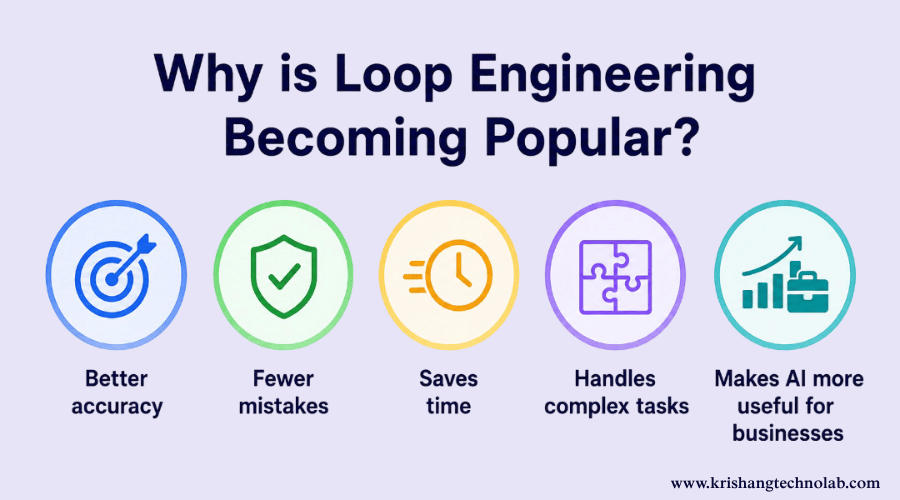
- Better accuracy: multiple passes catch mistakes a single response wouldn’t.
- Fewer mistakes: self-checking steps reduce the need for manual correction.
- Saves time: Less manual back and forth for routine work.
- Manages complex tasks by breaking multi-step jobs into manageable, checkable pieces.
- Makes AI more useful for business: repeatable workflows that don’t need someone watching every single step.
The term itself only caught on in June 2026, when a developer’s post about no longer “prompting” coding agents but instead designing the loops that prompt them spread quickly online, followed by a widely shared essay that gave the idea its name and structure. It resonated because plenty of people doing serious AI-assisted work had already started operating this way without a name for it. Companies evaluating whether loop engineering fits their operations often turn to AI consulting before committing to a full build.
Easy Example: Prompt Engineering vs Loop Engineering
Suppose you want AI to write a blog.
Prompt Engineering
You write:

Write a blog about healthy eating.

AI writes one article.

Done.
Loop Engineering
You give AI a goal:

Write a beginner-friendly blog about healthy eating.

Review grammar.

Improve readability.

Add examples.

Check SEO headings.

Remove repetitive sentences.

Repeat until the blog is easy to understand.

Now AI doesn't stop after the first draft.

It continues improving before presenting the final version.
Where Is Loop Engineering Used?
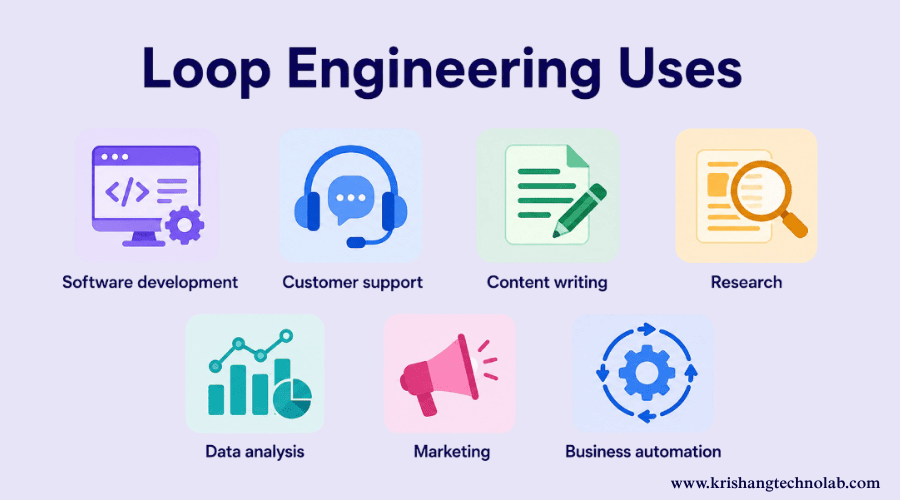
Most people don’t realize it is showing up in more places than you would think. Especially in environments where the work is repetitive and can be checked. Loop engineering is the design of any task that is repetitive, checkable, and requires human initiation to commence.
- Software development
- Customer support
- Content writing
- Research
- Data analysis
- Marketing
- Business automation
The clearest wins so far are bounded, checkable, high-volume tasks, rather than open-ended creative or strategic work where there’s no easy way to verify “done.”
Also Read: Best AI Coding Assistants
Popular Loop Engineering Techniques
These techniques are not complicated by themselves, most loop designs just combine a handful of them in different ways. Some core ideas that show up in most loop designs are:
- Planning before starting: breaking the goal into a sequence of steps up front
- Checking the output: verifying results against a clear standard, not just assuming they’re correct
- Learning from mistakes: feeding errors back into the next attempt
- Breaking large tasks into smaller ones: so each piece can be checked and fixed independently
- Using AI tools when needed: bringing in other tools (tests, linters, search, even a second AI reviewer) to verify or support the work
Do You Know: Game-Changing AI Platforms Developers Love in 2026
Is Prompt Engineering Still Important?
Yes, loop engineering doesn’t replace prompt engineering; it builds on it.
- Good prompts still help AI understand the goal clearly in the first place.
- Loop engineering sits on top of solid prompting, not instead of it.
- A loop is only as good as the goal and instructions feeding it; vague prompts still produce vague loops.
Both skills work together: prompting is how you communicate clearly with the AI, and looping is how you turn that communication into a repeatable system.
Read More About: Complete Guide on Prompt Engineering
The Future of AI
AI systems are clearly becoming more autonomous, and several trends indicate their future direction:
- AI agents that act on goals rather than waiting for step-by-step instructions
- Multi-step workflows that chain tasks together without manual handoffs
- Smarter automation that adapts based on results, not fixed rules alone
- AI systems that review and improve their own work before a human ever sees the output
The overall shift looks less like “AI replacing typing” and more like the human role moving up a level from writing every instruction to designing the systems that decide what instructions get written. Organizations that want this skill on demand can hire ChatGPT developers who already understand how to write prompts that perform well inside automated loops, not just as one-off instructions.
Final Thoughts
Loop Engineering is a natural step in the way we use AI.
Instead of using AI as a simple question-and-answer tool, it makes us build workflows where AI plans, creates, checks, improves, and iterates until the work is of the right quality.
For the average user, this means better results with less back-and-forth. It helps companies to be more efficient and to automate smarter. And it provides developers a way to build AI agents that can take on more complex tasks.
AI is constantly evolving. Learning Prompt Engineering and Loop Engineering will help you leverage what is available today and prepare you for the next generation of AI-powered workflows. When you’re ready to transition from experimentation to implementation, the team at Krishang Technolab can help you design, build, and deploy loop-driven AI systems for your business.
Found this post helpful? Don't forget to share it with your network!