Quick Overview: Learn what web development really means in 2026, from frontend and backend basics to how startups choose between hiring a developer, outsourcing to an agency, or going no-code. A practical, guide for founders and entrepreneurs.
Your website is often the first impression a potential customer, investor, or partner has. It either builds trust in seconds or costs you the sale. But most web development guides are written for people who want to be web developers, not for founders and business owners who need to make web-development decisions.
This guide is unique. If you’re a startup founder or entrepreneur trying to figure out what web development actually is, how to find a reliable web developer for your business idea, what it costs, and whether to hire, outsource, or go no-code, then this is the guide you’ve been looking for.
What Is Web Development?
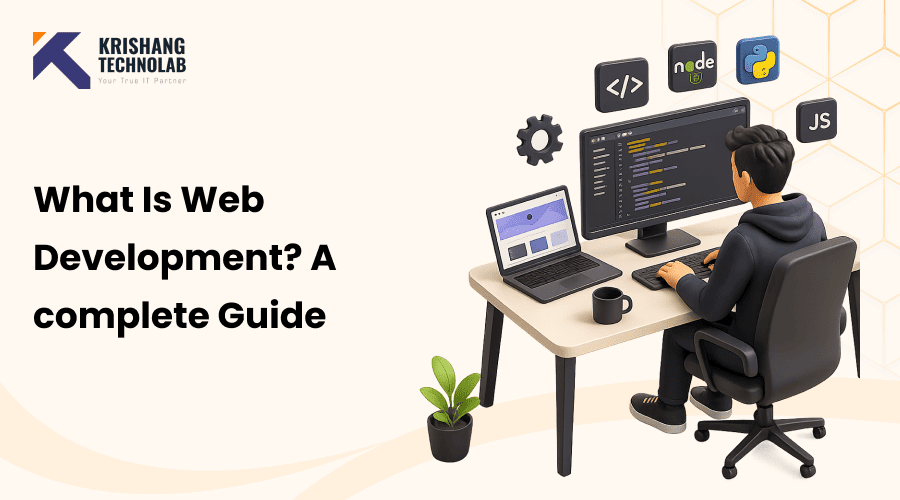
Web development is the process of designing and developing websites and web applications, all the stuff that runs in a browser. That includes a simple landing page, booking system, e-commerce store, SaaS dashboard, or customer portal. Anything you see on the internet that people interact with was built using web development.
The term covers much more than just writing codes. This includes how to structure information, how to connect your site to databases and third-party tools, how to make it load fast and work on mobile, and how to keep it secure after launch. At Krishang Technolab, we provide custom services for web application development that encompass the entire web development process, thereby eliminating the need for founders to coordinate with multiple vendors.
Here’s the version that matters to your business: Web development is how you get paid and show up online. A badly built site leaks leads. A successful one can be your best salesman 24 hours a day.
What’s the Real Difference between Web Development and Web Design?
This is the greatest confusion for founders. Web design is about the look of something: the layout, colours, typography, and user interface. Web development is all about the functionality, the behind-the-scenes code that makes buttons clickable, forms submittable and data saveable.
On smaller projects, these two are often done by one person. On larger ones they are separate positions. We provide website design and web development services so you get both under one roof and nothing gets lost in handoffs.
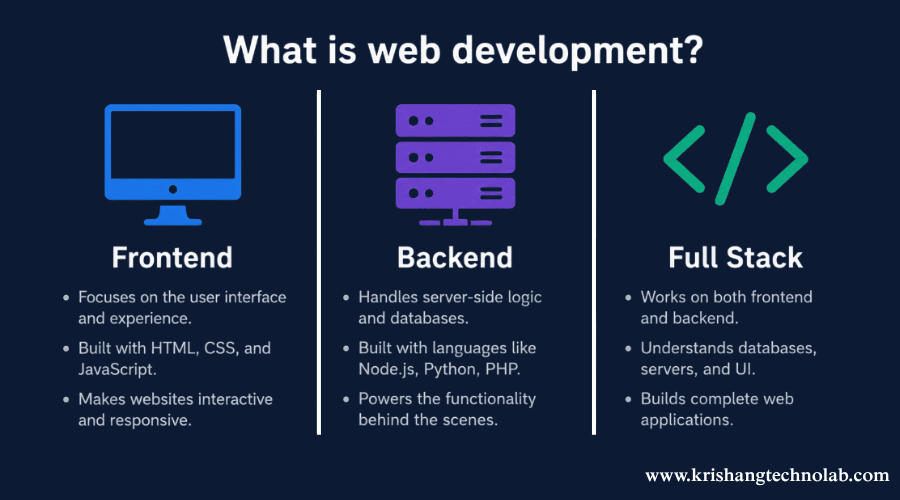
The 3 Core Types of Web Development
Knowing the three types helps you to ask the right questions when talking to developers or agencies and avoid paying for what you don’t need.
1. Frontend Development — What Users See and Interact With
Frontend development is what you see from the browser. This includes the style, navigation, buttons, forms, animations and what happens when a user does something on the page. Frontend workers make fast, interactive interfaces with frameworks like ReactJS or Next.js. They write code in html, css and javascript.
These two frameworks are the dominant ones in 2026 and for good reason. React is used to build everything from startup dashboards to Fortune 500 portals. If someone tells you that your site “feels slow” or “looks broken on mobile,” it’s almost certainly a front-end problem.
2. Backend Development — The Logic and Data Behind the Scenes
When you build something the backend is the engine. It handles business logic, stores and retrieves data from databases, manages user accounts, and integrates your website with email platforms, payment processors and CRMs.
Top backend choices in 2026 are Node.js and Python. Node.js is good for speed and JS uniformity, while Python is best for data-heavy, AI-integrated products. If you are building on top of Laravel or Django, both are still solid choices for structured, scalable backend architectures.
Users don’t see the backend, but they feel it. Failed checkout, slow-loading dashboard (8s) Login doesn’t work in Safari. These are backend failures.
3. Full Stack Development — When You Need Both
A full-stack developer works across both the frontend and backend. If you’re looking to hire a full stack developer for your startup, this is often the most practical move at the early stage: one person who can build end-to-end, make architectural decisions, and move fast without handoffs.
As your product grows, you’ll want specialists. But at the MVP stage, a strong full-stack developer or a web development agency for startups with both capabilities is usually the right call.
Key Web Development Technologies in 2026
You don’t need to learn to code. But knowing what technologies exist helps you evaluate whether an agency’s stack fits your long-term needs.
1. Frontend: React and Next.js Dominate
React continues to be the most frequently employed front-end framework in 2026. If you’re a startup and you need a marketing site and web application, the default solution is to build on React with Next.js development. It includes routing, performance optimisation and server side rendering out of the box which results in faster load times and better SEO.
Other modern front end options you should know about: Vue.js for lightweight, performance-driven builds and AngularJS for enterprise-grade applications that need a strong structure. Any good web development company for small business should be comfortable across these frameworks not just tied to one.
2. Backend: Node.js, Python, and Serverless
Node.js is the most popular backend solution for startup teams. Developers use the same language JavaScript for front-end and back-end which speeds up the build time. Python is a very good choice for data-intensive or AI-driven products.
It’s been a big year for serverless in 2026. That’s an important cost consideration for early-stage startups and platforms like Vercel and AWS Lambda enable small teams to deploy and scale without the need for a dedicated DevOps engineer.
3. Databases, APIs, and the Modern Stack
Most web applications use PostgreSQL (relational) or MongoDB (document-based). APIs connect your product to the outside world Stripe for payments, Twilio for SMS, HubSpot for CRM. In 2026, a well-built product is not defined by the construction of every component from the ground up, but rather by the intelligent integration of the appropriate components.
The Web Development Process — From Idea to Live Site
Knowing the process helps you set your expectations. Most web projects that go wrong are not wrong because of bad code, but rather because of bad scoping before a line of code is ever written.
Discovery and Planning: Define Scope Before You Build
The phase that most founders want to skip is the most important. Discovery is about documenting what you’re building, who it’s for, what it needs to do, and what it doesn’t need to do in version one.
Jumping straight to code without a discovery phase is a warning sign. Ambiguous scope leads to scope creep, blown budgets, and missed deadlines. The discovery call is the decisive factor in winning or losing projects, according to any web development company that collaborates with early-stage startups.
Design and Prototyping: Why Wireframes Save Money
A proper process, before writing any code, includes wireframes, structural diagrams of how each screen will work, and visual designs. Our Figma design services and website branding process are based on this principle: making changes at the wireframe stage costs one hour, while the same change after development is complete can cost a day or more.
If you’re planning a website redesign, this stage is especially important; it’s where you define what’s changing, why, and how to improve on what’s already there rather than simply replicating it.
How Long Does It Take to Build a Business Website?
This is one of the most searched questions by new founders, and the honest answer depends entirely on what you’re building:
| Project type | Timeline |
| Landing page / brochure site | 2–6 weeks |
| Business website | 4–10 weeks |
| Custom web app / MVP | 10–20 weeks |
| SaaS product (full build) | 16–32 weeks |
| E-commerce website | 8–18 weeks |
The most significant variable is the degree to which the scope is defined prior to development starting. Almost always, a well-scoped project is completed and done on time. A vague one almost never does.
Launch and Post-Launch: The Part Everyone Forgets to Budget For
Going live is not the finish line. When you launch you will need hosting, security patches, performance monitoring, bug fixes and eventual updates.Website Maintenance Services had a monthly agreement for updates and issues. It’s worth budgeting for website maintenance from day one, as it’s standard practice. $500–$2,000 per month, depending on product complexity. Retainer services provide predictability to web development for startups so that growth is not interrupted by technical fires.
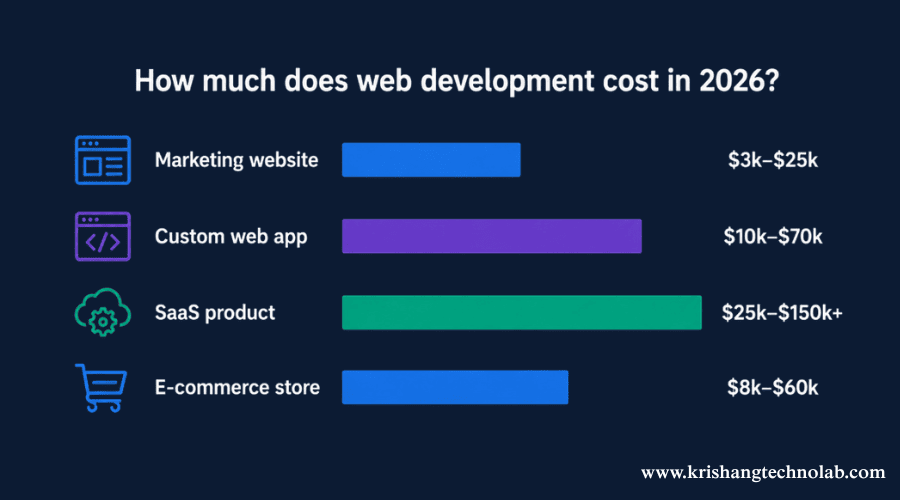
How Much Does Web Development Cost for a Startup?
Here are honest 2026 ranges based on real agency and freelancer market rates.
| Project type | Agency cost | Freelancer cost |
| Business website | $5,000–$25,000 | $3,000–$10,000 |
| Custom web app / MVP | $15,000–$50,000 | $10,000–$35,000 |
| SaaS product (full build) | $35,000–$150,000+ | $25,000–$80,000 |
| E-commerce website development | $10,000–$60,000 | $8,000–$30,000 |
If you’re looking for affordable web development services for a new business, offshore agencies in India typically deliver at 40–60% of UK or US rates without sacrificing quality when you choose a team with a proven portfolio and verified client reviews.
Hidden Costs Founders Often Miss
Beyond the build cost: domain ($15–$50/year), hosting ($30–$500+/month), SSL, email infrastructure, monitoring tools, and security scanning. For a custom web app, budget an additional 15–25% of your build cost per year for website maintenance and ongoing development.
Web Developer vs Web Development Agency — Which Is Right for Your Startup?
This is the most important decision, and the right answer depends on your stage and budget.
Freelance Developer
Best for small, clearly defined projects with tight budgets: a landing page, a specific integration, or a template customisation. The risk is no project management, no design, and no QA unless you manage it yourself. Freelancers work best when you know exactly what you want and can describe it clearly in writing.
In-House Developer
Makes sense once you have product-market fit and ongoing development needs. But a mid-level developer costs $60,000–$100,000+ per year in salary alone before benefits and overhead. If you’re not ready for that commitment, you can hire dedicated developers on a flexible model instead, getting the continuity of an in-house developer without the long-term overhead.
Outsource Web Development to an Agency
Outsourcing your web development project to an agency makes sense when you need a full team – a developer, designer, and project manager under one contract, with accountability and a defined process. A dedicated web development team for your growing startup through an agency also means continuity; unlike a solo freelancer, the project doesn’t stall when one person is unavailable.
For founders evaluating software development outsourcing for the first time, the key is choosing a partner that works with startups specifically, not one that applies the same enterprise process to every client regardless of size or stage.
No-Code vs Custom Web Development for Your Startup
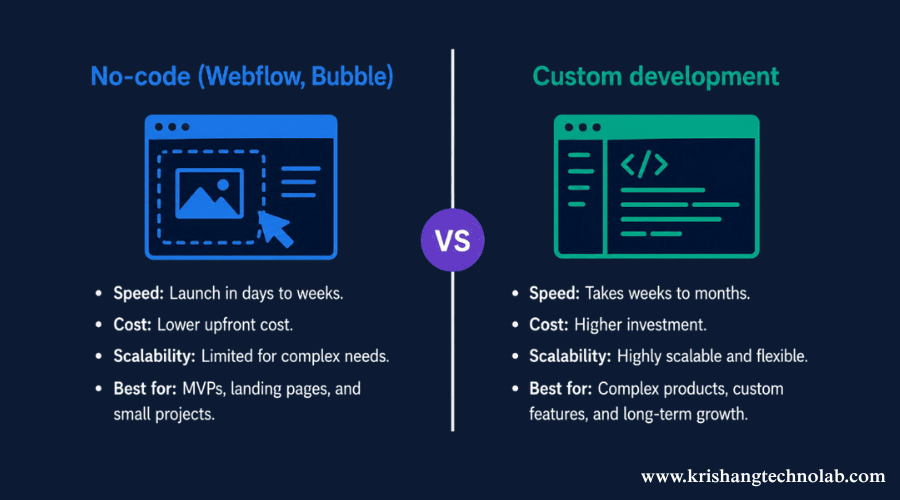
In 2026, the no-code vs. custom development decision is truly nuanced. Tools like Webflow are great for early stage marketing sites and they can be surprisingly powerful for content heavy products.Webflow development is a good middle ground between template builders and fully custom code for startups who want a fast, professional looking site but don’t want a long build cycle.
You hit the ceiling when you need custom business logic, complex integrations, or performance at scale. Most founders reach this limit between Stage 1 and Stage 2. At that point, it’s worth the investment to move to a custom build using ReactJS or a full MERN stack.
Read About: Revolutionizing Websites with No-Code and Low-Code Platforms
What to Look for When Choosing a Web Development Agency
When you are searching for a web development agency for startups or a SaaS product development agency for the founders, the criteria for evaluation are the same:
Live URLs of Portfolio. Ask to see projects of similar complexity to your own, not just mockups. Our portfolio and case studies showcase real, working products in e-commerce, SaaS, and enterprise.
Startup history. A good web development company that works with early-stage startups knows MVP scope, lean budgets and iterative delivery. We built our MVP development process specifically around the needs of founders who need to validate fast without over-engineering.
Tech stack alignment. If you want to hire in-house developers in the future, look for an agency that works on a mainstream stack like React, Next.js, Node.js or Python. Niche frameworks make future hiring significantly harder.
Clear process and communication. How does the agency handle scope changes? Who do you talk to day-to-day? Dedicated project managers and clear sprint milestones mean you always know exactly where things stand at Krishang Technolab.
Support after launch. What happens if something goes wrong after launch? Our website maintenance services and retainer plans provide continuous updates, performance monitoring and technical support, so your product continues to perform well long after the launch day celebration.
Explore More: Top 10 Custom Software Development Companies in India
E-Commerce Web Development for Small Business Owners
E-commerce website development deserves its own mention because it’s one of the most commercially high-stakes categories for small businesses and entrepreneurs. The platform choice you make at the start affects your ability to scale, customise, and integrate later.
- Shopify development: the fastest path to a conversion-ready online store, ideal for product-based businesses that want reliability over customisation
- WooCommerce development: built on WordPress, best for content-driven stores that need maximum flexibility
- Magento development: enterprise-grade, best for high-volume catalogues and complex B2B trade portals
- BigCommerce: a strong mid-market option with powerful native features and lower dev overhead
Choosing the wrong platform is one of the most expensive mistakes an e-commerce founder can make; it’s worth a proper consultation before you commit.
Web Development Trends Founders Should Know in 2026
1. AI-assisted development changes your budget.
Tools like GitHub Copilot and Cursor have made developers measurably faster. A project that cost $50,000 in 2023 might come in at $30,000–$35,000 today. Our AI development and ChatGPT integration services mean we don’t just use AI tools in our workflow; we can build AI-powered features directly into your product.
2. Core Web Vitals affect your revenue, not just your rankings.
Google’s performance metrics directly affect search rankings. Pages loading in 2.4 seconds convert at nearly 3x the rate of slow pages. This is why digital marketing and SEO need to be part of the web development conversation from day one, not bolted on after launch.
3. Accessibility is now a legal requirement in many markets.
WCAG 2.1 compliance is required across the UK, EU, and increasingly the US. It’s also better for SEO. Build it in from the start; retrofitting it later is expensive.
Wrapping Up
Web development is not one thing. It’s a set of decisions: what to build, who to build it with, how much to spend, and when to invest more. The founders who get it right are the ones who match the investment to the question they’re trying to answer right now.
If you’re validating an idea, use no-code tools like Webflow, move fast, and spend as little as possible. Also have traction and need a real product: invest in MVP web development with the right team. And you’re scaling, look for a dedicated development team that can own the platform long-term.
The worst move at any stage is building more than you need or less than you’ve already proven is necessary.
Found this post helpful? Don't forget to share it with your network!