Quick Overview: Agency margins are shrinking even as client demand grows. This post breaks down 2026 agency profitability statistics, the biggest factors eroding margin, and how white label development helps agencies convert fixed hiring costs into variable, scalable delivery capacity without sacrificing client relationships or service quality.
Agencies aren’t short on clients right now; they’re short on margin, and the white label agency profitability statistics for 2026 make that gap difficult to ignore. Client demand for websites, apps, AI integrations, and automations continues to climb, but the cost of hiring and retaining dedicated developers has climbed faster.
Executives worldwide have responded by outsourcing more: 76% now report outsourcing at least some IT functions, and among startups specifically, 47% treat outsourced development as their primary delivery model, up from roughly 30% in 2020. White label development is one specific way agencies are converting that broader outsourcing shift into better margins, without giving up the client relationship. This post walks through the numbers, the mechanics, and where the model does and doesn’t make sense.
Why Agency Profitability Matters More Than Revenue
A growing agency isn’t necessarily a healthier one. A few differences matter more than top-line growth:
- Revenue vs. profit. Revenue is the money your clients pay you for. Profit is what is left after payroll, tools, overhead, and delivery costs. Agencies can grow revenue every year while profit stays flat or shrinks, usually because costs are scaling in step with client work.
- Gross margin vs. net margin. Gross margin is revenue minus direct delivery costs (developer time and contractor fees). Net margin subtracts everything else: rent, admin, sales, and benefits. A healthy gross margin can still produce a thin net margin if overhead is bloated.
- Utilization rate. The percentage of a team’s paid hours that are actually billed to clients. A developer earning a full salary but only 60% billable is a quiet margin drain that doesn’t show up until you calculate it directly.
- Client acquisition cost (CAC). What it costs, in sales and marketing spend, to land a paying client. High CAC combined with thin margins makes growth expensive to sustain.
- Fully loaded employee cost. Salary is only part of what a hire costs; benefits, taxes, equipment, management time, and recruiting costs all add up, often to 1.25 — 1.4x base salary.
Once these are separated out, it becomes clearer why an agency can be busy and growing while still struggling to bank cash.
Agency Profitability Statistics for 2026
1. Market growth
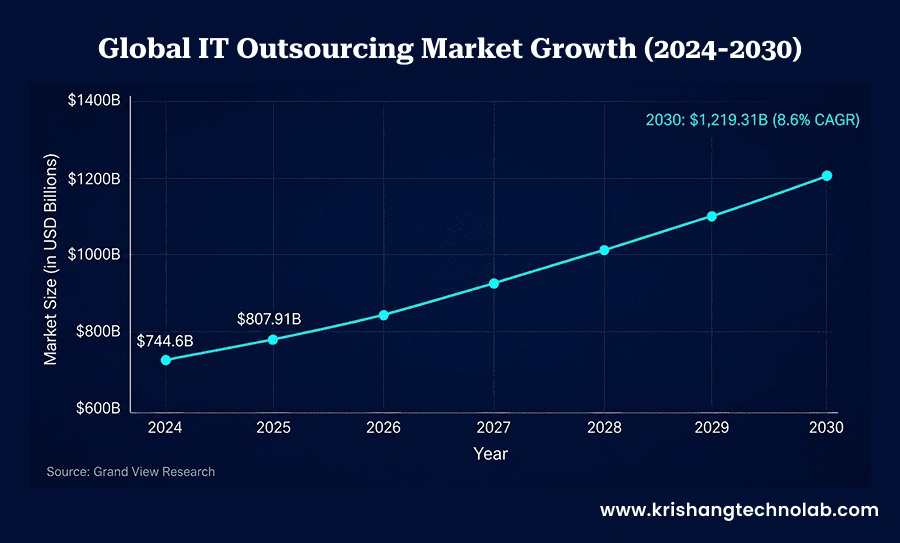
According to Grand View Research, the global IT services outsourcing market was valued at $744.6 billion in 2024 and is expected to reach $807.91 billion in 2025, growing at an 8.6% compound annual growth rate to $1,219.31 billion by 2030. That’s a sustained, multi-year growth trajectory rather than a short-term spike and it’s the demand pool that offshore development and white label agency both draw from.
2. Profitability benchmarks
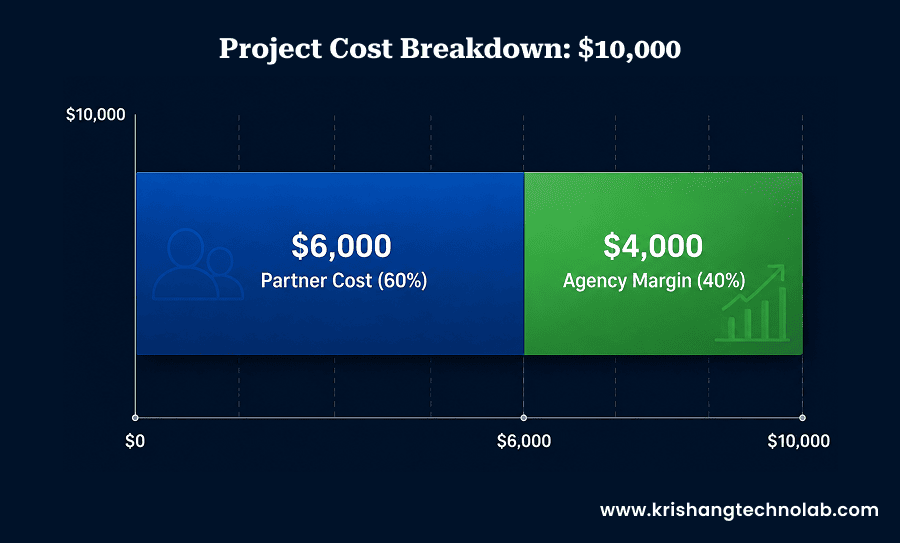
Independent, well-documented margin data specific to white label development is limited; most of what circulates in agency blogs traces back to vendor claims rather than named studies. The more defensible figure comes from the web development side specifically: the industry norm for white label web development sits at a 50–70% gross margin, meaning a project purchased wholesale for $2,500 is commonly resold to the client for $5,000–$7,500.
3. Hiring and talent pressure
The lack of talent for technical roles remains a major driver of outsourcing. There are still a good amount of employers that have challenges finding qualified developers in-house, and specialized skill areas make the problem even worse. Within two years, 93% of organizations will be using specialized external providers for some of their defenses rather than developing that expertise in-house, especially when it comes to cybersecurity.
4. Outsourcing adoption
Deloitte’s 2024 Global Outsourcing Survey found 83% of surveyed executives are already using AI as part of their outsourced services, but the same survey revealed a countertrend worth noting: 70% of organizations have selectively insourced work that was previously outsourced over the past five years, often to strengthen internal capabilities or reduce vendor markups. The takeaway for agencies isn’t that outsourcing is universally rising; it’s that organizations are getting more deliberate about which work to outsource and which to keep in-house, which is exactly the calculation white label development is meant to help agencies make well.
The Biggest Factors Affecting Agency Profitability Statistics
Behind most agency profitability statistics is the same underlying story: margin doesn’t erode from one big mistake; it leaks from several small, ongoing ones:
- Bench time. Developers paid a full salary with no billable client work assigned.
- Scope creep. Projects that quietly expand past their original quote without a corresponding change in price.
- Client churn. Losing clients costs more than losing revenue; it also strands any capacity built to serve them.
- Poor utilization. A team that’s technically busy but not billing enough hours to cover its cost.
- Slow delivery. Long project timelines tie up capacity that could otherwise be sold to new clients.
- Rising specialized-talent costs. AI integrations, security, and newer frameworks expertise can be highly compensated but not enough to employ on a full-time basis for sporadic client needs.
Hiring vs. White Label Development
| Factor | In-House Hiring | White Label Development |
| Cost structure | Fixed salary, paid regardless of workload | Pay per project or retainer |
| Getting started | Recruitment cycle (often weeks to months) | Ready-made team, available immediately |
| HR overhead | Full HR, benefits, and management burden | None, the partner manages their own team |
| Bench cost | Ongoing, if utilization dips | None, no cost when there’s no active project |
| Scaling speed | Slower, bounded by hiring capacity | Fast, capacity scales with the partner’s team |
| Skill depth | Limited to what you’ve hired for | Access to specialists you don’t have in-house |
| Training investment | Required, ongoing | Minimal, partner brings existing expertise |
Neither column is universally better. Hire Dedicated developers wins when a skill is core to your agency’s identity and in constant demand. White label development wins when demand is real but inconsistent, or when the skill needed is outside what you can justify hiring for full-time.
Where White Label Development Improves Agency Profitability
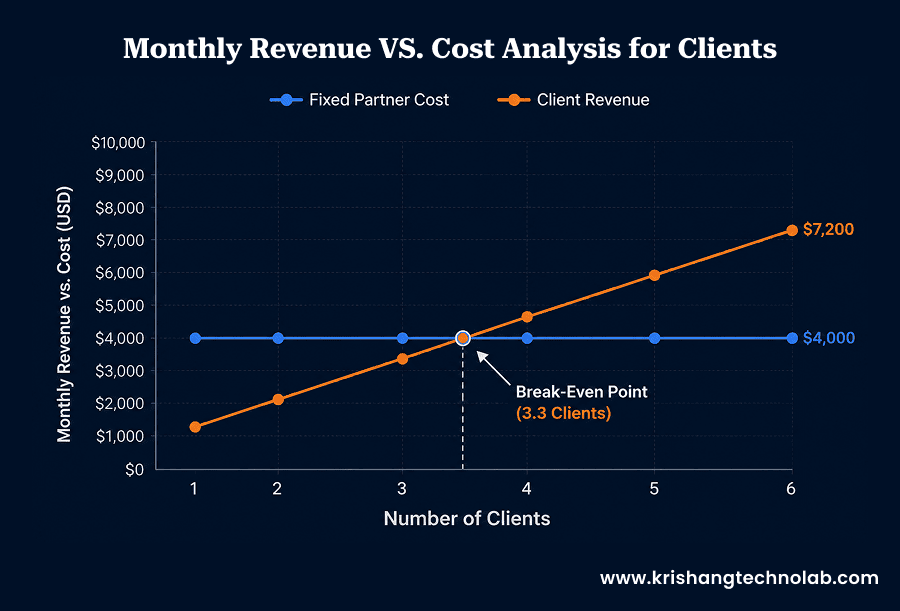
- Reduces payroll costs: Fixed salaries convert to variable, project-based costs you only pay when there’s billable work to cover it.
- Increases project capacity: A partner’s team effectively extends your delivery capacity without extending your headcount.
- Speeds up delivery: An experienced partner team can often start immediately, rather than requiring a hiring and onboarding cycle first.
- Provides access to specialized skills: AI integration, cybersecurity, and niche framework expertise become available without a dedicated full-time hire for each.
- Improves resource utilization: Your core team stays focused on what they do best while a partner absorbs variable or overflow demand.
- Supports client retention: Being able to say yes to a wider range of client requests without turning work away keeps clients from shopping around for a full-service alternative.
- Enables easier scaling: Growth in client demand can be met by scaling a partner relationship rather than running a new hiring cycle each time.
Illustrative Scenario — Two Agencies, Two Models
This is a hypothetical example meant to show the mechanics, not a claim about universal outcomes.
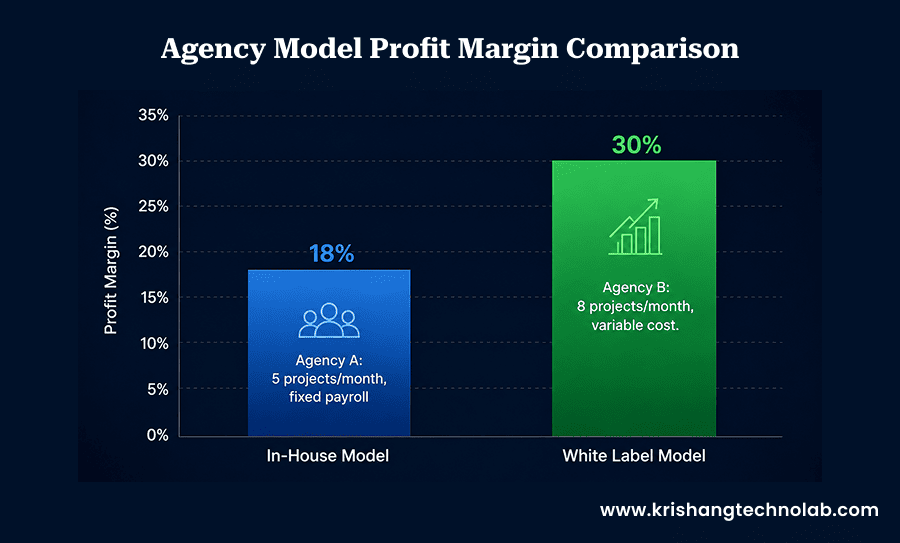
Agency A — fully in-house
- 8 employees, all salaried
- Handles 5 projects per month
- 18% profit margin, most of it consumed by fixed payroll during slower months
Agency B — lean core team plus white label partner
- Small core team handling sales, project management, and client relationships
- Development work routed through a white label partner
- Handles 8 projects per month using the same core headcount
- 30% profit margin, driven by variable delivery costs that scale with actual project volume
The difference isn’t that Agency B works harder; it’s that Agency B’s costs move with its workload, while Agency A’s costs stay fixed whether client demand is high or low that month.
Is White Label Development Right for Every Agency?
Generally a good fit:
- SEO and digital marketing agencies fielding web development requests outside their core service
- Branding and design agencies whose clients ask for functional builds, not just design
- Shopify and e-commerce agencies needing custom development beyond template work
- HubSpot and CRM-focused agencies needing integrations or custom portals
- Web design agencies without a deep in-house engineering bench
- SaaS consultancies advising on strategy without maintaining a large internal dev team
Generally a weaker fit:
- Agencies with constant, high-volume, full-time development demand at that volume, in-house hiring often becomes more cost-effective than ongoing partner markup
- Teams building proprietary technology or IP where keeping development entirely in-house is a security or ownership requirement
Example: What a White Label Development Partner Looks Like in Practice
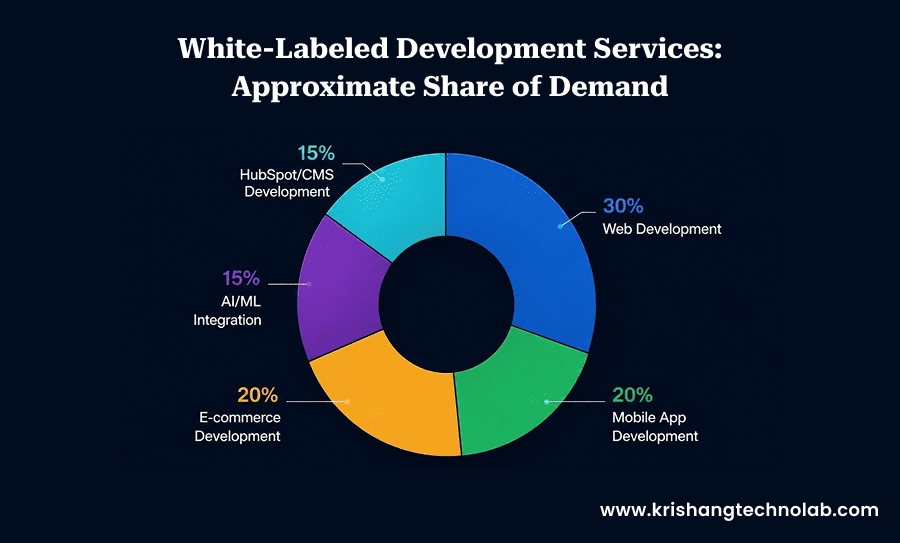
Krishang Technolab is one example of how this model plays out. Founded in 2015 and operating out of India with a business team in the UK, the company works across web development, mobile app development, e-commerce development, HubSpot development, and AI-driven software projects. Over roughly eight years, it has served more than 300 clients across the US, UK, Canada, Australia, and other markets, working with businesses ranging from early-stage startups to larger enterprises across sectors like retail, healthcare, real estate, and financial services. Agencies can see examples of this kind of work in the company’s portfolio of client case studies.
For an agency evaluating a white label partner, this is a useful reference point for what to look for: a track record spanning multiple years, a client base across several countries and industries rather than one narrow niche, and service coverage broad enough to absorb overflow or specialized work (AI, e-commerce, CMS platforms) without requiring a separate vendor for each.
Conclusion
The agency profitability statistics covered here point to the same conclusion: sustainable agency growth isn’t just a function of landing more clients; it’s a function of keeping cost structure aligned with actual, variable client demand. Hiring makes sense for the work that defines an agency’s core service and stays busy month after month.
White label development makes more sense for everything adjacent: the requests that are real but inconsistent or that call for specialized skills that don’t justify a full-time seat. Used that way, it’s not a shortcut around building a real team; it’s a way to keep margin healthy while that team focuses on what it does best.
Found this post helpful? Don't forget to share it with your network!