Quick Overview: Explore white label software vs custom software development, comparing costs, benefits, customization, scalability, ownership, and long-term value to help you choose the right software solution for your business.
Every growing company eventually outgrows its basic tools. Then leaders must decide how to build the next product. The White Label Software vs. Custom Software Development question sits at the center of that choice. It appears in retail, finance, healthcare, and logistics alike.
Some businesses want speed. So they license ready products and launch under their brand within weeks. Others want control, so they hire software developers and build from scratch. Meanwhile, many leaders feel stuck between white label software and custom software because the price tags look so different. Both groups share one worry, which is choosing the wrong model and wasting money.
This guide explains both models in plain language. First, you will see how each one handles cost, features, ownership, and growth. Next, we compare Custom Software vs White Label Software on real business factors. You will also learn when a white label software development company makes sense.
Because software development mistakes are costly, each section gives clear tips for real buying choices. Once you finish reading, your decision will feel clear and well informed. In short, the White Label Software vs Custom Software Development comparison replaces guesswork with clear criteria. Any busy founder can apply them today.
What Is White Label Software?
With white label software, one company builds the product and a second company sells it under a new brand. Buyers add their logo, colors, and domain, then sell it as their own. A specialist white label software development company often builds the white label software solutions that other brands resell. As a result, buyers skip the build phase and launch within weeks. This off-the-shelf software model suits teams that want speed. The vendor handles hosting, updates, and bug fixes.
Therefore, small teams avoid heavy software development work. Agencies often choose a white label software development partner for the same reason. Likewise, startups use it to test an idea before they invest more. However, the vendor usually keeps the source code. For that reason, you should review license terms before you sign. Still, a ready product can earn revenue fast when the use case is common. Speed and low cost are its main strengths.
What Is Custom Software Development?
Custom software development means building a product around one company’s exact needs. Teams create, code, test, and plan each feature from scratch. Therefore, many firms hire dedicated developers to own the roadmap. Others hire software developers in phases to control cost. This custom path gives full control over features, data, and design. Moreover, the business owns the code and the intellectual property.
In addition, the product connects directly to existing systems such as a CRM or ERP. For example, firms with large AI plans can hire AI engineers early. Teams also gain freedom to change features whenever the market shifts. Security rules and approval steps follow your own policies. However, custom projects need more time and budget. They often take several months to launch. Still, the result fits the business exactly. Over time, that fit can lower total cost of ownership. Consequently, growth-focused companies often prefer this route for core products.
White Label Software vs Custom Software Development: Key Differences
This section compares both models side by side. Each factor shows where White Label vs Custom Software Development gains or loses ground. Use it to understand the difference between white label software and custom software before you commit to a budget. It also frames the classic build vs buy decision.
| Factor | White Label Software | Custom Software Development |
| Cost | Lower upfront, with recurring license fees | Higher upfront, with no license fees |
| Features | Fixed, with limited changes | Fully tailored to your workflow |
| Scalability | Limited by the vendor roadmap | Grows on your timeline |
| Ownership | Vendor keeps the source code | You own the code and the IP |
| Time to Market | A few weeks | Several months |
| Security and Maintenance | Vendor patches and updates | Your team or partner manages them |
Cost and Initial Investment
Cost drives most White Label Software vs Custom Software Development decisions. A ready product has a lower entry price because the vendor spreads development across many buyers. Upfront, Custom Software vs White Label Software looks lopsided, since one client funds everything. Still, the White Label Software vs Custom Built Software gap often narrows over several years.
Features and Customization
White label products ship with fixed features, so deep changes are rare. Custom builds work the other way, because every workflow follows your plan. Therefore, White Label Software vs Custom Software Development often depends on how unique your processes are. Some white label software solutions do allow light setup.
Scalability and Flexibility
In White Label Software vs Custom Software Development, scalability matters most after launch. A shared platform grows only as fast as its vendor allows. A custom product, however, scales on your timeline. For example, firms that hire AI developers can add smart features without waiting for a roadmap.
Software Ownership and Intellectual Property
Ownership is a core part of the White Label Software vs Custom Software Development choice. Most white label licenses let you rebrand the product. Even so, the provider holds on to the underlying code. In the Custom Built Software vs White Label Software contest, custom clients usually own the code outright. A trusted white label software development partner will state these terms in writing.
Development Time and Time to Market
A white label product can go live in weeks. Meanwhile, custom projects often take months. Therefore, white label software or custom software development becomes a question of revenue timing. Meanwhile, a skilled AI software development company can shorten custom timelines with proven methods.
Security, Integration, and Maintenance
Security and maintenance are also important in White Label Software vs Custom Software Development. Vendors patch all customers simultaneously on white label platforms. In contrast, custom systems need their own updates. Still, White Label Solutions vs Custom Software Development also involves integration limits. Skilled white-label software engineering teams can narrow those gaps through APIs.
Benefits of White Label Software for Businesses
Ready products give businesses a quick path to market. As a result, many startups and agencies choose white label software development services over a custom project. Buyers also compare several white label software companies before they sign. Each option saves time, money, or effort. Therefore, the benefits below show when a ready product beats a long build.
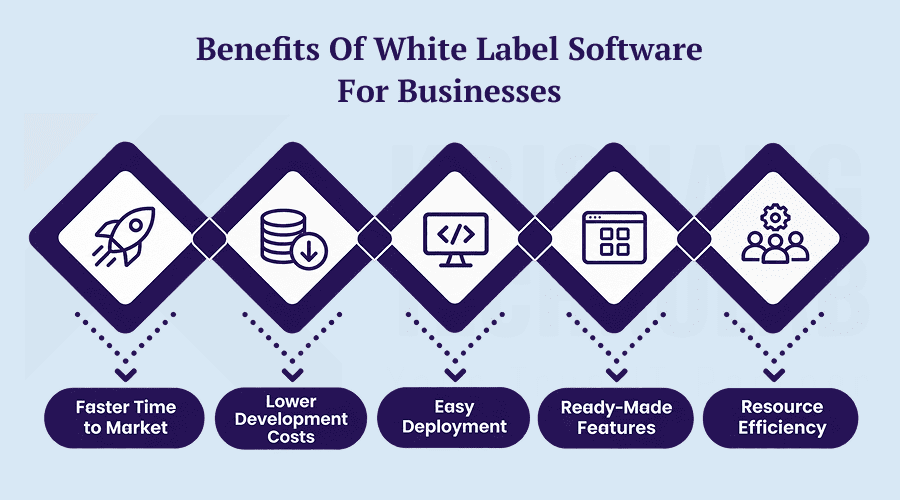
1. Faster Time to Market
A finished product removes months of planning, so brands reach clients sooner. Teams that compare White Label Software vs Custom Software Development for speed often go live within weeks. In addition, a white label software development agency can handle branding and setup.
2. Lower Development Costs
Budget pressure pushes many founders toward ready products. Vendors spread engineering costs across many clients, so each buyer pays less. For example, AI white label tools let small firms add smart features without a research team. White label software and custom software options, therefore, allow for early cash to be allocated to marketing.
3. Easy Deployment and Maintenance
Deployment stays simple because the vendor already tested the product. Updates, hosting, and bug fixes arrive from one source. Consequently, small teams avoid heavy software development work. A provider of white label app development services often manages these tasks on a fixed plan.
4. Ready-Made Features and Functionality
Leading white label software development services bundle ready features and save planning time. Login, payments, dashboards, and reports usually work from day one. Moreover, white label mobile app development services can deliver native apps under your name. Some vendors are going so far as to add AI development capabilities such as chatbots and smart recommendations.
5. Enhanced Business Focus and Resource Efficiency
Outsourcing the build lets leaders focus on sales and service. In White Label vs Custom Development, that focus saves real hours. A white label software development partner also manages software outsourcing tasks without extra payroll. Later, businesses can still hire software developers for work that needs unique logic.
Advantages of Custom Software Development for Businesses
Custom builds suit companies with clear and complex needs. The main difference between custom software development and white label software is control and fit. A custom software development company can shape every feature around your workflow. Moreover, you decide the roadmap, the data model, and the release dates. Therefore, many firms hire dedicated developers to protect that advantage over time.
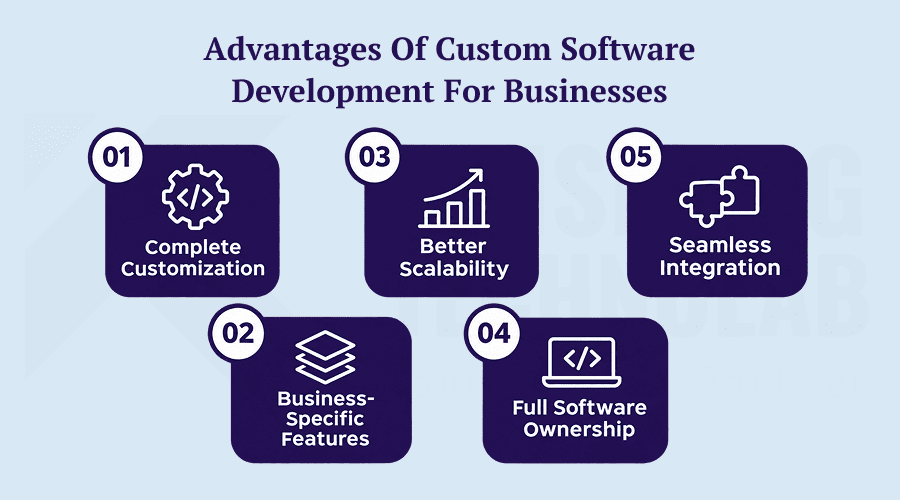
1. Complete Customization and Control
Custom software gives you every decision. You choose the design, the data model, and the release schedule. If AI development matters, you can hire AI engineers to build models around your data. That control often settles the White Label Software vs Custom Software Development debate for core products.
2. Better Business-Specific Functionality
Generic tools force teams to change their processes. A custom product, in contrast, adapts to the team. For that reason, white label vs. custom software development often favors custom builds in strict or niche fields. A custom software development company can encode your exact review rules.
3. Greater Scalability and Flexibility
You can add modules, users, and regions without renegotiating a license. Likewise, an AI software development company can add forecasting or automation when the business is ready. That flexibility explains why growth-focused firms ask about white label or custom software early.
4. Full Software Ownership and Intellectual Property Rights
Owning the code removes licensing risk. You can edit, resell, or protect the product as you wish. For this reason, it is often up to ownership to decide between White Label Software vs Custom Software Development for long-term assets. An artificial intelligence software development company can also transfer model rights clearly.
5. Seamless Integration with Existing Systems
Custom products connect to your CRM, ERP, and data warehouse directly. By comparison, White Label Software vs Custom Built Software shows a clear gap, since vendors limit API access. As a result, data often moves slowly between tools in a ready product. In contrast, a custom build lets your team design each connection around real workflows.
White Label Software vs Custom Software: Pros and Cons
A quick scorecard makes the White Label Software vs Custom Software Development trade-offs visible. Review the pros and cons before you compare Custom Software vs White Label Software on price. Furthermore, check which white label software companies offer real flexibility. Next, list what each option gives you and what it takes away. Then ask each vendor whether white label software solutions allow changes after launch.
Pros and Cons of White Label Software
Overall, ready products win on speed and price. But they limit revolutionary change and often lead to vendor lock-in. A lot of white label software development services also charge recurring license fees. Still, AI white label products add value fast when the use case is common.
Pros
- Fast launch, often within weeks
- Lower upfront cost than a full build
- Vendor handles hosting, updates, and bug fixes
- Ready-made features such as login, payments, and dashboards work from day one
- Lets small teams focus on sales while the vendor handles software development
Cons
- Limited control over features and the roadmap
- The vendor keeps the source code, which creates vendor lock-in
- Recurring fees from white label software development services add up over time
- Deep changes are rare, and custom requests cost extra
- Integration is limited when the vendor restricts API access
Pros and Cons of Custom Software Development
Custom software is about control, ownership, and a perfect fit. But in custom software development vs. white label software, it requires a bigger budget and longer timelines. For that reason, businesses often hire dedicated software developers to keep quality high. Weigh that cost against white label software and custom software benefits over five years.
Pros
- Full control over features, data, and design
- Full ownership of the code and the IP
- Direct links to your CRM, ERP, and other tools
- Scales on your timeline as users and features grow
- Security rules and approval steps follow your own policies
Cons
- Higher upfront cost
- Longer timeline, often several months
- Maintenance and hosting costs fall on you
- Needs skilled teams, so many firms hire dedicated developers or hire software developers
- Delays or scope changes can raise the final budget
White Label Software vs Custom Software: Cost Comparison
Price tags tell only part of the story. White label vs. custom development looks different once you add upkeep. So, compare licensing, build cost, and maintenance together. Ask top white label app development companies for detailed quotes. Next, request a clear breakdown of setup fees, monthly charges, and update costs. Finally, confirm what happens to your pricing as your user base grows.
| Cost Factor | White Label Software | Custom Software Development |
| Initial Investment | Low, since the product is already built | High, since design and coding start from scratch |
| Licensing | Recurring monthly or yearly fees | None, because you own the code |
| Customization Cost | Extra fees for each change | Included in the build scope |
| Maintenance | Bundled into the license | Paid separately for fixes and hosting |
| Upgrades | Vendor-controlled, often at an added price | Planned and paid by you |
| Return on Investment | Fast payback, but fees keep growing | Slower payback, but stronger long-term value |
| Total Cost of Ownership | Rises with users and add-ons | Stays steadier as the product scales |
Initial Development and Licensing Costs
White label licensing usually costs far less than a ground-up build. In Custom Software vs White Label Software comparisons, custom projects need design, coding, and testing budgets. In the meantime, quotes from white label app development companies often list setup and licensing separately.
Ongoing Maintenance and Support Costs
White label vendors bundle updates into the license. Meanwhile, custom owners pay for fixes and hosting directly. A well-known white label software development company keeps the monthly invoices at a reasonable level. Teams that hire AI developers should also expect model updates.
Long-Term Return on Investment (ROI)
Return on investment depends on your time frame and total cost of ownership. License fees accumulate, but white label products pay back quickly. White Label Software vs Custom Software Development can sometimes lean one way or the other over the years. Strong AI development projects often justify custom spending, and an artificial intelligence software development company can model the payback.
When Should You Choose White Label Software?
Go with a custom build if your workflow sets you apart from rivals. In custom software development vs. white label software, that advantage usually decides the winner. Tied-in systems and strict industries require total control. Likewise, firms with large AI development roadmaps should hire AI engineers early. Moreover, these teams can design models around your own data and rules. As a result, you avoid vendor limits as your needs change.
For Startups and Small Businesses
In White Label vs Custom Development, a ready product lets them test demand quickly. For that reason, White Label Software vs Custom Software Development often favors the ready product at first. Meanwhile, white label software development services can deliver an MVP with AI white label add-ons at low cost.
For Faster Product Launches
Some launches cannot wait for a long build. Seasonal campaigns, pilots, and client pitches reward speed. A white label software development agency can deliver within weeks. Here, white label vs. custom development usually favors the ready product. Agencies, therefore, often rely on companies that provide white label software development to meet tight deadlines.
For Businesses with Limited Development Budgets
A license spreads the cost over months instead of one large payment. In addition, strong white-label software engineering teams keep quality high at modest prices. Later, an AI software development company can quote a phased plan when budgets grow.
When Should You Choose Custom Software Development?
Choose custom when your process is to your advantage. In custom software development vs. white label software, that advantage usually decides the winner. Full control is needed in strict industries and linked systems. Likewise, companies on the path of AI development should hire AI engineers in the early stages.
Each case below shows a point where a custom build beats a ready product. Check how many of them match your business before you decide.
- Unique workflows that generic tools cannot handle
- Strict industries with security or compliance rules
- Complex integrations with existing systems
- AI development roadmaps where you plan to hire AI engineers
- Long-term growth that needs flexible scaling
- Full ownership of the code and the intellectual property
White Label Software vs Custom Software: Which Is Better for Your Business?
There is no one winner. It all depends on your budget, timeline, and long-term goals. White Label Software vs Custom Software Development If speed and low cost are important to you, the answer is ready products. If control and ownership matter most, however, it points toward custom builds.
Many successful firms use a hybrid approach. First, they launch with a licensed product. They build custom features as revenue grows. This path minimizes early risk while preserving optionality over the long term. Some companies hire AI engineers after that first launch. Consequently, they avoid choosing between white label software and custom software too early.
Before you commit, list your must-have features and your five-year budget. Next, compare Custom Software vs White Label Software against that list. Ask each white label software development partner for clear ownership terms. Document every answer so your team can review the choice later. An artificial intelligence software development company should also explain model ownership.
Finally, remember that tech keeps changing. AI features now shape what clients expect in almost every field. Therefore, plan to hire AI developers or choose an AI software development company that can grow with you. Review the decision yearly, because the White Label Software vs Custom Software Development trade-offs shift.
Frequently Asked Questions
What Is the Main Difference Between White Label Software and Custom Software?
The main difference is control. White label software arrives ready to use, and you simply apply your branding. Meanwhile, custom software gets built around your exact requirements. The difference between white label software and custom software affects cost, speed, and ownership. Therefore, White Label Software vs Custom Software Development starts with one simple question about uniqueness.
Is White Label Software Cheaper Than Custom Software Development?
Yes, white label is usually cheaper at the start. Licensing replaces a large build budget. However, compare the custom-built software vs. white label software costs over five years before deciding. Meanwhile, hire software developers only for features the vendor cannot provide.
Which Is Better for Startups: White Label or Custom Software?
Most startups should begin with white label to test demand. It cuts risk and launch time. They can then hire dedicated developers to develop custom features. White Label vs Custom Software Development The ready product favors quick validation.
Can White Label Software Be Customized?
Yes, within limits. Vendors provide the branding, themes, and lighting settings. But more fundamental changes require extra work by a white label software development partner. Many white label software development services also offer paid AI white label modules.
Is Custom Software Development More Scalable?
Usually yes. A custom build grows alongside your audience and your feature list. For example, companies can hire AI developers to their staff to increase automation as demand increases. White Label Software vs Custom Software Development: Scalability limited by vendor limits.
Who Owns the Software in White Label and Custom Development?
In white label deals the source code is typically retained by the vendor. But for custom projects it is usually owned by the client. Therefore, White Label Software vs Custom Built Software contracts need careful review.
How Long Does Custom Software Development Take?
Most custom projects take several months, depending on scope. Meanwhile, a skilled artificial intelligence software development company can estimate scope early. Many firms hire software developers in phases to control time and cost.
Which Software Solution Is Better for Long-Term Business Growth?
Custom software is usually a good fit for long-term growth, while white label is a good fit for fast starts. White Label Solutions vs Custom Software Development often involves a hybrid approach. They put out a finished product and then add custom features through a white label software development company. Teams may decide to hire AI engineers and make automation a priority.
Found this post helpful? Don't forget to share it with your network!