
Quick Overview: This guide explains website maintenance cost in 2026, covering pricing by website type, hidden expenses, SEO impact, and smart budgeting tips to help businesses maintain secure, high-performing websites without overspending.
The first step is to make a website. The success of a website and its long-term website maintenance cost depends on how well it is maintained.
Websites are more than just digital brochures in 2026. They connect to payment systems, marketing tools, analytics, security, and search engines that change all the time. Because of this, businesses, new companies, and brands that are growing need to keep an eye on how much it costs to keep their websites up to date.
This blog makes it clear how much it costs to keep a website up to date. You’ll learn what maintenance includes, why prices are different, how much you should save, and how to keep from spending too much.
What Is Website Maintenance and Why Is It Important?
Website maintenance is the continuous work to keep a site secure, fast, and useful. Regular updates, security checks, and performance tuning are often overlooked, especially by businesses that are unfamiliar with common website maintenance mistakes.
A helpful way to think about it is this:
- Website development creates the structure
- Website maintenance keeps everything running smoothly
Even if your website looks fine, hidden problems like old software, security risks, or slow performance can hurt traffic, rankings, and sales if you ignore maintenance.
Core Areas of Website Maintenance
Website maintenance usually focuses on six key areas:
- System updates: Keeping the CMS, themes, plugins, and integrations current
- Security protection: Preventing hacks, malware, spam, and data leaks
- Backups and recovery: Making sure your site can be restored quickly
- Performance optimization: Maintaining fast load times and stability
- Technical SEO health: Ensuring search engines can crawl and rank your site
- Content accuracy: Keeping information fresh and correct
Each of these areas contributes to the overall website maintenance cost.
Why Has Website Maintenance Cost Increased in 2026?
Many people are surprised by modern website maintenance prices. The higher costs reflect changes in the web.
1. More Security Risks
Websites of all sizes are targeted today. Automated attacks affect both small and large businesses. That’s why proactive security monitoring is essential.
2. Higher Performance Expectations
Users expect websites to load quickly. Search engines favor fast, stable sites and penalize slow ones. Ongoing optimization is essential.
3. More Moving Parts
Most websites now rely on multiple third‑party tools such as CRMs, payment processors, analytics platforms, and marketing software. Each connection adds maintenance work.
Together, these factors directly increase the cost of website upkeep in 2026.
How Much Does Website Maintenance Cost by Website Type?
Website type is the biggest factor that influences maintenance pricing. Below is a practical breakdown.
1. Informational Website
These websites are more about giving information than letting people talk to each other.
They usually have a few pages, like Home, About, Services, and Contact. There are no accounts for users, payments, or advanced features.
The main goal of maintenance is to keep the site safe, easy to use, and visually consistent on all devices.
Typical maintenance focus:
- Security monitoring
- Hosting checks
- Occasional content edits
Average cost: $50–$150 per month
2. Small Business Website
Small business websites support lead generation and customer communication.
They commonly use content management systems and include contact forms, blogs, service pages, and tracking tools.
Because these sites change more often, maintenance must be more consistent.
Typical maintenance focus:
- CMS and plugin updates
- Backups
- Performance checks
- Minor content updates
Average cost: $150–$400 per month
3. WordPress Website Maintenance Cost
Because WordPress relies on frequent updates and plugin compatibility, many companies prefer working with teams that specialize in WordPress development and maintenance rather than handling updates on their own.
Typical maintenance focus:
- Core, theme, and plugin updates
- Security hardening
- Backup management
- Speed optimization
Average WordPress maintenance cost: $100–$500 per month
4. Ecommerce Website Maintenance Cost
To avoid checkout issues and security risks, ecommerce brands often rely on professional ecommerce development services that include ongoing maintenance and performance monitoring. Access to clear ecommerce platform comparisons and insights helps store owners avoid costly platform changes and maintenance issues later.
Typical maintenance focus:
- Payment system monitoring
- Security and compliance
- Product updates
- Performance and uptime monitoring
Average ecommerce website maintenance cost: $500–$3,000 per month
5. Enterprise Website Maintenance Cost
Large organizations usually work with experienced teams offering custom web development services to manage complex integrations, high traffic, and ongoing system maintenance.
Typical maintenance focus:
- Advanced security and compliance
- Load testing and performance scaling
- System integration monitoring
- Ongoing technical support
Average cost: $2,000–$5,000+ per month
What Are the Different Website Maintenance Pricing Models?
Website maintenance services are priced in different ways.
| Pricing Model | How It Works | Best Use Case |
| Monthly plans | Fixed recurring fee | Most businesses |
| Hourly rates | Pay for time used | Occasional fixes |
| On‑demand | Pay only when needed | Very small sites |
| In‑house teams | Salaried staff | Large enterprises |
Monthly plans are the most predictable and cost‑effective for ongoing needs.
What Does a Website Maintenance Checklist Look Like?
Taking care of a website isn’t just one thing; it’s a routine. It’s more like a series of small, repeated tasks that keep a website healthy over time, just like regular maintenance keeps a car running well.
A good website maintenance checklist breaks this ongoing work down into clear, doable tasks that are done every day, week, month, or year. With a checklist-based approach, problems are stopped before they hurt users, search rankings, or revenue, instead of being fixed after the fact.
Ongoing tasks include:
- Monitoring uptime and security alerts
- Updating software and integrations
- Testing forms and site functionality
- Checking backups
- Reviewing performance and SEO health
Regular maintenance prevents small issues from turning into expensive emergencies.
What Are the Common Website Maintenance Costs?
Website maintenance cost includes several recurring expenses:
| Expense | Typical Range | Purpose |
| Domain renewal | $10–$50/year | Keeps domain active |
| Hosting | $5–$300+/month | Site infrastructure |
| SSL certificate | Free–$200/year | Data encryption |
| Premium tools | $100–$500+/year | Added features |
| Security services | $100–$500/month | Threat protection |
What Hidden Website Maintenance Costs Should You Watch Out For?
Some website maintenance costs don’t appear until something goes wrong. These are often the most expensive because they arrive unexpectedly and usually require urgent fixes.
Some hosting plans and maintenance packages don’t include all of the maintenance costs that you might not know about. These costs can hurt your business. On some bills, they don’t always show up as a clear line item. Instead, they’re often listed as lost sales, wasted marketing funds, or sudden development costs.
In many cases, these costs are caused by delayed updates, skipped monitoring, or incomplete maintenance coverage. A website may look fine on the outside, but problems may be building up in the background until something goes wrong and action is needed right away.
Understanding hidden website maintenance costs helps you:
- Plan a more realistic budget
- Avoid emergency expenses
- Protect SEO rankings and user trust
- Reduce long-term operational risk
Here are the most common hidden costs of website maintenance for businesses in 2026, as well as why it’s usually much cheaper to do maintenance ahead of time than to wait until something goes wrong.
Is DIY or Professional Website Maintenance Better?
| Aspect | DIY | Professional |
| Cost | Lower upfront | Higher upfront |
| Risk | High | Low |
| Time | Significant | Minimal |
| Reliability | Inconsistent | Consistent |
Instead of managing maintenance internally, many businesses choose to hire dedicated web developers who handle updates, security, and performance as an ongoing responsibility.
Deciding between in-house and outsourced help?
This guide on choosing the right development model will help you make that call.Dedicated Development Team VS Outsourcing
How Can You Reduce Website Maintenance Cost Without Risk?
Working with a flexible team that offers scalable website support services allows businesses to control maintenance costs without compromising reliability.
Many businesses spend too much because they buy features, tools, or services that they don’t need. Others don’t invest enough and have to pay a lot for expensive repairs later on. Instead of taking short-cuts, a balanced approach focuses on smart planning, prevention, and efficiency.
These tips will help you lower the costs of maintaining your website without putting it at greater risk of downtime, security breaches, or long-term costs.
- Choose hosting that matches your site’s needs
- Avoid unnecessary plugins and tools
- Fix small issues early
- Use a clear maintenance plan instead of emergency work
How Website Maintenance Cost Impacts SEO and Rankings
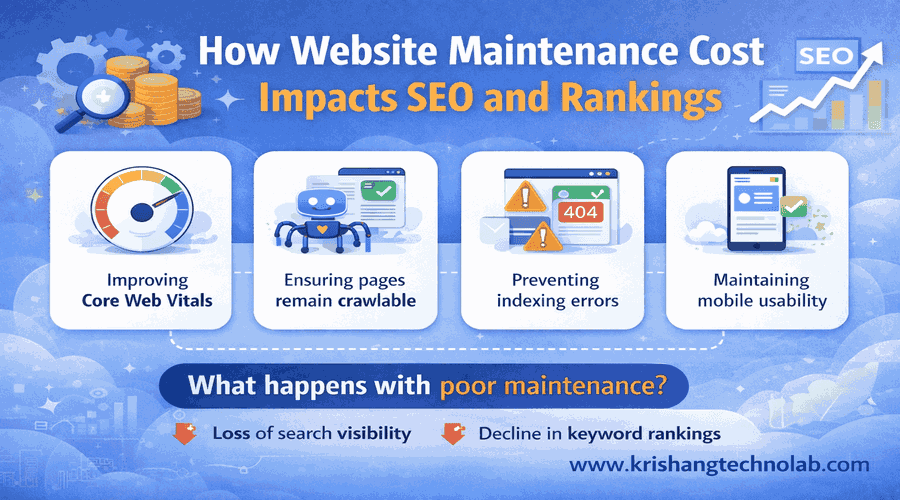
How well you take care of your site has a direct effect on how search engines rate it. Search engines like websites that load quickly, are safe, and are always up to date.
Maintenance is important if you want to avoid issues like broken links, slow page speed, old plugins, and security alerts. People will not trust you as much if you send these signals, which will affect your rankings.
From an SEO perspective, regular maintenance helps by:
- Improving Core Web Vitals
- Ensuring pages remain crawlable
- Preventing indexing errors
- Maintaining mobile usability
In simple terms, good maintenance protects your organic traffic and reduces the risk of sudden ranking drops.
Website Maintenance Cost vs Website Redesign Cost
Many businesses delay maintenance and later face a full website redesign. This usually costs far more.
| Scenario | Typical Cost | Long-Term Impact |
| Regular maintenance | Predictable monthly cost | Stable performance |
| Emergency fixes | High one-time cost | Business disruption |
| Full redesign | $5,000–$50,000+ | Major downtime & rework |
Ongoing maintenance is significantly cheaper than rebuilding a neglected website.
How Website Maintenance Costs Differ by Industry
What it costs to keep a website up and running varies from business to business because each has its own technical needs, risks, and rules. A site that just gives you information doesn’t need as much security or monitoring as a site that deals with a lot of transactions or sensitive information.
If a business knows how website maintenance costs change by industry, they can make more accurate budgets and avoid comparing their costs to websites that have very different needs. The costs and needs for maintenance change in different fields as shown below.
Healthcare and Finance
- Higher security standards
- Compliance requirements
- Frequent audits
Ecommerce and Retail
- Payment system monitoring
- Inventory updates
- High uptime requirements
SaaS and Technology
- API integrations
- Performance optimization
- Continuous feature updates
Industry-specific needs directly affect maintenance scope and pricing.
Website Maintenance Cost for Global Businesses
Global websites need more maintenance because they serve people from many different areas, languages, and systems. Managing performance, security, and compliance on a global scale is harder and costs more.
Reasons include:
- Multi-language content updates
- Regional compliance requirements
- CDN and global performance optimization
Global websites require more testing and monitoring, increasing maintenance effort.
How to Choose the Right Website Maintenance Plan
The best way to keep your website up to date depends on how important it is to your business. The level of support you really need depends on things like how complicated your site is, how often it needs to be updated, how much traffic it gets, and how secure it needs to be.
Consider:
- How often your site changes
- Whether downtime affects revenue
- Security and compliance needs
- Internal technical expertise
A good plan balances cost with risk prevention.
Website Maintenance Cost Planning Checklist
Use this checklist to plan your maintenance budget:
- Identify website type and complexity
- List required integrations
- Estimate traffic and growth
- Decide DIY vs professional
- Review plans annually
This approach prevents surprises and helps control costs.
Related Read: When managing errors or improving navigation, this Shopify 404 page guide can give you useful ideas.
The Future of Website Maintenance Beyond 2026
As websites become more automated, focused on security, and driven by performance, website maintenance will continue to change. Companies will have to get used to new technologies, stricter privacy rules, and higher expectations from customers.
Expected trends include:
- More AI-driven monitoring
- Stronger privacy regulations
- Increased automation
- Higher performance expectations
Planning ahead keeps maintenance costs predictable.
How to Choose the Right Website Maintenance Provider
Choosing the right website maintenance company can help you avoid downtime, security problems, and extra costs. The best providers don’t just fix issues after they happen; they also work to avoid them in the first place and make things clear and dependable.
When evaluating a provider, look for:
- Clear service details: You should know exactly what tasks are included
- Relevant experience: They should understand your website platform and industry
- Strong security and backups: Regular monitoring and reliable recovery plans
- Fast support response: Quick action when issues arise
- Transparent pricing: No hidden fees or unclear charges
A good website maintenance provider acts as a long-term partner, helping keep your website secure, stable, and cost-efficient. Companies that offer both development and long-term support such as teams providing end-to-end web development solutions are often better equipped to manage ongoing maintenance needs.
Why Should You Choose Krishang Technolab for Superior Website Maintenance?
Maintenance work at Krishang Technolab isn’t just about getting things fixed quickly; it’s also about making sure the site stays stable and safe and works well over time. Our team constantly monitors your website to address any issues before they negatively impact users, rankings, or sales.
We help websites of all sizes, from simple business sites to complex platforms, by using our technical knowledge, clear communication, and flexible maintenance plans. We make sure your website stays fast, safe, and reliable by focusing on security, performance optimization, and timely updates.
When you choose Krishang Technolab, you get a reliable maintenance partner who will keep your website running smoothly while keeping long-term maintenance costs low.
Final Thoughts
The cost of maintaining a website in 2026 shows how important websites are for business success. Maintenance is no longer something you do when something breaks; it’s something you plan ahead of time.
A well-maintained website delivers better performance, stronger security, higher search visibility, and lower long-term costs. When approached correctly, website maintenance is not an expense but an investment in stability and growth.
Found this post helpful? Don't forget to share it with your network!