Quick Overview: Vibe coding is transforming software development by allowing developers to use AI and natural language prompts to generate code faster. This blog explains what vibe coding is, how it works, its benefits, real-world uses, and how AI is shaping the future of programming.
Things are changing faster than ever in software development. Building software used to mean writing thousands of lines of code, fixing bugs, and spending years learning programming languages. Thanks to artificial intelligence, that process is changing. They can now tell AI what they want in plain English, and the AI will write the code.This new way of doing things is often called “vibe coding”.
An AI researcher, Andrej Karpathy, talked about the term, and it became more well-known. AI is used to do a lot of the technical work in a new way to make software that lets developers focus on ideas and results, such as automating repetitive tasks, generating code snippets, and providing intelligent suggestions during the development process.
This blog will discuss vibe coding, what it is, how it works, and how it might change the way people make software.
What Is Vibe Coding?
Vibe coding is a new way of writing code where programmers use prompts in natural language to tell AI tools what to do. This approach allows developers to describe the desired feature instead of manually writing every function or class. In this workflow, AI-driven vibe coders combine their programming knowledge with AI tools to generate code faster and focus more on building features and solving problems.
A developer might just describe the feature they want instead of writing each function or class manually. The AI assistant will then write the necessary code, which the developer can then look over, change, and make better.
A developer might type something like this instead of writing hundreds of lines of code to create a basic app:
“Create a simple web app that allows users to sign up, log in, and manage a to-do list.”
An AI coding tool can generate the structure, interface, and logic for that app.
Traditional Coding Vs Vibe Coding
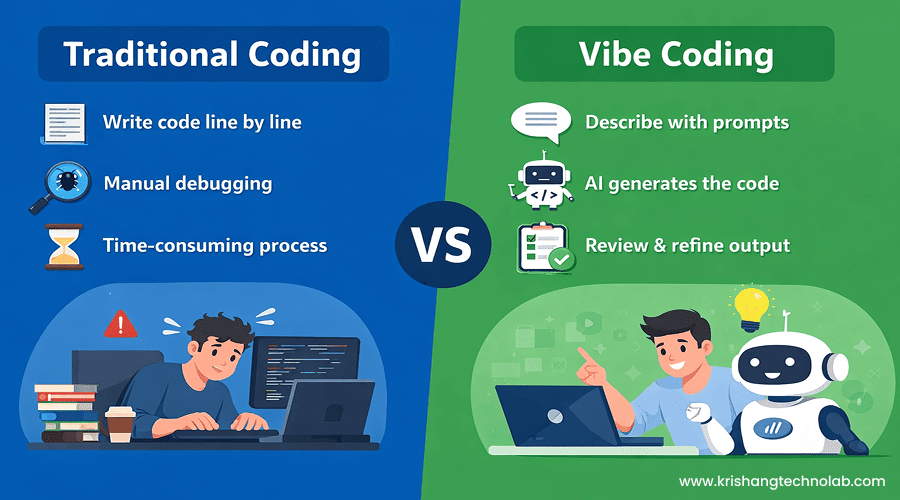
This approach turns programming into a more collaborative process between humans and AI.
Why Vibe Coding Is Getting So Popular
The quick rise of AI coding assistants is closely linked to the rise of vibe coding. GitHub Copilot, ChatGPT, and Cursor are examples of tools that let developers write code, fix bugs, and even plan out the structure of software with just a few words.
There are several reasons why developers and companies are adopting this new approach.
1. Faster Development
Speed is one of the best things about Vibe coding. Developers can now complete tasks that once took days or hours in just a few minutes.
Developers can quickly generate:
- boilerplate code
- API integrations
- database models
- basic user interfaces
Because of this productivity boost, many businesses are starting to hire vibe code developers who understand how to use AI tools to speed up development.
2. Lower Barrier to Entry
To become a developer in the past, you had to learn complex programming languages and frameworks.
AI coding assistants help beginners get started on projects much faster. People who don’t know much about coding can still make simple apps if they explain their ideas clearly.
Of course, knowing how to code is still important, but AI tools make it a lot simpler to learn.
3. Faster Prototyping
Startups and entrepreneurs often need to build prototypes quickly to test ideas.
Vibe coding makes it possible to create a working product prototype in hours instead of weeks. That speed can make a huge difference for startups trying to validate ideas or attract investors.
Read About: How to Choose the Right AI Software Development Partner
How Vibe Coding Works in Practice
Even though vibe coding sounds simple, it’s actually done in a structured way that follows certain methods to ensure the development process is clear and effective.
Many companies looking for faster development workflows now choose vibe coding developers for hire, as these professionals know how to use AI tools efficiently while still following proper development practices and structured processes.
Step 1: Describe the Goal
The developer begins by talking about what they want to make.
Example prompt:
“Create a landing page with a signup form that saves user emails in a database.”
The AI looks at the request and starts writing the code it needs.
Step 2: AI Generates the Code
The AI assistant writes the code that the feature needs. This could mean:
- frontend components
- backend logic
- database queries
- styling
Thereafter, developers can copy the code or use it in their own work.
Step 3: Test the Results
The developer then runs the app to see if it works as planned after writing the code.
Testing is still very important because code made by AI could have mistakes or not work as well as it should.
Step 4: Improve Through Iteration
By giving more instructions, developers improve the output.
For example:
- “Add a dark mode toggle.”
- “Improve the mobile layout.”
- “Optimize database queries.”
Key Benefits of Vibe Coding
Here are some of the most interesting things about vibe coding.
1. Higher Productivity
Developers spend less time writing code that does the same thing over and over again and more time resolving real problems.
AI can handle tasks like:
- code suggestions
- documentation generation
- bug detection
- refactoring
This improves development work overall.
2. More Focus on Creativity
It’s less important to remember syntax and more important to come up with solutions when you’re programming.
Developers can concentrate on:
- product ideas
- user experience
- system architecture
Now that things have changed, software developers can be more creative.
3. Faster Learning for Beginners
New developers can use AI tools to help them learn.
For instance, when AI writes code, people who are just starting out can look at the structure and figure out how it works. This helps them learn how to code more quickly.
4. Faster Product Launches
Businesses can get new goods on the market faster.
Businesses can test new ideas faster and respond to customer feedback better when their development cycles are shorter.
To get the best results from AI-powered development, some organizations also hire prompt engineers who specialize in writing structured prompts that guide AI tools to produce cleaner and more reliable code.
Read About: A Complete, In-Depth Guide to Mastering AI Communication
Real-World Applications of Vibe Coding
Vibe coding is already being used in many industries.
1. Startup Product Development
Startups use AI tools to build MVPs (minimum viable products) quickly and test new ideas before investing heavily in development.
2. Internal Business Tools
Companies often need simple internal software such as dashboards or automation tools.
AI-generated code makes it easier to create these tools without dedicating large engineering teams.
3. Rapid Website Creation
Websites, landing pages, and e-commerce platforms can be built much faster using AI coding assistants.
4. Automation and Integration
Businesses frequently need to connect different systems such as CRM platforms, payment systems, and analytics tools.
Another growing trend is software development outsourcing, where businesses partner with experienced development teams that already use AI-powered workflows. This allows companies to build applications faster without expanding their internal development team.
Challenges and Risks of Vibe Coding
While vibe coding offers many benefits, it also has some limitations.
AI-Generated Bugs
AI-generated code is not always perfect. It can contain errors, inefficient logic, or outdated libraries.
Developers still need to review and test everything carefully.
Security Concerns
Security is a major issue in software development.
If developers blindly trust AI-generated code, they may introduce vulnerabilities into their systems.
This is why human oversight remains essential.
Lack of Deep Understanding
Some critics argue that vibe coding could lead to developers who rely too heavily on AI without fully understanding the code.
Strong programming fundamentals are still necessary to maintain and scale complex applications.
Read More About: Challenges in AI Software Development and How to Overcome Them
The Future of Software Development
Vibe coding doesn’t mean programmers will disappear. Instead, their role is evolving.
In the future, developers will likely focus more on:
- designing system architecture
- guiding AI tools
- reviewing generated code
- solving complex technical problems
Programming may become more about thinking and problem-solving, rather than typing code.
AI and Human Collaboration
The most effective development teams will combine human creativity with AI automation.
AI excels at:
- generating code quickly
- handling repetitive tasks
- analyzing large datasets
Humans excel at:
- critical thinking
- product design
- strategic decisions
- understanding user needs
Together, they can build software more efficiently than ever before.
Build AI-Powered Applications with Krishang Technolab
Even though vibe coding speeds up software development, it still takes experienced developers to turn AI-generated ideas into apps that are reliable, safe, and scalable.
That’s where Krishang Technolab comes in.
Krishang Technolab helps startups and businesses hire vibe code developers who understand how to combine AI tools with modern software development practices.
Their team helps companies build powerful digital products faster by using AI-assisted workflows and scalable architectures.
Their expertise includes:
- AI-assisted software development
- Custom web and SaaS applications
- Scalable backend systems
- UI/UX-focused product development
Businesses that want to fully benefit from AI-powered development often choose to hire AI developers who understand both modern programming practices and AI-assisted tools used in vibe coding workflows.
Final Thoughts
Vibe coding represents one of the biggest shifts in the history of software development.
Instead of writing every line of code manually, developers can now collaborate with AI systems that generate and refine code based on natural language instructions.
This approach makes development:
- faster
- more accessible
- more creative
However, AI is not replacing developers. It is simply changing the way they work.
The future of programming will likely involve humans guiding intelligent systems, combining technical expertise with powerful AI tools.
As AI technology continues to improve, vibe coding may become the new standard for building software. And for developers, entrepreneurs, and businesses alike, that shift opens up exciting new possibilities.
Found this post helpful? Don't forget to share it with your network!