Quick Overview: Agencies constantly face client requests beyond their core skills. White label development partnership let agencies offer web, mobile, and software services under their own brand without hiring in-house developers. This guide covers seven ways to generate revenue through these partnerships, how to choose the right partner, and mistakes to avoid.
Digital demand isn’t slowing down. Clients no longer just want a marketing campaign or a brand refresh; they want websites, apps, e-commerce stores, and custom software to go with it. For agencies built around design, marketing, or branding, that shift creates a real problem: how do you say yes to development work without becoming a software company overnight? A White Label Development Partnership is how most agencies solve it.
Hiring an in-house dev team is expensive, slow to build, and difficult to keep busy year-round. Turning clients away means losing revenue and sometimes losing the client to a competitor who can offer everything. This is exactly the gap white label development partnerships are built to close, and it’s become one of the clearest paths to revenue growth for digital agencies willing to lean on outsourced development services instead of building every capability in-house.
In this guide, we’ll break down what a white label development partnership actually is, why it represents a genuine revenue opportunity (not just a workaround), seven concrete ways agencies can profit from it, how to choose the right partner, and the mistakes to avoid along the way.
What Is a White Label Development Partnership?
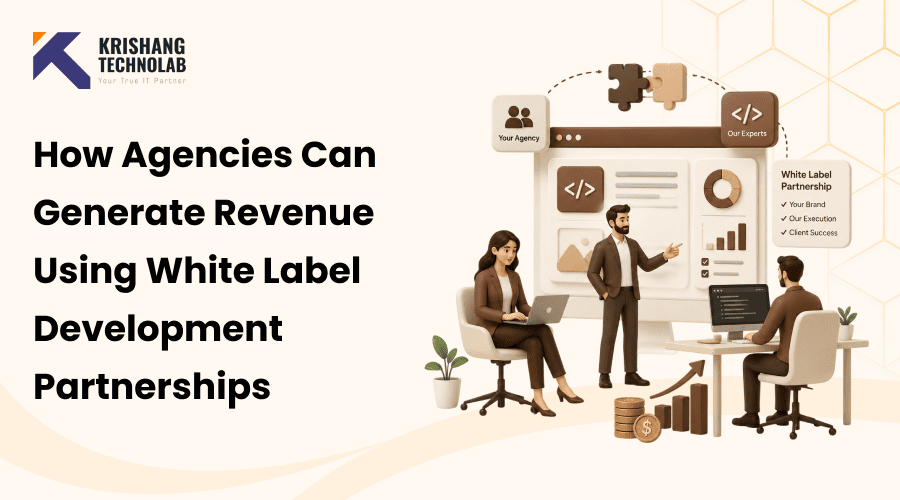
A white label development partnership is an arrangement where an outside development team builds technical work, websites, apps, software, and integrations while your agency remains the only brand the client ever sees. The developers work behind the scenes. Your agency handles the client relationship, the invoicing, the account management, and the strategic direction.
In practice, this means:
- The agency sells the project, manages the client relationship, and owns the outcome.
- The development partner does the technical build, reporting to the agency, never directly to the client.
- The branding stays entirely with the agency. Contracts, communications, and deliverables all carry your name, not the partner’s.
This is different from a typical freelancer or one-off outsourcing arrangement. A white label partnership is a standing relationship with established pricing, workflows, and communication norms and a bench of developers your agency can call on repeatedly, project after project. Unlike hiring a single freelancer, working with a full white label development company gives you access to a broader range of white label development services from web to mobile to custom software under one relationship.
Why Agencies Choose White Label Partnerships
There are a few consistent reasons why agencies turn to this model:
- Cost-effective scaling: You gain development capacity without the fixed cost of full-time salaries, benefits, or office overhead.
- Access to Experienced Developers: Established white label partners possess specialized skills (mobile, e-commerce, custom software) that would take years to develop in-house.
- Faster project delivery: Established partners have processes, tooling, and developers already in place; no ramp-up time.
For many agencies, the right agency development partner effectively becomes an extension of the team available on demand, without the commitment of a full-time hire. This is why white label outsourcing has become such a common growth lever across the industry, rather than a niche workaround, a shift we cover in more depth in our guide on how white label partnerships help business growth.
Why White Label Development Is a Revenue Opportunity for Agencies
It’s easy to think of white label development purely as a defensive move, a way to avoid losing clients who need technical work. But the real opportunity is offensive: it lets an agency actively grow revenue.
Growing demand for web, mobile, and software development.
Nearly every client-facing business now needs some combination of a website, an app, or custom software to compete. That demand isn’t going away, and agencies positioned to offer white label web development and white label software development capture more of the budget.
Ability to offer complete digital solutions.
Clients increasingly prefer a single vendor who can handle strategy, design, and build, rather than managing three separate agencies. Full-stack agencies are winning more business and larger contracts.
Increased client expectations.
Clients today expect their agency to be a full digital partner, not just a specialist. Meeting that expectation profitably is where white label development pays off.
7 Ways Agencies Can Generate Revenue with White Label Development Partnerships
Whether the goal is to scale your agency’s service offering or simply protect existing accounts, the following approaches show where the actual revenue comes from, not just the theory behind it.
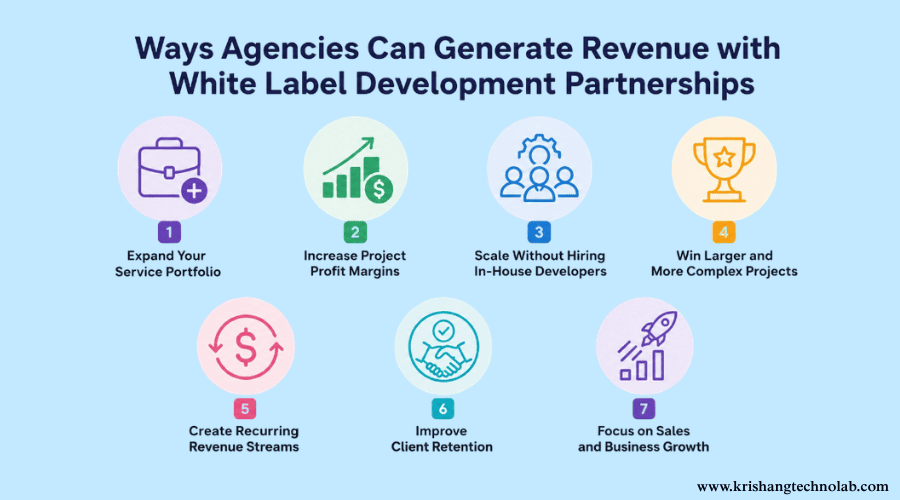
1. Expand Your Service Portfolio
The most direct way white label development generates revenue is by letting you say yes to services you couldn’t otherwise offer:
- White label web development: custom websites beyond template builds
- Mobile apps: iOS and Android builds for clients moving beyond web
- E-commerce: Shopify, WooCommerce, or custom storefront builds
- CMS development: WordPress, Webflow, headless CMS implementations
- White label software development: internal tools, dashboards, and platform builds
Each of these is a new line item you can sell without hiring a single new employee, a model explained further in our post on the benefits of a white label web design reseller.
2. Increase Project Profit Margins
White label partnerships work on a simple wholesale-to-retail model. You pay the partner their rate, the “wholesale” cost, and bill the client at your own “retail” rate. The spread between the two is pure margin.
Because you’re not carrying the overhead of full-time developers (payroll, benefits, management, and downtime between projects), that margin can be substantial. Agencies commonly mark up white label development work by 40–80%, depending on complexity, project management involvement, and market positioning. The result is a higher ROI per project than most agencies get from their core services alone.
3. Scale Without Hiring In-House Developers
Hiring in-house means recruitment costs, onboarding time, benefits, and the risk of being underutilized during slow periods. A white label partnership avoids all of this:
- Lower your recruitment costs: no job postings, interviews, or lengthy hiring processes.
- Less overhead: no extra salaries, benefits, or office space attached to development personnel.
- Flexible resource allocation: scale up for a big project and scale down when it’s done, with no layoffs and no idle payroll.
This flexibility means agencies can take on more (and bigger) projects without the financial risk of overstaffing, making it one of the lowest-risk ways to scale your agency without touching headcount.
4. Win Larger and More Complex Projects
With a reliable development partner behind you, your agency can credibly pitch for work that would have been out of reach before:
- Enterprise opportunities: Bigger companies, with bigger budgets, often require full-stack ability as a baseline.
- Multi-service contracts: Packaging marketing and development with design into one contract increases deal size and client stickiness.
- Competitive advantage: when a competing agency can’t offer development and you can, you win the pitch.
Bigger projects mean bigger invoices and white label partnerships are what make bidding on them realistic.
5. Create Recurring Revenue Streams
One-off projects are beneficial; recurring revenue is better. White label development partnerships make it possible to sell ongoing service retainers that didn’t exist in your offering before:
- Website maintenance: regular updates, bug fixes, and content changes
- Technical support: a support line clients can call when something breaks
- Hosting: managed hosting sold as part of a package
- Security updates: patching and monitoring sold as a safety net
- White label SEO: ongoing optimization retainers sold under your agency’s brand
- Monthly retainers: a flat monthly fee covering a bundle of the above
These retainers turn unpredictable, project-based income into predictable, recurring monthly revenue, often the most valuable kind of revenue an agency can build.
6. Improve Client Retention
Clients are much less likely to leave an agency that can support all their digital needs. White label development means your agency becomes a one-stop shop:
- Single-source digital solutions: no need to manage multiple vendors.
- Better customer experience: fewer handoffs, fewer points of friction, faster turnaround.
- Long-term relationships: clients who rely on you for more services are more expensive (and more inconvenient) for them to leave.
Retention is its own revenue driver; keeping an existing client is almost always cheaper than acquiring a new one.
7. Focus on Sales and Business Growth
Perhaps the most overlooked revenue benefit: white label partnerships free up your team’s time. Instead of your leadership or account managers getting pulled into technical problem-solving, they can focus on what actually grows the business:
- Spend more time acquiring clients, instead of managing developers.
- Let experts handle development, while your team handles strategy and relationships.
- Increase overall productivity; your existing staff can serve more clients since they’re not stretched thin on technical execution.
Benefits of a White Label Development Partnership
White label development for agencies has structural benefits outside the direct revenue angle, benefits that compound over time, which we break down further in our post on white-label services for agency expansion:
- Faster turnaround times: established partners can start quickly, without a hiring or onboarding delay.
- Access to skilled developers: specialized expertise without the cost of building it internally.
- Reduced operational costs: no added payroll, benefits, or equipment.
- Enhanced scalability: capacity grows or shrinks based on client demand.
- Higher project quality: partners with proven QA processes.
- Lower business risk: no long-term staffing commitments tied to the volume of project work.
- Higher profitability: the combination of margin, retention, and reduced overhead adds up.
How to Choose the Right White Label Development Partner
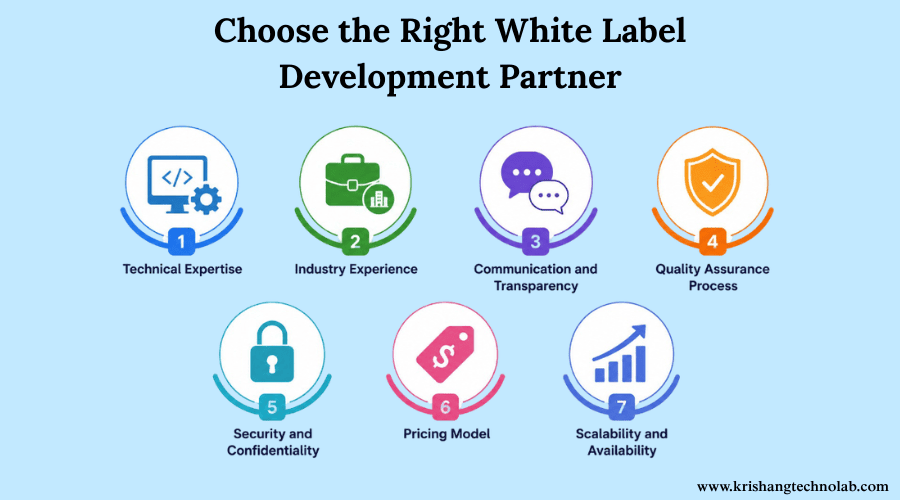
Not all partners are created equal, and the wrong choice can undo all of the above benefits. Whether you’re evaluating a small dev team or a full white label development company, assess potential partners.
1. Technical Expertise
Do they have a history of working with the technologies you’ll be selling? Ecommerce platforms? Mobile frameworks? Custom software stacks?
2. Industry Experience
Have they worked with clients in your normal verticals before? Industry familiarity often means fewer surprises and faster onboarding per project.
3. Communication and Transparency
Will they give you clear, regular updates without needing to be chased? Poor communication from a partner becomes your problem the moment it reaches the client.
4. Quality Assurance Process
Do they have a defined QA process before work is handed back to you? You shouldn’t be the only line of defense against bugs.
5. Security and Confidentiality
Will they sign NDAs and protect client data? This is important for an enterprise or regulated customer.
6. Pricing Model
Does their pricing model (hourly, fixed-fee, retainer) align with how you want to bill clients? Mismatched pricing models create margin headaches.
7. Scalability and Availability
Can they flex up if you get a big project and be available for smaller, ongoing work? You need an agency development partner who can help you with projects of all sizes, not just one.
Best Practices for a Successful White Label Partnership
Once you’ve chosen a partner, these practices keep the relationship and the margin healthy:
- Define project scope clearly. Vague scope is where profit disappears; detailed statements of work protect both sides.
- Develop communication workflows. Set expectations up front on how often you’ll be providing updates, through which channels and how escalation will work.
- Employ project management tools. Shared visibility into timelines and tasks reduces friction and missed handoffs.
- Set realistic timeframes. Padding in estimates protects both your partner’s workload and your client relationship.
- Conduct quality checks. Never pass partner work straight to a client without your own review.
- Maintain client transparency (about the arrangement internally, not necessarily to the client) make sure your own team understands how the partnership works so nothing is miscommunicated.
- Build long-term collaboration. Treating the partner as a long-term ally, not a disposable vendor, leads to better pricing and priority over time.
Common Mistakes Agencies Should Avoid
- Partner selection based solely on price. Usually the cheapest option costs more in rework, delays, and client unhappiness.
- Poor communication. Gaps in updates from the partner become gaps in your client relationships.
- Lack of quality assurance. If you skip your own QA pass, you risk shipping bugs under your agency’s name.
- Overpromising to clients. Commit only to what you’ve confirmed is realistic with your partner, not what sounds good in a pitch.
- Not signing confidentiality agreements. Have strong NDAs in place from the outset to protect your reputation and client data.
- No support was provided post-launch. Projects that don’t launch successfully leave money and client goodwill on the table.
Is a White Label Development Partnership Right for Your Agency?
This model tends to work best for agencies with client trust and a sales engine but who lack in-house technical capacity. That includes marketing agencies, design studios, branding shops and consultancies that get regular requests for web or app work that they currently turn down or refer elsewhere. For these teams, white label development for agencies is less about replacing existing services and more about filling the capability gap with trustworthy outsourced development services.
Signs it’s time to consider outsourcing development:
- You’re regularly turning down technical requests from existing clients.
- Competitors are winning larger, full-stack contracts you can’t currently bid on.
- You’ve tried hiring in-house but can’t keep developers consistently busy.
- Clients are asking for ongoing technical support you’re not equipped to provide.
Questions to ask before partnering:
- Can this partner handle the specific type of work my clients need?
- What does their QA and revision process look like?
- How will pricing translate into a markup that’s sustainable for my agency?
- Are they set up to stay invisible to my clients, or will they want direct contact?
Why Agencies Choose Krishang Technolab as Their White Label Partner
Krishang Technolab is a full-spectrum white label development company with 8+ years of experience supporting agencies across web, mobile, e-commerce, and HubSpot development. Agencies partner with Krishang Technolab because the team works entirely behind the scenes branded under the agency’s name, with no direct client contact unless requested while handling everything from white label WordPress development and white label Shopify development to custom software and ongoing maintenance.
Krishang Technolab has worked with 300+ agencies and businesses in 25+ countries, providing transparent pricing, signed NDAs and dedicated project teams that integrate seamlessly with an agency’s existing tools and workflows. Krishang Technolab is designed exclusively for agencies that require a reliable technical partner, not a one-time vendor.
Conclusion
Agencies can expand their service offering, increase profit margins, win larger contracts and build recurring revenue through white label development partnerships without the cost and risk of hiring an in-house development team. Those agencies who benefit most from this don’t see it as a stopgap; they create clear scoping practices, invest in the right partner relationship and use the extra capability to grow their business, not just plug a gap.
If your agency is regularly fielding requests it can’t fulfil or losing ground to competitors who offer full-stack digital services, it may be time to evaluate white label outsourcing as a long-term growth strategy, not just an occasional workaround. Done right, it’s one of the most reliable levers for sustained revenue growth for digital agencies of any size.
Found this post helpful? Don't forget to share it with your network!