
Quick Overview: Choosing the right white label Shopify agency can make or break how an agency scales ecommerce delivery. This guide breaks down what to look for, what services to expect, current 2026 pricing, red flags to avoid, and how to vet a partner before signing on.
If you run a digital agency, you have probably faced this moment: a client wants a Shopify store, but your team does not have the in-house bandwidth or deep platform expertise to build it the way you would like. This is exactly where a white label Shopify agency comes in. Instead of saying no to the project or hiring full-time developers you might not need in six months, you partner with a specialist who creates the store behind the scenes while you stay the face of the relationship.
The challenge is that not every white label partner is built the same way. Some are reliable, transparent, and genuinely invested in your client’s success. Others create more operational headaches than they solve. This guide walks through everything you need to know to choose a white-label Shopify partner with confidence, what to look for, what to avoid, and how to make the relationship work long after the contract is signed.
What Is a White Label Shopify Agency?
A white label Shopify agency is a development partner who will build, customize, or maintain Shopify and Shopify Plus stores for you to brand as your own. Your client never sees the partner’s name, logo, or communication. From their perspective, your agency designed the store, wrote the code, and delivered the final product.
Behind the scenes, the white label partner usually provides theme development, app integrations, custom features, migrations, and ongoing technical support. You manage the client relationship, pricing, and strategy, while the technical execution happens through your partner’s team.
This model has become especially common as agencies expand into ecommerce development without wanting to carry the overhead of full-time Shopify developers on payroll. A growing number of agencies also use white labeling for other platforms, not just Shopify, which is why many partners present it as part of a broader white label web design offering rather than a one-off service.
Also Read About: How White Label Shopify Development Works
Why Agencies Are Turning to White Label Shopify Development
The move to white label models is not a convenience-driven trend. There are some practical realities pushing agencies in this direction:
Shopify expertise is a niche. Shopify Plus, liquid templating, headless storefronts, app ecosystem integrations, and checkout customizations all require a dedicated expert to work with.Generalist developers can build a functional store, but they often miss the performance and conversion details that come from doing this work day in and day out.
Hiring is slow and expensive. Recruiting and training a qualified in-house Shopify developer can take months, and with that comes the risk of payroll, particularly when your project pipeline is inconsistent.
Client demand for ecommerce is rising. More businesses are launching or migrating to Shopify every year, and agencies that cannot deliver these projects often lose the client entirely to a competitor who can.
Scalability matters. A white label model lets you take on two Shopify projects or twenty without proportionally growing your internal team. You increase delivery capacity without increasing fixed costs.
Signs You Need a White Label Shopify Partner
Not every agency needs to outsource Shopify work, but certain signals make it worth exploring:
- Clients are asking for Shopify builds, redesigns, or migrations, and you currently have to decline or subcontract informally.
- Your in-house developers are stretched across multiple platforms and cannot dedicate focused time to Shopify Plus or complex integrations.
- You are losing deals to competitors who can offer faster Shopify turnaround.
- You want to expand intoShopify development services without the upfront cost of building a specialized team.
- Project volume is inconsistent, making full-time hiring financially risky.
If two or more of these apply to your agency, a white label partnership is worth evaluating seriously.
What Services Should You Expect from a Top White Label Shopify Agency?
It’s wise to know what a full white label Shopify offering should really include before you start looking at partners. Agencies that only do basic theme installs will limit how far you can grow your ecommerce offering, but a truly capable partner will support the entire lifecycle of a Shopify store. What should be on the table is this:
- Custom Shopify and Shopify Plus store development
- Theme and UI/UX design
- App and API integrations
- Custom Shopify app development
- Platform migrations
- Headless and composable commerce
- Performance and Core Web Vitals optimization
- Ongoing maintenance and support
- NDA-backed confidentiality and white label delivery
A partner who can genuinely deliver across all of these areas gives your agency the flexibility to take on a wider range of Shopify projects, from a simple single-product store to a complex Shopify Plus enterprise build, without having to “shop around” for different specialists each time. This is also where it becomes worth confirming whether the partner’s Shopify development services extend into the more advanced end of this list, rather than just the basics.
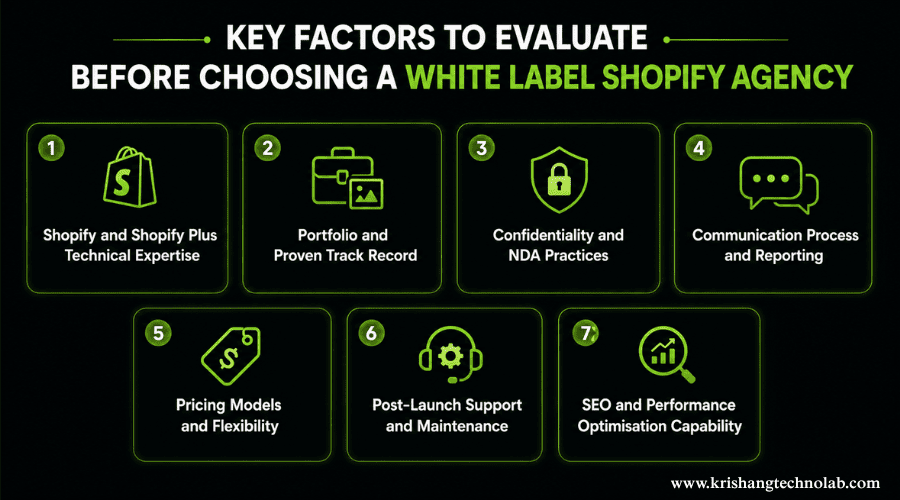
Key Factors to Evaluate Before Choosing a White Label Shopify Agency
This is the part that determines whether the partnership succeeds or quietly damages your client relationships. Go through each of these factors methodically before signing any agreement.
1. Shopify and Shopify Plus Technical Expertise
Not all Shopify developers are equal. “Have you worked with Shopify before?” Extensions for custom checkouts Headless commerce with Hydrogen and other frameworks Liquid third-party app integrations for theme customisation When a client requires more sophisticated features, such as B2B wholesale functionality or intricate subscription logic, a partner who has only developed basic stores on free themes will be at a disadvantage.
It also helps to confirm whether the partner offers broader eCommerce development capability beyond Shopify alone. Agencies that understand multiple e-commerce platforms tend to bring more architectural judgement to Shopify projects, since they are not limited to “the Shopify way” of solving every problem.
2. Portfolio and Proven Track Record
Request to see actual, completed Shopify projects, not just generic mockups. Test the site’s speed, mobile-friendliness, checkout process and overall quality of the design. If you can, ask for references or case studies of agencies who have used their white label service specifically, not just end clients.
A partner confident in their work will have no hesitation sharing a portfolio of completed projects across different industries and store complexities.
3. Confidentiality and NDA Practices
This is non-negotiable in a white-label relationship. Your partner should offer a signed NDA as standard practice, communicate only through your branded channels, and never reach out to your client directly. Just ask, “What if my client gets in touch with you somehow?” A mature partner has a documented process for doing this.
4. Communication Process and Reporting
White label work fails most often not because of bad code but because of poor communication. Before committing, understand how updates are shared, what tools are used for project tracking, how quickly questions get answered, and what time zone overlap looks like if the partner is offshore. Agencies that align closely with your existing workflow, rather than asking you to adapt to theirs, tend to create a much smoother long-term relationship.
5. Pricing Models and Flexibility
White label Shopify pricing typically falls into three main categories: fixed project pricing, hourly/retainer-based engagement or dedicated monthly resourcing. None of these are better, but the better one depends on your volume and predictability of projects. Be wary of partners who lock you into long minimum commitments before you have tested the relationship on a smaller project.
6. Post-Launch Support and Maintenance
A Shopify store is not “done” at launch. Theme updates, app conflicts, seasonal traffic spikes, and platform updates from Shopify itself all require constant attention. Does your white label partner have a support window after delivery? How quickly do they respond to urgent issues such as checkout failures?
7. SEO and Performance Optimisation Capability
Today, many agency-client relationships are about more than design and development, but visibility and growth. Rather than thinking about SEO after the store is live, a white label partner knowledgeable in SEO services and Shopify development will be able to structure collection pages, product schema, and site speed in a way that will help organic rankings from day one. If your agency also resells search optimisation, ask if the partner can support a coordinated white label SEO workflow in addition to the build itself.
More Read About: Top Features to Look For in a White-Label Shopify Provider
How Much Does White Label Shopify Development Cost in 2026?
Pricing for white label Shopify development varies more than most agencies expect, mainly because “cost” depends heavily on whether you are paying hourly, per project, or through a dedicated monthly engagement. The table below breaks down how the numbers generally look going into 2026.
| Engagement Type | Typical Range (2026) | Best Fit For |
| Hourly – Offshore / South Asia | $20 – $60/hour | Ongoing tweaks, smaller tasks, agencies testing the white label model |
| Hourly – US / Western Europe | $90 – $200/hour | Agencies needing tight time-zone overlap or premium Shopify Plus expertise |
| Fixed project – Standard Shopify build | $2,500 – $15,000 | Theme customization, basic app integrations, launch support |
| Fixed project – Shopify Plus / headless | $20,000 – $150,000+ | Custom checkout logic, B2B functionality, headless or enterprise catalogs |
| Monthly retainer – Entry tier | $600 – $700/month | A fixed block of development hours for occasional Shopify needs |
| Monthly retainer – High-volume tier | $3,000 – $4,000+/month | Agencies running multiple concurrent Shopify Plus projects with faster turnaround and dedicated account management |
What actually drives the price up or down:
| Cost Driver | Lower-Cost Scenario | Higher-Cost Scenario |
| Theme complexity | Modified existing theme | Fully custom design built from Figma |
| Integration depth | A handful of standard apps | ERP, CRM, or custom payment integrations |
| Shopify tier | Standard Shopify | Shopify Plus, checkout extensibility, B2B logic |
| Migration scope | New store build | Migrating an existing catalog, reviews, and SEO equity from another platform |
| Support window | Short or no post-launch support | Extended post-launch support bundled or billed separately |
For your margin planning, most agencies mark up white-label Shopify work by around 40-60 percent once you add in project management time and a typical round of client revisions. A fairly typical example of how that margin plays out in the real world is a client-facing build that costs $6,000 but is sourced through a partner for $2,500 to $3,000. The lowest hourly rate is rarely the best value here. A lower rate that involves multiple rounds of correction usually costs more in elapsed time and client patience than a slightly higher rate from a partner who produces clean work the first time around.
How Krishang Technolab Helps Agencies Deliver White Label Shopify Projects at Scale
Looking at how an established provider structures this model can make the evaluation criteria above feel more concrete. Krishang Technolab has built its white-label Shopify offering specifically around the scale problem agencies run into once Shopify demand outgrows what an internal team or a single freelancer can absorb.
A few things stand out in how this works in practice for agency partners:
1. Full-spectrum Shopify and Shopify Plus capability
The team handles everything from standard store setup and theme customization to Shopify Plus builds, including custom checkout logic, B2B functionality, and headless storefronts, so agencies do not need separate vendors for simple projects versus enterprise ones. This sits alongside broader e-commerce development experience across other platforms, which often means stronger architectural decisions even on Shopify-only projects.
2. Flexible engagement models
Whether an agency needs a single fixed-price build, an hourly arrangement for ongoing tweaks, or a dedicated monthly resource for high-volume Shopify Plus work, the engagement structure is built around how the agency actually sells the work to its own clients, rather than forcing every project into one rigid pricing format.
3. NDA-backed, invisible delivery as standard practice
Confidentiality is not an add-on request; it is built into how every white label engagement runs. Communication stays inside the agency’s branded channels, and the partner team never appears in a client’s Shopify admin or contacts the client directly.
4. Integrated SEO and performance support
Because the team also runs dedicated SEO services and a structured white label SEO program, Shopify builds can be handed over with clean URL structures, schema, and Core Web Vitals already accounted for, rather than treating organic visibility as a separate project months later.
5. Agency-aligned workflow and reporting
With 8+ years of experience and 1,000+ delivered projects across more than 25 countries, the team is set up to work inside an agency’s existing project management tools and reporting cadence rather than asking agencies to adapt to a new system.
A look at the portfolio of completed work is generally the fastest way to judge whether this kind of structure, full Shopify capability, flexible pricing, strict confidentiality, and integrated SEO, lines up with what a specific agency actually needs before committing to a partnership.
Red Flags to Watch Out for When Hiring a White Label Shopify Partner
Some warning signs are easy to miss in that first sales conversation but are obvious once a project is underway:
- Vague answers about NDA or confidentiality terms. If they stall out or seem to be going through the motions, take that as a red flag.
- No clear project management process. Down the line expect confusion when your partner can’t explain how updates, milestones and revisions are tracked.
- Pressure to commit to large retainers immediately. Good partners are generally comfortable starting small with a pilot.
- Generic, templated portfolios. Shopify stores without any signs of custom functionality lack technical depth.
- Unclear ownership of code and assets. Confirm in writing that you and your client retain full ownership of the final store, theme files, and any custom apps built.
- No defined escalation path. Things go wrong on every project eventually. A partner with no clear plan for handling delays or bugs is a liability, not a safety net.
Questions to Ask a White Label Shopify Development Company
Use these during your vetting calls to separate serious partners from the rest:
- How many Shopify Plus projects have you completed in the last 12 months?
- Can you walk me through your QA and testing process before handoff?
- What is your standard turnaround time for a mid-complexity store build?
- How do you handle scope changes mid-project?
- What does your post-launch support package include, and for how long?
- Who owns the code, theme, and custom apps once the project is delivered?
- How do you ensure confidentiality if my client ever tries to reach your team directly?
- Can you share a reference from another agency you have worked with under a white label arrangement?
White Label Shopify Agency vs Hiring In-House: Which Is Better?
There’s no single answer, but it usually comes down to volume, predictability, and specialization.
In-house hiring makes sense when your agency has consistent high-volume Shopify work, you want full day-to-day control of the development process, and you have the budget to absorb the downtime between projects.
White label development is a better option if your Shopify projects are inconsistent or seasonal, you need specialized Shopify Plus or headless expertise without a long hiring cycle, or you want to test demand for e-commerce services before committing to permanent headcount.
Most growing agencies will use a hybrid model: a small in-house team will set the strategy and design direction for the client, and a white-label Shopify development partner will tackle the technical build. Thus, creative control stays in-house, while the pieces that require deep, ongoing platform expertise are offloaded.
Read Detail Comparison: White-Label Shopify Development vs In-House Shopify Development Team
How to Onboard a White Label Shopify Partner Successfully
The right partner is just half the equation. A smooth onboarding process protects both your timeline and your client relationship:
- Try a smaller pilot project before you commit to a long-term retainer. This shows the quality of communication and technical realization in real conditions.
- Document your brand and communication standards so that the partner’s output is consistent with your agency’s look and feel.
- Have clear escalation contacts on both sides for urgent issues
- Establish how often you will report back to each other, whether that’s weekly check-ins, milestone updates, or a shared project board.
- Write out the revision rounds and scope boundaries before the build starts, not when disagreements arise.
A partner who works as a genuine extension of your team, following your existing website design standards and workflow tools, will make this transition largely invisible to your clients, which is the entire point of white labeling.
Final Thoughts: Making the Right Choice for Long-Term Growth
Choosing a white label Shopify agency is less about finding the cheapest option and more about finding a partner whose technical depth, communication style, and confidentiality practices match how your agency actually operates. Take the time to vet thoroughly, start small, and pay close attention to how a potential partner handles the details, NDAs, reporting, scope, and support, because those details are what separate a partnership that scales your agency from one that quietly puts your client relationships at risk.
If you are exploring this path, it is worth reviewing a few completed builds and case studies before making a decision, regardless of which partner you ultimately choose. The right fit will be obvious once you compare how different teams actually work, not just what they promise in a sales call.
Found this post helpful? Don't forget to share it with your network!