

Quick Overview: Choosing the right Next.js development partner in 2026 can make or break your agency’s growth. This guide covers the essential criteria technical depth, white-label discipline, communication, scalability, and pricing transparency plus red flags to avoid, so you can confidently vet and structure a long-term white-label Next.js development partnership.
Agencies are under more pressure than ever to deliver fast, high-performing, SEO-friendly websites and web apps without inflating headcount or overhead. That’s why more and more agencies are turning to white-label Next.js development partner instead of trying to build every project with an in-house team.
The right partner can help you take on more clients, hit tighter deadlines, and deliver technically superior work under your own brand. The wrong one can quietly damage your reputation, blow your margins, and leave you fixing broken code before a client demo.
In 2026, with Next.js now the default choice for performance-driven, SEO-conscious web projects, choosing a white-label partner isn’t just a hiring decision; it’s a strategic one. This guide breaks down exactly what agencies should look for before signing on with a Next.js development partner, the red flags to avoid, and how to structure the relationship for long-term success. If you’re weighing your options, it also helps to see how the top white-label agency partners in the USA are structuring these relationships in 2026.
Why Next.js Is the Framework Agencies Can’t Ignore in 2026
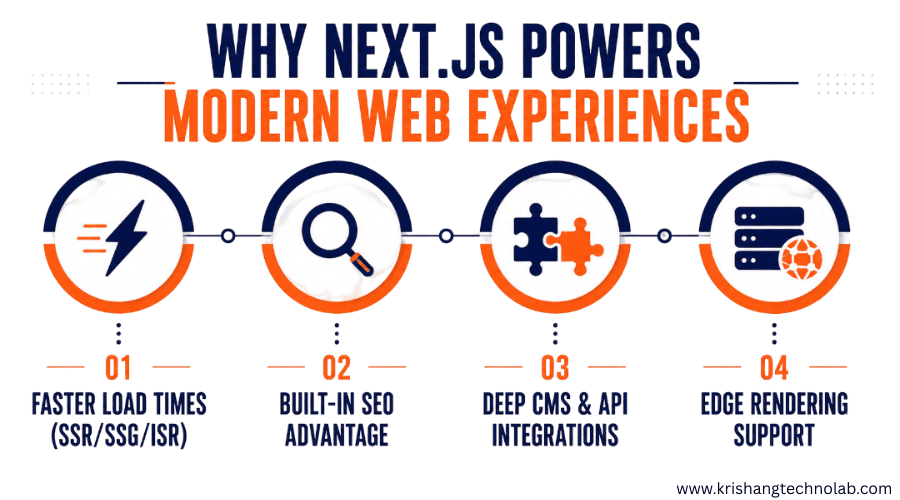
Next.js has moved well past “trendy React framework” status. It’s now the standard many enterprise and mid-market clients expect by default, largely because it solves problems agencies used to spend weeks working around manually.
Why Next.js is ruling client conversations in 2026
- Flexibility in hybrid rendering This gives teams the flexibility to choose the rendering strategy that makes sense for each page, instead of being locked into a single architecture for the entire site with one framework that has SSR, SSG, and ISR (or hybrid rendering).
- Server Components and the App Router have come a long way to ship less JavaScript to download and faster page loads, all without losing interactivity.
- SEO performance. Clients, especially marketing-driven agencies, care deeply about Core Web Vitals, crawlability, and page speed. Next.js is built with these priorities baked in.
- Ecosystem maturity. With deep integrations with headless CMS platforms, e-commerce backends, GraphQL APIs, and edge deployment platforms, you’ll spend less time on custom workarounds and get to builds faster.
This growing complexity is exactly why generalist web development shops often struggle to deliver Next.js projects at a consistently high standard. Agencies need a Next.js development partner who lives and breathes this framework, not one that’s dabbled in it on a couple of side projects. Partners who specialize in dedicated Next.js development services tend to have the App Router and Server Components experience that generalist shops simply haven’t built up yet.
What “White Label” Really Means in Development
Before diving into evaluation criteria, it’s worth clarifying what a white-label arrangement actually looks like in practice, since the term gets used loosely.
In a white-label agency partnership, the technical partner builds the product, but your agency owns the client relationship, the branding, and the communication. The client typically never knows a third party is involved. Common models include:
- Project-based engagements: a defined scope, timeline, and deliverable, billed as a fixed project.
- Dedicated team models: a set of developers who work exclusively (or near-exclusively) on your agency’s projects over an extended period.
- Staff augmentation: individual developers who plug into your existing workflows and act as an extension of your internal team.
Understanding which model you need before you start evaluating partners will save you a lot of back-and-forth. A dedicated team makes sense if you have a steady pipeline of Next.js work; project-based engagements are better suited to occasional or one-off builds. If you’re still unclear on the fundamentals, it’s worth reading up on what a white-label agency actually is before you start reaching out to vendors.
Core Criteria Agencies Should Evaluate in a Next.js Development Partner
Once you know what kind of engagement you need, it’s time to vet the partner itself. Whether you’re outsourcing a single project or building a long-term white-label Next.js development relationship, here’s what actually matters.
1. Technical Depth in Next.js — Not Just React
This is the single biggest differentiator between a strong and a weak Next.js development partner. Plenty of developers know React well but haven’t worked deeply with Next.js-specific architecture. Look for demonstrable experience with:
- App Router and Server Components (not just legacy Pages Router projects)
- Rendering strategy decisions, knowing when to use SSR, SSG, or ISR, and why
- Edge functions and edge middleware for latency-sensitive applications
- Core Web Vitals optimization (LCP, CLS, INP) at a code level, not just via plugins
- Integration experience with headless CMS platforms (Contentful, Sanity, Strapi), Shopify headless commerce, GraphQL APIs, and Tailwind-based design systems
Ask to see real, shipped Next.js projects, not just Figma mockups or GitHub repos with no production history. It’s also worth asking how their React developers approach component architecture, since strong React fundamentals underpin everything Next.js does on top of it.
2. True White-Label Discipline
A partner can be technically excellent and still be a poor white-label fit if they can’t operate invisibly. Before signing anything, check:
- Whether their code, comments, commit history, and documentation are free of their own branding
- Whether they can produce client-facing reports, documentation, and communication under your agency’s name
- Whether they have formal NDAs and confidentiality agreements ready to go, not drafted on request after you ask
This discipline matters most in high-stakes moments: client calls, technical audits, or handoffs. A partner who slips and reveals themselves even once can damage the trust you’ve built with a client over months.
3. Communication and Workflow Compatibility
Even the best developers are a liability if communication breaks down. Evaluate:
- Time zone overlap: how much working-hours overlap you’ll realistically have for real-time collaboration
- Response times: both during the sales process (a strong predictor of what’s to come) and stated SLAs for ongoing projects
- Project management tooling: do they work comfortably in Jira, Linear, Asana, or whatever your agency already uses, or will you need to adapt to their systems?
- Reporting cadence: daily standups, weekly summaries, or milestone-based updates
A technically brilliant Next.js development partner who’s difficult to reach or vague in updates will cost you more in managed stress than they save in development hours.
4. Scalability and Team Flexibility
Agency workloads are rarely constant. A good partner should be able to:
- Scale a team up quickly for a large project or tight deadline
- Scale down without friction once a project wraps, without locking you into unnecessary retainers
- Run multiple client projects in parallel without quality dropping
- Offer bench strength, meaning if a developer leaves or gets sick, there’s a qualified backup, not a scramble.
Ask directly: “If I needed to double my team size next month, could you do it, and how fast?” Partners who run a broader software development outsourcing practice, rather than a single small team, are usually better positioned to flex up or down on short notice.
5. Quality Assurance and Code Standards
This is where many white-label relationships quietly go south. Having “working” code is one thing; maintainable, secure, and scalable code is quite another. Look for
- TypeScript by default, not an afterthought
- Code review processes in place (not just one developer pushing directly to production)
- Automated testing practices, unit tests, and end-to-end (E2E) testing frameworks such as Playwright or Cypress
- CI/CD pipelines for safe, repeatable deployments
- standards of linting and formatting in the codebase
Ask to see a sample of their code style guide or how they do their review process. If you find that there are no formal ties with partners, this is a warning sign.
6. Design-to-Development Handoff Capability
Your Next.js development partner needs to translate the designs faithfully, not loosely “interpret” them, as agencies usually have their own design teams. Search for
- Experience translating Figma files into pixel-perfect, responsive builds
- Comfort with component-based design systems (so design changes don’t require a full rebuild)
- Willingness to work with your design team during the build, not just at handoff
7. Post-Launch Support and Maintenance
A project doesn’t end with launch, and nor should the partnership. Ask about:
- Bug fix and critical issue response time SLAs
- Ongoing performance monitoring and tuning
- Whether they are considering a long-term partnership or a single delivery
Agencies that approach each project as a “ship it and move on” transaction tend to leave behind technical debt that surfaces months later, typically in the form of a client escalation.
8. Pricing Transparency and Flexibility
Finally, and not surprisingly, price matters. But the objective isn’t lowest cost; it’s predictable, transparent pricing that protects your margins. Calculate:
- What they provide, such as fixed price, hourly, or retainer models, and what works for your typical client work
- Clarity on what is included versus what is billed as an extra (revisions, extra environments, and third-party integrations)
- Red flags include vague estimates, a reluctance to put pricing in writing, or scope definitions that appear deliberately loose.
If you want a benchmark before negotiating, this breakdown of dedicated development team pricing provides a realistic sense of what rates look like across regions and seniority levels in 2026.
Red Flags to Watch Out For
Beyond the criteria above, a few warning signs should make you pause before signing with any Next. JS development partner:
- Vague or unverified portfolios: If they can’t point to specific, live Next.js projects they built from scratch, don’t.
- Slow or inconsistent communication during the sales process: This behavior almost always predicts how they’ll communicate once you’re a paying client.
- No clear IP or ownership terms: You need contractual clarity that all code, assets, and intellectual property belong to your agency (and by extension, your client).
- Overpromising timelines: A partner who agrees to unrealistic deadlines without pushing back on scope is either inexperienced or willing to cut corners. Neither is good for you.
Questions Agencies Should Ask Before Signing a Partner
Bring these into your vetting calls:
- Can you walk me through a live Next.js project you built from scratch, including the technical decisions behind it?
- How do you handle scope creep mid-project?
- What does your onboarding process look like for a new agency partner?
- What’s your standard code review and QA process?
- How do you ensure white-label confidentiality is maintained across communication and documentation?
- What happens if a developer on our project becomes unavailable?
- What are your standard SLAs for bug fixes post-launch?
- Can you scale our team up or down, and how much notice do you need?
The quality and specificity of their answers will tell you more than any pitch deck. If the answers check out, the next logical step is usually to hire dedicated developers for a trial engagement before committing to a full retainer.
How to Structure the Partnership for Long-Term Success
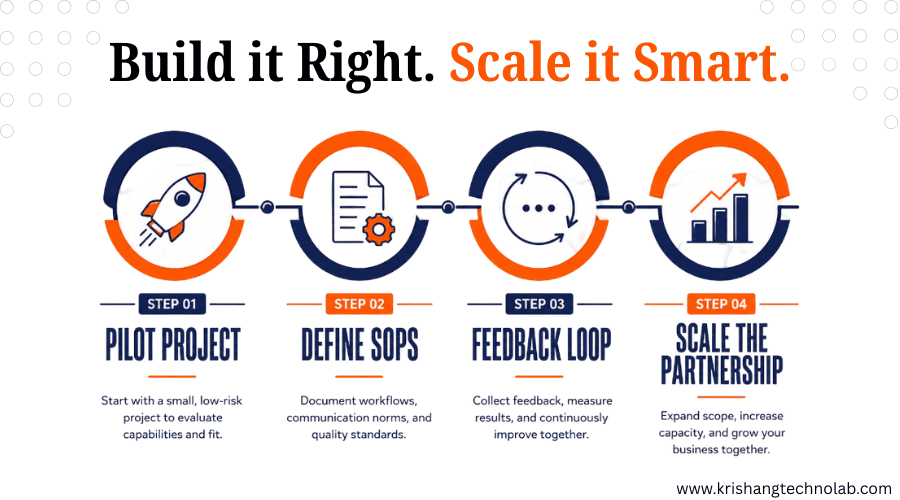
Once you’ve found a partner, set the relationship up for success:
- Start with a pilot project: Instead of immediately jumping into a bigger retainer or long-term contract, go for a smaller, lower-risk build to test out communication, quality, and reliability.
- Define SOPs early: Document communication channels, escalation paths, reporting formats, and approval processes before the first sprint.
- Build a feedback loop: Do regular retros, even short ones, to catch friction early, and over time you improve collaboration.
- Revisit the arrangement periodically: As your agency’s needs evolve, make sure the partnership model (project-based, dedicated team, staff augmentation) still applies.
Common Mistakes Agencies Make When Choosing a Next.js Development Partner
Even experienced agencies fall into predictable traps when vetting a Next.js development partner. Knowing these in advance can save you from a costly mismatch.
Prioritizing price over process.
The cheapest hourly rate often hides the highest long-term cost in rework, missed deadlines, or client escalations. A partner with a slightly higher rate but a documented QA process and clear communication standards will almost always save money over the life of a project.
Skipping a technical interview with the actual developers.
Sales calls are run by account managers who may not touch code. Before committing, insist on a working session or technical interview with the developers who will actually be assigned to your projects. Their answers to architecture questions reveal far more than a polished sales pitch.
Assuming “React experience” equals “Next.js experience.”
These are related but distinct skill sets. A developer comfortable with client-side React apps may have little experience with server components, rendering strategies, or edge deployment, all core to modern Next.js work. It’s worth confirming directly whether the people you’d hire as Next.js developers have shipped production apps with the App Router, not just legacy React SPAs.
Not clarifying ownership of design systems and components.
If your partner builds a reusable component library as part of a project, make sure your contract specifies that it belongs to your agency, not the development partner, so you can reuse it across future client work without renegotiating terms.
Treating the first project as a formality instead of a trial.
Agencies sometimes commit to a large retainer before testing the relationship on a smaller build. A pilot project isn’t just good practice; it’s your best insurance policy against a bad long-term fit.
Overlooking cultural and working-style fit.
Technical skill is necessary but not sufficient. A partner whose working style, pace, and communication standards are out of sync with your agency culture will cause friction, regardless of the quality of their code, and friction adds up over a multi-month engagement.
The Long-Term Value of Getting This Right
Trusted white-label Next.js development partnership agencies often find the payoffs multiply well beyond the first project. Once a partner is familiar with your agency’s standards, client expectations, and preferred workflows, onboarding every new project is faster. You develop institutional knowledge on both sides, and the partner starts to anticipate your needs, see risks earlier, and suggest technical improvements proactively rather than reactively.
This also opens the door to taking on more ambitious client work. Agencies that once had to turn down complex, performance-critical, or large-scale Next.js projects because of internal bandwidth constraints can confidently pitch for them, knowing they have a dependable technical partner behind the scenes. In a market where clients increasingly expect fast, SEO-optimized, highly interactive web experiences, that capability difference can directly translate into new business.
Conclusion
And if you’re looking for a Next.js development partner in 2026, it’s not just about finding someone who can write React code. It’s about finding a team that has deep Next.js expertise, true white-label discipline, and the communication and QA processes to easily become an extension of your agency.
Get this decision right, and you gain a scalable growth lever: the ability to take on more ambitious projects, hit deadlines with confidence, and deliver consistently excellent work under your own brand. Get it wrong, and you risk your reputation on every project that partner touches.
Take the time to vet thoroughly, ask the hard questions, and start small before scaling the relationship. The right white-label partner won’t just build your next Next.JS project, they’ll become a long-term asset your agency can rely on for years to come.
Found this post helpful? Don't forget to share it with your network!