
Quick Overview: Build dedicated development team by hiring skilled developers who work exclusively on your project under your management. This model offers full control, transparent communication, flexible scaling, and cost savings, making it the preferred choice for startups and enterprises building long-term software solutions.
Behind every successful software product are the right people. The best idea in the world is still just an idea without the right engineers, designers and testers working together. This is exactly why so many founders, product managers and CTOs now choose to build dedicated development team instead of relying on scattered freelancers or slow in-house hiring.
A dedicated development team gives you full-time professionals who work only on your project, understand your product deeply, and grow with you over time. An industry survey in 2025 showed that cost efficiency, and access to skilled talent were the top reasons for more than 70% of companies outsourcing software development to choose this model. That number is still climbing as more companies realize that traditional hiring is too slow for the speed at which products need to move today.
In this guide, you will explore exactly how to build a dedicated development team for your project, what roles you need, how much it costs, and how to avoid the common mistakes businesses make when hiring dedicated developers.
What Is a Dedicated Development Team?
A dedicated development team is a team of software engineers, designers, and other tech professionals who work on a single client’s project exclusively for a long time. Unlike freelancers, or outsourced agencies juggling multiple clients, this team is an extension of your company, following your priorities, your roadmap and your deadlines.
When you build dedicated development team structures, you are not just hiring people. You are creating a long-term partnership where the team knows your business, your users and your product inside and out: No short-term contractor or one-off freelancer can bring this profound product knowledge.
The dedicated development team model is different from a fixed-price project. You pay for the time, skill and commitment of the people working for you, not for a set deliverable. So you can change scope, add features or change direction without having to renegotiate a whole new contract. Many companies compare this approach to outsourcing their software development entirely before even choosing the right model for their roadmap.
How Is a Dedicated Team Different From In-House Hiring, Freelancers, and Staff Augmentation?
Businesses are often confused between these four models before deciding to build dedicated development team. Here’s a simple breakdown:
| Model | Control | Speed to Start | Cost | Best For |
| Dedicated Development Team | High; works exclusively on your project | Fast; days to a few weeks | Predictable monthly cost | Long-term, evolving projects |
| In-House Hiring | Full control | Slow; 45+ days per role on average | High; salaries, benefits, infrastructure | Companies with stable, long-term headcount needs |
| Freelancers | Limited; juggling multiple clients | Very fast | Low but inconsistent | Small, short-term tasks |
| Staff Augmentation | Shared control with in-house team | Fast | Hourly or monthly rate | Filling specific skill gaps temporarily |
A dedicated software development team hits the sweet spot between rapid setup and total control. You have people who care about your product like an in-house team, but without the long recruitment cycle or the fixed overhead costs.
Also Read About: Which Development Model Is Right for Your Project a Dedicated Team or Outsourcing?
When Should You Build a Dedicated Development Team?
Not every project requires this model, but for the right situation it’s the smartest way to proceed. Here are the most obvious signs that it’s time to build dedicated development team support for your project.
Your Project Runs Six Months or Longer
For short projects where the scope is clearly defined and will not change, a fixed-price contract will generally work. But long-term projects require people who understand your codebase, understand your users and understand where the product is going. The dedicated development team model is a good idea when your timeline exceeds six months. It might be time to hire dedicated developers to your project.
You Need to Scale Engineering Fast
Hiring in-house takes time. Studies have shown that the average tech hiring cycle in the US is around 45 days per role, and that’s before the onboarding even begins. A dedicated, strong development team services partner can bring on experienced engineers within two to three weeks, helping you hit deadlines you might otherwise miss. Remote developers are able to hit the ground running, and many companies close that gap by hiring them.
Local Talent Is Scarce or Too Expensive
If you find yourself in an area where skilled developers are scarce, or too costly to hire full-time, you can partner with a dedicated software development team offshore to tap into strong talent at a more affordable price point, without compromising on the quality of work. Instead, some companies establish an offshore development center, giving them a permanent staff of engineers in a lower-cost location.
You Want Output Without Management Overhead
Running a large in-house engineering department takes time away from building your actual product. When you hire dedicated development team professionals through an established partner that takes care of the recruitment, HR and daily operations, you can concentrate on strategy and not on admin work. Companies often turn to dedicated developers based in India for this reason, since it combines lower overhead with round-the-clock development coverage.
Key Roles You Need in a Dedicated Development Team
The exact makeup of your team will depend on your product, but these core roles are typical of most dedicated development team structures.
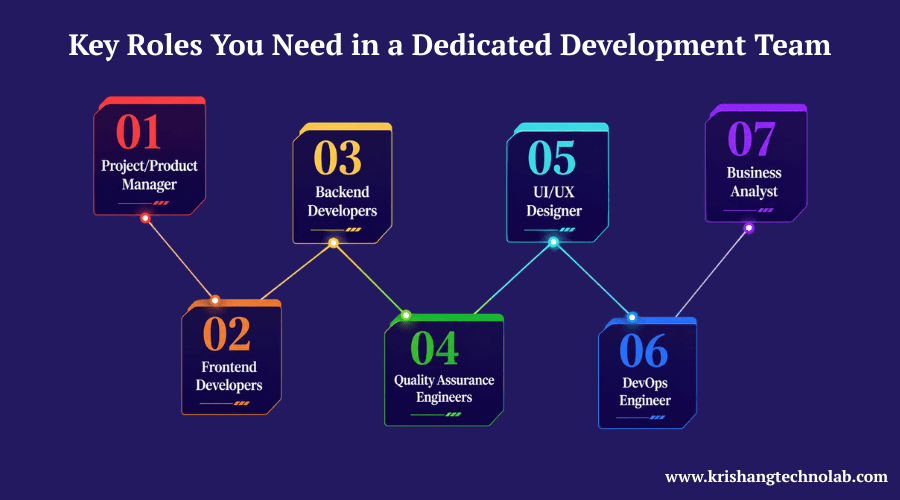
Project/Product Manager
The project manager is the person who makes sure everyone is honest about deadlines. They manage timelines and priorities and are the bridge between you and the engineers, which is more important than people realise when a project has more than three or four moving parts.
Frontend Developers
They build everything users see and interact with using frameworks like React, Vue, or Angular. Frontend developers are responsible for this experience, so if your app feels slow or clunky while loading, this is usually where the fix has to happen..
Backend Developers
They’re the backend developers running the servers, databases, APIs, and the logic that makes your app work. Users don’t see their work directly, but if it’s missing or broken, they’ll notice immediately.
Quality Assurance Engineers
They test each and every release before it reaches users, catching bugs before they become problems. In the long run, skipping this role to save money will typically cost more when customers start reporting problems you could have caught in-house.
UI/UX Designer
This role defines the look and feel of the product, making it simple and delightful to use. A skilled designer can make average features look polished; a bad one can make great functionality look confusing.
DevOps Engineer
They run deployment pipelines, cloud infrastructure and ensure that systems are reliable. When your app goes down at 2 a.m., a DevOps engineer is who you want on call.
Business Analyst (optional)
They translate business goals into clearly defined technical actions. Not every team requires one from the outset, but as requirements grow more intricate, having someone who can connect “what the business wants” with “what engineers can actually build” significantly reduces the need for back-and-forth communication.
Some teams also bring in security specialists, data engineers, or solution architects as the product grows more complex. When you first build a dedicated development team, start with the essential roles, then expand as your needs change. Many projects start by hiring React specialists for the interface layer and then add other roles.
For the server side, teams often bring in Node.js developers to handle APIs, databases and the logic that keeps the application running smoothly.
How to Build a Dedicated Development Team: Step-by-Step Process
Here is the exact process to build dedicated development team the right way, from the first planning conversation to your first sprint.
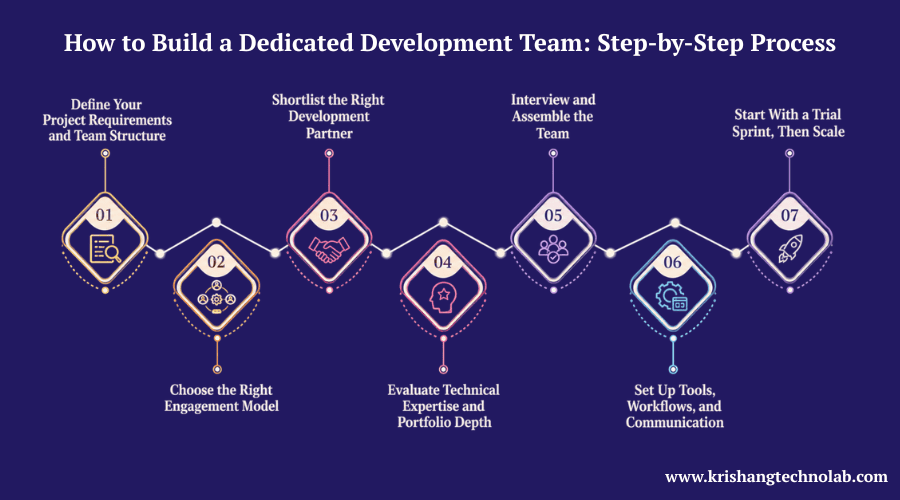
Step 1: Define Your Project Requirements and Team Structure
Get clear on what you’re building before hiring anyone. What is the tech stack? Which budget range are you working within? How long is the realistic timeline? Wrong hires, almost always, mean a vague brief. The more specific you are here, the smoother the rest of the process goes when you develop dedicated development team plans from day one. This is also the right point to scope out if you need software developers for a single feature, or a full product build.
Step 2: Choose the Right Engagement Model
There are three common ways to build a dedicated development team:
- Fully managed: Your partner handles hiring, HR and daily oversight and you review deliverables.
- Staff augmentation: You add developers directly to your existing team, and manage them yourself.
- Hybrid: A mix of both, useful when you already have a partial in-house team.
Many growing companies start with staff augmentation, and move to a fully managed dedicated development team model as the product matures.
Step 3: Shortlist the Right Development Partner
Do not just search “dedicated development team services”, and pick the first name you see. Look at the verified reviews, ask for relevant case studies for your industry and check that the agency has experience delivering projects like yours. This step is more important than most when you’re hiring dedicated development team professionals, especially if you have been weighing committed developers against short-term freelancers for your project.
Step 4: Evaluate Technical Expertise and Portfolio Depth
Look past surface-level portfolios. Ask about code quality standards, testing practices, and how the team deals with complex technical decisions. This will tell you if the agency can actually build dedicated development team capacity suited to your particular project.
Step 5: Interview and Assemble the Team
Even if your partner does the first cut of candidates, you still have to do your own technical interviews. A short coding assessment, a problem-solving conversation and a reference check go a long way to confirming you are getting the right people. If the product needs significant design input, this is when you want to bring in UI/UX designers along with the engineering hires.
Step 6: Set Up Tools, Workflows, and Communication
Before you begin working, decide on your project management tools (Jira, Trello, Asana), communication channels (Slack or Teams) and meeting cadence. Once the dedicated software development team is in place, daily standups and weekly progress reviews keep everyone on the same page. These kinds of workflows mean dedicated development team output you can build on consistently, from week one.
Step 7: Start With a Trial Sprint, Then Scale
Before you go long-term, do a short paid trial sprint, usually one to two weeks. This gives you a look into how the team communicates, how they take feedback and how they work under real deadlines. Generally the best way to build trust with a dedicated development team is a short trial period before a long term commitment. Once everything is verified you can be confident to scale the team as your project scales.
How Much Does It Cost to Build a Dedicated Development Team?
The price to build dedicated development team members typically costs between $18 and $50 per hour per developer depending on experience level, tech stack and location. Businesses that outsource to regions with strong technical talent, and lower operating costs often see savings of 40-60% compared to hiring the same roles locally.
| Experience Level | Cost Range (USD/hour) |
| Junior Developer | $18 – $25 |
| Mid-Level Developer | $25 – $35 |
| Senior Developer | $35 – $49 |
| Team Lead / Architect | $49+ |
What Affects Dedicated Team Pricing?
There are a few things that will affect the final cost when you hire a dedicated development team:
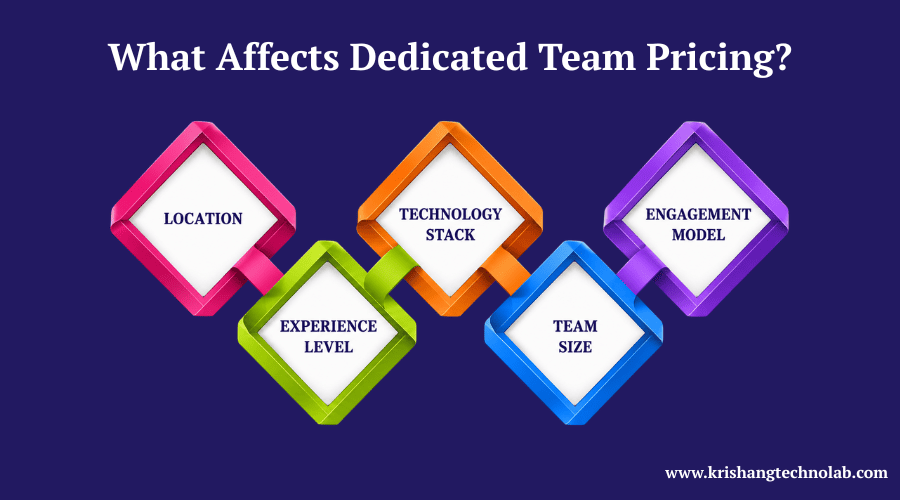
- Location: Rates vary quite a lot depending on the region you’re hiring from
- Experience level: Senior engineers, and architects can command higher hourly rates
- Technology stack: Special skills like AI, blockchain, or DevOps are generally pricier
- Team size: The bigger the dedicated software development teams, the bigger the monthly costs in general
- Engagement model: Full management services usually include a management fee
Benefits of Building a Dedicated Development Team
Once you build dedicated development team operations the right way, the benefits compound over time:
- Predictable costs: Fixed monthly or hourly rates over uncertain hiring costs
- Faster setup: Teams can be onboarded in weeks, not months
- Full control: You define the priorities, sprint goals and deadlines
- Continuous development: No gaps in resources or delays in contractor handoffs
- Access to wider talent: Skills without location restrictions
- Easier scaling: Grow or shrink your team as project needs change
- Better product alignment: The same team works on your product, building up their knowledge of the product over time
According to the latest data from the outsourcing reports, businesses that utilize a dedicated development team model experience a time-to-market that is up to 30% faster than those that exclusively depend on in-house hiring for new projects. This is especially true for teams hiring full-stack developers, who can work across both frontend and backend work without handoff delays.
Common Challenges When You Build a Dedicated Development Team (and How to Solve Them)
Even a well-planned effort to build dedicated development team structure runs into a few common obstacles along the way.
| Challenge | Solution |
| Misalignment with business goals | Set measurable goals and define clear indicators of success from the outset |
| Limited visibility into daily progress | Maintain common project tracking platforms and schedule frequent progress discussions |
| Onboarding delays | Prepare documentation and access before the team starts |
| Inconsistent code quality | Establish consistent coding practices and conduct routine code evaluations |
| Difficulty scaling at the right time | Work with a partner that offers flexible team expansion |
How to Choose the Right Partner to Build Your Dedicated Development Team
It’s not just hourly rates that go into choosing the right agency. Keep these factors in mind before you sign any contract to build dedicated development team support for the long term.

Portfolio Relevance Over Portfolio Size
A large portfolio means nothing if none of it is in your industry. Before you hire dedicated development team services from the agency, ask them if they have developed similar products to yours.
Communication Standards
Poor communication kills more projects than bad code. Ask how often the team sends out updates, what tools they use, and how they work with time zone differences. This is particularly important when working with developers in the United States, or any team that is distributed across multiple time zones.
IP Ownership, NDAs, and Security Practices
Gain clarity in writing on the ownership of the code, data protection, and post-engagement intellectual property rights. Any serious dedicated development team agency will have these documents ready, no question.
Cultural and Communication Fit
Teams with similar work values and communication styles work better together. This aspect is harder to put on paper, but it is evident within the first several weeks of working together, which is precisely why so many businesses choose to build a long-term engineering team rather than rotate through short-term hires.
Why Businesses Choose to Build a Dedicated Development Team With an Experienced Agency
By working with an established software development agency, you can remove the guesswork from the equation. You will take responsibility for the roadmap and priorities, and Krishang Technolab, an experienced dedicated development team agency, will handle the hiring, onboarding and day-to-day operations. You will not have to deal with recruitment, contracts and infrastructure.
Companies that work with a reliable agency to find USA dedicated development team talent tend to have faster onboarding, more consistent code quality and fewer of the communication headaches that come with dealing with remote freelancers. Krishang Technolab works with companies from all industries to build customized development team structures that fit their specific technology stack, timeline and budget. They also have flexible engagement models so businesses can scale up without the overhead of hiring in-house talent.
If you are planning to build a dedicated development team for your next project, working with a partner who has done this type of work repeatedly, like Krishang Technolab, reduces risk and speeds up the path from planning to actual delivery.
Conclusion
One of the largest decisions you will make to ensure long-term success is deciding to build a dedicated development team for your project. It combines the control of an in-house team with the speed and flexibility of outsourcing, without the overhead of full-time recruitment.
Start by defining your requirements clearly. Pick the engagement model that suits your growth stage. Choose a reliable partner and spend some time setting up straightforward communication from the start. Follow these steps and you will build a dedicated development team, which will bring real, and consistent results to your project.
Frequently Asked Questions
What is a dedicated development team?
A dedicated development team is a group of engineers, designers and technical specialists who work exclusively on your project for an extended stretch of time. They become an extension of your internal team, aligned with your priorities, and roadmap, while the partner agency takes care of hiring, HR, and the day-to-day work behind the scenes.
How do you build dedicated development team from scratch?
First, determine what your project needs, then select the engagement model that suits, narrow down a few reliable development partners and check out their technical capabilities. From there, conduct direct interviews with the proposed team members, rather than relying solely on the agency’s assurances, and initiate a brief trial sprint before committing to a longer engagement.
What roles do you need in a dedicated development team?
The dedicated development team is usually composed of a project manager, front-end and back-end developers, a QA engineer, a UI/UX designer, and a DevOps engineer. For larger or more complex projects it’s often necessary to bring in a business analyst, security specialist, or solutions architect.
How much does it cost to build dedicated development team?
The price of each developer varies from $18 to $50 per hour, depending on the experience level, tech stack and location of the developer. The top end is filled with senior developers and architects, while junior and mid-level engineers pull the average down.
How long does it take to build dedicated development team?
With the right partner, you’ll have a fully onboarded team in two to four weeks. The time it takes depends on the complexity of your project and the skills you need, and how quickly you can nail down requirements on your end.
What’s the difference between a dedicated team and staff augmentation?
You get a development team dedicated only to your project, managed by the partner. Staff augmentation is when you insert individual developers into your existing team, which you manage on a day-to-day basis. Both give you flexibility, but dedicated teams give you more end-to-end ownership of delivery.
Who owns the code when working with a dedicated development team?
You retain full ownership of the code and everything created along the way in almost all cases. This should be explicitly written into the contract before the project begins, including NDA terms and how data protection is managed.
What size team should you start with when you build dedicated development team?
Most projects start with three to five people. Usually there is a project manager, two developers, a QA engineer and a designer. That gives you the basics without overcommitting the budget upfront, and you can scale the team as the product grows and priorities change.
How do you manage a dedicated development team remotely?
Remote management comes down to a few fundamentals: structured tools like Jira or Trello, straightforward communication through something like Slack, regular standups and KPIs people really agree to. Companies that provide dedicated development team services already have those workflows established, so you won’t need to create them from scratch.
Found this post helpful? Don't forget to share it with your network!