
Quick Overview: Curious about Consensus AI in 2026? This guide breaks down what Consensus AI is, its standout features like the Consensus Meter and Study Snapshots, current pricing tiers, and how it stacks up against alternatives like Elicit, Perplexity, and Semantic Scholar helping you decide if it fits your research workflow.
If you’ve ever spent an entire afternoon buried in Google Scholar tabs trying to figure out whether a single research question has a clear answer in the scientific literature, you already understand the problem Consensus AI was built to solve. Instead of manually opening dozens of PDFs, skimming abstracts, and trying to mentally tally up “for” versus “against,” Consensus AI lets you type a plain-language question and get back a synthesized, citation-backed answer pulled directly from peer-reviewed research.
In this guide, we’ll break down what Consensus AI actually is, walk through its core features, look at 2026 pricing, and compare it to other AI research tools like Elicit, Perplexity, and Semantic Scholar so you can decide whether it belongs in your research workflow.
What Is Consensus AI?
Consensus AI is an AI-powered search engine built specifically for academic and scientific research. Unlike a general-purpose chatbot, it doesn’t generate answers from open-ended internal knowledge. Instead, it searches a large index of peer-reviewed papers, reporting at well over 200 million, retrieves the most relevant studies for your query, and then uses large language models to synthesize what those papers actually say, with every claim linked back to its source.
This design choice matters more than it might seem. General AI assistants have a well-documented tendency to invent citations that don’t exist, a problem serious enough that courts have caught lawyers submitting briefs with fabricated case law generated by AI tools. Because Consensus only summarizes content it has actually retrieved from its database, it sidesteps that particular failure mode, though it isn’t immune to misinterpreting nuance, which is why high-stakes conclusions should still be checked against the original paper.
Eric Olson and Christian Salem founded Consensus, which has grown into a widely used tool for researchers, graduate students, clinicians, and journalists who need fast, evidence-based answers grounded in real studies. Tools like Consensus are part of a broader wave of applied AI reshaping how people work, and businesses looking to build something similar for their own domain often turn to a specialized AI development company to design and ship it.
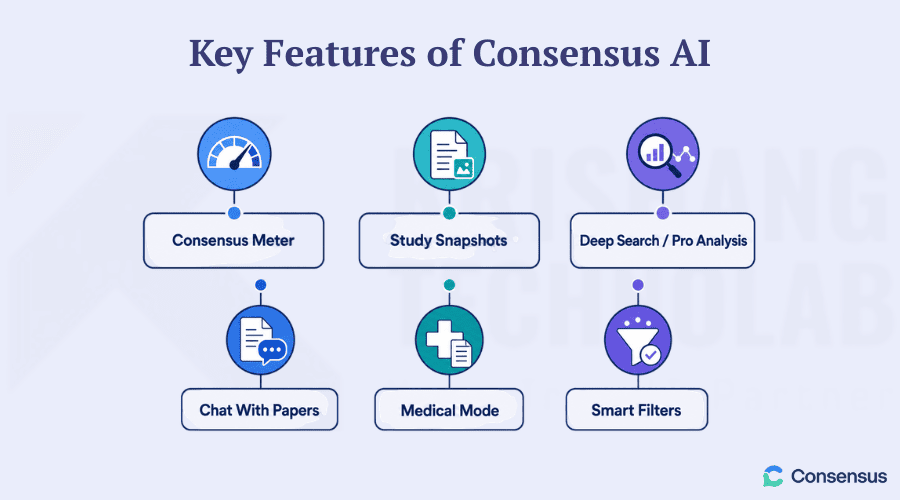
Key Features of Consensus AI
1. AI-Synthesized Search Results
Type a research question in plain English, and Consensus retrieves relevant peer-reviewed papers and then generates a concise summary of what the literature says, complete with inline citations linking back to each source paper.
2. The Consensus Meter
This is arguably Consensus AI’s signature feature. For yes/no or “Does X affect Y?” style questions, the Consensus Meter visualizes agreement levels across the top studies on that topic (yes/no/possibly), often re-ranked by factors like citation count and study design quality. It provides a quick overview of the level of consensus or controversy surrounding a question in the literature.
3. Study Highlights
Rather than reading a full paper, you can get a structured snapshot of an individual study’s methodology, key findings, and takeaways, all distilled into digestible summary.
4. Deep Search / Pro Analysis
For more complex or multi-part research questions, Consensus offers a deeper analysis mode that draws on a larger set of papers and produces more thorough synthesis than a standard search.
5. Chat With Individual Papers
Once you’ve found a relevant paper, you can ask it follow-up questions directly, rather than rereading the whole document to extract a specific detail. This conversational, document-grounded interaction pattern is very similar to what companies now request when they hire teams for ChatGPT integration services to build chat-based interfaces on top of their own internal knowledge bases.
6. Medical Mode
For health and clinical questions, Medical Mode narrows results to high-quality medical sources, including clinical guidelines and top-ranked medical journals useful for clinicians who need trustworthy, domain-specific answers.
7. Filtering and Study Details
You can filter search results by factors like study design, sample size, and publication recency, helping you weight findings from a well-powered randomized controlled trial differently than a small observational study. Under the hood, ranking and filtering results in this way precisely requires solid machine learning development work since the model has to understand study quality signals rather than just keyword relevance.
Consensus AI Pricing in 2026
Pricing for AI tools changes often, and Consensus is no different. You may see slightly different numbers depending on when you look and where and whether billing is monthly or annual. The overall structure, as of 2026, looks like this:
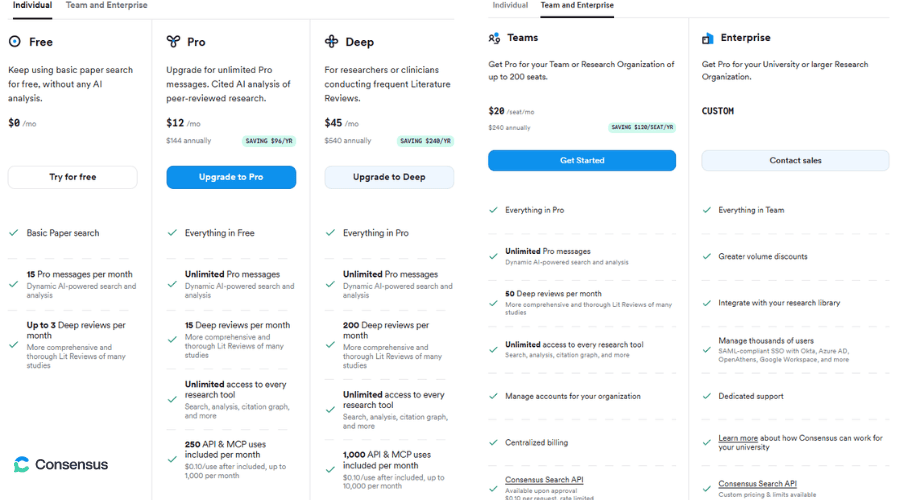
- Free tier: A limited number of AI-powered searches per month (often quoted as ~20), enough for occasional or light usage.
- Premium/Pro tier: Usually in the 9-15/month range (depending on billing cycle and promos), this tier generally gives you unlimited standard searches and a monthly allotment of Deep Search / Pro Analysis credits.
- Deep tier: $45/month or so for users who need to use the more advanced synthesis mode a lot.
- Teams: per-seat plan for research groups, billed monthly per user.
- Enterprise: Custom, volume-based pricing for universities, research institutions, and healthcare organizations, usually with API access, team management, and custom integrations.
Student and clinician discounts can reach 40% and 25%, respectively, so check your eligibility if you belong to either group.
These details may change, so it’s always a beneficial idea to check the current pricing directly on Consensus’s own pricing page before signing up. If you’re debating on creating a similar AI product as a subscription service for your niche, a first AI consulting engagement can help you identify plausible pricing tiers before any code is written.
Who Should Use Consensus AI?
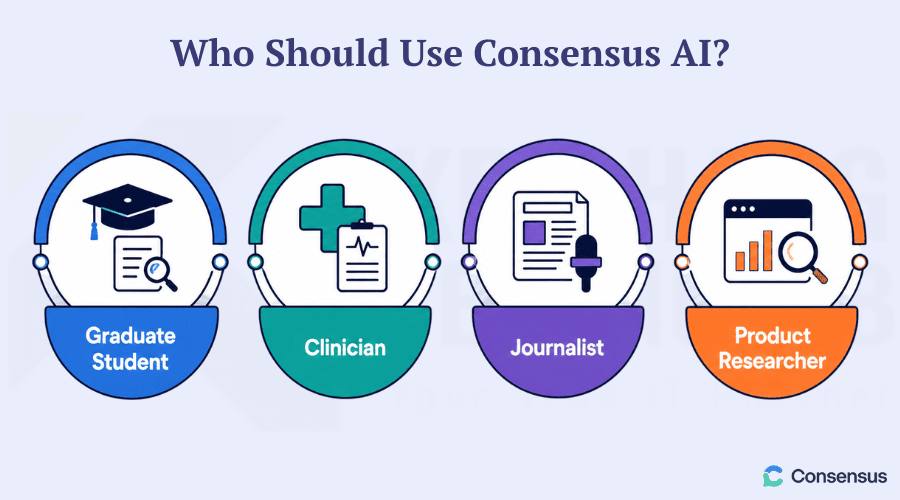
Good fit for:
- Graduate students and academic scholars doing literature reviews
- For clinicians seeking quick, evidence-based answers from clinical literature
- Journalists must check scientific claims before publishing them.
- Product managers, UX researchers or policy analysts who need a defensible, source-backed answer rather than a guess
- Anyone sick of wading through irrelevant search results to see what the actual research says
- Founders interested in generative AI development for their own research or knowledge tool for a particular vertical
Less ideal for:
- Full-text deep reading consensus provides summaries and metadata but does not always offer full-text access to every paper.
- Full systematic review workflows, including screening, deduplication, and PRISMA-style reporting (better used with a tool such as Elicit)
- General web research that is not academic in nature (best done with tools such as Perplexity or Google)
How Consensus AI Compares to Alternatives
| Tool | Best For | Key Differentiator | Citation Grounding |
| Consensus AI | Quick, evidence-based answers from peer-reviewed research | Consensus Meter, Study Snapshots, Medical Mode | Only summarizes retrieved papers |
| Elicit | Full systematic review workflows | Screening, data extraction, structured review tables | Strong, review-oriented |
| Semantic Scholar | Traditional academic search and citation graphs | Citation network exploration | Search-based, no AI synthesis by default |
| Perplexity AI | General web research with citations | Broad web coverage, not academic-only | Mixed web + academic sources |
| Scite.ai | Understanding how a paper has been cited (supporting vs. contradicting) | Citation context analysis | Citation-focused, not full synthesis |
Consensus vs. Elicit: Elicit generally handles full systematic review workflows better, including screening large batches of papers, extracting structured data, and building review tables. Consensus is faster for a quick, direct answer to a specific research question. Many researchers use both together.
Consensus v. Perplexity/ChatGPT: General AI assistants search the wider web and can hallucinate citations. Consensus focuses on peer-reviewed literature and summarizes its findings, making it more trustworthy for scientific claims while limiting its scope for general research.
Semantic Scholar/Google Scholar vs. Consensus : These are primarily search and citation-tracking tools without built-in AI synthesis. Consensus adds a layer of AI-generated summaries and agreement analysis on top of a similar underlying corpus of papers. Building that synthesis layer well typically depends on strong data science consulting to structure the underlying corpus and design the ranking logic correctly from the start.
Consensus vs. Scite.ai: Scite focuses on showing how subsequent research cites a paper whether it supports, contradicts, or simply mentions the paper. Consensus is more about answering a question directly by synthesizing multiple papers.
Strengths and Limitations
Strengths:
- Answers are grounded in real, retrievable papers, not fabricated
- Consensus Meter gives a fast visual read on scientific agreement
- Study Snapshots save significant reading time
- Medical Mode adds credibility filtering for health-related questions
- Free tier available for light or occasional use
Limitations:
- Free tier search limits can be consumed quickly during intensive research
- No full-text access to every underlying paper
- Nuance and context can still be missed or oversimplified in AI-generated summaries
- Not built for full systematic review methodology (screening, PRISMA compliance, etc.)
- Pricing tiers and discounts have shifted over time, so it’s worth double-checking current terms
Final Verdict: Is Consensus AI Worth It in 2026?
For anyone who regularly needs to know “What does the actual research say about X?”, students, clinicians, journalists, and knowledge workers alike can use Consensus AI as one of the fastest ways to get a citation-backed, trustworthy answer without manually digging through academic databases. Its Consensus Metre and Study Snapshot features are genuinely useful shortcuts that few competitors replicate in the same way.
It’s not a replacement for reading primary sources when the stakes are high, and it doesn’t support full systematic review workflows. If your work requires that level of rigour, pairing Consensus with a tool like Elicit, using Consensus for fast exploratory answers and Elicit for structured review work, is likely the best setup.
Products like Consensus also show how much opportunity exists for niche, AI-native search and research tools outside of academia, from legal research to internal company knowledge bases. Teams considering that kind of build often start by choosing whether to hire AI developers in-house or bring in prompt engineers to fine-tune how the model retrieves and synthesises domain-specific content, much like Consensus has tuned its retrieval and summarisation pipeline for scientific literature.
Found this post helpful? Don't forget to share it with your network!