Quick Overview: Custom AI agent development helps businesses automate tasks, streamline workflows, improve decision-making, and enhance customer experiences. This guide explores AI agent types, development processes, key benefits, challenges, and best practices for building secure, scalable, and efficient AI solutions.
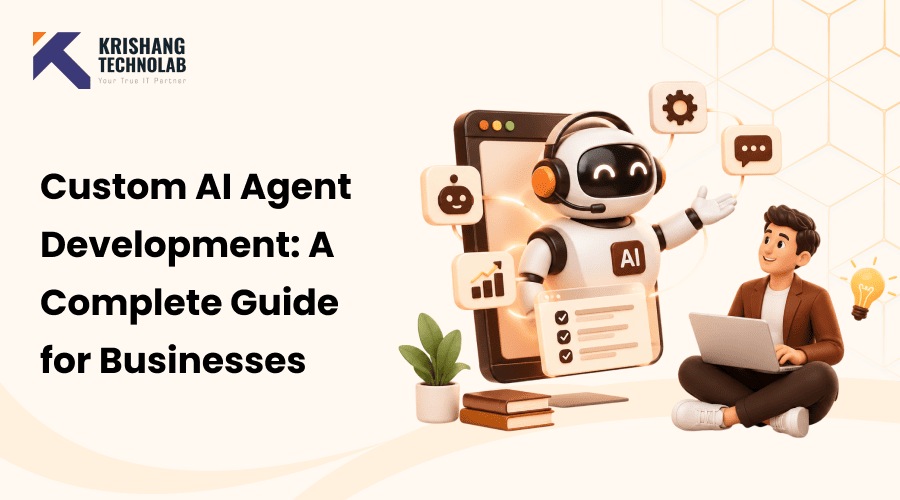
Custom AI agent development is the process of designing, building and deploying intelligent software agents that are tailored to fit a business’s specific goals, data, workflows and systems. Unlike generic chatbots or off-the-shelf tools, a custom AI agent can understand context, reason through problems, make decisions and take action across your business software with limited human intervention.
As a result, businesses are quickly embracing custom AI agents, since the pressure to do more with less has never been greater. First, teams are inundated with repetitive work. Second, customers want real-time, personalised responses. Finally, leaders want insights faster than manual reporting can provide. AI agents solve all three problems at the same time.
AI agents help businesses in the following ways:
- Automate operations like ticket handling, invoice processing, lead qualification and report generation.
- Improve productivity productivity by releasing employees from routine work to think about strategy, creativity and relationships.
- Support decision-making by analysing large volumes of data, surfacing patterns, and recommending next steps in real time.
This guide will explain what custom AI agent development is, how AI agents work, the main types of agents, their benefits and use cases, the step-by-step development process, the technologies behind them, realistic cost expectations, common challenges, how to choose the right Custom AI agent development company and where the field is heading.
What Is Custom AI Agent Development?
Custom AI agent development is the full process of building an AI agent specifically for an organisation. To be precise, an AI agent is a software system that perceives its environment (user requests, documents, databases and events), reasons about what to do, and acts to achieve a goal, often by calling tools, APIs and other systems.
A custom AI agent is trained, configured and integrated around your specific processes, terminology, data sources, compliance rules and brand voice. That’s why AI agent development solutions for businesses are so much more useful than generic tools.
How Custom AI Agents Differ From Pre-Built AI Solutions
Custom AI agents give businesses better system integration, more control over their data and more flexibility. On the other hand, pre-built AI solutions are cheaper and faster to deploy, but they offer less customisation, integration and control over future updates. For this reason, an excellent AI agent development company in India can help businesses build tailor-made AI solutions as per their requirements.
| Aspect | Custom AI Agents | Pre-Built AI Solutions |
| Fit to workflows | Designed around your exact processes | Generic, one-size-fits-most |
| Integration | Deep integration with your CRM, ERP, databases, and internal tools | Limited, often through standard connectors |
| Data control | Your data stays in your environment, with tailored security | Data often processed on vendor infrastructure |
| Differentiation | Becomes a competitive advantage | Competitors can use the same tool |
| Upfront cost | Higher | Lower |
| Time to launch | Longer | Faster |
| Flexibility | Evolves with your business | Limited to vendor roadmap |
In short, custom AI agents offer greater flexibility, deeper integration, and better alignment with specific business goals, while pre-built AI solutions are more affordable and quicker to deploy. Ultimately, the right choice depends on your budget, workflow complexity, security requirements, and long-term business objectives.
How Do Custom AI Agents Work?
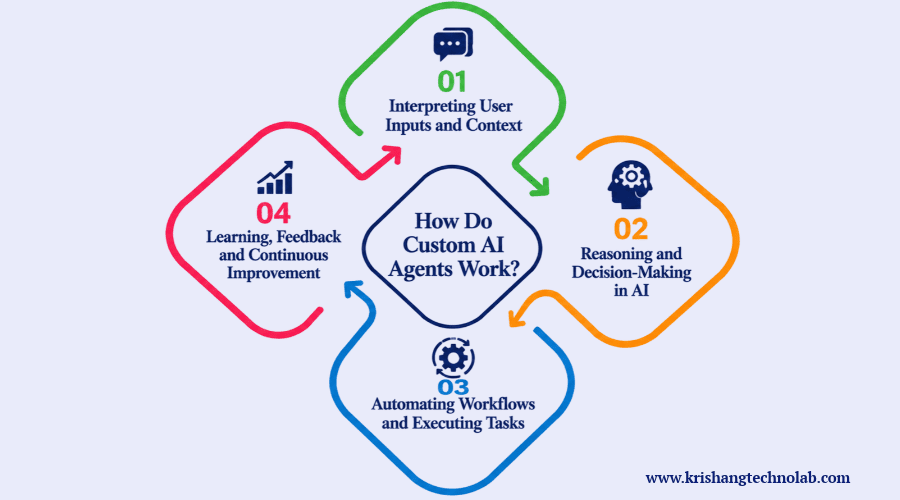
Knowing how AI agents work allows businesses to have realistic expectations. A typical architecture of an AI agent goes through four connected stages. Whether you’re building intelligent AI agents for support or autonomous AI agents for back-office operations, partnering with an experienced AI Agent Development Company in USA can help you implement the right approach. The underlying pattern remains the same.
Interpreting User Inputs and Context
To begin with, the agent takes an input, which can be a typed question, a voice command, an email, a form submission, or a system trigger such as a new support ticket. Then, using natural language processing and LLMs, it identifies intent, extracts key entities (names, dates, amounts, product IDs), and gathers context from conversation history, user profiles, and business data. As a result, strong context handling is what lets an agent respond accurately rather than generically.
Reasoning and Decision-Making in AI
After understanding the input, the agent moves on to planning. First, it determines what information is missing, which tools to use, and in what order. To keep answers reliable, modern agents ground them in facts using techniques such as chain-of-thought reasoning, task decomposition, and retrieval from company knowledge. At the same time, business rules and confidence thresholds determine when the agent will take action and when it will escalate to a human.
Automating Workflows and Executing Tasks
Once the plan is made, the agent acts. For example, it can look up an order in your ERP, edit a lead in your CRM, generate a draft contract, schedule a meeting or initiate a multi-step approval process. Because the agent connects to real systems via APIs, it moves beyond conversation to real business AI automation.
Learning, Feedback and Continuous Improvement
Finally, after execution, the agent logs the results. Next, human feedback, user ratings, error reports, and performance indicators are used to refine prompts, update the knowledge base, and adjust workflows. Over time, the agent becomes more accurate, faster, and better aligned to how your business actually works.
Types of Custom AI Agents Businesses Can Developopment
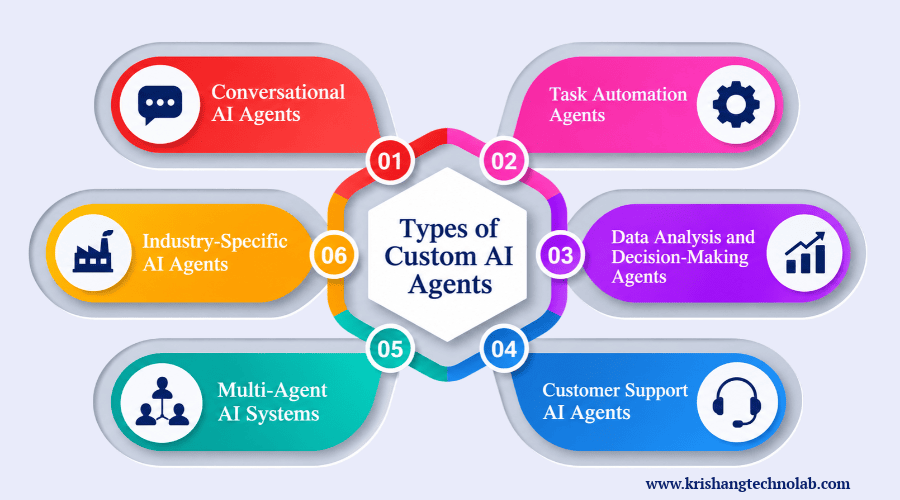
AI agents come in many flavours, and the appropriate one depends on the problem you’re trying tosolve. Here are the most common custom AI agent solutions:
Conversational AI Agents
These agents carry out natural, context-aware conversations via chat, voice, or messaging apps. They go beyond scripted chatbots by understanding intent, remembering context, and completing tasks like booking appointments, answering product questions, or guiding onboarding.
Task Automation Agents
Task automation agents automate structured, repetitive tasks like data entry, document classification, email triage, invoice matching, scheduling and report generation. They offer the flexibility of AI with the reliability of workflow automation.
Data Analysis and Decision-Making Agents
These agents can ask questions of databases, analyse trends, detect anomalies, and generate insights orrecommendations. Finance teams use them for forecasting, operations teams use them for demand planning, and executives use them for natural-language access to dashboards.
Customer Support AI Agents
Customer support agents handle common queries, track orders, manage returns and pass complex cases to human agents with all the context. They are available 24/7, reduce waiting time and deliver a consistent service level across channels.
Multi-Agent AI Systems
In multi-agent systems, multiple specialised agents work towards a bigger goal. For example, a research agent collects the data, an analyst agent performs the analysis, a writer agent writes the report, and a reviewer agent ensures the quality remains high. As a result, this division of labour handles complex workflows better than one general-purpose agent.
Industry-Specific AI Agents
These agents are trained on domain knowledge and regulations for sectors like healthcare (patient intake, claims support), banking (KYC checks, fraud triage), retail (personalised shopping assistants), logistics (route and inventory optimisation), real estate, insurance and manufacturing.
Benefits of Custom AI Agent Development for Businesses
The advantages of bespoke AI agent development agency go way beyond cost savings. When implemented properly, business AI agents are a permanent operational advantage and a core element of enterprise AI solutions.
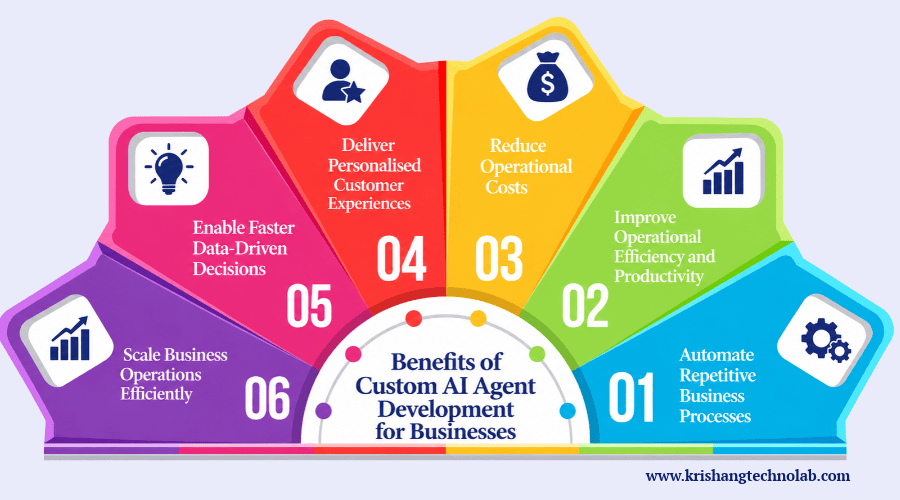
Automate Repetitive Business Processes
Agents do a lot of high-volume, rules-based work like data entry, document processing, approvals and routine communications. This minimises human error and allows processes to run 24×7.
Improve Operational Efficiency and Productivity
By handling mundane tasks in seconds instead of hours, agents reduce turnaround times and allow employees to focus on more important work. Therefore, teams achieve more without adding headcount.
Reduce Operational Costs
Automation of support, back-office and analysis functions reduces labour costs, rework and the cost of errors. Marginal cost per task remains low, and savings tend to increase with the scale of agent usage.
Deliver Personalised Customer Experiences
Agents can personalise responses, recommendations and offers to customers in real time, based on their history, preferences and behaviour. It’s hard to achieve personalisation at this scale with human teams alone.
Enable Faster Data-Driven Decisions
Agents instantly scan vast data sets and translate what they find into plain language insights. Leaders can ask questions like “Which regions are underperforming this quarter and why?” and get answers that are based on seconds.
Scale Business Operations Efficiently
With demand spikes, agents can scale immediately without hiring and training delays. This makes seasonal peaks, rapid growth, and new market launches far easier to manage.
Top Business Use Cases of Custom AI Agents
These AI agent use cases show where AI agents for business automation deliver measurable value today.
Customer Service and Support Automation
Agents can respond to FAQs, check order status, process refunds and account updates, summarise tickets and escalate sensitive issues with full context. A lot of companies can handle a large percentage of tier-one questions without any human intervention.
Sales and Lead Generation Automation
Sales agents qualify inbound leads, enrich contact data, personalise outreach, schedule demos, update the CRM and surface the hottest opportunities for reps. It reduces response time and increases conversions.
Marketing Campaign Management
Marketing agents can write content variations, segment audiences, optimize send times, monitor campaign performance and make budget suggestions. They make campaigns more consistent across channels, and data-driven.At OpenAI, there are a number of powerful AI models and tools available that companies may use to build smart marketing agents and run their campaign operations more efficiently.”
HR and Recruitment Automation
HR agents screen resumes, schedule interviews, respond to employee policy questions, automate onboarding checklists and track engagement. More time recruiting candidates, less time on admin.
Finance and Accounting Operations
Similarly, finance agents can manage invoices, reconcile transactions, identify anomalies, support expense audits and create financial summaries. Consequently, month-end close speeds up and accuracy improves.
Supply Chain and Inventory Management
Supply chain agents can forecast demand, track inventory levels, reorder stock, monitor deliveries, and recommend alternative suppliers in the event of disruptions. Therefore, they help minimise stockouts and carrying costs.
Data Processing and Business Intelligence
Agents pull data from documents, emails and databases, clean and structure it and generate reports and dashboards on demand. Business users get answers without waiting on the analytics team.
Custom AI Agent Development Process: Step-by-Step
Having a defined process for building AI agents reduces risk and speeds time to value. Here’s the lifecycle of this AI agent development and how to build a custom AI agent from idea to production.
Step 1: Identify Business Goals and Requirements
Don’t start with the technology; start with the business problem. First, identify which process to improve and who the users are. Next, define what success looks like (cost per ticket, resolution time, conversion rate, etc.). Then, review what data is available, along with security and compliance requirements and other constraints. Above all, a tight first use case is better than a vague, ambitious one.
Step 2: Define the capabilities and workflows of the AI agent.
Define what the agent can do autonomously, what requires human approval, what systems it can access, and how to handle edge cases. Document the whole workflow: inputs, tools, outputs, and escalation paths.
Step 3: Select the Correct AI Models and Technologies
After that, select LLMs and related technology based on accuracy, latency, cost, privacy requirements and language support. Then choose between hosted models, private deployments or open-source alternatives, and select frameworks, vector databases and cloud services accordingly.
Step 4: Design AI Agent Architecture
Discuss the architecture of the agent (reasoning model, memory, RAG pipeline, tool layer, orchestration logic, permissions, guardrails, logging, human-in-the-loop controls, etc.). Good planning of architecture prevents costly reworking as you get bigger.
Step 5: Train and Embed the AI Agent
Define agent prompts, retrieval pipelines, tool functions, and workflows. Connect with your CRM, ERP, Helpdesk, Databases and Communication Systems Start with a minimal viable agent, and add capabilities.
Step 6: test and optimise the AI agent performance
After building the system, test it with real-world scenarios, edge cases, and adversarial inputs. During this phase, evaluate accuracy, hallucination rate, task completion, latency, and user satisfaction. However, before full deployment, pilot with a small group of users so that any issues surface early. Lastly, use the results to refine your prompts, retrieval quality, and guardrails, ensuring the system keeps improving over time.
Step 7: Deploy, Monitor and Maintain AI Agent.
Audit log monitoring, dashboard and alerts. Feedback loops ship to production. Monitor performance against business KPIs. Retrain/fine-tune as required. Update knowledge sources. AI agents are living systems that get better with continued care.
Custom AI Agent Development Cost: What Should Businesses Expect?
The cost of custom AI agent development varies greatly because no two agents are the same. As a very rough guide, a single-purpose agent might cost between $15,000 and $50,000. In comparison, a mid-complexity agent with a few integrations typically falls between $50,000 and $150,000. At the top end, an enterprise-grade or multi-agent system can range from $150,000 to $500,000 or more. Keep in mind that these are indicative ranges only. For this reason, it’s best to request a scoped estimate, since AI agent development pricing depends heavily on your specific needs. Additionally, providers in other markets, such as India, may charge lower hourly rates than those in the USA. However, the overall cost will ultimately depend on scope, quality, and ongoing support.
Custom AI Agent Development vs. Pre-Built AI Solutions
Pre-built tools are cheaper, faster to deploy, and well suited to generic needs like basic website chat. In contrast, custom agents development cost more, but they offer deeper integration, better data control, behaviour that you design yourself, and a competitive advantage. For this reason, many businesses start with a pre-built tool to validate demand, and then move to a custom ai agent as their needs grow. That said, custom agents make particular sense in three situations: first, if your workflows are unique; second, if your data is sensitive; and finally, if the agent is central to your customer experience.
How to Optimise AI Agent Development Costs
- Start with a narrow, high-impact use case and then expand after demonstrating ROI.
- Then iterate on a minimal viable agent.
- Use expensive fine-tuning and prompt engineering before RAG.
- Match model size to task complexity, using smaller models for simpler steps.
- Reuse the existing components and frameworks.
- MoTrack token usage and use caching.
- Plan early integration to prevent rework.
Challenges in Custom AI Agent Development and How to Overcome Them
Building custom AI agents comes with several challenges, including data quality, systems integration complexity, security, high development costs, and scalability. Furthermore, businesses may struggle to select the appropriate AI models, ensure the AI responds correctly at all times, and get agents to perform tasks reliably. Fortunately, these issues can be overcome with clear business goals, good-quality data, the right technology, and solid safety protocols. Moreover, an experienced team of AI developers can help organisations build secure, scalable, and efficient AI agents that fit easily into their workflows. Finally, regular testing, performance monitoring, and continuous improvement ensure long-term business value from the agents.
How to Choose the Right AI Agent Development Company?
The right partner can determine whether your project becomes a business asset or an expensive experiment. Whether you are comparing an AI agent development company in India, in the USA, or elsewhere, evaluate Custom AI agent development services and custom AI development companies on the following criteria. These apply equally to a boutique AI agent development agency and a large provider of enterprise AI development services.
Evaluate Technical Expertise and Experience
Look for a team that combines machine learning engineers, software architects, data engineers, and domain consultants. Ask how long they have been building LLM-based systems and how they approach production reliability, not just demos.
Review of previous AI agent development projects.
Live demos, references and case studies are available upon request. Look for measurable results like lower handle times, cost savings, or improved conversion rates, ideally in industries similar to your own.
Review Expertise: Artificial Intelligence technology and framework
Hands-on experience with LLMs, RAG, vector databases, frameworks (LangChain, LangGraph, AutoGen, CrewAI) and cloud platforms. A good partner is agnostic to technology and will suggest tools based on your needs, not their own.
Security and scalability capabilities
Ask about their security practices, compliance certifications, data handling policies and testing procedures. Make sure they build for growth. Make sure the architecture can handle more users, more agents, and more integrations over time.
Understand Post-Deployment Support
Finally, ask what happens after launch: monitoring, bug fixing, model updates, performance tuning, training for your team and service-level agreements. Because agents need ongoing care, support is key in the long term.
Future Trends in Custom AI Agent Development
The future of AI agents is more autonomy, collaboration and specialisation. These AI automation trends will shape enterprise AI innovation in years to come.
Rise of Agentic AI Systems
Agentic AI development company is moving away from single-turn assistants and towards systems that can chase goals over multiple steps, plan autonomously, use tools and adapt to evolving conditions, all within defined guardrails.
Growth of Multi-Agent Collaboration
Specialised agents will work in closer collaboration as a digital team with planner, researcher, executor and reviewer roles. There are emerging standards for agent communication and tool access that will make these systems easier to build and connect.
Autonomous Business Process Automation
“Moreover, agents will manage entire processes end to end, such as procure-to-pay, order-to-cash, or employee onboarding, rather than isolated tasks. Consequently, humans will shift to supervising exceptions.”
Personalised and Industry-Specific AI Agents
The most effective deployments will pair people and agents. Agents deal with volume and routine work; humans with judgement, empathy and supervision. Look for more designs with “human-in-the-loop” and AI copilots built into everyday tools.
Personalised and Industry-Specific AI Agents
Agents tuned to the language, regulations, and workflows of specific industries and to individual users will become standard. Domain-specific knowledge and proprietary data will be the key differentiators.
Conclusion
In conclusion, custom AI agent development allows businesses to automate repetitive work, increase productivity, and reduce costs. Moreover, it helps personalise customer experiences and enables faster, better-informed decisions. Unlike generic tools, a custom agent is built specifically for your workflows. Furthermore, it protects your data, and it scales with your business as your needs grow. Ultimately, investing in a custom AI agent is a smart step toward long-term efficiency and growth.
Success is all about the right approach. Start with a clear business problem, pick the right technologies, design for security and scalability, and partner with an experienced team like Krishang Technolab that will stick by you after launch. Begin with one high-value use case, prove the return, and expand from there.
Take a look at your own operations. Which tasks are repetitive, time-consuming, or dependent on scattered data? Those are your best automation opportunities.
Ready to build an AI agent tailored to your business? Talk to our AI experts for a free consultation and get a roadmap, timeline, and cost estimate for your custom AI agent development project. Contact us today to get started.
Found this post helpful? Don't forget to share it with your network!