Quick Overview: AI agent development is reshaping how businesses automate complex workflows in 2026. This guide explains what AI agents are, how they differ from chatbots, the step-by-step development process, real-world use cases, costs, and the tools needed to build autonomous, task-completing AI systems that scale with your business.
Search interest in “agentic AI” and “autonomous AI agents” has grown faster than almost any other tech category over the past year. There’s a clear reason why. Businesses have moved past asking what AI can answer, and started asking what AI can actually do on their behalf. That shift is what AI agent development is all about.
This guide breaks down what AI agent development actually means and how AI agents are architected and built. You’ll also learn what the real development process looks like, what it costs in 202. And where this technology is headed next. Whether you’re a founder exploring automation, a product manager scoping a build, or just trying to understand the buzzword. You’ll leave with a clear, practical picture.
What Is an AI Agent?
An AI agent is a software system that can understand a goal and decide on the steps needed to reach it. It can use tools or data sources and carry out actions with a degree of autonomy; without a human manually directing every step. Unlike a basic AI model that simply responds to a prompt, an agent can plan and reason across multiple steps. It can call external APIs, retrieve information, and adjust its actions based on what it finds along the way.
Think of the difference between asking a system “What’s our refund policy?” versus telling it “Process this customer’s refund.” The first is a lookup. The second requires judgment, system access, and follow-through; that’s agent behavior. There are several distinct categories of agents, depending on how much autonomy and reasoning they’re given. Understanding the AI Development is a useful starting point before deciding what kind of system your business actually needs.
What Is AI Agent Development?
AI agent development is the process of designing, building, and deploying these autonomous systems. It combines large language models (LLMs), memory, tool integrations, and decision-making logic into a working application that completes real tasks inside real business workflows.
It sits at the intersection of several disciplines: prompt design, software engineering, API integration, and increasingly, governance and risk management. A development team building an AI agent isn’t just fine-tuning a model. They’re architecting an entire system that can perceive context, reason about a goal, take action, and learn from the outcome. This overlaps with broader custom AI development services, but agent development focuses specifically on autonomy and task execution rather than single-turn predictions or classifications.
AI Agent vs. Chatbot vs. Traditional Software: What’s the Difference?
This is one of the most common causes of confusion, so it’s worth being precise:
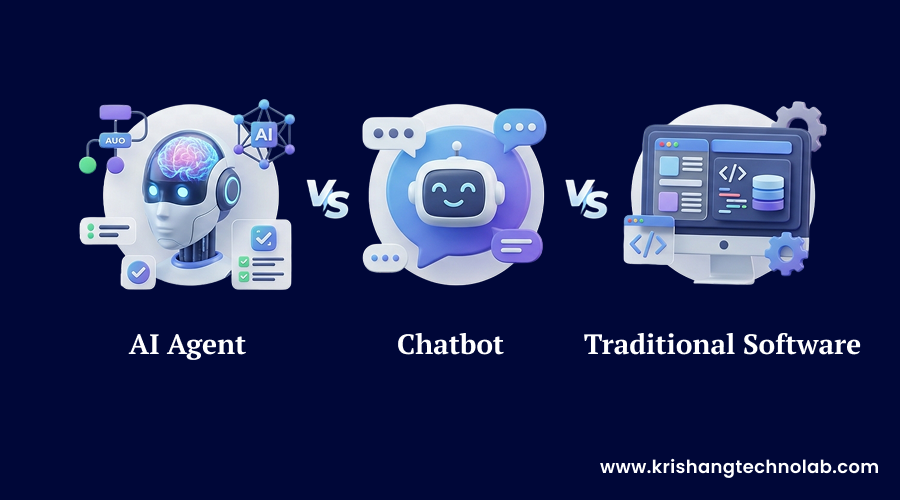
- Traditional software follows fixed, pre-programmed rules. It does exactly what it’s coded to do, nothing more.
- A chatbot answers questions and holds conversations, but it doesn’t take independent action inside other systems.
- An AI agent understands a goal, decides what steps are required, calls APIs or tools, updates records, and completes multi-step tasks, escalating to a human only when needed.
In short: a chatbot replies, and an agent acts. That distinction is exactly why “AI agents for business” search interest has surged over the past year, companies have realized chatbots solve a narrower problem than they originally hoped, and agents solve the broader one.
Why AI Agent Development Matters in 2026
Three forces are converging to make this the moment for agent adoption: LLMs have become reliable enough to reason over multi-step tasks, API and tool-calling standards have matured, and businesses are under real pressure to cut operational costs without sacrificing speed or customer experience.
Enterprise teams are now using agents to automate Tier 1 support tickets, process invoices, monitor IT systems, qualify leads, and coordinate workflows across departments, work that used to require dedicated headcount. This is also why agentic AI overlaps so heavily with the broader trend of generative AI transforming business productivity: generative models give agents the reasoning and language capability, while the agent framework gives that capability somewhere useful to act.
Core Components of AI Agent Architecture
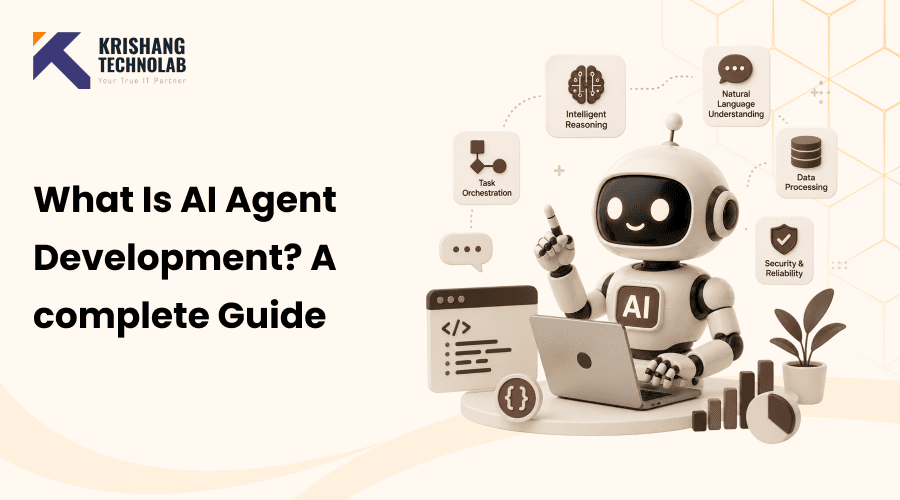
Every functional AI agent, regardless of use case, is built from a similar set of architectural building blocks.
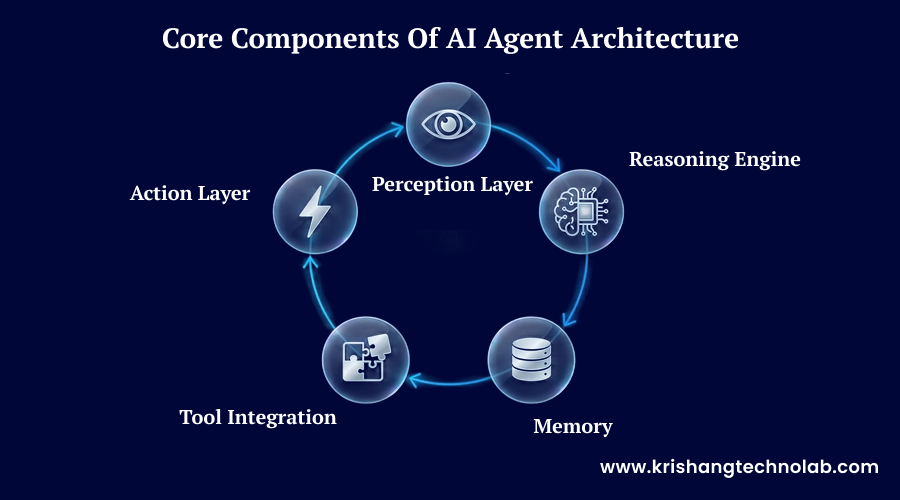
1. Perception / Input Layer
The agent receives information via user messages, system events, documents, sensor data, or API triggers. It’s the agent’s view of the world it operates in.
2. Reasoning & Planning Engine (LLM)
The core “brain” of the agent is usually a large language model. This brain understands the goal, breaks it into steps, and decides what to do next.
3. Memory
Agents need short-term memory and long-term memory to behave consistently and not repeat mistakes.
4. Tool & API Integration
This is the thing that makes an agent different from a chatbot: the ability to call external tools, query databases, trigger workflows, or interact with CRMs, ERPs, and other business systems.
5. Action / Execution Layer
The piece that actually does the chosen thing, whether it’s sending an email, updating a record, creating a document or escalating to a human reviewer.
Selecting the right mix of these components is highly dependent on the underlying tech stack, which is why teams scoping a build often begin by looking at the best AI programming languages for agent development before committing to an architecture.
Types of AI Agents Used in Development
Not all agents have to be equally sophisticated. Some of the more common categories include:
- Simple reflex agents: respond to certain inputs with pre-programmed actions
- Model-based agents: have an internal representation of their environment to make better decisions
- Goal-based agents: define a sequence of actions to achieve a specific goal
- Utility-based agents: consider multiple possible outcomes and choose the one with the highest value
- Learning agents: improve behaviour over time based on feedback
- Multi-agent systems: a set of specialized agents that work together as part of a larger workflow
To see how each of these works in practice, with examples in the enterprise, see our complete guide to different types of AI agents.
Not sure if your business is ready for an AI agent?
Our team can assess your workflows and tell you honestly whether agent automation makes sense right now or what to fix first.
Talk to an AI ConsultantThe AI Agent Development Step by Step Process
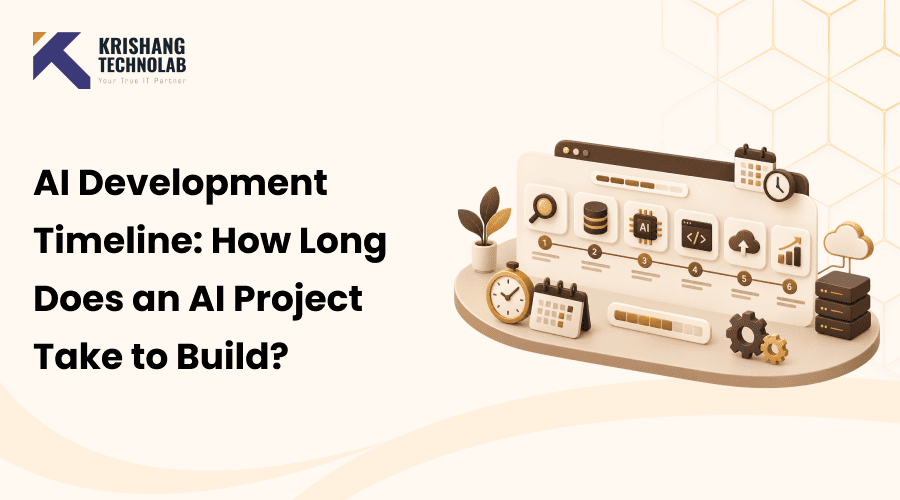
The development of a production-ready AI agent generally occurs in five stages:
1. Define the use case and success criteria
The biggest decision in developing agents isn’t technical; it’s choosing the right workflow. The best candidates are high-volume, repeatable, and time-consuming activities where you can measure a clear result.
2. Choose the architecture and framework
This includes the choice of the LLM, the orchestration method, the memory strategy, and whether the agent is a single or multi-agent system.
3. Select tools, data sources, and integrations
The agent needs to have safe, limited access to the systems it will be working on, such as CRMs, ERPs, knowledge bases, or internal APIs. It also needs to know what it can do on its own and what needs to be approved.
4. Build, train, and test
This requires prompt engineering, tool-calling logic, and a lot of testing on edge cases, as agents that work in a demo can behave unpredictably in production without rigorous evaluation. This is often where teams choose to hire skilled prompt engineers to fine tune the quality of reasoning.
5. Deploy, monitor, and scale
In a live environment, agents should monitor observability metrics such as task success rate, escalations and cost per interaction, and have a feedback loop to retrain or adjust as usage increases.
Popular Tools & Frameworks for AI Agent Development
The agent development ecosystem has matured quickly. Common building blocks include orchestration frameworks for multi-step reasoning, vector databases for memory and retrieval, model providers for the underlying LLM, and observability platforms for monitoring agent behavior in production. Most teams combine several of these rather than relying on one all-in-one platform, which is why many businesses choose to work with a partner offering full-stack machine learning development services rather than assembling the stack themselves.
Real-World AI Agent Use Cases by Industry
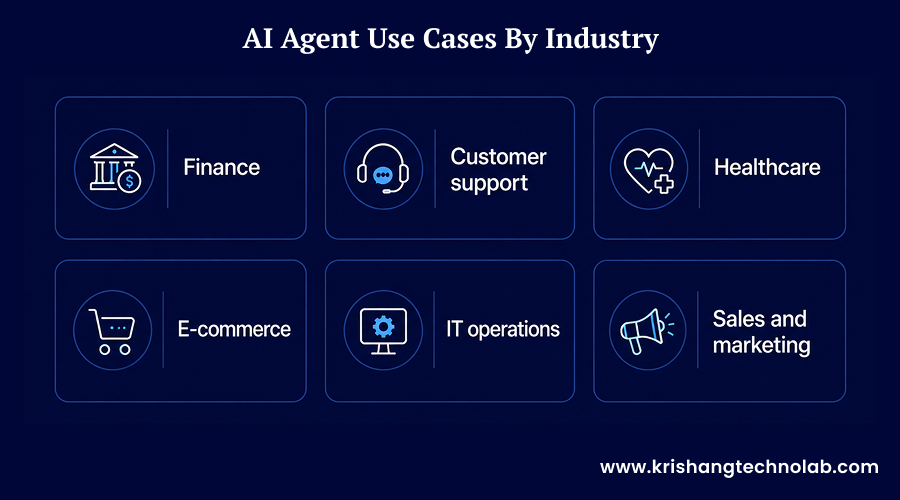
AI agents are already being used in almost every industry:
- Customer Support: managing Tier 1 tickets, returns, escalating complex cases and significantly improving handling time
- Finance: invoice reconciliation, anomaly flagging, compliance check automation
- Healthcare: controlling the scheduling of appointments and patient intake processes
- E-commerce: personalizing recommendations, automating inventory and order management
- IT operations: automatic resolution of routine incidents and monitoring systems
- Sales & Marketing: multi-channel outreach and lead qualification
Many of these use cases also rely on natural language interfaces and this is where dedicated ChatGPT integration services come in, bridging conversational AI with the underlying agent logic.
Benefits of AI Agent Development for Businesses
The appeal of AI agents goes beyond simple automation. Done well, they reduce manual workload across departments, cut response times for customers, lower the operating cost of repetitive processes, and free up skilled staff to focus on higher-value work. Because agents can operate continuously and consistently, they also reduce the variability that comes with manual handling, a meaningful advantage for compliance-heavy industries.
Challenges and Risks in AI Agent Development
When you build an agent, there are no guarantees. Typical issues are hallucination or wrong actions when an agent has too much autonomy without guard rails, integration complexity when connecting to legacy systems, increasing LLM API costs at scale, and governance gaps around who is accountable when an agent makes a wrong call. Any production deployment requires strong oversight, clear paths of escalation and continuous monitoring.
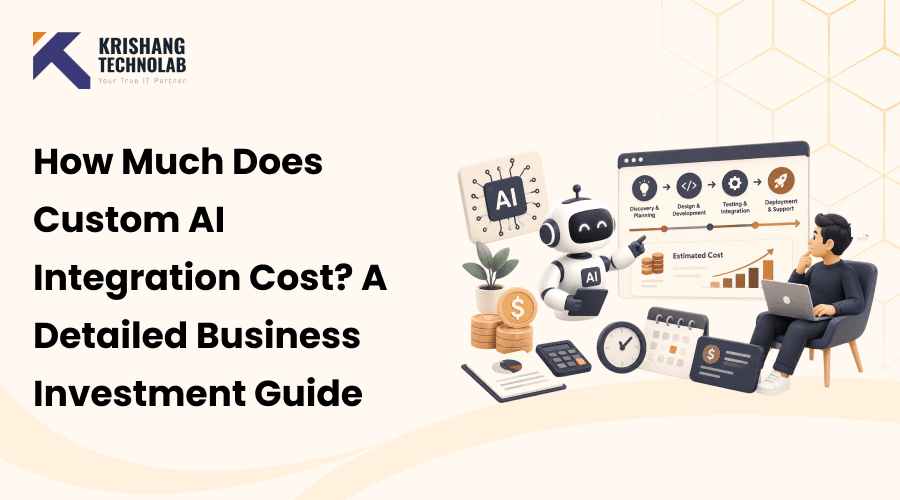
How Much Does AI Agent Development Cost in 2026?
Costs vary widely based on complexity, but to give you a ballpark, a simple agent used internally might cost a few hundred dollars a month in compute and API costs, while a customer-facing agent that handles thousands of interactions a day might easily cost several thousand dollars a month once you factor in infrastructure, monitoring, and ongoing tuning.
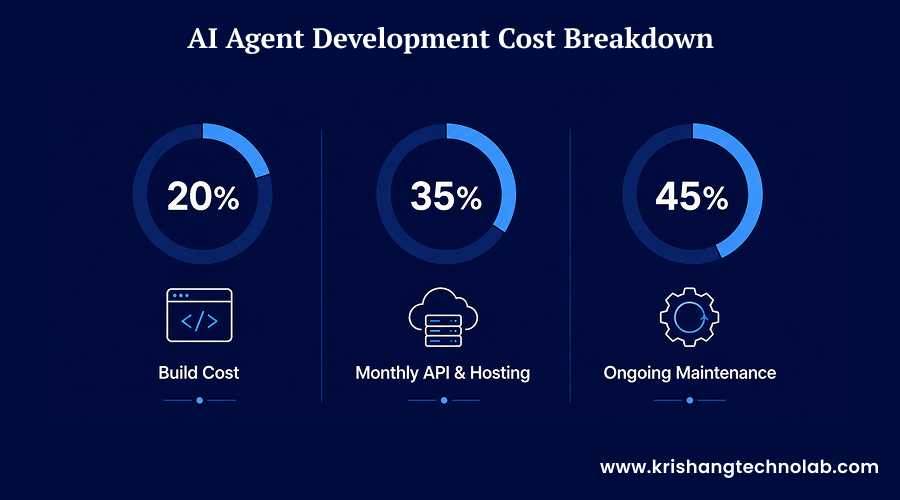
And don’t forget the cost of maintenance, which can be anywhere from 15-30% of the original development costs annually for retraining, security updates, and scaling. Many teams wisely address costs by using the software development outsourcing or offshore development center model to tap into experienced talent without the overhead of a full internal team.
How to Choose the Right AI Agent Development Company
The right development partner should ask about your compliance requirements before scoping begins, be transparent about ongoing API and infrastructure costs (not just the build fee), and have a track record of shipping agents that actually complete tasks end-to-end, not just AI tools that assist a manual process. It’s worth reviewing real AI project case studies from any prospective partner and confirming they offer both AI consulting services and hands-on engineering, since strategy without execution (or vice versa) tends to stall agent projects before they reach production.
It also helps to understand the underlying technology landscape before you scope a project; for instance, knowing the difference between LLMs and generative AI will make conversations with any development partner far more productive, since the two terms get used interchangeably even though they describe different layers of the stack.
The Future of AI Agent Development
Look for three main trends in the next phase: multi-agent systems will be common, there will be stricter rules and checks as regulators adapt to autonomous decision-making, and pricing will move from seat-based licensing to billing based on usage and results from completed tasks. As models get cheaper and more capable, the bottleneck for most businesses will shift from “can we build this” to “can we govern and scale this responsibly.”
Final Thoughts
AI agent development has moved from an experimental technology to a practical business tool in a very short time. The opportunity isn’t just in building an agent; it’s in identifying the right workflow, architecting it properly, and maintaining it responsibly once it’s live. If you’re exploring where to start, requesting a free consultation with a team that’s built production agents before is usually faster and safer than figuring it out from scratch.
Found this post helpful? Don't forget to share it with your network!