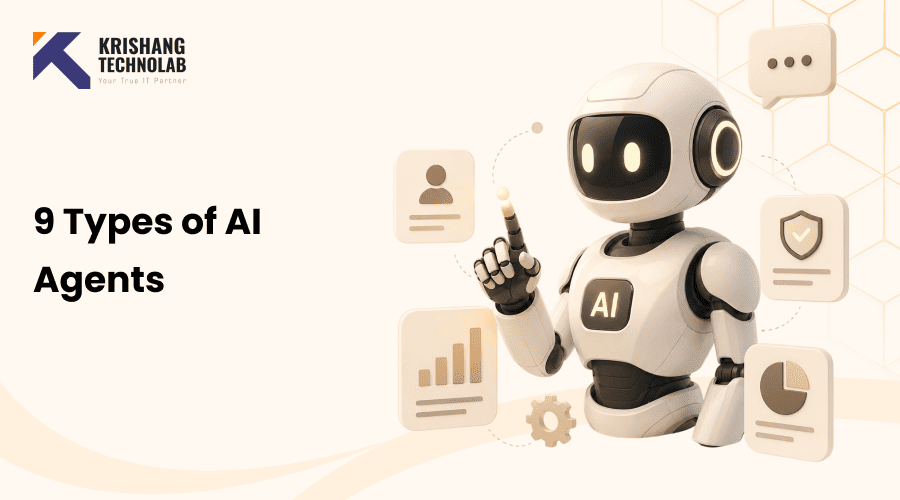
Quick Overview: Explore every types of AI agents, from simple reflex agents to enterprise AI agents, with one complete breakdown of how each works, real-world use cases, key challenges, and the right fit for your business needs. Types of agents in artificial intelligence with examples, all in one place.
Artificial intelligence is no longer just about answering questions. Today, AI acts. It plans, decides, learns, and executes tasks on its own. Consequently, AI is increasingly becoming an active part of business operations and daily workflows.
AI agents are the core of this change, and knowing the different types of AI agents is the first step to using them effectively. These agents are actually changing the way organisations automate processes, solve problems and make decisions.
Here’s a blog that breaks down all 9 types of AI agents in simple terms. You will explore the functions of each agent, their strengths, and their limitations. If you’re a business leader, a developer, or just AI-curious, this is your complete roadmap to intelligent agents in AI.
What Are AI Agents?
An AI agent is a software agent that senses its environment, makes decisions and takes actions to achieve certain goals. A simple chatbot just responds to prompts. An AI agent works with some degree of independence. It can plan, use tools, and adapt to changing conditions – all without constant human input.
It’s like a chatbot answering your question. One AI agent that books your flight, checks the weather, re-schedules your meeting and emails you a confirmation.
Also Read About: What Are the Key Differences Between AI and Automation?
How AI Agents Work
A basic loop is followed by all artificial intelligence agents:
- Perceive – Collect input from the environment (data, sensors, user commands, APIs).
- Process – Analyse that input with rules, models or reasoning.
- Act – Perform an action (send a message, update a record, execute a query).
- Learn (in some agents) – Update according to the outcome.
The power of autonomous AI agents is that this loop continues and continues. They don’t wait around to be told what to do next. They work it out.
Core Components of AI Agents
All AI agent systems have a few basic components:
- Perception module: It takes inputs from the world. These can be data streams, images or text. Helps the agent to know what is going on.
- Knowledge base: Keeps information. The agent uses it to decide. It stores facts, rules and data as well.
- Reasoning engine: It uses logic, rules, or machine learning. It looks at the options. Then it selects the best.
- Action module: Executes an action after a decision. It can be software, or it can be real-world. Hence, the agent is able to do tasks.
- Memory: Significant bits are preserved. The agent has both short-term and long-term memory. It also helps the agent to remember previous steps.
- Goal manager: Keeps the agent on track with its goal. Thus, the agent remains on the right track.
To understand how AI agents work, one has to understand AI agent architecture. It also demonstrates why different agents fit different tasks. It also shows how these parts work as a team. This implies that the agent can reach its goal.
Also Read About: How Do LLMs Differ from Generative AI?
Benefits of AI Agents for Businesses
AI-powered agents are being adopted by businesses in many industries. The reasons are obvious:
- 24/7 Availability – Agents don’t sleep. They work all day and all night. And tasks are accomplished at all times.
- Speed and scale – An agent can work on thousands of tasks at once. This saves companies time and lets them get more work done.
- Consistency – Agents will always be subject to the same rules. So they are always reliable and give constant results.
- Cost efficiency – Agents perform repetitive tasks. Also, employees can focus on more valuable work.
- Smarter decisions – Advanced agents analyse a lot of data. This allows businesses to gain useful insights and make better decisions.
These advantages make AI agents for business automation one of the most important investments a company can make today. Moreover, AI agents help businesses become more productive, better serve their customers and grow at a faster pace. Artificial intelligence statistics further highlight this impact, showing that organizations adopting AI-driven solutions often experience improvements in efficiency, customer satisfaction, and overall business performance.
Fundamental Types of AI Agents in Artificial Intelligence
Artificial intelligence agents are systems that perceive their environment, reason about what is perceived and act to achieve a goal. They range from simple rule-based systems to sophisticated intelligent agents used in real-world applications.
| Agent Type | Description | Example Use Cases |
| Simple Reflex Agents | React only to current input using fixed condition-action rules. No memory or learning. | Thermostats, basic alarm systems, simple game bots |
| Model-Based Reflex Agents | Maintain an internal model of the world to handle partial information. | Robot vacuum cleaners, simple navigation robots |
| Goal-Based Agents | Choose actions based on achieving specific goals through planning. | GPS navigation systems, chess AI |
| Utility-Based Agents | Select actions that maximize a utility (best outcome score). | Self-driving cars, trading systems |
| Learning Agents | Improve performance over time using data and feedback. | Recommendation systems (Netflix, YouTube), fraud detection |
| Task Agents | Perform specific predefined tasks or workflows end-to-end. | Email assistants, meeting schedulers, document summarizers |
| Collaboration Agents | Work with other agents or humans to complete complex tasks. | Multi-agent research systems, team-based AI assistants |
| RAG Agents | Combine retrieval of external knowledge with AI generation. | Document Q&A bots, enterprise search assistants |
| Enterprise Agents | Large-scale AI systems integrated into business workflows and tools. | HR automation, IT support bots, CRM automation |
Types of AI Agents in Detail
Let’s get to the main part of this guide now. 9 types of agents in artificial intelligence explained clearly and completely.
1. Simple Reflex Agents
Simple reflex agents are the most basic of all AI agent types and one of the most common types of AI agents. They have a basic rule. If you see an object, do that. These agents have no memory. Neither do they make plans. Instead, they only react to what is happening now.
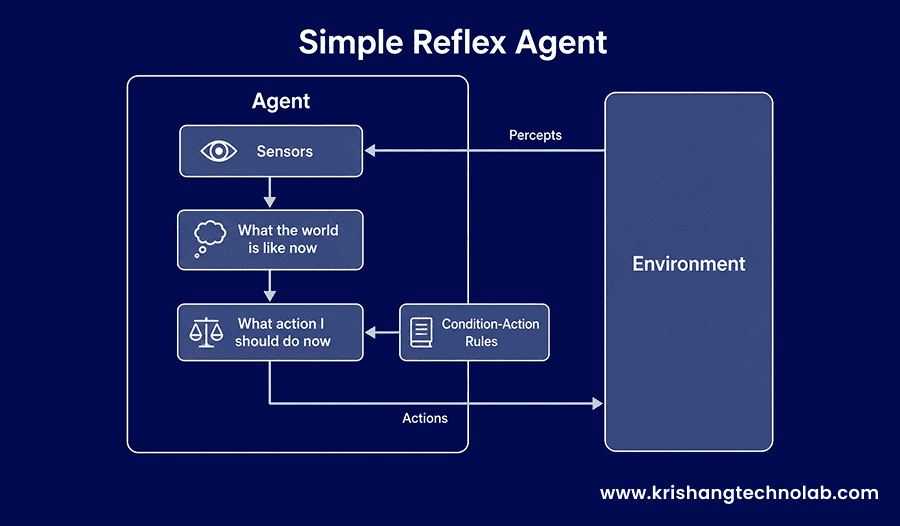
How Simple Reflex Agents Work
These reactive agents employ condition-action rules. When an agent detects a condition, the agent performs the corresponding action. Therefore, the response is prompt and direct. The decision is not influenced by past events. Future results are not taken into account. The agent just responds to the present situation.
For example, if it’s above 80 degrees Fahrenheit, the agent activates the air conditioner. Likewise, if the customer message contains the word “refund”, the agent forwards it to the billing team.
Advantages
- Easy to build and understand – Its logic is transparent and simple to validate. So teams can easily check and audit it.
- Fast response time – No complex calculations slow things down.
- Reliable in stable environments – These are agents that are consistent in environments where rules are clear.
Limitations
- No memory – Every input is processed independently. So past information is out of the question.
- Cannot handle novel situations – The agent may fail when it encounters a situation not part of the rule set.
- Brittle in complex environments – Minor changes in input can cause unexpected behavior.
Real-World Examples
- Basic email spam filters
- Simple thermostat controllers
- Rule-based customer service chatbots
- Traffic light controllers using sensor data
2. Model-Based Reflex Agents
Model-based reflex agents take the next stage in the types of AI agents. They have an internal model of the world. This model is used for memory, which helps them understand context. Thus, they are more powerful than simple reflex agents.
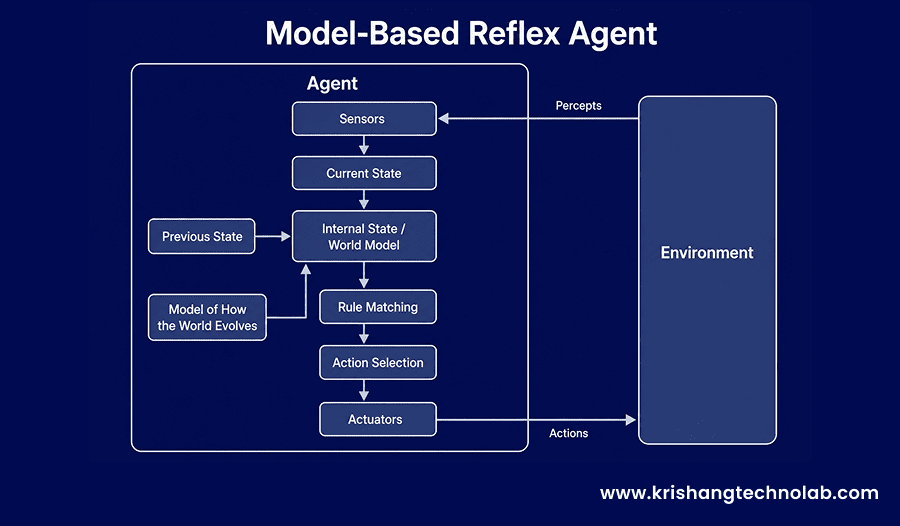
How Model-Based Agents Work
These agents are not just about the present. Instead, they retain a history of past observations and use that history to make decisions. The internal model is updated when the agent gets new information. Therefore, the agent gains a better view of its environment.
For example, a robot vacuum cleaner can map your floor plan and remember where it has already been cleaned. So it’s more than just reacting to dirt. It can also move smartly and efficiently about the room.
Advantages
- Better context awareness – The agent can know the current state, even if it can’t see everything directly.
- Handles partial information – It can make reasonable decisions based on partial data.
- More adaptive than simple reflex agents – It can also react better to changing situations.
Limitations
- Model accuracy is critical – The agent might make bad decisions. Model accuracy is critical.
- Higher computational cost – More costly to maintain and update the model.
- Still limited in long-term planning – But these agents can’t plan far into the future.
Real-World Cases
- Robot vacuum with mapping capabilities
- Navigation systems for autonomous vehicles
- Industrial process monitoring instruments
- Smart home automation hubs
3. Goal-Based Agents
Goal-based agents are one of the most important kinds of AI agents. They bring in something important, intentionality. These agents are not solely reactive. Instead, they strive for specific goals. They think about possible actions and select the one that is most likely to help them achieve their goal.
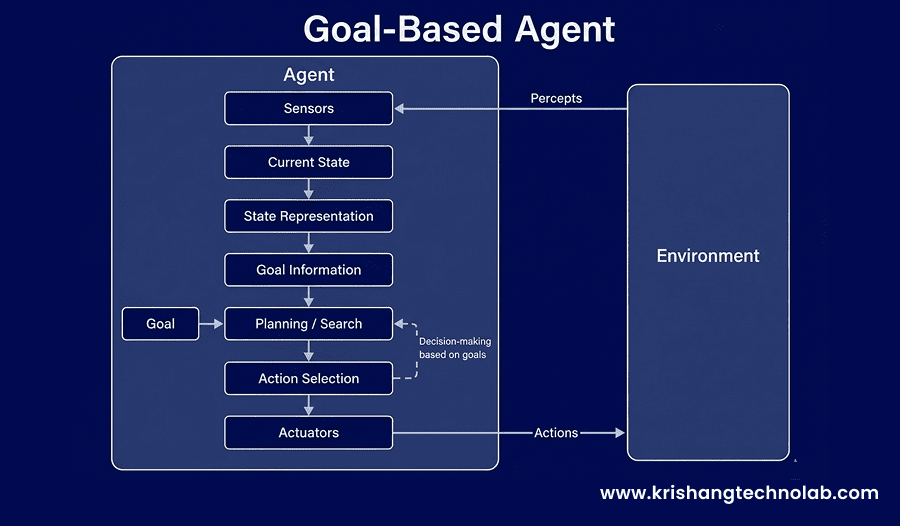
How Goal-Based Agents Work
An agent’s goal might be “book the cheapest flight to Mumbai before Friday.” It will come up with a set of steps to achieve this goal. It will use search algorithms, decision trees or AI reasoning to determine the best course of action. This allows the agent to perform more complex tasks.
This means that goal-based agents are useful for AI decision-making in complex multi-step environments. Also, they can change their behavior when things change.
Advantages
- Purposeful behavior – All behavior is oriented toward a goal. Thus, the agent keeps its attention on the goal.
- Flexible and adaptable – The agent can take different routes to achieve the same goal. This means it can bend to changing circumstances.
- Good at planning – These agents are efficient when a task consists of several steps. They can also put actions in a logical sequence.
Limitations
- Planning can be computationally expensive – Complex goals may require much computing power.
- Goal definition is critical – Poorly defined goals can lead to poor results.
- Doesn’t weigh trade-offs well – Agent finds a path to the goal. However, it may not identify the optimal choice.
Real-World Examples
- GPS navigation route planning
- Automatic scheduling assistants.
- Game playing AI (chess engines)
- Travel booking tools powered by AI
4. Utility-Based Agents
One of the most advanced types of AI agents is the utility-based agent. They are more than goal-based agents. They also ask, “Can I reach the goal?” but “What is the best way?” They rate how useful different results are. Then they select the one that has the highest value. They can decide what to do better.
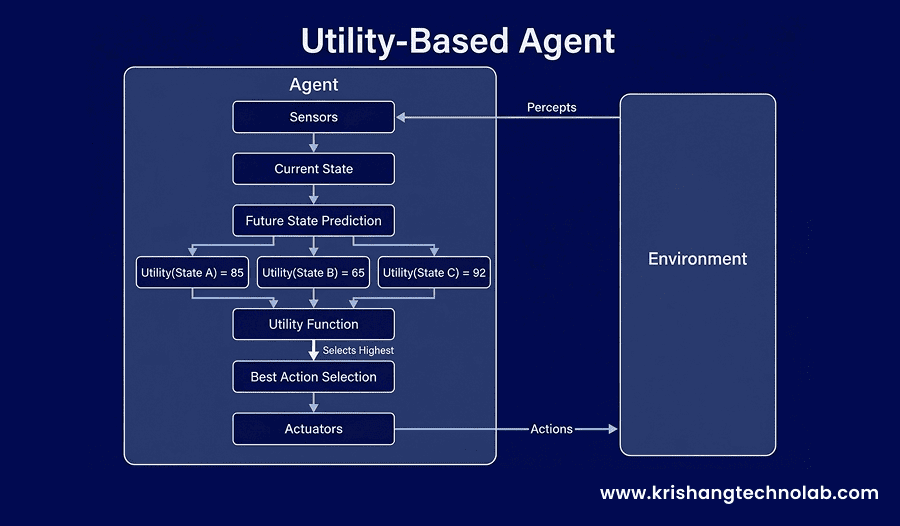
How Utility-Based Agents Work
They consider different possible states of the world. Each state is assigned a number score. The score can be based on cost, time, risk or user preference. The agent then chooses the option with the highest utility. Thus, it acts in such a way as to maximize the total value. That’s where AI agent systems begin to feel intelligent.
Advantages
- Optimizes outcomes – The agent does more than meet a goal. Instead, it tries to achieve its goal in the best possible way.
- Handles trade-offs – It can rank factors like speed, cost, and accuracy. This puts it in balance.
- More human-like reasoning – The decision process is similar to how humans compare choices. As a result, the outcomes can be more natural.
Limitations
- Defining utility functions is hard – What is the “best” option can vary from situation to situation.
- Computationally demanding – Requires a lot of resources to test a number of options. This means processing may take longer.
- May behave in an unexpected way if the utility function does not include all important factors.
Real-World Examples
- Recommendation engines (Netflix, Spotify)
- Tools for optimising financial portfolios
- AI in digital advertising bidding systems
- Medical diagnostic support tools Risk vs. benefit
5. Learning Agents
Learning agents are some of the most advanced types of AI agents. They are also called adaptive AI agents. These agents learn in time. They don’t simply follow rules or optimize known functions. They learn by experience, instead. So they improve with each encounter.
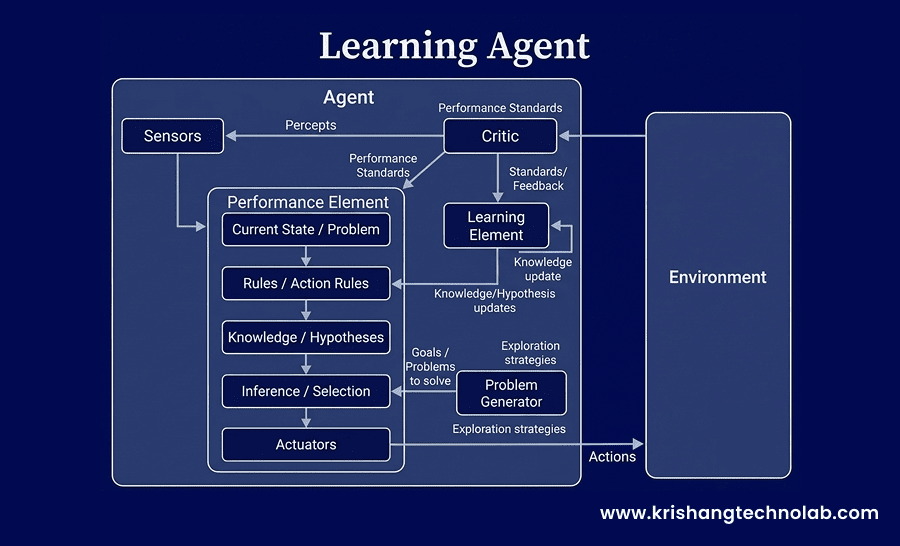
How Learning Agents Work
A learning agent has four important elements.
- Learning element – Improves the agent’s performance according to feedback.
- Performance element – Selects and performs actions.
- Critic – Judges results against a standard of performance.
- Problem generator – Suggests new experiences that could improve learning.
These elements together help the agent learn from data. It can thus refine its strategies over time. And it can get better as it gets additional information. Prompt engineering further enhances this process by enabling users to provide clear and effective instructions, helping the agent generate more accurate, relevant, and context-aware responses.
Advantages
- Improves continuously – The more an agent works, the better it gets. Hence, performance can get better with time.
- Handles novel situations – It can use previous experience on new problems. Therefore, it can respond to unfamiliar situations.
- Highly adaptable – The agent can automatically adapt to a changing environment. It can also keep learning as things change.
Limitations
- Requires large amounts of training data – Learning usually needs a large amount of quality data.
- Learning takes time – Early performance can be poor. However, often the results improve as the agent acquires experience.
- Can learn bad habits if exposed to biased or low-quality data – Therefore, data quality is very important.
Real-World Examples
- Large language models like Claude and GPT
- Fraud detection systems in banking
- Personalized news feeds
- Self-improving customer service bots
Also Read About: Which Programming Languages Are Best for Artificial Intelligence?
6. Task Agents
Task agents are one of the major types of AI agents. Sometimes they are called autonomous task agents. The purpose of such agents is to perform structured workflows with little human intervention. They are often the workhorses of intelligent automation, which is why many organizations choose to hire software developers to design, build, and optimize these systems for real-world use cases.
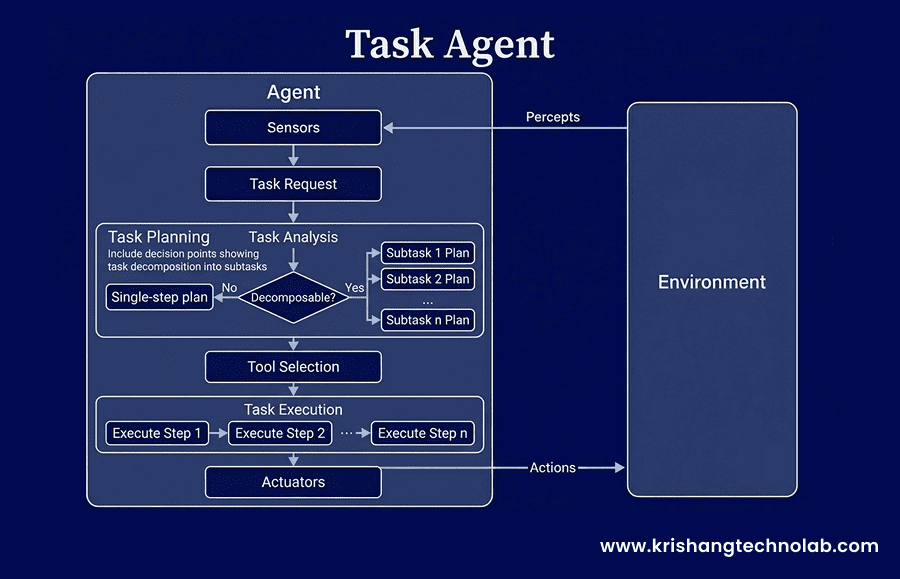
How Task Agents Work
A task agent is given a goal or instruction. Then they decompose the goal into smaller subtasks. Then it executes each step sequentially. It uses tools such as web search, databases, APIs and code execution to get things done. This allows it to complete workflows, from start to finish. Imagine a digital worker who handles complete processes.
This agent type is widely used in modern AI workflow automation platforms. This explains their widespread use in real systems today, including some of the best AI coding assistants.
Advantages
- End-to-end automation – The agent executes complete workflows, rather than single steps. This means less human effort is required.
- Tool use – It can search the web, run code and query databases. So it can deal with many types of tasks.
- High autonomy – Minimal human input is required once the task is defined. Besides, it can work without supervision.
Limitations
- Struggles with unclear instructions – Agents may fail if the objective is not clear.
- Error propagation – One error can change the outcome of subsequent steps. Therefore, the final result might be wrong.
- Limited by available tools – It can only do what the tools will allow. Its efficacy depends on its configuration.
Real-World Examples
- AI coding assistants that write, test, and debug code
- Research agents that gather and synthesize information
- Data pipeline automation tools
- Document processing and summarization agents
Also Read About: What Is AI-Powered Software Development for Startups and Enterprises?
7. Collaboration Agents
Collaboration agents are one of the major types of AI agents. They are at the heart of multi-agent AI systems. The agents are designed to cooperate with one another. Instead of one agent doing all the work, a group of agents share it. That way they are working together for the same goal.
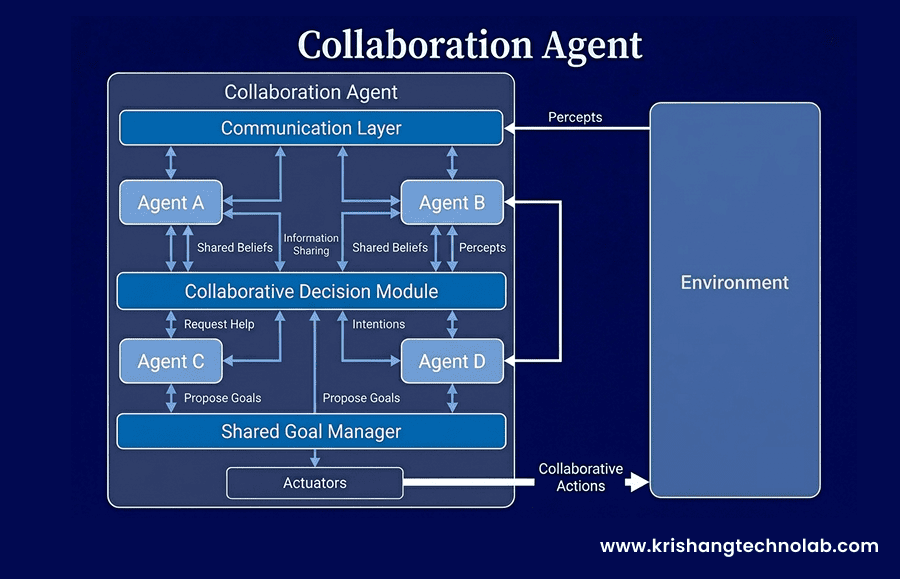
How Collaboration Agents Work
In a multi-agent collaboration setting, each agent has a role. One agent can do data retrieval. Alternatively, one agent can be responsible for analysis. One third will write the report. An orchestrator agent manages the whole process. It coordinates all the agents. Hence, the system is systematic in its working.
The agents can talk to each other. They also share results along the way. They also collaborate to combine their outputs and tackle problems that a single agent cannot solve. And this approach is what drives AI orchestration in modern enterprise systems and aligns with best practices for microservice architecture, where independent components work together to deliver scalable and efficient solutions.
Advantages
- Parallelism – Many agents work at the same time. That means tasks get done faster.
- Specialization – Each agent is assigned a single role. So the performance becomes better for every task.
- Scalability – Additional agents can be added as the workload increases. In addition, the system can be easily expanded.
Limitations
- Coordination complexity – Many agents are hard to deal with. This complexity complicates the system design.
- Failure cascades – One agent failure can have an impact on the whole workflow. Errors can therefore propagate.
- Higher infrastructure cost – Running many agents needs more resources.
Real-World Examples
- Autonomous research teams (one agent searches, another summarizes, another validates)
- Complex software development pipelines
- Multi-agent customer service platforms
- AI-driven business process automation across departments
Also Read About: What Are the Key Differences Between Monolith and Microservices?
8. RAG Agents
In, RAG agents are one of the most advanced types of AI agents. RAG stands for Retrieval-Augmented Generation agents. These agents use large language models with real-time information retrieval. So, they are useful for knowledge-intensive tasks.
What Are RAG Agents?
Standard language models have a fixed knowledge cut-off. So they don’t know recent history. RAG agents bridge this gap. They retrieve relevant documents or data at query time. And then they take that data and refine that answer.
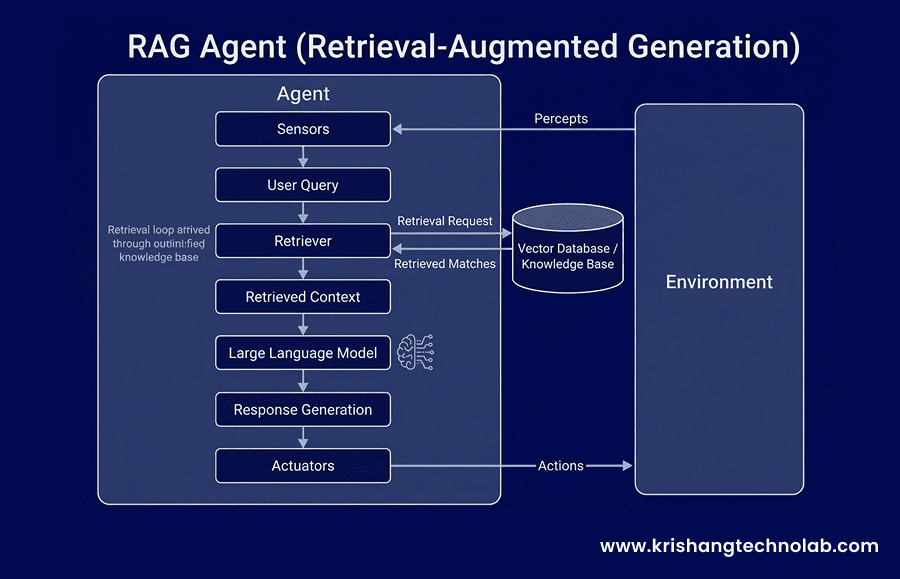
How RAG Agents Work
When a user asks a question, the RAG agent processes it as follows:
- The agent vectorizes the query. This vector is a mathematical version of the question.
- Searches a knowledge base or document store for the most relevant chunks.
- Then those chunks are fed along with the question to a language model.
- The model generates a grounded, accurate response based on the retrieved context.
This approach improves the reliability of RAG agents over vanilla LLM-only systems. It also helps keep answers more up to date, especially when integrated with headless CMS platforms for enterprise to ensure content is centrally managed and consistently delivered across systems.
Advantages
- Grounded in real data – The agent is based on real documents. So you have fewer hallucinations.
- Always current – Fetches new data at query time. That means keeping responses current.
- Highly customizable – It can connect to any knowledge base or database. And it fits many use cases as well.
Limitations
- Retrieval quality matters – Wrong documents lead to wrong answers. Therefore, search quality matters.
- Latency – The retrieval step introduces a delay. This may result in slower responses.
- Requires well-organized knowledge bases – Poor data organization slows things down.
Real-World Examples
- Knowledge management systems in the enterprise
- Tools to look for legal documents and describe them
- Healthcare AI assistants’ access to clinical guidelines
- Product documentation powers customer support bots
9. Enterprise Agents
Enterprise AI agents are one of the most advanced types of AI agents. They are designed for large business processes. These systems bring together different skills, like memory, learning, using tools, and working together. They deliver business value directly across organisations, often making it essential for companies to hire AI developers to build and maintain these complex systems.
What Are Enterprise Agents?
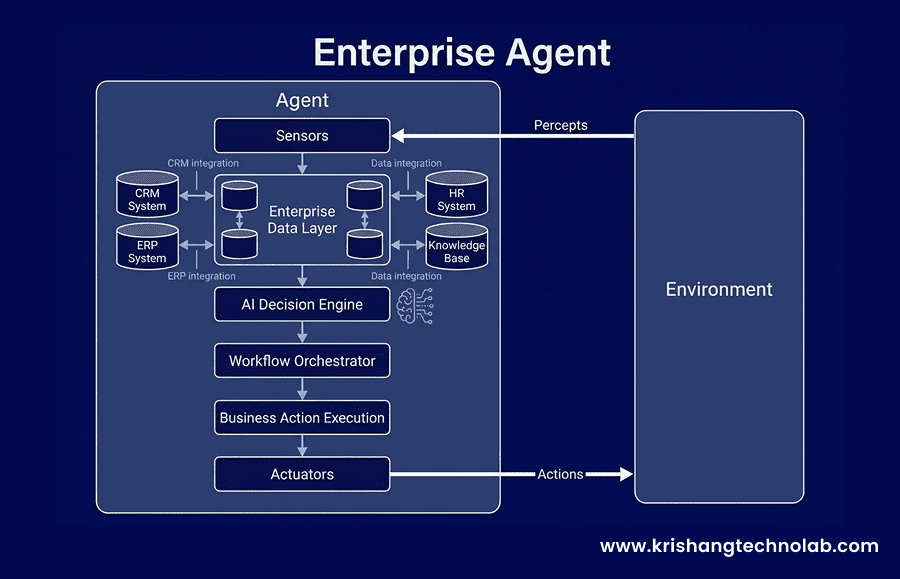
They are not independent tools. Instead, they are complete AI agent systems. They are embedded in business workflows. They also integrate with enterprise software, like CRMs, ERPs, and HRMs. Moreover, they adhere very strictly to the company policies. They operate at scale and handle sensitive data. So they must conform to regulations and security standards.
How Enterprise Agents Work
Enterprise agents are structured in layers:
- Orchestration layer – This layer is concerned with coordination among agents. It also sends tasks to the right place.
- Integration layer – This layer integrates business systems with the help of APIs. This means data can easily flow from tool to tool.
- Governance layer – This layer is about compliance rules, security and audit logs. Therefore, operations stay safe and traceable.
- Intelligence layer – This layer deals with reasoning, generation and decisions. It also powers intelligent outputs.
This setup allows enterprise agents to perform complex tasks across departments. For example, they can assist in financial reporting and supply chain optimisation.
Advantages
- Robust integration with existing business systems – They plug straight into core tools. This means that work gets done more efficiently.
- Enterprise-grade security and compliance – They have rules and they’re sticking to them. Therefore, they are safe for sensitive data.
- Can scale easily – Scalable across departments and geographies. Plus, they have global exposure.
- High ROI when used well in key business processes – They reduce effort and increase output.
Limitations
- Complex to implement – They need planning and technical expertise. So, setup is time.
- High upfront cost – Infrastructure, integration and training are expensive. That means the initial investment is high.
- Change management – Organisations need to change workflows. And teams need time to adapt, as well.
Real-World Examples
- AI-driven ERP assistants for finance and procurement
- Enterprise knowledge management systems
- Systems for automated compliance monitoring and reporting
- Massive customer experience automation platforms
Also Read About: What Is Custom Software Development?
Practical Challenges When Deploying Different AI Agent Types & Their Solutions
The deployment of AI agent systems in the real world poses unique challenges for each type of agent. Each type has its own problems. So, here’s a quick rundown of what you can expect. It also explains how to resolve these issues with the support of an AI software development partner.
Simple Reflex Agents
Challenge: These agents use fixed rules. Such rules may cause the output to fail when the environment is changed.
Solution: Improve rules with real cases. Also, upgrade the agent type to more advanced when more context is needed. So you have more flexibility.
Model-Based Reflex Agents
Challenge: An internal model can become out of date. If the environment changes rapidly.
Solution: Update the model on a fixed schedule. Also, add confidence scores for uncertain states.
Goal-Based Agents
Challenge: If the goal is vague, the outcome will be poor. The agent may follow the rules. But it may miss the real intent.
Solution: Have clear goal templates. Also define success criteria. Also, stringent limits must be added. And finally, test before you launch.
Utility-Based Agents
Challenge: It is hard to put trade-offs such as speed, cost and risk into one formula.
Solution: Bring in domain experts during design. Also, test against previous decisions. So, the quality of the decisions improves.
Learning Agents
Challenge: These agents learn wrong patterns from biased data. Performance may suffer over time as a result.
Solution: Performance testing frequently. Additionally, use human feedback on a daily basis. It also reduces drift.
Task Agents
Challenge: A single misstep can throw off all the steps that follow.
Solution: Between-step checkpoints. Provide fallback paths for failures as well. Thus, reliability is improved.
Collaboration Agents
Challenge: Debugging is difficult. Agents are using different formats. They may also fail in silence.
Solution: Establish clear communication guidelines. And also, use central logging. This means it is easier to debug.
RAG Agents
Challenge: Incorrect retrieval leads to the wrong answer. Such errors can happen even if we are very confident.
Solution: Build a clean knowledge base. Use hybrid searches as well. Also, combine semantic and keyword searching. Therefore, the accuracy is improved.
Enterprise Agents
Challenge: It complicates deployment. This covers legacy systems, compliance and alignment issues.
Solution: Go through each part step by step. Please consider making change management a core workstream early on.
AI Agents Use Cases
The following use cases for AI agents are some of the most impactful across industries today:
1. Simple Reflex Agents – Use Cases
These reactive agents operate on fixed rules and have no knowledge of the past. Some common examples are email spam filters that filter out emails having certain keywords, thermostats that turn on heating or cooling based on the current temperature, simple customer support bots that give preset responses, factory alarm sensors that turn on when some threshold is crossed and traffic lights that change depending on the current movement of vehicles.
2. Model-Based Reflex Agents – Use Cases
Because these agents track an internal world model, they suit dynamic environments. Consider a robot vacuum that knows what it has cleaned. Consider autonomous vehicle navigation that knows what lane it is in and what obstacles are around it. Think of smart home hubs that learn your routines, and adjust settings accordingly.
3. Goal-Based Agents – Use Cases
Goal-based agents do well in environments that require multi-step planning. They drive GPS route planners, automated meeting schedulers, engines for chess and strategy games, and AI-based travel booking tools that shoot for a specific destination and date.
4. Utility-Based Agents – Use Cases
Utility-based agents take over when the best outcome, not just any outcome, matters. The power recommendation engines like Netflix and Spotify, financial portfolio optimizers, digital ad bidding systems, and clinical decision-support tools that weigh treatment risk versus benefit.
5. Learning Agents – Use Cases
Adaptive AI agents learn and improve with each interaction. They power large language models, fraud detection in banking, personalized news feeds and self-improving customer service bots that get sharper as ticket volume rises.
6. Task Agents – Use Cases
Autonomous task agents can execute end-to-end workflows with minimal human intervention. Important use cases are AI coding assistants that write and debug code, research agents that gather and synthesize information from the web, data pipeline automation, and document processing products that summarize and extract information at scale.
7. Collaboration Agents – Use Cases
Multi-agent collaboration systems partition complex work among several specialized agents. The power autonomous research teams, large-scale software development pipelines, cross-department business process automation and multi-agent customer service platforms where triage, resolution and escalation agents take ownership of their own roles.
8. RAG Agents – Use Cases
RAG agents are excellent in knowledge-heavy areas. The power enterprise knowledge management systems, legal document search and summarization applications, healthcare assistants based on clinical guidelines and customer support bots trained on live product documentation.
9. Enterprise Agents – Use Cases
Enterprise AI agents work at the level of the organization. In real-world use, this includes AI helpers for finance and purchasing, automatic checking and reporting for compliance, big systems that improve customer experiences, and agents that work across HR, supply chain, and sales at the same time.
Future Trends Shaping AI Agents
Things are moving fast in the world of AI agents. These are the trends to look out for.
Agentic AI Ecosystems
Agentic AI is an AI system that is truly autonomous, in control of its resources, and adapting its behavior based on outcomes. We are moving from single-purpose tools to entire ecosystems of interacting agents that collectively manage complex organizational functions, including the use of white label AI agents for scalable and customizable deployments.
Multi-Agent Collaboration
The future of collaboration between agents will be more sophisticated coordination protocols, shared memory systems and specialized agent roles. Instead of a single powerful generalist agent, organizations will deploy fleets of specialized agents dynamically collaborating on complex tasks.
Advanced RAG Systems
Next generation RAG agents will do more than simple retrieval. They will reason across multiple retrieved documents, synthesize conflicting information, and proactively fetch data they predict will be needed – before a user even asks.
Autonomous Enterprise Agents
Enterprise AI agents will move from task execution to strategic input. They will not simply run predefined workflows – they will find inefficiencies, recommend process improvements, and autonomously optimize business operations within defined governance frameworks.
Also Read About: What Is Vibe Coding and How Is AI Changing Software Development?
Human-AI Collaboration
The most disruptive future isn’t AI replacing humans, but humans and AI as real partners. The best organizations will build systems where human judgment and AI agent capabilities are complementary – humans setting strategy and values, agents doing execution and analysis at scale.
Choose the Right AI Agent for Your Business Needs with Krishang Technolab
Krishang Technolab boasts vast experience in AI agent development services and enterprise AI solutions. The team supports organisations from strategy to architecture. It helps with deployment too. And it keeps you improving. In this way, companies receive support at each step of their intelligent automation journey. It is not only about technology. No. It’s based on clear and measurable business results.
You could want the specialised AI consulting service to evaluate preparation. Or you might need a full build of custom agents. Krishang Technolab works in both cases to suit your needs. It begins with where you are today. It then expands to suit your needs. Thus, it is suitable for both small and large projects.
Request a quote and let us build the ideal AI agent strategy for your organization.
Conclusion
The nine types of AI agents vary from simple rule-based responders to full-fledged enterprise AI agents. The right one depends on your data, decision complexity and need for autonomy. AI agent systems are no longer an experiment; they’re transforming the business landscape. Partnering with an experienced AI development company means you can choose, build and scale the right agent so your investment in intelligent automation pays off with real, lasting results.
Frequently Asked Questions
What is an AI agent?
An AI agent is a system able to sense its environment, process information and act to achieve particular goals. It is somewhat self-governing, it makes decisions based on input, rules or learned experience.
What is the difference between reflex agents and learning agents?
Simple reflex agents and model-based reflex agents act on current inputs according to pre-defined rules. They don’t get better with time. However, learning agents adapt through experience. They update their internal models with feedback about their actions, and thereby improve their performance on each interaction.
What are RAG agents and how do they work?
RAG agents (Retrieval-Augmented Generation agents) combine large language models with live document retrieval. When a user asks a question, the agent looks for relevant information in a knowledge base and uses that information to provide a factually correct answer. It cuts down on hallucinatory responses, and keeps it fresh.
Which AI agent is best for business automation?
It depends on the use case. Task agents work well with structured multi-step workflows. Learning agents are suited to cases where performance needs to improve over time. Enterprise agents are suited to complex organization-wide automation involving multiple systems and compliance requirements.
What are enterprise AI agents?
Enterprise AI agents are complete AI systems for large-scale business operations. They integrate with existing enterprise software, operate under governance and compliance frameworks, and coordinate multiple agent capabilities, reasoning, retrieval, tool use and collaboration, to drive business outcomes at scale.
How do collaboration agents differ from task agents?
Task agents are autonomous and execute a given workflow. Collaboration agents are designed to work with other agents to share information and divide tasks in a multi-agent team. Collaboration agents are good in problems that are too complex, or too large for any one agent to handle.
What industries use AI agents the most?
The classical AI literature recognizes five types of agents: simple reflex, model-based reflex, goal-based, utility-based, and learning agents. Modern practice adds four more: task agents, collaboration agents, RAG agents and enterprise agents, for a total of nine types of agents commonly recognized in artificial intelligence.
Which industries use AI agents the most?
Financial services, healthcare, retail, technology, manufacturing, logistics, and marketing are using AI agents. Intelligent agents can be applied to any industry that requires processing large amounts of data, complex workflows, or real-time decision-making.
Can multiple AI agent types work together?
Yeah. In fact, the most powerful modern systems use several kinds of agents together. A collaboration agent can orchestrate a RAG agent to pull knowledge, a task agent to execute workflow, and a learning agent to continuously improve, all within a unified architecture for enterprise AI agents.
How can businesses implement AI agents successfully?
Successful AI agent implementation starts with a well-defined problem statement and realistic success metrics. Build pilots prior to full-scale deployment. Invest in data quality, system integration and governance. Train your team to work with agents effectively. And find an experienced AI development partner who knows the technology as well as the context of your industry.
Found this post helpful? Don't forget to share it with your network!