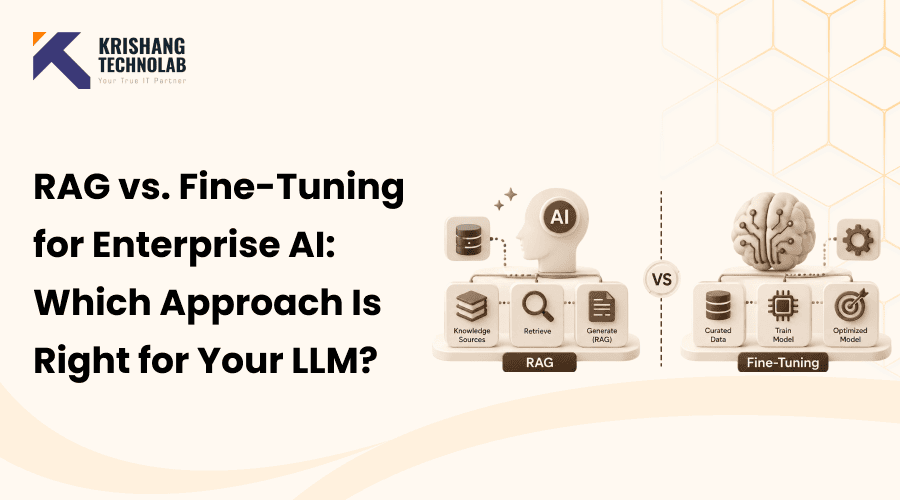
Quick Overview: Choosing between RAG vs. Fine-Tuning depends on your enterprise AI goals; RAG excels at real-time, source-grounded answers, while fine-tuning is better for deep domain adaptation. This blog compares cost, accuracy and implementation complexity to help you pick the right approach for your LLM.
All companies developing AI face the same critical decision point. How do you hook up your large language model to live company data or retrain the model itself on your examples? This is the RAG vs. fine-tuning decision and getting it wrong can waste months of engineering time and a big chunk of your AI budget.
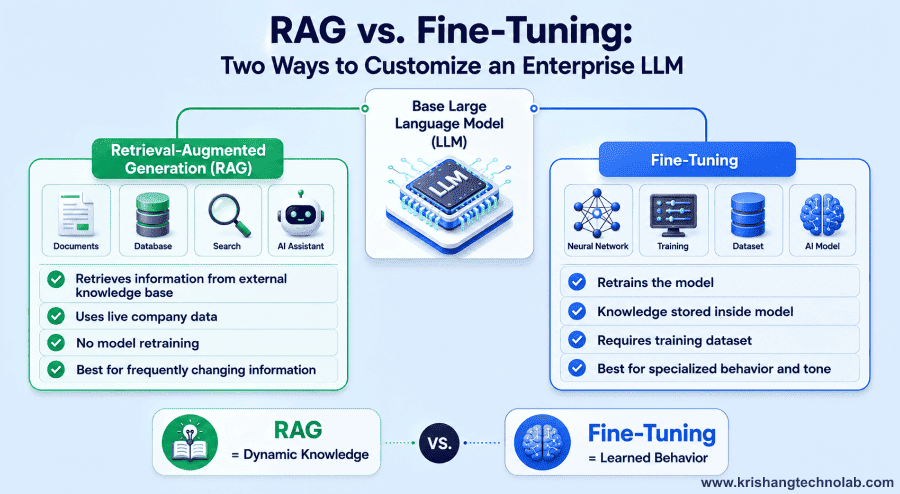
In simple words, Retrieval-Augmented Generation (RAG) is a method of retrieving information from an external knowledge base. You ask a question and it feeds that information into the model. Fine-tuning goes the other way. It retrains the model’s internal weights, so the knowledge lives inside the model itself. Both are valid ways to build a domain-specific LLM. But they are solving different problems. And they have completely unique cost and maintenance profiles.
The money backs that up. The global RAG market sits at roughly $1.92 to $2.69 billion today and is on track to hit around $10 billion by 2030, growing at a CAGR of about 38% to 49%. Fine-tuning is smaller but growing steadily, valued near $2.15 billion currently and projected to top $15 billion by the mid-2030s at a CAGR of about 21.4%. RAG is scaling faster, largely because most enterprise use cases lean on live, changing data rather than static knowledge baked into weights.
This blog takes you through how each approach works. It is where each one wins, what they cost and how to combine them when one isn’t enough. We’ll also walk you through real numbers on enterprise AI development spend so you can make this call with data, not guesswork.
What Is RAG (Retrieval-Augmented Generation)?
Retrieval-Augmented Generation (RAG) enables a language model to enhance its responses by retrieving relevant information from external sources, such as organizational documents, knowledge bases or databases, before generating an answer. It does this before it answers a question. RAG does not rely on what the model has learned during training but rather grounds each answer in real-time information.
How RAG Works: Retrieval, Ranking, and Generation
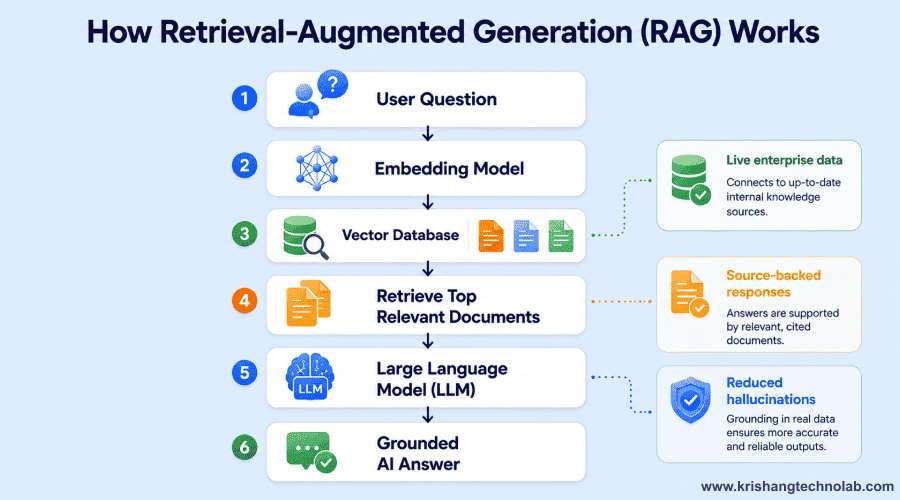
A typical RAG pipeline has three steps: First, your question is converted into a number code. The code is then compared with a vector database for enterprise AI that contains your company documents in a searchable format. Secondly, the system ranks and extracts the most relevant text snippets. The LLM analyzes the input question along with the relevant document fragments retrieved from the external knowledge source. It then generates an answer from the retrieved content.
That’s what makes RAG different from a plain chatbot. A standard model only knows what it has learned in training. A RAG-powered assistant can answer questions about a policy document uploaded five minutes ago. It doesn’t remember the answer; it looks it up.
When to Use RAG
RAG makes sense whenever accuracy depends on information that changes and you need to show where an answer came from:
- Source material updates often. Docs, pricing, policies, wikis, anything edited weekly is a bad fit for a model’s frozen training data.
- You need to show your work. In finance, healthcare or legal settings, an answer without a source is a liability. RAG can point back to the exact document.
- The knowledge base is too big for a prompt. RAG retrieves only the relevant snippets per question instead of cramming everything upfront.
- You’re working with private data. Contracts, internal reports, customer records, information no public model was ever trained on.
- You want to launch fast. Standing up RAG over an existing document store beats collecting a labeled dataset and running a training job.
- Wrong answers are costly but recoverable. Source citations give you a way to catch mistakes before they become real problems.
If the task is more about tone or pattern recognition than looking things up, that’s usually fine-tuning territory instead. The two often work together.
Real-World RAG Example
Picture an internal HR assistant. Employees ask about vacation policy, benefits or reimbursement guidelines. HR doesn’t need to retrain the model for each policy change. Rather, the company stores its documents in a vector database. The assistant pulls the newest version every time a question is asked. This is a textbook case of LLM knowledge base integration. It’s also one of the most common enterprise generative AI solutions in production today.
What Is Fine-Tuning an LLM?
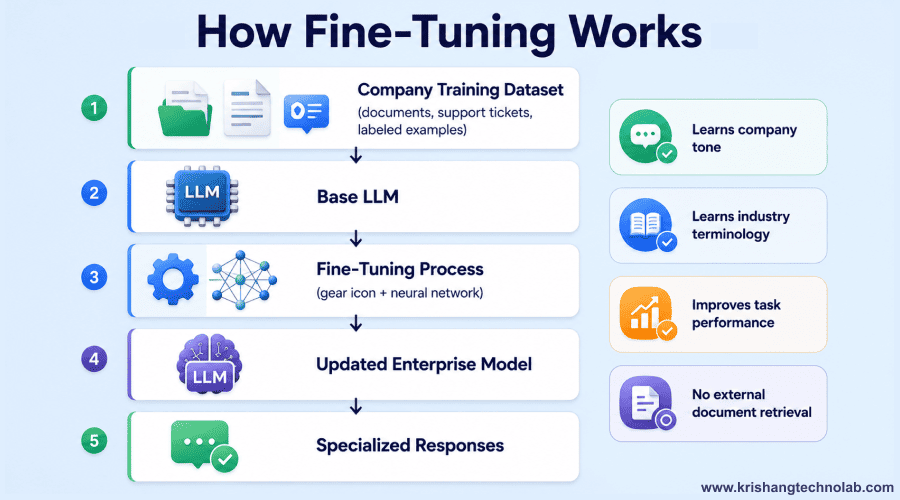
Fine-tuning is the process of continuing to train a pre-trained language model on a smaller, specialised data set. This is an important aspect of the machine learning development work of today. The goal of fine-tuning is to change the behaviour, tone or knowledge of the model so that it can perform better at a specific task without outside lookups.
How Fine-Tuning Updates Model Weights
During fine-tuning, engineers provide the model with thousands of labelled examples. It could be classified as sample support conversations or tickets for support. The model then fixes the internal parameters to be equal to these patterns. After the training is complete, that knowledge becomes baked into the model. No retrieval step is required.
When to Use Fine-Tuning
Fine-tuning makes sense when the task is about behavior or pattern recognition, not looking things up:
- The task is repetitive and pattern-based. Classifying tickets, tagging sentiment, routing requests, anything the model will do the same way thousands of times over.
- Tone or voice needs to be built in. Brand voice, regulated communication formats or a specific writing style that should hold up without relying on prompt instructions every time.
- Speed and cost matter at scale. A fine-tuned model skips the retrieval step, so it can run smaller, faster and lower-cost in high-volume production use.
- The domain has its own language. Industry jargon, internal shorthand or clinical and legal terminology that a general-purpose model wasn’t trained on.
- The knowledge is stable. Fine-tuning bakes information into the weights, so it’s a poor fit for anything that changes often; it works best when what you’re teaching the model won’t need constant updates.
- You don’t need source attribution. If the use case doesn’t require pointing back to where an answer came from, fine-tuning’s lack of citations isn’t a dealbreaker.
Full Fine-Tuning vs. LoRA and PEFT
Not all fine-tuning is the same. Full fine-tuning updates every setting of the model. This requires heavy computing and large datasets. LoRA (Low-Rank Adaptation) and other PEFT (Parameter-Efficient Fine-Tuning) methods are different; they are lighter. They only update a small part of the model. This reduces training costs significantly while still producing strong results. For that reason, most enterprises now default to LoRA-style methods rather than full fine-tuning.
Real-World Fine-Tuning Example
Picture a company that must sift through thousands of support tickets into categories such as billing, technical or account problems. By fine-tuning a smaller model on the old labelled tickets, you get a fast, low-cost and accurate classifier. This approach is better than RAG for this use case. This is not a fact search but pattern recognition work.
RAG vs. Fine-Tuning vs. Prompt Engineering: Where Each One Fits
Before comparing RAG and fine-tuning head-to-head, it’s useful to bring prompt engineering into the picture. That’s where many teams start. Prompt engineering is to build better instructions for a ready-made model. No retraining or retrieval setup is required. It is the lowest cost and quickest way. And it’s often enough for simple tasks.
The limitation of prompt engineering is when the model requires real-time data. RAG provides an effective approach to address this challenge by enabling the model to access and use external knowledge. Fine tuning takes over when the task requires a particular tone, format or skill to be built in. Most mature LLM customization approaches use all three in layers. Prompt engineering first, then RAG for grounding and finally fine-tuning for behavior control.
Also Read About: How can you master AI communication through prompt engineering?
RAG vs. Fine-Tuning: Side-by-Side Comparison
The fastest way to get a feel for the RAG vs. fine-tuning LLM trade-offs is to compare them head-to-head. These are the things that matter most to enterprise teams.
| Factor | RAG | Fine-Tuning |
| Data freshness | Updates instantly by editing the knowledge base | Requires retraining to update knowledge |
| Setup time | Faster to launch, less upfront data prep | Slower, needs labeled training data |
| Cost | Lower upfront cost, ongoing retrieval infra cost | Higher upfront compute cost, lower-cost to run afterward |
| Accuracy on niche tasks | Strong for factual, document-based Q&A | Strong for tone, format and specialized skills |
| Explainability | High; can cite the source document | Low; no built-in source attribution |
| Maintenance | Update documents, no retraining needed | Needs periodic retraining as data changes |
| Best for | Knowledge-heavy, fast-changing information | Stable tasks needing a specific style or skill |
Benefits and Trade-Offs of RAG
RAG has clear benefits for enterprise AI but also genuine engineering trade-offs that are worth planning for early.
Where RAG Wins
Most of the benefits of RAG are related to accuracy, cost and trust.
- Reduced hallucinations: It answers using text it has retrieved, rather than guessing, so it is far less likely to hallucinate facts.
- Traceability and verification: You can show exactly which document backed an answer, which matters a lot for regulated industries.
- Lower setup cost: Since you’re not retraining the model, RAG usually costs less to get running. Many teams bring in an AI development company to scope this stage.
- Works well with limited training data or resources: No need for a large labeled dataset to get started.
Where RAG Falls Short
RAG is not without its challenges and most of those are in engineering effort.
- Building and maintaining retrieval infrastructure: This is real engineering work because someone has to manage the vector database, keep the embeddings up-to-date and tune retrieval quality.
- Engineering complexity and performance optimization: The retrieval speed and relevance need continuous tuning.
- Context window limitations: This limits the amount of retrieved text the model can handle at once, which can be problematic for very large documents.
Benefits and Trade-Offs of Fine-Tuning
Fine-tuning allows for a much deeper level of customisation than you could get from prompting or retrieval, but there is a cost. It needs more data, more compute and more ongoing maintenance than RAG usually does.
Where Fine-Tuning Wins
Fine-tuning makes sense when the need for customisation is inside the model itself, not tacked onto the outside in context.
- Domain-specific accuracy: A model that has been fine-tuned on the language and edge cases of your industry can capture nuance that is truly difficult to replicate through clever prompting alone.
- Speed and efficiency: There’s no retrieval step to slow things down, so a fine-tuned model can often be leaner and respond faster.
- Tone and style control: If you need to maintain a brand voice or follow a strictly regulated format, fine-tuning lets you bake that consistency in instead of hoping the prompt holds up every time.
Where Fine-Tuning Falls Short
There are real trade-offs and they tend to manifest themselves after the initial excitement passes.
- Data and compute requirements: You need a good, well-labelled dataset and a real budget for training, which isn’t trivial to assemble.
- Overfitting risk: A model can start memorising training examples rather than generalising from them, which quietly sabotages what you are trying to achieve.
- Harder maintenance: Every time the underlying information changes, it’s a new training cycle, not a quick edit to a knowledge base.
- No source attribution: A fine-tuned model can’t show its work or point back to where an answer came from, which rules it out for anything that requires an audit trail.
Cost Breakdown: RAG vs. Fine-Tuning
Cost is typically the deciding factor in the RAG vs. fine-tuning debate. It’s worth breaking down where the money really goes. An AI consulting engagement can save you from costly missteps here.
Compute cost
With RAG, computation costs are distributed over repeated retrieval processes, while LoRA methods have lowered the barrier to fine-tuning by reducing training expenses; however, the main computational burden still occurs during the initial model training stage.
Data preparation cost
With RAG, you need to get your documents into shape and embed them. This tends to be less time-consuming than fine-tuning, which requires clean, labeled training examples.
Ongoing maintenance cost
RAG maintenance involves keeping your knowledge base up to date. Fine-tuning maintenance means periodic retraining. That can add up if your data is frequently changing.
Market data backs the approach up as the default starting point for many teams. RAG-based enterprise LLM deployments were 38.4% of the enterprise LLM market in 2025. The segment is also forecast to be among the fastest-growing categories over the next decade, according to Straits Research. The momentum tells one thing clearly. For many organizations, accuracy and auditability are more important than the more profound customization that fine-tuning provides. These AI adoption trends offer metrics that give a broader perspective on the direction of enterprise budgets.
When Should You Combine RAG and Fine-Tuning? (Hybrid Approach)
RAG vs. fine-tuning are not exclusive alternatives. Indeed, more and more enterprises combine the two for a hybrid RAG vs. fine-tuning approach.
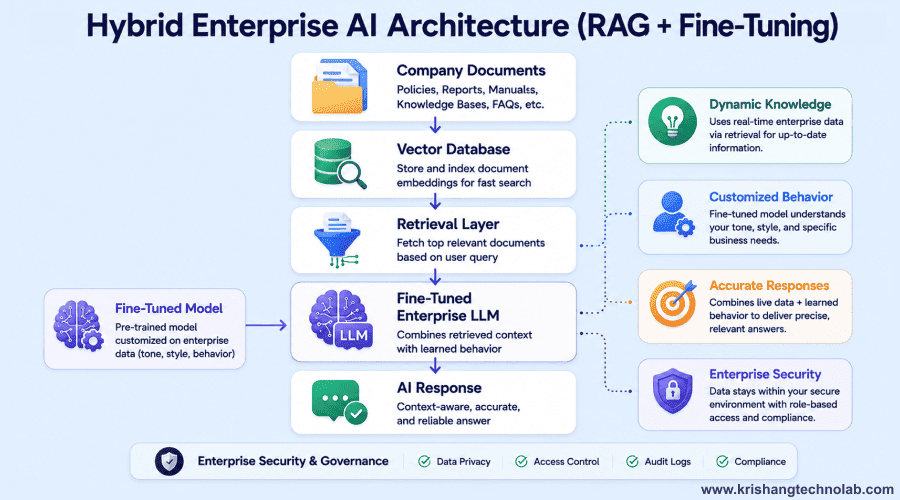
What a Hybrid Architecture Looks Like
First, the model is fine-tuned in a hybrid manner. It teaches it the terminology, tone and task structure of your industry. Then RAG provides new relevant information at query time. A financial services company is one example of a project that is often planned out with a data science consulting team. It could calibrate a model to speak in compliant, precise financial language. Then, it uses RAG to inject the latest account or market data into each response.
Is Hybrid Worth the Extra Complexity?
A hybrid approach is more costly to install and maintain than either approach alone. It is generally only used when accuracy and brand consistency are both critical. If your use case doesn’t need solving more than one problem, stick with the single approach. It will launch lower-cost and faster. This kind of scalable LLM architecture for enterprises is usually the end goal of mature AI programs, not the starting point.
Tools and Tech Stack: RAG vs. Fine-Tuning Ecosystems
The tooling ecosystem is very different between the two approaches.
- RAG stack: Vector databases store and search your embedded documents. Libraries like LangChain and LlamaIndex manage the retrieval pipeline, chunking and orchestration between your data and the LLM. This stack is central to most retrieval-augmented generation for business projects today.
- Fine-tuning stack: The training loop is managed by OpenAI’s fine-tuning API and Hugging Face’s training libraries. LoRA and other PEFT frameworks enable fine-tuning of large models without the need for a full data center’s worth of compute.
Also Read About: How Is AI Transforming Software Development in 2026?
Choosing the right tools is as important as choosing the right approach. A mismatch in the stack can turn a two-week project into two months.
Enterprise Use Cases: Which Companies Choose Which Approach
Different industries are on different ends of this decision and it’s usually a matter of one thing: does the underlying data move quickly or does it stay still long enough to train on?
E-commerce and retail
They are good examples of the first case. Product catalogues, prices and stock levels are constantly changing, sometimes multiple times a day. A fine-tuned model isn’t fast enough to keep up with that pace, so most e-commerce teams rely on retrieval instead, pulling live inventory and pricing data into every customer-facing answer.
Banking and financial services
It usually ends up somewhere in the middle. They change models so they spit out the kind of uniform, compliant language regulators want and then add retrieval on top to make sure the system can still pull up current account details or policy changes without having to be retrained whenever something changes.
Healthcare organizations
They are one of the clearer cases for retrieval. Clinical guidance and drug information change so quickly that a stale answer is not just inconvenient; it’s a liability. Retrieval also provides the model with a reference point, which is crucial when an answer must be able to withstand an audit.
Legal organizations
It tends to go the other direction. Drafting contracts and legal writing are heavily dependent on tone, structure and precedent, so fine-tuning is a natural fit there. There are still some organizations that tack retrieval onto that, mostly so the model can pull in case law or organizations-specific templates while drafting.
SaaS and software companies
They typically start with retrieval for support and documentation, because products change too fast for a fine-tuned model to stay accurate. Fine-tuning is more obvious in more focused jobs, like code generation for a specific tech stack, where consistency of output is more important than creativity. Many of these teams also lean on a straightforward ChatGPT integration for early-stage support bots before deciding whether a custom retrieval or fine-tuned setup is worth building.
Enterprise IT teams
It almost always defaults to retrieval. Company wikis, HR policies and internal documentation are constantly changing and retraining a model every time a policy is updated is not realistic. Retrieval also has the side benefit of giving employees a source link so they aren’t just trusting the answer blindly.
Zoom out far enough and a pattern emerges: retrieval wins when data moves fast and traceability is key; fine-tuning wins when tone or a narrow skill is more important than being current. Hybrid setups continue to arise where both needs exist at the same time, especially in regulated industries.
This is also what’s happening at the market level. The use of generative AI in businesses has been increasing in recent years. According to Hostinger’s 2026 LLM statistics report, almost 70% of organizations now use generative AI in at least one of their business functions. Global spending on AI is forecast to hit $2.59 trillion in 2026, a 47% increase from the previous year. But the money has not translated cleanly into results. Menlo Ventures’ 2025 research shows only about 40% of enterprises can cite measurable ROI from their AI work so far.
That gap between spending and results is no side note. Usually it’s a sign that the architecture decision was made too lightly. You can’t decide between RAG, fine-tuning or a hybrid approach after launch. Often that’s the difference between a system that stands up in production and one that never gets out of the pilot stage.
How an Enterprise AI Development Agency Helps You Get This Right
Choosing between RAG and fine-tuning is not a one-time decision. It should be reviewed again as your data, budget and compliance needs change. That’s where working with an experienced AI development agency pays off. A team that has shipped real RAG implementation services and LLM fine-tuning services can help you avoid two common mistakes. The first is over-engineering a simple use case: fine-tuning. The second is under-engineering a compliance-heavy use case with a basic RAG setup.
Also Read About: How to Choose the Right AI Software Development Partner?
This is the kind of decision that Krishang Technolab helps enterprises make. The team will analyze your data, workflows and compliance requirements and suggest RAG, fine-tuning or a hybrid build. The team offers a wide range of custom LLM development services. This involves creating a vector storage system, developing the retrieval workflow, preparing high-quality datasets and optimizing the model performance through fine-tuning. Companies still mapping out their AI roadmap can tap broader generative AI consulting services. Perhaps you need a private LLM deployment behind your infrastructure. Or perhaps you need a fully managed enterprise AI development services engagement. Regardless of the approach used, the ultimate objective remains unchanged. Don’t chase the trends; match the architecture to the actual business problem. That’s the same idea behind the entire range of development services the team provides.
Why Hire an AI Development Team for Your Enterprise LLM Project?
You can build a RAG pipeline or fine-tuned model in-house. But that requires specialised skills that are still scarce and expensive to hire full-time. Many companies opt to hire AI developers on a project basis instead of creating an internal team from the ground up.
Are you thinking about whether to hire LLM developers, hire generative AI developers or hire a dedicated AI development team? Find a partner who has hands-on experience with both RAG vs. fine-tuning projects, not just one or the other. Krishang Technolab’s engineers become an extension of your team. You can hire AI consultants for enterprise strategy work. Teams that are building prompt-layer workflows alongside RAG or fine-tuning also hire prompt engineers to improve instructions before scaling. Or you can bring on a full-hire AI development agency engagement to build, deploy and maintain the system long-term.
Final Thoughts on RAG vs. Fine-Tuning
There’s no universal winner in the RAG vs. fine-tuning debate; the best solution depends on your data change frequency, your level of traceability, your budget and your compliance needs. RAG is suited for rapidly changing, knowledge-intensive use cases. Fine-tuning is suited for stable tasks that require a particular skill or voice. Many mature businesses end up with a hybrid of both.
Enterprise AI spending is growing rapidly. Recent industry research chronicled the leap in adoption from less than 5% in 2023 to more than 80% by 2026. Building this architectural choice early can save actual time and budget later.
Still weighing RAG vs. fine-tuning for your enterprise LLM project? Krishang Technolab can help you. The team will examine your data, workflows and goals. Then, the team will build the right solution for you, whether it is a RAG, fine-tuning or a hybrid solution, starting from scratch.
Frequently Asked Questions
What is the difference between RAG and fine-tuning?
RAG retrieves external information at answer time; fine-tuning embeds knowledge directly into the model’s weights through retraining. RAG updates immediately by editing documents. Fine-tuning requires a new training run to update knowledge.
Is RAG better than fine-tuning for enterprises?
Neither is always better. When data is changing quickly and traceability is important, RAG often wins. Fine-tuning is often better for tasks that require a specific tone, format or specialized skill, rather than new facts.
How does the cost of RAG compare to fine-tuning?
Generally, RAG is less expensive to set up because it avoids the compute-heavy training process. However, RAG carries ongoing retrieval infrastructure costs, so long-term costs depend on your data volume and query frequency.
Does RAG reduce hallucinations more than fine-tuning?
Yes, most of the time. RAG grounds answers in the retrieved source text to reduce the likelihood of the model fabricating facts. Fine-tuning improves accuracy on trained patterns, but not grounded, source-backed answers.
Can RAG and fine-tuning be used together?
Yes. A hybrid RAG and fine-tuning approach fine-tunes the model for tone and task structure. RAG then supplies current, specific facts on top. This is common in regulated industries that need both consistency and accuracy.
What is the difference between RAG, fine-tuning, and prompt engineering?
Prompt engineering involves tweaking instructions to an existing model without retraining or retrieval setup. RAG adds the retrieval of external knowledge. The fine-tuning retrains the weights of the model. All three are layered together in many enterprise systems.
Is fine-tuning or RAG better for classification tasks?
Fine-tuning tends to be better for classification. The job is pattern recognition on labelled examples, not looking up current information, which is what RAG does best.
What is LoRA fine-tuning and how is it different from full fine-tuning?
LoRA (Low-Rank Adaptation) updates a small subset of a model’s parameters without retraining the entire model. It is much less costly and faster than full fine-tuning but still achieves good task-specific performance.
How do you evaluate RAG vs. fine-tuning performance?
Evaluate RAG for retrieval accuracy, answer grounding and citation quality. Evaluate fine-tuning for task accuracy, consistency and generalization to unseen examples. Both should also be tested for cost per query and latency of response.
How much does it cost to hire an AI development agency for RAG or fine-tuning?
Pricing depends on project scope, data volume and if you want a hybrid build. Most agencies scope the project after an initial look at your data, infrastructure and compliance requirements. A custom quote is worth asking for rather than generic pricing.
Found this post helpful? Don't forget to share it with your network!