
Quick Overview: Elicit is better for structured literature reviews, systematic review workflows, and extracting comparable data from multiple papers. Consensus is better for quickly answering research questions with evidence-backed citations. We tested both tools to see how they perform in real research workflows.
If you’ve spent any time trying to get through a stack of academic papers, you’ve probably run into Elicit vs Consensus AI, two of the most talked-about AI research assistants for people who need to find, understand, and synthesise scientific literature. Both promise to save you hours of manual searching and reading. Neither does the exact same job.
AI research tools have exploded in popularity among grad students racing to finish a thesis, academics who need to stay current in their field, and professionals who have to make evidence-based decisions without a research department behind them. The appeal is obvious: instead of wading through pages of search results, you can ask a plain-language question and get an answer built from real papers, with citations attached.
This surge mirrors a broader trend across industries, where organisations are turning to AI development to automate work that used to take teams of people days to complete. Elicit and Consensus both do this, but they come at it from different angles. Elicit leans into structured workflows, screening thousands of papers, extracting data into tables, and running systematic reviews. Consensus AI leans into fast, conversational answers to specific research questions, with a visual “metre” showing how the evidence leans.
This guide walks through how the two compare on features, search, literature reviews, citations, accuracy, pricing, and the situations where each one shines so you can figure out which one (or both) belongs in your workflow.
Elicit vs Consensus: Quick Comparison
| Feature | Elicit | Consensus |
| AI research assistant | Yes — Research Agent for multi-step questions | Yes — Research Agent for multi-step questions |
| Academic paper search | 138M+ papers | 220M+ papers |
| Literature reviews | Structured, table-based workflow | Narrative, citation-backed summaries |
| Systematic reviews | Dedicated PRISMA-oriented workflow (Pro/Enterprise) | Not a dedicated systematic-review tool |
| AI-generated summaries | Yes, per paper and across sets | Yes, via Pro messages and Study Snapshots |
| Evidence synthesis | Tables, extracted columns, report generation | Consensus Meter (yes/no/mixed visual) |
| Citation support | Export to RIS, CSV, BIB, PDF, DOCX | In-line citations, APA/MLA/Chicago/Harvard/BibTeX export |
| Research extraction | Custom columns pulled from uploaded/found papers | Claims & evidence tables, Study Snapshots |
| Natural-language search | Yes | Yes, built around question-style queries |
| Pricing | Free; Plus $11/mo; Pro $49/mo; Scale $169/mo (monthly billing; discounts for annual) | Free; Pro $20/mo; Deep $65/mo; Team custom (monthly billing; discounts for annual) |
| Best for | Systematic reviews, structured data extraction | Quick evidence-based answers, agreement/disagreement at a glance |
(Pricing reflects officially published rates as of mid-2026; both companies frequently adjust tiers, so check their pricing pages before buying.)
What Is Elicit?
Elicit is an AI research assistant built around automating the more tedious parts of a literature review: finding papers, pulling structured data out of them, and organizing findings into tables you can actually work with. It searches across more than 138 million papers and layers a language model on top to help you extract, summarize, and compare findings without opening every PDF yourself.
Key Features of Elicit
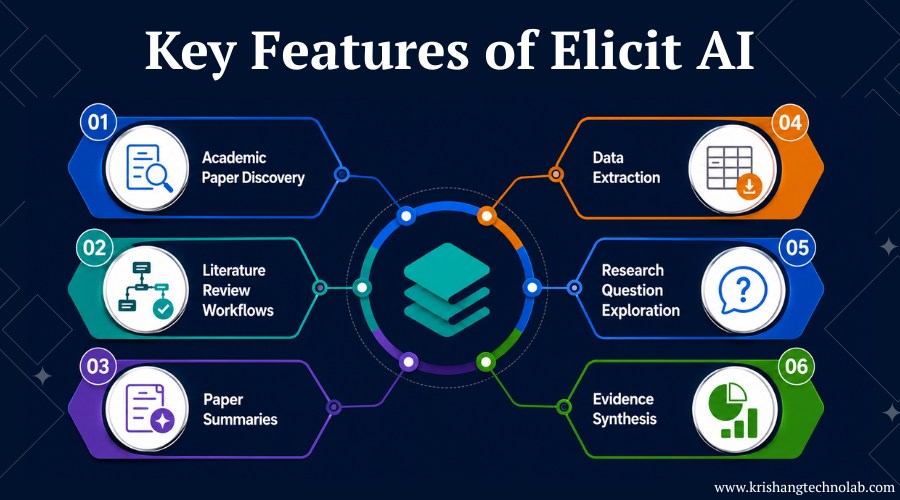
- Academic paper discovery: search across Elicit’s full corpus, plus a dedicated clinical trials index
- Literature review workflows: a structured, table-first way to move from a research question to an organized set of findings
- Paper summaries: automatic summaries of individual studies, with explanations for how the AI arrived at its answer
- Data extraction: pull specific data points (sample size, methodology, outcomes) into customizable table columns across many papers at once
- Research question exploration: a research agent that plans and chains together multi-step research tasks
- Evidence synthesis: automated reports that pull from up to 135–200+ data sources depending on the plan, plus a dedicated systematic review workflow that can screen thousands of papers on paid tiers, built on the same kind of generative AI development techniques powering large-scale summarization tools elsewhere
Who Should Use Elicit?
- Researchers running formal literature reviews
- Graduate students working through a thesis or dissertation
- Academics who need PRISMA-style rigor in a review
- Students conducting structured literature reviews for coursework
- Professionals in fields like pharma or policy doing evidence-based research at scale
Read About: 9 Types of AI Agents
What Is Consensus?
Consensus is an AI-powered academic search engine built around answering research questions directly, rather than handing you a list of links to sort through yourself. It draws from a database of more than 220 million peer-reviewed papers and is designed to feel closer to asking a well-read colleague a question than running a database search.
Key Features of Consensus
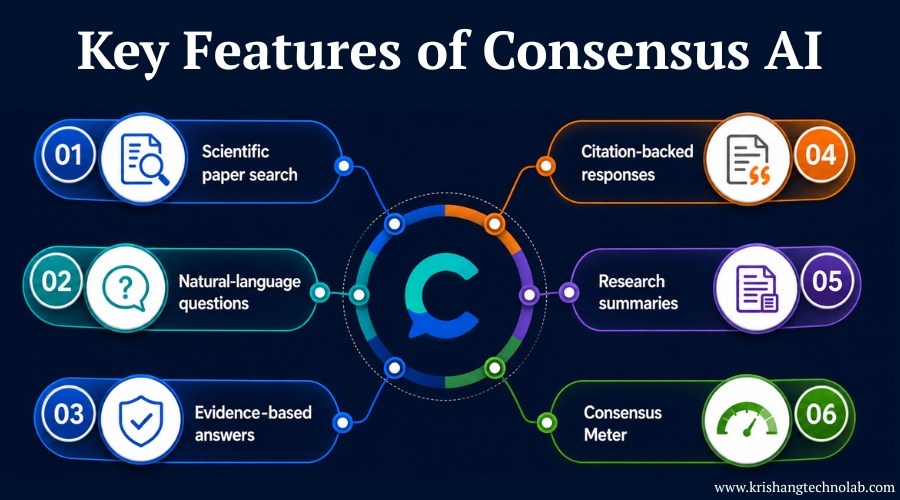
- Scientific paper search: searches across peer-reviewed literature spanning most academic disciplines
- Natural language questions: ask a question the way you’d ask a person, not the way you’d construct a database query.
- Evidence-based answers: Pro messages summarise key findings from top-ranked papers with a high-level synthesis.
- Citation-backed responses: every synthesised claim links back to the specific paper it came from.
- Research summaries: Study Snapshots and Deep Search modes for progressively deeper dives into a topic.
- Consensus Meter: a visual bar showing how many retrieved papers support, oppose, or report mixed results for a yes/no research question, with a “snapshot” view breaking down study type, recency, and journal quality behind each position
Who Should Use Consensus?
- Students who want a fast, sourced answer to a specific question
- Researchers doing early-stage exploration of a topic before committing to a deep review
- Healthcare and science professionals who need a quick read on what the evidence says
- Anyone who wants an evidence-backed answer without manually screening papers themselves
Related to Read: How Consensus AI Compares to Alternatives
Elicit vs Consensus: Key Differences
1. Search and Discovery
Both tools let you type a question in plain language instead of building a Boolean search string. Elicit’s search is built to feed directly into its extraction and review workflows. You search, then immediately start pulling structured data from what you find. Consensus’s search is built to answer the question itself, surfacing the most relevant papers and synthesizing what they say rather than leaving you to read through the list. Consensus’s index is somewhat larger; Elicit’s search is more tightly integrated with downstream analysis tools like tables and reports.
2. Literature Review
Elicit treats a literature review as a structured project: you build a table, add extraction columns, and end up with a spreadsheet-like view of your papers that you can export and keep refining. This is genuinely useful when you need to compare dozens or hundreds of studies side by side. Consensus treats a literature review more like a conversation: you ask a question, get a synthesized answer with the Consensus Meter showing where the evidence lands, and can go deeper with Deep Search if you need more rigor.
Which is better for reviewing multiple papers? Elicit if you need to compare structured data across a large set of studies. Consensus, if you want a fast, readable synthesis of what the literature says on a specific question.
3. Research Summaries
Elicit’s summaries are built for depth and comparison; they’re meant to feed into a larger table or report, and each one includes an explanation of how the AI reached its conclusion. Consensus’s summaries are built for speed. Pro messages and Study Snapshots are meant to get you an answer quickly, with the option to switch to Deep Search when you need more thoroughness. Both link claims back to specific papers, but Elicit’s format assumes you’ll be cross-referencing many summaries at once, while Consensus’s assumes you mostly want the answer.
4. Evidence Synthesis
This is where the two tools diverge most. Elicit synthesizes by extracting comparable data points into tables and generating structured reports from many sources. Consensus is synthesized by aggregating the stance of individual papers into a single visual, the Consensus Meter, for yes/no/possibly questions. It’s worth knowing that the Meter counts positions across whatever papers its retrieval step surfaces for that specific query; it doesn’t weight a large randomized trial more heavily than a small case report, though the Meter’s snapshot view does show you the study types and journal quality behind each position so you can judge that for yourself. Elicit’s synthesis is generally better suited to formal, defensible evidence review; Consensus’s is better suited to getting oriented on a topic quickly.
5. Citations and Sources
Both tools prioritize citing real sources over generating unverified claims; this core design principle drives each platform rather than serving as an add-on. Elicit lets you export citations in RIS, CSV, BIB, PDF, and DOCX formats, which slot neatly into reference managers like Zotero (from which it can also import directly). Consensus supports APA, MLA, Chicago, Harvard, and BibTeX export and shows the specific papers behind every synthesized sentence so you can trace a claim back to its source. In both cases, the citation is a starting point, not a substitute for reading the original paper, especially for any claim you plan to rely on.
6. Accuracy and Reliability
Both platforms operate as closed systems that search a fixed corpus of peer-reviewed literature rather than the open web. This limits, but does not eliminate, the risk of fabricated sources. That said, like any product built on machine learning development, AI-generated synthesis can still misrepresent nuance. Consensus’s Meter can misclassify a paper’s findings when the question doesn’t closely match the study’s population or conditions, for example, when it counts a study of children toward a question about adults. Elicit’s extraction step can likewise pull a data point slightly out of context, especially from papers with unusual formatting. Neither tool should replace reading the underlying study before you cite it in your own work. Think of both as a fast first pass, not a final answer.
7. Ease of Use
Elicit has more of a learning curve because it’s built around a workflow. You set up tables, add columns, and configure extractions, which pays off on bigger projects but takes longer to get comfortable with. Consensus is closer to a search engine: type a question, get an answer, done. Beginners and people who want quick answers tend to find Consensus more approachable; people running larger, more structured research projects tend to get more value out of investing time in Elicit.
8. Pricing
Elicit’s official pricing (as of mid-2026) starts with a free basic tier offering unlimited search, summaries, and paper chat, then moves to paid tiers, Plus, Pro, and Scale, that unlock higher usage limits, systematic review workflows, larger data extraction tables, and API access, with an enterprise tier for institutions. Consensus’s official pricing also starts free, with unlimited standard searches and a limited number of Profound Search reviews per month, then moves to Pro and Deep subscription tiers that unlock unlimited Pro searches and a larger monthly allotment of Profound Search reviews, plus a custom-priced Teams plan for labs and departments. Both companies offer meaningful discounts for annual billing over monthly. Broadly, Consensus offers cheaper entry-level paid plans, while Elicit prices its higher tiers around specialized systematic-review features.
Elicit vs Consensus: Pros and Cons
Pros of Elicit
- Strong for structured, PRISMA-oriented systematic reviews
- Powerful custom data extraction into comparable tables
- Generous free tier for search and summarization
- API access on paid plans for embedding into other workflows
Elicit Cons
- Steeper learning curve than a simple search tool
- Limited to academic/peer-reviewed literature no news, web, or grey literature
- Elicit gates its best features, including systematic review workflows and high column counts, behind paid tiers.
Consensus Pros
- Fast, conversational path from question to sourced answer
- Consensus Meter gives an at-a-glance read on how evidence leans
- Large paper index with strong coverage in medicine and social science
- Lower-cost entry point for individual paid usage
Consensus Cons
- Paid plans still cap the Deep Search allowance.
- Consensus Meter counts papers rather than weighting evidence quality by default; it’s a signal, not a substitute for judgment
- Not designed to replace a full systematic-review methodology
Also Read: Tech Stack for AI Startups
Elicit vs Consensus: Which Is Better for Literature Reviews?
- Finding relevant papers: Both do well; a slight advantage in raw coverage goes to the larger index of consensus.
- Screening research: Elicit has a systematic review workflow designed to screen large numbers of papers against inclusion criteria.
- Extracting information: Elicit’s custom table columns are more powerful for pulling comparable data across many studies, a task that mirrors what data science consulting teams do when they structure messy inputs into analyzable datasets.
- Comparing studies: Elicit’s table format makes side-by-side comparison easier. Consensus’s study snapshots are better for a quick comparison of a handful of papers.
- Synthesizing evidence: Consensus’s meter gives you a faster directional read, while Elicit’s reports work better for a formal write-up.
- Building a literature review: Elicit AI is closer to a finished draft. Consensus is closer to a research aid you’d use before writing.
Verdict: If your literature review needs to hold up to scrutiny, a thesis chapter, a systematic review for publication, a grant proposal appendix Elicit’s structured workflow will get you further. If you’re doing early exploration or need a fast, well-sourced answer to guide your next step, Consensus is the quicker tool for the job. Many researchers end up using both at different stages of the same project.
Elicit vs Consensus: Which Is Better for Academic Research?
- For students: Consensus’s free tier and conversational interface help you learn fast.
- For researchers: Elicit’s extraction and reporting tools support more rigorous, repeatable workflows.
- For PhD students: Elicit’s systematic review workflow and table exports fit dissertation-scale literature work.
- For systematic reviews: Elicit, without much competition
- For quick research questions: Consensus, especially with the Consensus Meter for yes/no questions
- For evidence-based answers: Consensus is built specifically for this use case.
- For exploring unfamiliar topics: Consensus’s natural-language search lowers the barrier to getting oriented fast.
Can You Use Elicit and Consensus Together?
Yes, and a lot of researchers do, because the two tools are strong in different stages of the same process.
Example workflow:
- Use consensus to quickly explore a research question and see how the existing evidence leans.
- Identify the most relevant, highly cited papers surfaced in that search.
- Move into Elicit to organize those papers (and any others you find) into a structured table, extract the specific data points you need, and run a more formal synthesis.
- Don’t just trust the summary from either tool; check important claims, especially anything that directly affects your conclusions, against the original papers.
- Build your final literature review or research report using Elicit’s structured output as the backbone, informed by the directional read Consensus gave you early on..
Elicit vs Consensus: Which One Should You Choose?
Choose Elicit if you need a structured, defensible literature review, systematic review support, or the ability to extract and compare data across a large set of papers.
Choose Consensus if you need a fast, sourced answer to a specific research question or a quick read on which way the evidence leans before committing to deeper work.
Use both if you need to progress from initial exploration to a rigorous, citation-backed literature review consensus during the early scan, and use Elicit for structured follow-through.
Beyond Elicit and Consensus: Custom AI Solutions for Your Organization
Elicit AI and Consensus AI excellent at searching and synthesizing published, peer-reviewed literature. But that’s also their ceiling. Neither tool searches your organization’s internal reports, proprietary datasets, past client work, or other non-public academic documents. They also do not integrate directly with existing internal workflows or compliance systems. For a solo researcher, that’s rarely a problem. For a company that wants AI-assisted research built around its own data, it’s the whole limitation.
That’s the gap a development partner like Krishang Technolab is built to close. Rather than working within the constraints of a subscription product, their team builds custom systems through AI development, machine learning development, and generative AI development, like an internal knowledge assistant trained on a company’s own documents, a custom extraction pipeline that outputs data in the exact format a team already uses, or a research dashboard wired directly into existing databases and workflows. For organizations trying to decide whether an off-the-shelf tool is enough or whether it’s time to invest in something purpose-built, their AI consulting services are a reasonable place to start that conversation, and their write-up on AI development for startups walks through what that path from idea to production actually looks like.
Final Verdict
Elicit vs Consensus AI are solving a similar problem: helping you find and understand academic research faster. But they serve different needs at different stages of the research process. Elicit is the deeper, more structured tool: it shines when you need to screen, extract, and compare data across a large set of papers in a way that holds up to scrutiny. Consensus is the faster, more conversational tool: it shines when you have a specific question and want a sourced, evidence-based answer without digging through a search results page yourself.
Neither tool replaces the work of actually reading and verifying the research behind a claim. Both are aids to that process, not substitutes for it.
Briefly, use consensus for fast, evidence-based answers and early exploration. Use Elicit for structured, rigorous literature and systematic reviews. Use both together when your project has the entire path from the first question to the final review.
Found this post helpful? Don't forget to share it with your network!