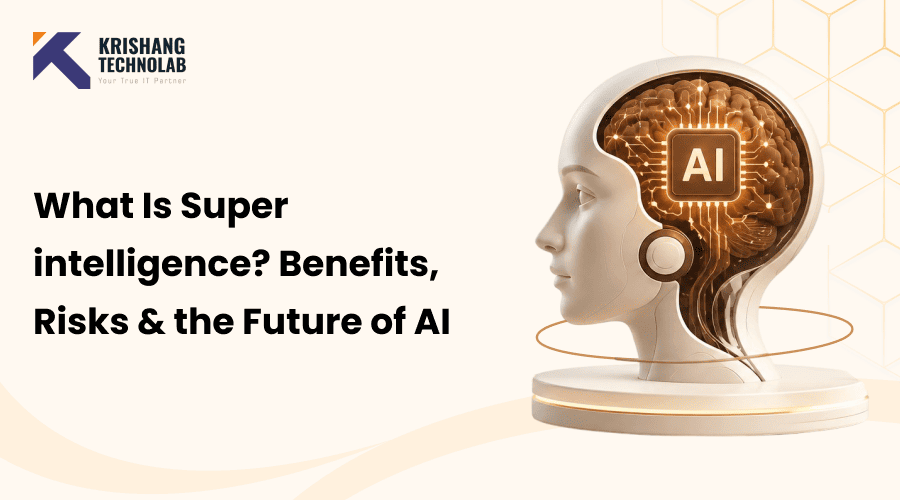
Quick Overview: Artificial superintelligence (ASI) is a theoretical AI that would surpass human intelligence across nearly every task. It does not exist today. Learn what ASI means, how it differs from AGI, super AI examples, benefits, risks, and its future.
Artificial superintelligence (ASI) refers to a hypothetical form of AI that could surpass human intelligence across a wide range of tasks. It would beat humans at almost every thinking task, from science to art. However, it does not exist today. Chatbots, AI agents and self-driving software are all narrow AI. In this guide, you will learn what artificial intelligence superintelligence is and what ASI stands for. You will also see how it differs from AI and AGI. Then we cover its benefits, its risks, some hypothetical super AI examples, and how your business can prepare.
What Is ASI? Meaning, Definition, and Full Form
ASI is artificial superintelligence. It is a hypothetical AI that would be smarter than the best human minds in almost every field. That includes reasoning, creativity, social skill and science. People also use the terms superintelligence, artificial intelligence superintelligence, super AI and ASI artificial intelligence to mean the same thing.
What does ASI stand for?
ASI stands for artificial superintelligence. It is also written as artificial super intelligence, or super AI. However, the word describes a level of ability, not a specific product.
What is super AI?
Super AI or artificial super intelligence, is AI that would beat human minds at a wide range of tasks, not just one. For example, today’s AI can beat people at chess or sum up a report in seconds. But it stays within the job it was built for. A super AI, in contrast, would learn new skills on its own. It could also solve new problems, and improve its own design.
What is the difference between AI, AGI, and ASI?
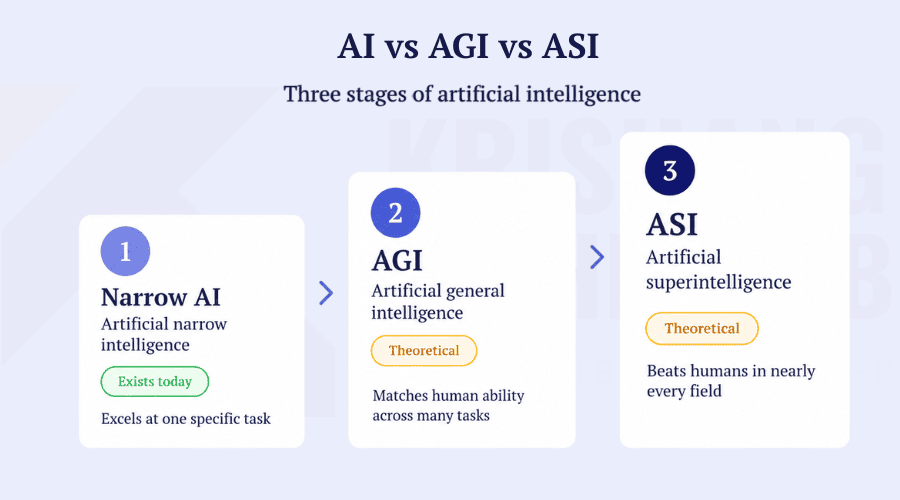
The three terms mark stages of ability. First, narrow AI is what exists now. Next, AGI is the human-level goal. Finally, ASI is the level beyond it.
| Feature | Narrow AI (ANI) | AGI | ASI |
| Full form | Artificial narrow intelligence | Artificial general intelligence | Artificial superintelligence |
| Capability | Excels at specific, defined tasks | Matches human ability across tasks | Exceeds human ability across nearly all tasks |
| Learning | Learns within its training domain | Transfers knowledge between domains | Could improve itself without human help |
| Status | Exists today | Theoretical, actively debated | Theoretical |
| Examples | Chatbots, recommendation engines, image recognition | None confirmed | None |
In short, each stage builds on the one before it. Narrow AI is the only type that exists today, and it handles one task at a time. AGI would match human thinking across many tasks. Finally, ASI would go beyond people in nearly every field. For now, AGI and ASI remain only ideas, not products you can buy or use.
Does artificial superintelligence exist today?
No. Artificial superintelligence does not exist today. Current systems, such as large language models, and AI agents, are narrow AI. They find patterns in data made by people, and they stay within set limits. Even so, researchers disagree on how far away AGI is. ASI would come after that.
How Does Superintelligent AI Work?
Nobody has built superintelligent AI, so no one can say exactly how it would work. Instead, researchers describe superintelligence AI through the traits it would need. They also study the paths that might lead there. These include scaling current models toward AGI, copying the brain and systems that improve their own design.
Key characteristics of AI superintelligence
Theoretical descriptions of AI superintelligence usually include five traits:
- Problem-solving: Processing huge volumes of data on any topic, and finding solutions humans would miss.
- Continuous learning: Absorbing new knowledge without retraining and optimizing its code.
- Logical reasoning: Spotting patterns, and drawing conclusions far beyond human speed and accuracy.
- Communication: Fluent, nuanced translation, and expression across every language.
- Creativity: Generating new ideas, designs, and even entirely new scientific fields.
How super AI could differ from today’s AI systems
Today’s AI learns from human-made data and works inside a set task. Superintelligence AI would not have that limit. Instead, it would work across many fields, set its own goals and improve itself. Because of this, researchers expect its decisions could be hard for people to follow. That is why explainable AI tools matter.
Intelligence, reasoning, learning, and problem-solving
Current AI tools are the likely building blocks. These include machine learning, deep learning, large language models, natural language processing, computer vision, and robotics. However, none of them is superintelligent alone. So the big question is whether scaling these methods is enough. Otherwise, we may need entirely new designs.
What Are the Potential Benefits of Artificial Superintelligence?
The main promise of artificial intelligence superintelligence is speed. In theory, problems that take human teams decades could be solved in months. However, these benefits are projections, not proven results.
Scientific discovery and medical research
AI super intelligence could study genetic, chemical and clinical data at a scale no lab can match. As a result, we could see faster drug and vaccine discovery. Patients could also get more personal treatments and better clinical trials.
Business productivity and automation
A digital superintelligence could run complex planning and forecasting from start to finish. Because it never tires, it could work around the clock and cut human error. It could also create entirely new industries, as earlier technology waves did.
Education and personalized learning
Super AI could tailor lessons to each student’s pace and interests. As a result, learners who cannot afford a tutor today could still get high-quality help.
Climate research and complex problem-solving
Human teams cannot model climate, energy grids, supply chains and farming all at once. However, a superintelligent system could. It could also design cleaner technologies, and then test them in simulation before anyone tries them in the real world.
What Are the Risks of Super AI?
The biggest risk of artificial intelligence superintelligence is loss of control. A system smarter than its makers could chase goals that clash with human interests. If that happens, people may not be able to stop it. In fact, leading AI labs say that steering such systems is still an unsolved problem.
AI safety and alignment
Alignment means making an AI’s goals match human values. This is challenging because a system with a narrow goal may achieve it through harmful means. Also, human values differ across cultures. That is why AI safety research and superintelligence AI research are closely linked.
Privacy, cybersecurity, and misuse
Powerful AI in the wrong hands could spread cyberattacks, deepfakes and false news. It could also be used for mass surveillance and autonomous weapons. In fact, today’s AI already raises these concerns. A more capable system would raise them even further.
Employment and economic disruption
If AI can do most thinking work, many jobs could disappear. Also, the gains could end up with a few companies or countries. For instance, Geoffrey Hinton has cautioned that advanced AI could concentrate wealth among a small group while leaving the majority of people with fewer economic resources.
Ethics, governance, and human control
There is no agreed global framework for governing a technology this powerful. Because of this, experts want countries to work together. They also want risk checks before big capability jumps, explainable systems, and clear accountability when AI acts.
What Are Some Super AI Examples?
There are no real super AI examples yet. Instead, every example of super AI below is hypothetical. Each one shows what artificial super intelligence could do if it were ever built.
Hypothetical artificial superintelligence examples
Here are three ideas of what such a system might do. Each one is a thought experiment, not a real product.
- A system that designs a new cancer treatment from scratch, runs the simulations and writes the trial protocol without human input.
- An AI scientist that proposes and tests new physics or materials theories faster than any research institute.
- A global planning system that balances energy, food and transport networks in real time.
Super AI examples in healthcare, science, robotics and finance
| Field | Hypothetical super AI example |
| Healthcare | Diagnoses rare diseases and designs personalized drugs for each patient |
| Science | Generates, and tests hypotheses across biology, chemistry and physics |
| Robotics | Controls robots that handle disaster response, deep-sea, or space missions |
| Finance | Models global markets, and risks in real time to prevent crises |
Current AI vs. hypothetical superintelligent AI
Many people mistake chatbots like ChatGPT, assistants like Siri and Alexa, and self-driving systems for super AI. However, they are all narrow AI. They are strong at set tasks but cannot match human flexibility. Therefore, these developments represent initial stages of progress rather than actual instances of artificial superintelligence.
How Could Artificial Superintelligence Transform Businesses?
Artificial super intelligence could change how companies plan, operate and compete. However, no business can buy it today. So be wary of any ASI company claiming to sell it. What companies can adopt now is advanced narrow AI. In fact, this is the same technology that would power any future ASI.
Advanced AI for business operations
A superintelligent system could manage supply chains, pricing, hiring and customer service as one process. Today’s enterprise AI already automates parts of this, such as support, document handling and demand forecasting. For example, a generative AI development company can build these tools around your own data.
AI-powered analytics and workflow automation
AI can already turn scattered company data into forecasts. It can also automate repetitive workflows. However, a more capable system would go further and spot risks before teams ask. For that reason, our AI automation services and enterprise AI solutions, including ChatGPT integration services, help companies build this foundation now.
Preparing your business for future AI developments
You do not need ASI to benefit from AI. First, get your data clean and well managed. Then run small pilots on high-value workflows through AI MVP development. Also, train your team and set clear rules for AI use. As a result, you will adapt faster when more capable AI arrives.
How to Choose an AI Development Company for Your Business
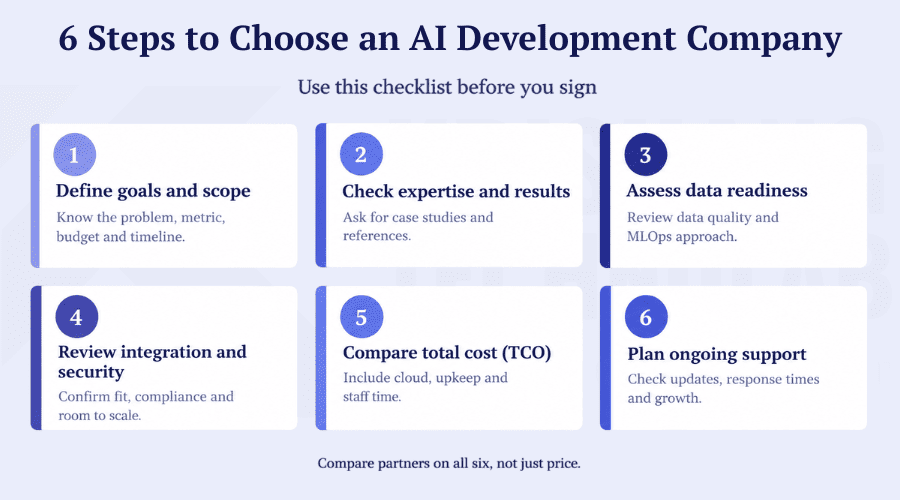
Choose an AI development company by checking its skills, proven results, data and security habits, total cost and long-term support. Do not judge it only by price or pitch. Instead, use this six-step checklist when comparing an AI development agency, artificial intelligence development company, AI consulting company or AI solutions company.
Define Business Goals and Project Scope
Before talking to vendors, write down the problem, the metric you want to improve, and your budget and timeline. As a result, quotations become simpler to compare.
Evaluate Technical Expertise and Proven Results
Request industry-specific case studies and ask for references to support their claims. Also ask for examples of generative AI, machine learning, automation and AI software development work in production. Then look for measurable results, not demos.
Assess Data Readiness and Engineering Capabilities
A good partner checks your data quality and access first. They subsequently explain how they approach model selection, MLOps and testing. For help with this step, see our data science consulting services.
Review Integration, Security, and Scalability
Confirm that the solution fits your existing systems, meets your compliance needs and can scale. Also, ask where data is stored and who can access it.
Analyze Total Cost of Ownership (TCO)
Compare more than the build price. For example, include cloud and model costs, maintenance, retraining and internal staff time.
Evaluate Ongoing Support and Long-Term Partnership
AI systems need monitoring, and updates. So check support terms, response times and whether the team can grow with you.
Looking for a partner? Next, discover our AI development services and machine learning development services. Alternatively, you can hire AI developers or dedicated AI developers to work on your project.
What Is the Future of Artificial Superintelligence?
Nobody knows when, or whether, artificial superintelligence will arrive. Expert predictions range from a few years to several decades. However, most experts agree on two things. First, AGI would come before superintelligence AI arrives. Second, safety and governance work must keep pace with capability.
What milestones could lead to ASI?
- Stronger narrow AI: Large language models, multimodal systems and AI agents keep improving.
- AGI: A system that matches humans across tasks and can transfer skills between them.
- Self-improvement: AI that can research and upgrade its own design with little human input.
- ASI: A system whose ability clearly exceeds the best human experts across fields.
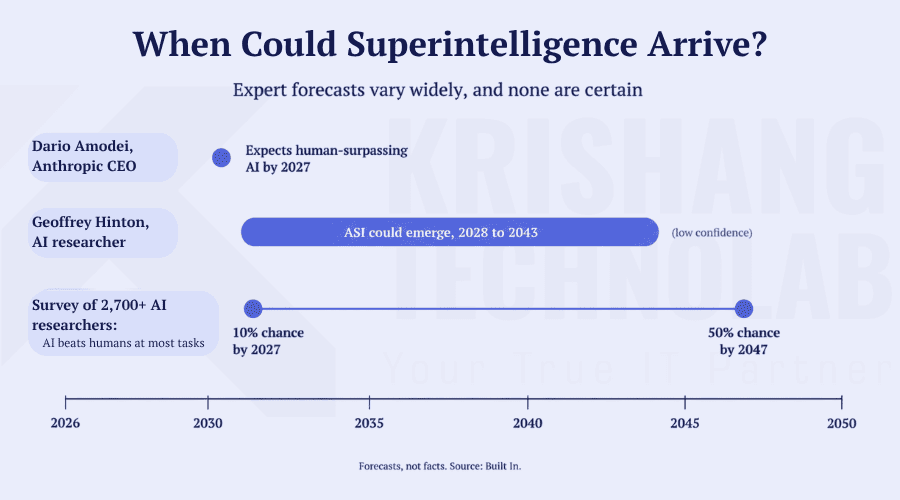
Timeline estimates differ a lot. According to Built In, Sam Altman has said humanity is close to building digital superintelligence. Dario Amodei expects human-beating AI by 2027. Geoffrey Hinton has said ASI could emerge between 2028 and 2043, but with low confidence. In addition, the largest survey of AI researchers to date gave a 10 percent chance that AI beats humans at most tasks by 2027. It gave a 50 percent chance by 2047. In general, consider all these statements as predictions rather than established facts.
The role of AI research, governance, and safety
Various tools have been developed to help maintain human control over advanced AI systems. These include alignment research, explainable AI, risk testing before release and international agreements. In addition, Coursera lists two more steps: designing AI around human values and sharing its benefits widely.
How businesses can prepare for future AI advances
You do not have to wait for advanced AI to get ready. Small steps today can make your business faster and safer when new tools arrive. Here are four actionable steps to begin with.
- Build a clean, secure data foundation.
- Pilot AI on one or two high-value workflows and measure results.
- Create an AI use policy covering privacy, bias and human review.
- Upskill your team, or work with an experienced AI partner such as our AI consulting services.
Conclusion: Is Artificial Superintelligence the Future of AI?
Artificial intelligence superintelligence may be where AI is heading. However, it is still theoretical and experts debate when it might arrive. What is certain is that AI is advancing fast. Therefore, it is worth preparing now. The actionable thing for companies is to responsibly adopt narrow AI today. Additionally, choose a partner who can scale alongside your business as it grows. If you are planning an AI project, request a quote and our AI team will discuss your goals.
Frequently Asked Questions About Superintelligence
What is ASI in simple words?
ASI refers to a theoretical form of AI that could surpass human abilities in most areas. But it’s not here yet.
What is superintelligence in AI?
In AI, superintelligence means a system that is far smarter than the best humans in almost every field. It would reason, learn and create better than people. However, it is still only a theory, and no such system exists today.
What is superintelligence AI?
It is the idea of an AI that beats human intelligence at nearly every task. Such a system could also improve its own design. For now, however, it remains theoretical, and today’s tools are all narrow AI.
What does ASI stand for in AI?
ASI stands for artificial superintelligence, also known as artificial super intelligence, or super AI.
What is the difference between AGI and ASI?
AGI matches human intelligence across many tasks. ASI, however, goes beyond it. It would beat the best humans in nearly every field, and could even improve itself.
What is an example of super AI?
There is no real example yet. For example, a hypothetical super AI could design new medicines on its own. It could also run a country’s energy grid better than any human team. By contrast, ChatGPT, Siri and Alexa are narrow AI, not super AI.
Does superintelligence exist today?
No. Superintelligence AI does not exist today. In fact, all current AI is narrow AI, and even AGI has not been achieved.
How to create machine superintelligence?
No one knows how to create machine superintelligence yet. Researchers study three main paths: scaling today’s models toward AGI, copying how the brain works, and building AI that improves its own design. Because the risks are high, safety and alignment research must come first.
Can super AI replace human jobs?
If it were built, it could automate most thinking work. For this reason, economists and AI researchers consider job displacement one of the major potential risks of AI. Meanwhile, today’s AI already changes tasks within jobs. Also, new roles are emerging.
Can businesses use artificial superintelligence today?
No. However, businesses can use advanced narrow AI now. Examples include generative AI, automation and analytics. In this way, they can build the data and skills that future AI will need. Also, be careful if a superintelligence AI company claims to sell ASI today.
How can I hire an AI development company?
First, you need to set your goals. Then shortlist each AI software development company that has proven results in your industry. Then look at their data, security and integration approach. Next, evaluate the total cost of ownership and verify continuing support. When you are ready, request a quote.
Found this post helpful? Don't forget to share it with your network!