Quick Overview: Machine learning statistics for 2026 show a market near $127 billion, 88% of firms using AI, and over 80% of projects still failing. This guide covers adoption, investment, ROI, jobs, industries, ML versus statistics, and how to hire the right experts.
What do the latest machine learning statistics tell us in 2026? They show a technology that is now common but still hard to run well. The global market is worth about $127 billion, according to Precedence Research. McKinsey reports that 88% of organizations use AI in at least one business function. Yet RAND research suggests that more than 80% of AI projects fail to deliver their intended value.
Here are the headline numbers:
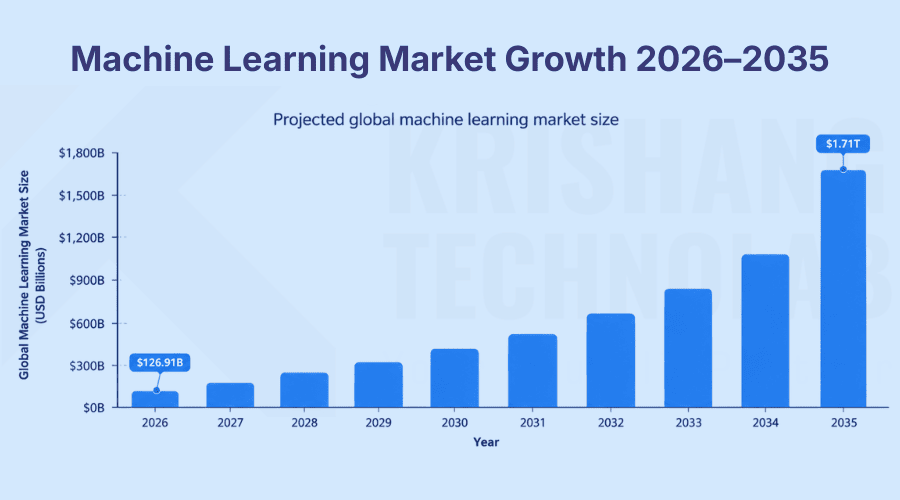
- The global machine learning market is valued at approximately $126.91 billion in 2026 and is projected to reach about $1.71 trillion by 2035.
- AI is now used in at least one business area by 88% of organizations.
- Around 78% of organizations have integrated generative AI into one or more business functions.
- AI companies attracted approximately 61% of global venture capital investment in 2025.
- Generative AI delivers an average return of approximately $3.70 for every $1 invested.
- AI engineering professionals saw average salaries of approximately $206,000 in 2025.
- Only a small share of enterprises have successfully scaled AI across the organization.
In this guide: you will find machine learning statistics on market size, adoption, investment, ROI, industries, jobs, ML versus statistics, technology trends and future predictions. Where sources disagree, we show both numbers and explain why.
Machine Learning Statistics at a Glance
This table gives you the machine learning statistics 2026 in one place. Use these machine learning statistics as a quick reference before you read the detailed sections. The “previous year” column shows the closest earlier data point, and the year is noted in the cell where it is not 2025.
| Metric | 2026 figure | Previous year | Forecast |
| Global ML market size | $126.91B | $93.95B (2025) | $1.71T by 2035 |
| ML market CAGR | About 33.7% | About 34% (2025) | About 33.7% (2026 – 2035) |
| Alternative ML forecast | About $74.95B (2025) | $55.8B (2024) | $282.13B by 2030 (30.4% CAGR) |
| Global AI spending | $301B | $223B | $632B by 2028 |
| Organizations using AI | 88% (2025 survey) | 78% (2024) | About 90% (2026) |
| Organizations using generative AI | 78% | 55% | About 85% (2026) |
| AI share of global VC | 61% (2025) | 30% (2022) | About 60% (2026) |
| AI venture funding | $258.7B of $427.1B (2025) | About $123.6B (2024) | About $280B (2026) |
| AI project failure rate | Over 80% | Over 80% | About 70–80% |
| Enterprises fully scaled on AI | About 7% | About 5% | About 10% |
| MLOps market | $3.33B | $2.43B (2025) | $56.6B by 2035 |
| Average AI engineer pay | About $206,000 (2025) | About $156,000 (2024) | About $220,000 (2027) |
| Firms using AI (OECD average) | 20.2% (2025) | 8.7% (2023) | About 25% (2027) |
| AI talent demand vs supply | 3.2 to 1 | About 2.5 to 1 | About 4 to 1 |
| Return per $1 on generative AI | $3.70 | About $3.50 | About $5 |
Machine Learning Market Size & Growth Statistics
The ML market is big and growing fast. The exact size depends on who you ask, because each research firm draws the boundary differently. This section covers machine learning market statistics from several sources, so you can compare each of these machine learning statistics side by side.
How big is the machine learning market in 2026?
The machine learning market size in 2026 is about $126.91 billion, up from $93.95 billion in 2025, according to Precedence Research. Other firms report smaller numbers because they count only software. Fortune Business Insights, for example, put the 2025 market at $47.99 billion.
Machine learning market growth rate
Most forecasts show growth of 26% to 36% a year. Precedence Research projects about 33.7%. Grand View Research projects 30.4%, and Fortune Business Insights projects 26.7%. Even the slowest forecast is much faster than the wider software industry.
Machine learning market CAGR
CAGR means compound annual growth rate. It shows the average yearly growth over a set period. The table below shows why you should always check the scope behind a number.
| Research firm | Base value | Forecast value | CAGR |
| Precedence Research | $93.95B (2025) | $1.71T (2035) | About 33.7% |
| Grand View Research | $55.8B (2024) | $282.13B (2030) | 30.4% |
| Fortune Business Insights | $47.99B (2025) | $432.63B (2034) | 26.7% |
Machine learning market forecast to 2030
Grand View Research projects that the global machine learning market could grow to approximately $282 billion by 2030. The deep learning market, a core part of ML, may reach $526.7 billion by 2030 at a 31.8% CAGR, according to the same firm. Always check whether a forecast covers ML only or a wider AI scope.
Machine learning market forecast to 2035
Precedence Research expects the market to hit $1.71 trillion by 2035. Research Nester gives a similar estimate of $1.88 trillion. Long forecasts like these rest on many assumptions, so treat them as a direction of travel rather than a promise.
Global ML market by region
North America currently dominates the market, while Asia-Pacific is experiencing the fastest expansion, led by major economies such as China, India, Japan, and South Korea. The U.S. ML market alone was worth about $20.39 billion in 2025 and may reach $380.59 billion by 2035, based on Precedence Research data.
Machine learning vs AI market size
AI is the bigger category, and ML sits inside it. Fortune Business Insights valued the broader AI market at $294.16 billion in 2025. IDC expects global AI spending to reach $301 billion in 2026, with software making up about $157 billion of that total. For a wider view of the numbers beyond ML, see these artificial intelligence statistics for small businesses.
Machine Learning Adoption Statistics
The ML stack has several fast-growing layers. Here is a quick tour of the machine learning statistics for each technology. Firms without in-house skills in these areas often turn to AI and ML development services to build and run them.
What percentage of companies use machine learning?
McKinsey’s 2025 research indicates that AI adoption has reached approximately 88% of organizations across at least one business function. That number was 78% in 2024 and 55% in 2023. Note that “use” can mean a small pilot, so this figure is wider than real production use.
Enterprise machine learning adoption rate
Among large enterprises, adoption is high. IBM research found that 42% of enterprise-scale companies actively use AI, while another 40% are exploring it. Deloitte’s findings indicate that nearly 78% of organizations have adopted generative AI in at least one business area.
Machine learning adoption by company size
Big firms adopt faster than small ones. In the EU, 55% of large enterprises used AI in 2025, compared with just 17% of small ones. Large firms have more data, more budget and more technical staff.
Machine learning adoption by industry
Technology and software firms lead, with reported adoption near 92%. Financial services follows at about 84%, and media at 78%. Manufacturing sits near 52% and agriculture near 28%, based on cross-industry research from 2026.
Machine learning adoption by region
Across the OECD, 20.2% of firms used AI in 2025, up from 8.7% in 2023. This represents a growth of over 130% within just two years. In the ICT sector, the OECD reports adoption of 57.3%.
ML pilot vs production adoption
This is where the gap shows up. About 62% of companies are still testing or piloting AI. Only around 7% of organizations have successfully expanded its use across the entire enterprise. Pilots are easy to launch, but production systems need clean data, monitoring and clear owners.
Machine learning deployment statistics
Deployment is where many projects stall. Gartner predicts that 60% of AI projects without AI-ready data will be dropped through the end of 2026. Another report found that only a quarter of enterprises have moved 40% or more of their AI experiments into production. These machine learning statistics on deployment explain why so many pilots never ship.
Machine Learning Investment & Funding Statistics
Money is flowing into AI faster than into any other sector. These machine learning investment statistics show where it goes. When firms plan a budget, AI and ML development services are one line item to consider alongside data, cloud and talent.
Global ML investment
Among the machine learning statistics on spending, corporate AI investment reached $252.3 billion in 2024, according to the Stanford AI Index. Private investment grew 44.5% that year. IDC expects global AI spending to nearly double between 2025 and 2028.
Enterprise ML spending
IDC puts 2026 AI spending at $301 billion. Gartner expects enterprise software spending to reach about $1.4 trillion in 2026. Companies are moving AI from side projects into regular budgets.
ML startup funding
According to Crunchbase data, foundation model companies raised about $80 billion in 2025 or around 40% of all AI funding. Coding-agent startups soared from about $550 million in 2024 to $4 billion in 2025.
Machine learning VC investment
Global venture capital in 2025 went to AI companies to the tune of 61%. That was out of $427.1 billion, of which $258.7 billion was according to the OECD. In 2022 AI was only 30%; U.S. companies accounted for around 79% of the AI total.
AI and ML investment trends
Funding is concentrating on fewer, larger deals. The OECD found that deals above $100 million made up about 73% of AI investment value in 2025. Investors are backing proven delivery, not just ideas.
Machine learning infrastructure spending
Computing is a major cost. The OECD reports $109.3 billion of AI investment in IT infrastructure and hosting in 2025. Epoch AI estimates that global AI compute capacity has roughly tripled every year since 2022.
Machine Learning ROI & Business Impact Statistics
Leaders want to know if the spending pays off. The answer is yes for some firms and no for many others. Here is the evidence on machine learning ROI. The machine learning statistics on returns are mixed, so read them with care. Clear goals and the right AI ML development services can help a team move from experiments to measurable returns.
What is the ROI of machine learning?
Deloitte says the average return is $3.70 for every $1 invested in generative AI. But the gains are not distributed evenly. McKinsey found that only 39% of organizations see any measurable profit impact from AI, and most of those see less than 5%.
Machine learning productivity statistics
Generative AI users save about 5.4% of their weekly work hours on average. An industry summary says that by 2026, 92% of software developers will use AI tools at some point in their workflow. Small daily savings add up across large teams.
ML cost reduction statistics
Industry estimates often cite operating cost cuts of 15% to 30% from automation, and predictive tools. Predictive maintenance can reportedly reduce unexpected equipment downtime by approximately 30% to 50%. These are broad estimates, so use these machine learning statistics as planning ranges, not guarantees.
ML revenue impact
McKinsey found that 66% of marketing and sales leaders report revenue gains from generative AI. BCG reports that AI leaders grew revenue about 1.5 times faster than laggards over three years. Revenue gains tend to go to firms that apply AI in many functions.
ML efficiency statistics
Better process design matters more than better models, according to the machine learning statistics from Accenture. Its research found that firms pairing AI with clear KPIs and redesigned workflows earned 2.7 times higher ROI than firms that simply added AI to old processes.
Machine learning business benefits
The main benefits are lower costs, faster decisions, better forecasts and more personalized service. Forecasting tools are often reported to improve accuracy by 20% to 35%. The best results appear when teams track clear business metrics from day one.
Machine Learning Project Failure & Success Statistics
This section holds the most important lesson in the data. The machine learning project failure rate is high, even while adoption keeps rising. Among all machine learning statistics, these figures may be the most useful for planning. Choosing an experienced ML development company is one practical way to lower the risk, because most failures trace back to goals, data and delivery.
What percentage of ML projects fail?
More than 80% of AI projects fail to deliver their intended business value, according to RAND Corporation. That is about twice the failure rate of normal IT projects. Treat this as a warning about execution, not proof that ML has no value.
Why do machine learning projects fail?
Most failures come from people and data, not algorithms. One analysis traced 84% of failed AI projects to leadership problems such as unclear goals and lost sponsorship. Data quality is the second big cause. Other issues include weak monitoring, model drift and poor links to business goals.
Machine learning project success rate
Success is rarer than headlines suggest. One analysis found that only 19.7% of AI projects met or beat their goals. Firms with strong data integration reportedly earn about 10.3 times ROI, compared with 3.7 times for firms with poor data links.
AI/ML pilot-to-production statistics
MIT’s NANDA research reports that 95% of companies using generative AI haven’t seen any measurable returns. S&P Global found that 42% of companies abandoned most of their AI efforts in 2025, up from 17% a year earlier. Often pilots die when no one owns the next step.
The machine learning implementation gap
The gap is simple. Adoption is easy, and delivery is hard. About 88% of firms use AI, yet only a small share have scaled it. Closing the gap needs three things: ready data, clear metrics and a team that can run models in production.
Machine Learning Statistics by Industry
Results differ widely by sector. This section collects machine learning industry statistics. Looking at machine learning by industry shows where the technology is most mature, and the machine learning statistics below back that up. Firms in each sector can use ML development services to move from a pilot to a working system.
Healthcare
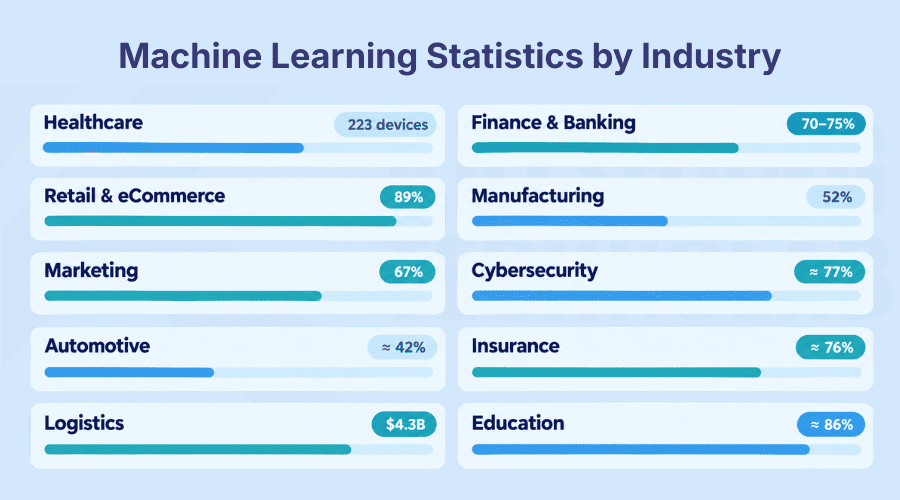
The FDA had authorized 223 AI-enabled medical devices by 2023, up from just 6 in 2015, according to the Stanford AI Index. Fortune Business Insights values the AI in healthcare market at $39.34 billion in 2025. Common uses include imaging, triage and risk prediction.
Finance & Banking
About 70% to 75% of financial institutions use ML in core operations, based on industry reports. Banking and insurance together form the largest vertical in the AI market, at about 18.9% in 2025. Fraud detection and credit scoring lead the list of uses.
Retail & eCommerce
NVIDIA’s survey found that 89% of retailers use AI or are testing it. Product recommendations are widely used, and Amazon is often reported to earn up to 35% of its sales from them. Retailers also use ML for pricing and stock planning.
Manufacturing
Manufacturing adoption sits near 52%, which is lower than finance or tech. The strongest use case is predictive maintenance. According to the International Federation of Robotics, China installed some 295,000 industrial robots in 2024.
Marketing
In one cross-industry study, marketing and sales are the highest business functions for AI adoption, at some 67%. Teams use ML for lead scoring, targeting, and content. Benefits reported include better engagement, and more acute forecasts.
Cybersecurity
ML helps security teams spot unusual behavior faster than fixed rules can. It is used to detect threats, filter phishing and issue fraud alerts. There are few public figures you can rely on. Check vendor claims against independent research.
Automotive
Carmakers use ML for driver assistance, quality checks and supply planning. Computer vision does much of the work in cameras and sensors. Safety rules and testing needs make rollouts slower than in software.
Insurance
Insurers use ML for claims triage, pricing and fraud checks. Rules on fairness and explainability shape how they build models. This is one reason regulated sectors invest early in governance.
Logistics
The ML in logistics market was about $4.3 billion in 2025 and may reach $5.3 billion in 2026, according to Global Market Insights. The wider AI in supply chain market may grow from $7.3 billion in 2024 to $63.8 billion by 2030. Route planning, and demand prediction are the main uses.
Education
Schools and learning platforms use ML to personalize lessons, flag at-risk students early, and help with automated grading. The issue of data privacy is a big one, particularly for minors. Watch the big claims; there’s little in public stats.
Machine Learning vs. Statistics: What’s the Difference?
Many readers ask how these two fields connect. The short answer is that they overlap a lot but aim at different goals. This section covers machine learning vs statistics in plain language, and it shows why statistics and machine learning are partners and not rivals. Teams that deliver AI ML development services use both every day, with statistics to test ideas and ML to build the product.
How Is Machine Learning Different From Statistics?
Statistics mainly explains data, and tests ideas about it. Machine learning mainly builds models that predict well on new data. Statisticians care about why something happens . ML engineers care about the accuracy of the prediction .
| Feature | Statistics | Machine learning |
| Main goal | Explain and infer | Predict and automate |
| Data size | Often small to medium | Often large |
| Model type | Simple, clear models | Flexible, complex models |
| Key question | “Is this effect real?” | “How well does it predict?” |
| Typical output | Estimates and confidence ranges | Predictions and scores |
Is Machine Learning Just Statistics?
No, but it rests on statistics. ML borrows ideas such as probability, regression and sampling. It adds computer science methods such as optimization, large-scale computing and neural networks. So ML is better seen as a close cousin than a copy.
Is Machine Learning Statistics or Computer Science?
It is both. The theory comes from statistics and math. The tools, speed and scale come from computer science. Most universities teach it across both departments, and good ML engineers need skills from each side.
Statistics vs Machine Learning
Trade-offs when comparing statistics vs machine learning. Classic statistics gives you understandable and transparent results, and works with small data sets. ML can find complicated patterns in large data sets but is harder to explain. Many teams do both: use stats to design the tests, and ML to power the product.
Statistical Learning vs Machine Learning
Statistical learning vs machine learning is mostly a difference in style. It comes from the statistics world and stresses models, assumptions and error bounds. Machine learning comes from computer science and stresses algorithms and performance. The methods overlap heavily, and the books An Introduction to Statistical Learning and The Elements of Statistical Learning cover much of the same ground as ML textbooks.
What Is Statistical Machine Learning?
It is the study of learning algorithms using the tools of probability and statistics. Researchers use it to prove how well a model should work on unseen data. Statistical machine learning covers topics such as generalization, bias and variance, and regularization.
How Are Statistics and Machine Learning Related?
They share a foundation. Probability theory, estimation and testing sit under almost every ML method. In practice, statistics helps you check data quality, design fair experiments and judge whether a model gain is real or just luck. It also helps you decide whether the machine learning statistics you read online are trustworthy, because poor sampling leads to misleading numbers.
Statistics for Machine Learning: What Do You Need to Know?
You do not need a math degree to start. You do need a few core ideas. This section explains statistics for machine learning in simple steps. A good ML development company expects its engineers to know these basics, so they are worth learning even if you plan to outsource the build.
What Statistics Do You Need for Machine Learning?
The statistics needed for machine learning start with the basics: mean, median, variance and standard deviation. Next come probability, common distributions, sampling, correlation, regression and hypothesis testing. Bayesian thinking helps with more advanced work.
Probability for Machine Learning
Probability tells you how likely events are. ML models often output probabilities, such as the chance an email is spam. You should know conditional probability, independence and Bayes’ rule.
Statistical Concepts Every ML Engineer Should Know
Every engineer should understand bias and variance, overfitting, confidence intervals, p-values and cross-validation. These ideas help you judge whether a model is trustworthy. They also stop you from trusting a lucky result.
Probability & Statistics for Machine Learning
Together, probability and statistics let you describe uncertainty and test claims. Probability starts with a known model and asks what data to expect. Traditional statistics often uses data to identify or validate a model, whereas machine learning takes a more flexible approach by learning patterns directly from data.
Linear Algebra vs Statistics for ML
Linear algebra handles how data is stored and transformed. Think of vectors, matrices and dot products. Statistics handles uncertainty and evidence. You need both, but beginners often get further by learning statistics first and adding linear algebra soon after.
Bayesian Statistics for Machine Learning
Bayesian methods start with a prior belief and update it as data arrives. They are useful when data is limited and when you need honest uncertainty. Many modern tools, from A/B testing to probabilistic models, use Bayesian ideas.
Regression Statistics for Machine Learning
Linear and logistic regression are the starting point for many ML projects. They are straightforward, quick to implement, and easy to understand. Learn to read coefficients, residuals and R-squared before moving on to more complex models.
Hypothesis Testing for Machine Learning
Hypothesis testing helps you decide if a result is real. Teams use it to compare two models or to run A/B tests on a live product. It guards against false wins, which are common in ML work. These skills also help you judge machine learning statistics published by vendors and research firms.
Machine Learning Technology Statistics
The ML stack has several fast-growing layers. Here is a quick tour of the machine learning statistics for each technology. Firms without in-house skills in these areas often turn to AI and ML development services to build and run them.
Deep Learning Statistics
The deep learning market was valued at $96.8 billion in 2024, and may hit $526.7 billion by 2030, with a 31.8% CAGR, according to Grand View Research. These deep learning statistics show that neural networks drive much of today’s growth.
NLP Statistics
NLP statistics vary by source. One forecast expects the market to add $272.47 billion between 2026 and 2030. Business and legal services hold the largest share at 26.5%, and early adopters report productivity gains near 28%.
Computer Vision Statistics
Computer vision statistics point to steady growth. The market was about $19.78 billion in 2024 and is forecast to pass $58 billion by 2030. Synthetic data from generative AI now helps train vision models where real images are scarce.
MLOps Statistics
MLOps statistics show a fast-growing young market. Precedence Research has pegged it at $2.43 billion in 2025 and $3.33 billion in 2026, and it projects it to reach $56.6 billion by 2035. It covers deployment, monitoring, retraining, so the demand increases with the number of models going live.
AutoML Statistics
AutoML tools automate model selection and tuning. Reliable, independent market numbers are limited, so be careful with claims. The trend is clear, though: more teams use automation to speed up routine modeling work.
Reinforcement Learning Statistics
Reinforcement learning teaches an agent through repeated actions, using rewards and penalties to guide its behavior. It powers robotics, game AI and some recommendation systems. Public market figures are scarce, and most use is still in research and specialized settings.
Edge ML Statistics
Edge ML runs models on devices instead of the cloud. Precedence Research expects hybrid and on-premises MLOps to grow faster than cloud between 2026 and 2035, driven by speed, privacy and weak connectivity.
Machine Learning Infrastructure Statistics
Computing is the backbone. Global AI compute has roughly tripled each year since 2022. Models are also getting more efficient: Microsoft’s Phi-3-mini matched a benchmark score that once needed a model 142 times larger.
Machine Learning Jobs & Workforce Statistics
Talent is one of the tightest parts of the market. These machine learning jobs statistics and machine learning salary statistics show why. They are among the most reliable machine learning statistics because hiring data is easy to track.
Machine learning job growth
AI and ML job postings rose by about 89% in the first half of 2025, according to industry data. The global ML workforce is estimated to be between 1.6 million and 2.5 million people and there are about 219,000 new positions being added each year.
ML engineer demand
Demand beats supply by about 3.2 to 1 in the U.S. Entry-level roles make up only about 3% of ML postings, so employers favor experienced people. This is a major reason many firms look at outside teams, including remote developers, to fill gaps.
ML engineer salaries
The average AI engineer earned about $206,000 in 2025, roughly $50,000 more than a year earlier. Mid-level ML engineers in the U.S. earn about $149,000 to $192,000. Top labs pay $350,000 or more in total compensation for senior staff.
Machine learning skills in demand
Large language models are the top AI skill, and 60% of data scientist postings now ask for AI skills. Cloud skills matter too, with AWS named in more than half of ML job listings. LLM fine-tuning specialists can earn $195,000 to $350,000.
Machine learning talent shortage
The World Economic Forum ranks AI and big data as the fastest-growing skill cluster through 2030. Hiring is still hard: about 63% of firms said finding ML engineers was difficult in 2024, down from 72% in 2023.
AI/ML career growth
AI has already created roughly 1.3 million new roles worldwide, according to LinkedIn and WEF data. Career paths include ML engineer, data scientist, MLOps engineer and AI product manager.
Machine Learning Statistics by Country
Looking at machine learning by country shows who leads in money, talent and adoption. These are the latest machine learning statistics by location.
United States
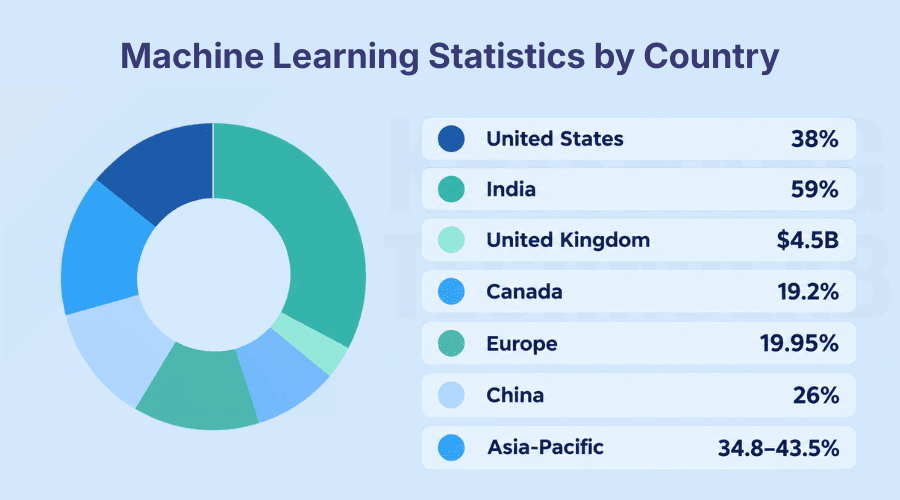
The U.S. leads in money. It holds about 38% of global AI spending, according to IDC. Private U.S. AI investment reached approximately $109.1 billion in 2024, almost twelve times the amount invested in China. In 2025, 50 notable AI models were released in the U.S. alone.
India
India has emerged as a leading market for enterprise AI adoption. Surveys put it at about 57% to 59%. AI and ML hiring in India’s IT industry grew by about 25% in a single month in 2025, while overall IT hiring fell.
United Kingdom
The U.K. is a strong research hub but a smaller investor. Private AI investment was about $4.5 billion in 2024, roughly one twenty-fourth of the U.S. figure, based on the Stanford AI Index.
Canada
Canada is catching up. Statistics Canada data shows 19.2% of businesses used AI in production in Q2 2026, up from 6.1% in 2024.
Europe
About 19.95% of EU enterprises used AI in 2025. Rules such as the EU AI Act push firms toward explainable, and well-governed models. The EU also announced its InvestAI plan to mobilize €200 billion.
China
China holds about 26% of global AI spending, according to IDC. It installed roughly 295,000 industrial robots in 2024, far more than the U.S., and Japan combined. It released 15 notable AI models in 2025 versus 50 from the U.S.
Asia-Pacific
Asia-Pacific is the fastest-growing region, with forecast growth of 34.8% to 43.5% a year through 2030 in some models. Fortune Business Insights expects AI to add up to $3 trillion to Asia-Pacific GDP by 2030.
| Region | Key figure | Strength | Challenge |
| United States | 38% of AI spending | Capital and talent | High salaries |
| India | About 57 – 59% enterprise adoption | Large talent pool | Uneven infrastructure |
| United Kingdom | $4.5B private AI investment (2024) | Research quality | Smaller funding base |
| Canada | 19.2% of firms (Q2 2026) | Fast recent growth | Lower adoption than leaders |
| Europe | 19.95% of firms (2025) | Strong governance | Complex regulation |
| China | 26% of AI spending | Robotics and scale | Export and chip limits |
| Asia-Pacific | Up to 43.5% CAGR | Fast growth | Mixed readiness |
Machine Learning Trends 2026 – 2030
These are the machine learning trends 2026 and beyond, and they shape the broader picture of machine learning statistics and trends.
Agentic AI
AI agents that plan and act will spread. Deloitte’s forecast of a $35 billion market by 2030 shows the scale of expected growth. Governance and human review will matter more as agents gain access to real systems.
Smaller specialized models
Small models are getting better. Phi-3-mini’s 142-times efficiency gain shows the trend. Smaller models cost less, run faster and can sit on devices.
Multimodal ML
Multimodal AI models can process and understand different types of content, including text, images, audio and video. One forecast expects the multimodal ML market to grow from $1.6 billion in 2024 to $27 billion by 2034.
Edge AI
Running models on phones, cameras and machines cuts delay and protects privacy. Hybrid setups, mixing cloud and local systems, are expected to grow fast.
Automated machine learning
AutoML will keep taking over routine tuning, so experts can focus on data and design. It lowers the barrier for smaller teams.
Explainable AI
Banks, insurers and hospitals must explain model choices. Expect more tools that show why a model made a decision.
Responsible AI
The AI Incidents Database logged 233 incidents in 2024, a 56.4% rise. Firms now manage about twice as many AI risks as in 2022, according to McKinsey.
MLOps automation
MLOps tools will automate testing, monitoring and retraining. With 91% of models reported to degrade without upkeep, this is a core need.
AI-powered software development
The AI in software development market may grow from $933 million in 2025 to $15.7 billion by 2033. Most developers already use AI tools in daily coding, and you can see how this plays out in practice in this look at AI in software development.
Machine learning infrastructure
Expect more data centers, custom chips and cheaper inference. Cost per token keeps falling, which opens ML to smaller firms.
Machine Learning Development Services for Businesses
Reading machine learning statistics is useful, but results come from execution. Many firms turn to machine learning services because the talent gap makes hiring slow. A good machine learning development company can help you move from idea to production. At Krishang Technolab, for example, teams can work with businesses on the full path from strategy to deployment through machine learning development services. Below are the main machine learning development services you may need.
Custom Machine Learning Development
Custom machine learning development means building models around your own data and goals. Off-the-shelf tools work for common tasks. A tailored approach makes sense when standard tools cannot accommodate unique data or processes. A strong AI ML development company will start with the business problem, not the algorithm, and will cover end-to-end AI development from data prep to launch.
Machine Learning Consulting
Machine learning consulting helps you choose the right use cases, check data readiness and plan a roadmap. A machine learning consulting company can save months by steering you away from low-value projects, often alongside broader AI consulting work. This is a key stage where many potential failures can be avoided.
Predictive Analytics Development
Predictive analytics forecasts demand, churn, risk and revenue. These projects often show ROI fastest because results are easy to measure. They work best when historical data is clean, which is why many teams start with data science consulting to prepare it.
Computer Vision Development
Computer vision services cover quality inspection, object detection, document reading and medical imaging. Projects need labeled images and good lighting or camera setups.
NLP Development
NLP services include chatbots, document search, sentiment analysis and text summaries. Good projects set clear accuracy goals and test on real user language.
Generative AI Development
Generative AI services build assistants, content tools and retrieval systems that answer questions from your own documents. Plan for testing, safety checks and cost control. Teams that want to build assistants and content tools often turn to generative AI development specialists.
MLOps & Model Deployment
MLOps turns a working notebook into a reliable service. It covers pipelines, monitoring, versioning and retraining. Without it, models degrade quietly.
AI/ML Integration Services
Integration connects models to your CRM, ERP, apps and dashboards. Many machine learning solutions fail here because the model is good but nobody uses it. Language models follow the same rule, so even a task like ChatGPT integration into a support tool needs a clear plan from the start.
When Should You Hire Machine Learning Developers?
Hiring is a major decision. The machine learning statistics on salaries and demand show that talent is scarce and costly, so timing and approach matter.
When to Hire ML Developers
Hiring machine learning developers makes sense once you have a well-defined use case, reliable data, and sufficient budget. If you plan to hire ML developers for the first time, a small group of AI developers is often enough to start. Other signs include a stalled pilot, no one to run models in production, or a need to ship faster than internal hiring allows.
Hire Machine Learning Engineers vs Build an Internal Team
Building in-house gives you long-term control and deep product knowledge. It is also slow and expensive, given a 3.2 to 1 demand gap. Whether you hire machine learning engineer staff directly or work with a partner, plan for the full cost. If you want to hire ML engineer talent quickly, an outside team or a mixed model can be faster, and outsourcing software development is one common route. Many firms start with machine learning developers for hire and build an internal team later.
Skills to Look for in an ML Developer
Look for Python, data handling, statistics, model evaluation and cloud skills. Strong Python developers usually cover most of this list. Add MLOps, SQL and communication. When you hire machine learning experts, ask for real production examples, not just notebooks. If you need strategy, hire machine learning consultants who can link models to business results.
How Much Does It Cost to Hire an ML Developer?
The cost to hire machine learning developer talent varies by region, and seniority. In the U.S., mid-level ML engineers earn about $149,000 to $192,000 a year in salary alone. Outsourced rates are usually lower per hour, but they depend on location and skill. The table below shows rough planning ranges that are our estimates, not sourced figures, so confirm with current quotes.
| Region | Typical hourly range (estimate) | Notes |
| United States | 100 – 200+ | Highest rates, deep talent |
| Western Europe | 70 – 150 | Strong skills, mid-high cost |
| Eastern Europe | 40 – 100 | Good value for senior work |
| South Asia | 25 – 60 | Lower cost, large talent pool |
For a project view, machine learning development cost often falls into three bands. These are rough estimates. A small proof of concept may run $20,000 to $60,000. A mid-size production system may cost $60,000 to $250,000. A large, multi-model platform can pass $250,000. The costs of data preparation, system integration, and ongoing monitoring can often exceed the expense of developing the model itself.
Dedicated Machine Learning Development Team
Dedicated machine learning developers work only on your project, like an extension of your team. This model suits long roadmaps and fast-changing needs. A dedicated team usually includes an ML engineer, a data engineer, an MLOps specialist and a project lead. Krishang Technolab and similar partners offer this kind of dedicated development team setup for companies that want steady capacity without long hiring cycles.
How to Choose a Machine Learning Development Company
The right partner can make or break a project. Whether you search for a machine learning agency in USA, or a machine learning consulting company USA, use this checklist. It also helps to compare it with the machine learning statistics on failure causes earlier in this post.
- Technical expertise: Check that they cover modeling, data engineering and deployment, not just one piece.
- Industry experience: Ask for work in your sector. Domain knowledge shortens the learning curve.
- Portfolio: Look for live production systems with measurable results, not only demos.
- MLOps: Ask how they monitor, retrain, and roll back models.
- Security: Confirm data handling, access control, and compliance with rules like GDPR.
- Data engineering: Good models need good pipelines. Check their data skills.
- Communication: Look for clear updates, honest risk talks, and plain language.
- Pricing: Compare fixed, hourly, and dedicated-team options, and ask what is not included.
- Post-launch support: Models drift over time, so ask what help you get after go-live.
A solid AI ML development company will welcome these questions. Krishang Technolab suggests starting with a small, well-scoped pilot, so both sides can test the fit before a bigger commitment. For additional guidance, explore these recommendations for selecting the right AI software development partner.
Conclusion
The big lesson from this year’s machine learning statistics is simple: ML is everywhere, but success is not. The market is worth more than $126 billion, most companies use AI, and money keeps pouring in. Yet most projects still miss their goals. The firms that win focus on clean data, clear metrics, strong MLOps and the right people.
If you are planning your next step, start small, measure results, and scale what works. A focused AI MVP is a low-risk way to test an idea before you commit a large budget. Keep the machine learning statistics in this post handy when you set goals and review progress.
Learn the basics of statistics for machine learning, understand how ML, and statistics differ and choose partners carefully. Whether you build in-house or hire machine learning developers from outside, keep the business goal at the center. If you want expert help with strategy, custom machine learning development or a dedicated team, Krishang Technolab can be a starting point for a no-pressure conversation about your use case.
Frequently Asked Questions
What are the latest machine learning statistics for 2026?
The latest machine learning statistics show a market of about $126.91 billion in 2026, according to Precedence Research. McKinsey reports that 88% of organizations use AI, and Deloitte says 78% use generative AI. At the same time, RAND research finds that more than 80% of AI projects fail to deliver their intended value.
How big is the machine learning market in 2026?
The ML market is about $126.91 billion in 2026 by Precedence Research’s count. Other firms report lower numbers because they define the market more narrowly. Fortune Business Insights, for example, put it at $47.99 billion in 2025. Among all machine learning statistics, market size is the most debated figure, so always check the scope before quoting it.
What percentage of companies use machine learning?
McKinsey’s research indicates that around 88% of organizations are applying AI to one or more business functions. Only about 7% have fully scaled it, based on industry surveys. So most firms use AI somewhere, but few run it across the whole business.
What is the ROI of machine learning?
Deloitte reports an average return of $3.70 for every $1 invested in generative AI. Results vary a lot. McKinsey found that only 39% of organizations see any profit impact, and most of those see under 5%. Firms with clear KPIs, and redesigned workflows earn the best returns.
Why do machine learning projects fail?
Most failures come from weak goals, poor data and lack of leadership support. One analysis linked 84% of failed projects to leadership issues. Other causes include poor data quality, no monitoring, model drift and trouble moving from pilot to production. The machine learning statistics on failure agree on one point: execution matters more than the model.
Is machine learning just statistics?
No. It is based on statistics and also uses methods from computer science, such as optimisation and neural networks. Statistics is about explaining the data. ML is about accurate prediction. The two fields share common ground and complement each other.
What statistics do you need for machine learning?
You need basic descriptive statistics, probability, common distributions, sampling, regression and hypothesis testing. Bayesian methods and cross-validation help as you move forward. Start simple, and as you grow, add linear algebra as well.
How much does it cost to hire a machine learning developer?
In the U.S., the average salary of a mid-level ML engineer is $149,000 to $192,000 a year. The hourly rates for outsourced employees range from around $25 to $200+, depending on region, and skill. Projects range in price from $20,000 for a small proof of concept to $250,000, or more for large systems.
Found this post helpful? Don't forget to share it with your network!