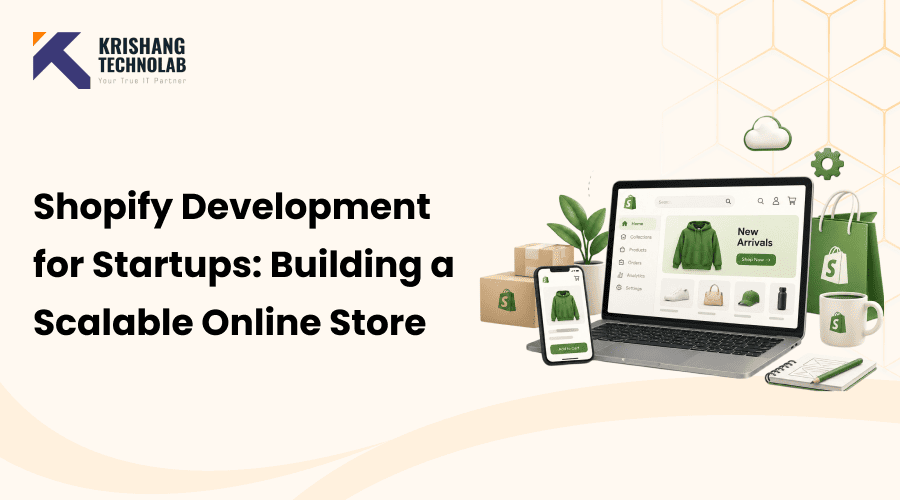
Quick Overview: Shopify development for startups helps businesses build scalable, secure, high-performing online stores. From custom Shopify development and ecommerce solutions to Shopify Plus, integrations, SEO, automation, and responsive design, startups can support sustainable growth.
Startups usually act quickly and fix problems as they appear. But this behaviour can hurt an online shop in the long run. A better way is to use Shopify Development for Startups. In fact, it combines speed with a tough build that will last.
At first, a simple store might be enough. But progress quickly shows its limits. There is more traffic, more sales, and more expectations from customers. Therefore, founders need a store built to handle change. Shopify Development for Startups in usa focuses on that exact need. It builds a base that grows with the business. As a result, teams avoid costly rebuilds down the road.
This guide covers every part of that base. Specifically, it looks at speed, safety, design, and smart integrations. You will also see a clear comparison of standard Shopify and Shopify Plus. Additionally, you will learn the signs that show your store has outgrown its current plan. For businesses exploring Shopify Development for Startups in india, these considerations can help create a store that is ready for changing customer demands and growing technical requirements. The guide also considers how Shopify Development for Startups in 2024 can address the evolving needs of modern ecommerce businesses.
Each section mixes clear steps with real startup context. After all, a small team has different needs than a large enterprise. Whether you are exploring Shopify Development for Startups and tech companies or looking at Shopify Development for Startups and entrepreneurs, the goal remains the same: build a store that can adapt as the business grows. In the end, you will know how Shopify Development for Startups builds a store that lasts. So, let us start with why Shopify suits early-stage founders so well.
Why Shopify Development for Startups Starts With the Right Platform
Most startups run lean teams, so they need a platform that stays simple yet flexible. Shopify Development for Startups begins with this exact balance. Indeed, the platform fits both new founders and skilled developers. For Shopify development for early-stage businesses, this flexibility makes it easier to start small while keeping room for future growth. Shopify solutions for startups also provide a practical foundation for Shopify Development for beginners, allowing new founders to get up and running quickly and add features later without changing tools. This approach is particularly useful for a Startup business that needs to move quickly while keeping its technology flexible.
Ease of Use for Non-Technical Founders
Many founders don’t know how to code but Shopify has a simple dashboard and drag-and-drop tools. So teams can update products and pages without a developer for every change. Its simplicity cuts initial costs and time-to-market from concept to live store, though many still choose to hire Shopify developers once design needs grow more advanced.
Built-In Scalability as You Grow
Shopify supports stores with ten products or ten thousand. As a startup scales, it doesn’t need to change tools. Rather, the system adapts itself to handle more traffic. This is the reason why the intrinsic scalability makes Shopify Development for Startups a smart long-term choice, and it is why a capable Shopify website design company plans the layout with future growth in mind.
Understanding Shopify Development Services for Growing Brands
Shopify development services cover setup, design and technical work that take startups beyond basic templates. All in all, these services help Shopify Development for Startups avoid costly mistakes early on. They also provide founders with a clear technical basis for growth, which is why many brands rely on full Shopify development services rather than piecing the work together themselves.
Custom Store Setup and Configuration
You’ll need to have a solid setup of payment options, shipping rules and tax settings. Developers adapt these depending on your market and products in particular, often through structured custom web application development work. This means the store runs seamlessly from day one. If you skip this step, you will often encounter checkout problems and shipping errors later. Many founders hire Shopify experts specifically for this configuration stage.
Theme Development and Customization
Templates give you a starting point but they rarely represent the full identity of a brand. Instead, developers modify layout, fonts and colours, or create a fully custom theme. This type of customisation creates brand loyalty and improves the buyer’s view of the product quality, making it especially valuable for Shopify development for emerging brands. It is also a task most founders leave to trusted Shopify Development companies or a specialized Shopify Development agency rather than handling alone.
Performance Optimization in Shopify Development for Startups
Speed shapes both sales and customer trust, since a slow store frustrates visitors fast. So, performance should get attention from day one. After all, it directly affects every part of Shopify Development for Startups. Scalable Shopify development helps ensure that performance remains consistent as traffic and order volumes increase. Speed shapes checkout, search rankings, and customer trust, making it an essential part of effective Shopify ecommerce development.
Page Load Speed Optimization
Slow loading pages can drive away customers in seconds. So, developers speed up with image compression and content delivery tools. These fixes do not compromise any visual fidelity and instead speed up loading times. Fast pages also help with search rankings, which is good for users and visibility. As part of effective Shopify store development, these performance improvements help create a faster and more reliable shopping experience.
Mobile Responsiveness
People are browsing on phones more than ever, and a broken mobile layout costs sales instantly. So developers test every page on many screen sizes to make sure performance is consistent, following the same mobile optimization tips for Shopify stores that top brands rely on. Today, mobile responsiveness is not a bonus, but a basic requirement for every store.
Scalable Architecture in Shopify Development for Startups
Early architecture decisions dictate how well a store scales down the road. That’s why Shopify Development for Startups has to be ready to scale from day one. This step keeps the store stable during times of fast change and saves money on rebuilds in the future, a principle that applies across all ecommerce development work, not just Shopify.
Flexible Backend for Future Growth
The flexible backend supports large catalogues and high order counts. Developers structure data so it’s ready for future growth, which is critical during busy seasons or sales spikes. This approach is an important part of scalable Shopify development, especially for a growing Shopify Development for Startup company that needs its store infrastructure to handle increasing demand. Overall, planning ahead will save you time, money and the risk of downtime.
Automated Workflows and Order Management
Manual work cannot keep up with rising order volume. Automated workflows manage stock updates, order alerts and fulfillment steps. For a growing Shopify Development for Startup business, Shopify Development companies can automate repetitive tasks and reduce duplicate work. Instead, teams can focus on strategy, growth, and customer experience.
User Experience in Shopify Development for Startups
User experience decides whether visitors become buyers, since a messy layout or slow checkout drives shoppers away fast. Therefore, Shopify Development for Startups treats user experience as a core goal. Shopify solutions for startups can help create intuitive shopping journeys, while Shopify ecommerce development focuses on navigation, filtering and checkout based on actual customer behavior.
Simplified Navigation and Product Filtering
The menus are clear, and there are smart filters to help you browse and find what you need quickly. Neat categories also lessen frustration in the shopping trip. For Shopify Development for beginners, keeping the Shopify Development store simple and easy to navigate helps visitors find products without confusion. Simple navigation, therefore, leads shoppers to explore more, which often leads to a higher average order size.
Optimized Checkout Process
A long checkout drives customers to abandon their cart. Fewer steps improve conversions, while trust badges ease buyer doubt. Effective Shopify store development keeps checkout simple, fast, and friction-free.
Security Standards in Shopify Development for Startups
Security concerns grow as you collect more customer data, so startups must guard this data from day one. Indeed, Shopify Development for Startups treats strong security as a standard, not an option. For a Shopify Development for Startup company, strong encryption, compliance and authentication are essential for protecting customer information. These measures help create a secure Shopify Development store as the business grows.
PCI Compliance and SSL
The Payment Card Industry rules protect sensitive card data. Shopify automatically applies SSL certificates to every store. But Shopify Development companies can add extra security layers to stores that have high sales volume. This establishes trust from the first sale and reduces legal risk.
Two-Factor Authentication and Data Protection
Two-factor login adds one more wall against hackers. Specifically, this simple step cuts the risk of account breaches, while encrypted storage protects saved customer data from leaks. A trusted Shopify Development agency can also help configure these security measures properly. These steps, taken together, help build a safe store where buyers feel comfortable sharing payment details.
Integrations That Support Shopify Development for Startups
Startups rarely rely on just one tool, since many small systems work together behind the scenes. So, integrations help to connect these tools together into one seamless setup in Shopify Development for Startups. Includes CRM, ERP, marketing and analytics platforms, and many founders bring in a white-label Shopify development team to manage the heavier integration work.
CRM, ERP, and Third-Party App Integrations
Linking Shopify with CRM and ERP tools smooths daily work, so customer data moves between systems on its own. Third party apps also add features for shipping, stock and reports. Shopify ecommerce development can connect these systems efficiently, while Shopify Development agencies can handle more complex integrations. Consequently, these links cut errors caused by manual data entry across teams.
Marketing and Analytics Tools
Marketing tools connect email, social media and ad accounts; analytics programs track how well each channel is performing. Therefore founders know precisely what drives sales. Shopify Development agencies can connect these tools and organize data for clearer insights. Overall, data replaces guesswork in marketing choices, helping teams spend budget more wisely.
SEO Foundations in Shopify Development for Startups
Visibility matters as much as design and speed. A great store with no search visibility still struggles to sell. So Shopify Development for Startups creates SEO from day one. It informs URLs, headings and content for longevity, which is exactly where dedicated SEO services or hiring Shopify SEO experts make the biggest difference.
SEO-Friendly Architecture and URLs
Clean URLs help make your pages easily readable by search engines. Thus, developers arrange the product and category in a clear, logical order. A skilled Shopify Development agency can ensure this structure supports efficient crawling and indexing. So this structure helps the crawling of the store by search engines. Clean sites get better rankings in search engines.
Content Structure for Search Visibility
Clear headings and meta descriptions guide search engines through each page. Additionally, good structure raises your odds of a featured snippet. Shopify Development companies can help optimize these elements while ensuring the SEO work is backed up by fast pages and mobile support. Overall, strong structure helps both search engines and real readers.
Signs Your Startup Has Outgrown Basic Shopify
Growth often reveals the limits of a basic plan. Spotting these signs early saves sales and keeps customers happy. Below, five signs suggest it may be time to move beyond standard Shopify, and our Shopify vs Shopify Plus comparison breaks each difference down in detail. Each one signals a different growth challenge.
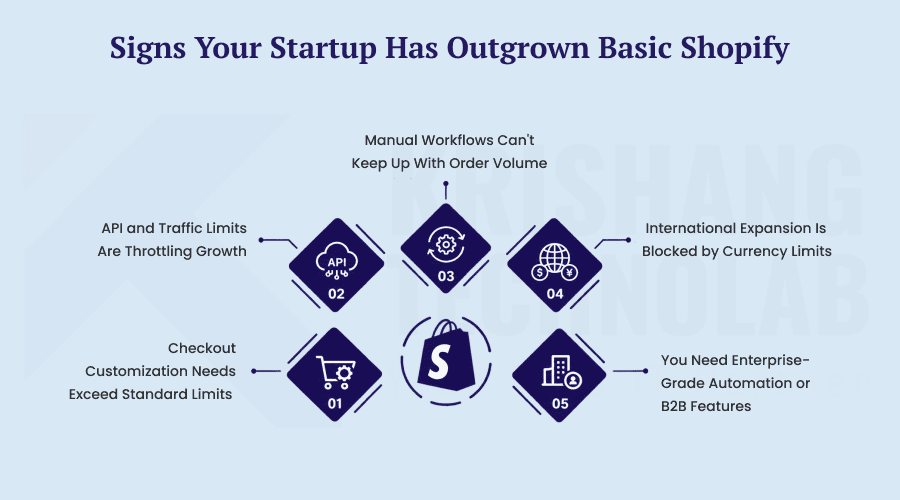
1. Checkout Customization Needs Exceed Standard Limits
Shopify limits what is changeable in the checkout. In the meantime, growing brands often need custom fields or unique payment flows. For Shopify Development for Startups and tech companies, these advanced checkout requirements can become important as operations expand. If you’re a founder whose operation is outgrowing these limits, then it’s a smart move to upgrade to Shopify Plus.
2. API and Traffic Limits Are Throttling Growth
Busy times can mean stores are busy and sometimes hit API call limits. This, in turn, slows down apps and other tools, since how APIs work directly shapes how much load a store can take at once. The fact that it slows down again and again during rush hours, shows that there is indeed a scalability problem in terms of Shopify Development for Startups.
3. Manual Workflows Can’t Keep Up With Order Volume
Fulfilment steps done by hand can become difficult as orders grow. For a Shopify Development for Startup business, automation reduces routine work and supports better strategy. With continued growth, more automation, integrations and structural support become essential.
4. International Expansion Is Blocked by Currency Limits
Needed multi-currency, multi-language support to sell in new markets. However, basic plans of Shopify are limited in this regard. For Shopify Development for Startups and entrepreneurs, international expansion often requires flexible tools for managing different markets. So, startups going global often need a more powerful toolkit and this usually pushes them to Shopify Plus.
5. You Need Enterprise-Grade Automation or B2B Features
For deep automation, bulk orders, wholesale pricing, enterprise tools are required. But these features aren’t usually part of standard plans. Therefore, their absence is often the last straw for an upgrade in the strategies of advanced Shopify Development for Startups.
Standard Shopify vs. Shopify Plus
Choosing between standard Shopify and Shopify Plus depends on size and need. The regular Shopify plan is usually fine for simple needs of early-stage startups. Shopify Plus is for high volume or international stores.
| Feature | Standard Shopify | Shopify Plus |
| Checkout customization | Limited | Fully customizable |
| API request limits | Standard limits | Much higher limits |
| Automation tools | Basic | Advanced and built-in |
| Multi-currency support | Limited | Broad global support |
| Dedicated support | Standard channels | Priority merchant support |
| Pricing | Lower monthly cost | Higher enterprise cost |
Overall, this table shows which plan fits your current stage. Meanwhile, it helps you plan ahead before you hit a growth wall.
Choosing a Partner for Shopify Development for Startups
The right partner shapes your whole project’s success, and not every agency offers the same skill level. Therefore, Shopify Development for Startups depends heavily on this one choice. It’s about portfolio strength, technical depth and quality of support, which is why founders often study how to hire a Shopify expert before reaching out to any Shopify experts directly.
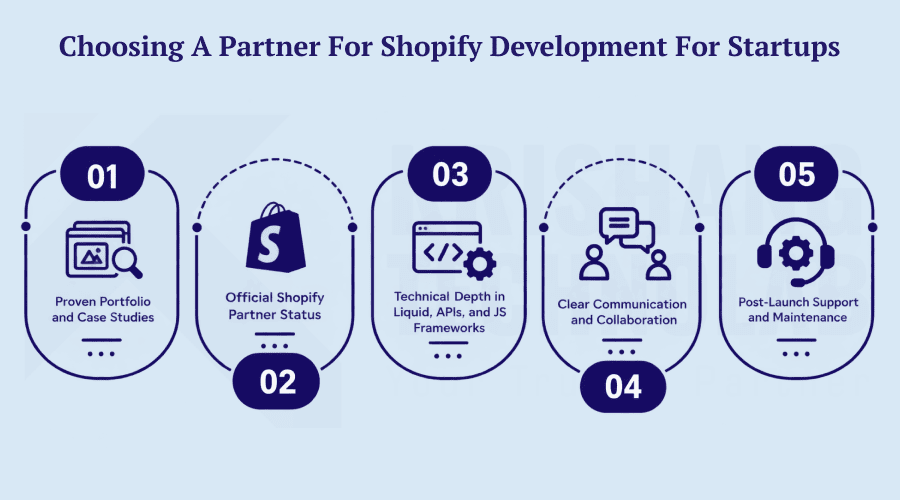
1. Proven Portfolio and Case Studies
Building a strong portfolio shows real skill in design and code. Case studies also show how a partner solved business problems in the past. All in all, working through this work sets reasonable expectations for your project before entering into a full development partnership with a Shopify development company.
2. Official Shopify Partner Status
Shopify Partners have deeper knowledge of the platform. It also gives you more tools and direct support. Validated partners are thus more likely to provide predictable results to founders investing in Shopify Development for Startups.
3. Technical Depth in Liquid, APIs, and JS Frameworks
Strong skill with Liquid, API’s and Javascript is a big plus. Specifically, these skills shape how well a partner can expand your store. But without that depth, it’s difficult to build complex features well, or maintain them over the long term.
4. Clear Communication and Collaboration
Open communication keeps a project on time and on budget. Meanwhile, the build is not confused by regular updates. Overall, the teamwork is strong so it makes it easy to pivot if things come up that change priorities or business needs.
5. Post-Launch Support and Maintenance
The work doesn’t end on launch day, it starts. Regular maintenance keeps the store safe, up-to-date and in full working order, ideally through ongoing website maintenance services or a dedicated Shopify store maintenance and support guide. That’s why in any good Shopify Development for Startups plan, you have a reliable partner here to support you long after launch.
Conclusion: The Long-Term Value of Shopify Development for Startups
Building a successful online store is more than just choosing a tool and adding products. Instead, Playbook for Startups Shopify Development combines speed, security and design into a single clear plan. Every early decision determines how well the store scales later. For a growing Shopify Development for Startup business, choosing scalable Shopify development from the beginning creates a stronger foundation for future growth.
People who are looking at structure, integrations and SEO are building their stores for real growth. Also, recognising the signs of outgrowing standard Shopify helps avoid unnecessary friction. Meanwhile, the comparison between standard Shopify and Shopify Plus provides a clear path for that shift. These Shopify solutions for startups can support businesses as their requirements become more complex, while Shopify Development for beginners provides an accessible starting point for founders with limited technical experience.
All these factors come together in choosing the right development partner. Indeed, skill, plain talk and ongoing support determine whether a store thrives long after launch. Shopify Development companies and experienced Shopify Development agencies can provide the technical expertise needed to maintain and improve the store over time. So this is a choice that deserves some real thought, not a rash decision.
Shopify Development for Startups is not something you do once. Rather, it’s a continuous investment in the business, much like the website migration services many growing brands eventually need. As your business expands, your store should evolve right alongside it. The right base enables startups to build stores for long-term success.
In conclusion, have a clear plan, and choose a good partner. A store that scales today avoids a costly rebuild tomorrow. That’s the true value of Shopify Development for Startups at the end of the day.
Frequently Asked Questions
1. How much does Shopify development cost for a startup?
Depending on the amount of work, Shopify development cost can cost a few hundred dollars to several thousand dollars. Creating a custom theme is more expensive than the basic setup. Startups are small initially and invest more as revenues and complexity of stores grow over time.
2. What is the difference between Shopify Plus and standard Shopify?
Shopify Plus also has higher API limits, more checkout customization, and more dedicated support. Shopify standard is for the smaller catalogs and simpler workflows. Most startups begin on standard Shopify and move to more sophisticated tools when traffic, automation needs or global sales are demanding.
3. Can I fully customize my Shopify store design?
Yes, Shopify store customisation can range from minor theme changes to building a fully custom store from the ground up. Developers are able to also change the look and feel of the dashboard, including the fonts, colors and layouts. Editing Liquid code gives full control over design, structure and on page functionality for more complex changes.
4. Do I need coding knowledge to use Shopify Liquid?
No programming needed for simple store management. But for more sophisticated customisation it’s down to Shopify Liquid, the platform’s templating language. Learning Liquid or hiring a developer that is familiar with it gives you more freedom in design than your theme editor options.
5. How long does it take to build a Shopify store?
Time taken will depend on the intricacy of the task and features needed. Typically 1-3 weeks basic store. Unique builds with custom themes, integrations and testing often take four to eight weeks from start to final deployment.
6. Is Shopify secure enough for handling customer payment data?
Shopify meets PCI standards, and you can get SSL licenses. This keeps customer payment data secure, anywhere. High-volume transactional businesses will often add two-factor authentication and more encryption to provide ongoing protection.
7. How do I make my Shopify store more scalable?
In terms of building a scalable Shopify store, think about the backend flexibility, automation and integrations from the beginning. The solid architecture can handle traffic peaks and the growth of catalogs without any problem. Thinking at scale saves startups the expensive rebuild down the road, saving time and development budget.
8. What should I look for when hiring a Shopify development partner?
A good Shopify development partner will have a strong portfolio of experience, official Partner status and significant technical skills. “Open communication and after launch support are also important.” These are the things that will make or break your store in the long run, long after the initial launch.
Found this post helpful? Don't forget to share it with your network!