Quick Overview: Healthy white label web development profit margins come from turning a fixed developer payroll into a variable cost that is paid only when a project is sold. Agencies typically gain margin by avoiding idle developer time, selling more projects with the same sales team, and delivering without hiring delays. Whether it works for you depends on your project pricing, your partner’s rates and how much management time you keep.
Developer salaries keep rising, good WordPress and ecommerce specialists are hard to hire, and clients still expect fast launches. Most agencies hit the same wall: sales are growing, but the in-house team is already full. Hiring another developer adds a fixed monthly cost before the new revenue arrives, and a slow quarter turns that salary into a loss.
A white label development agency USA solves this differently. It builds websites for your clients under your brand, and you resell the work at your own price. You add delivery capacity without immediately expanding payroll, and you keep control of the client relationship, the pricing and the margin. That is how agencies protect white label web development profit margins as they grow, using white label web development services for the build work.
This guide explains how white label web development profit margins work, with a worked example and clearly stated assumptions. It also covers seven ways it can increase agency profits, how to choose a partner, when to hire a white label website developer and how to calculate ROI.
What Are White Label Web Development Profit Margins?
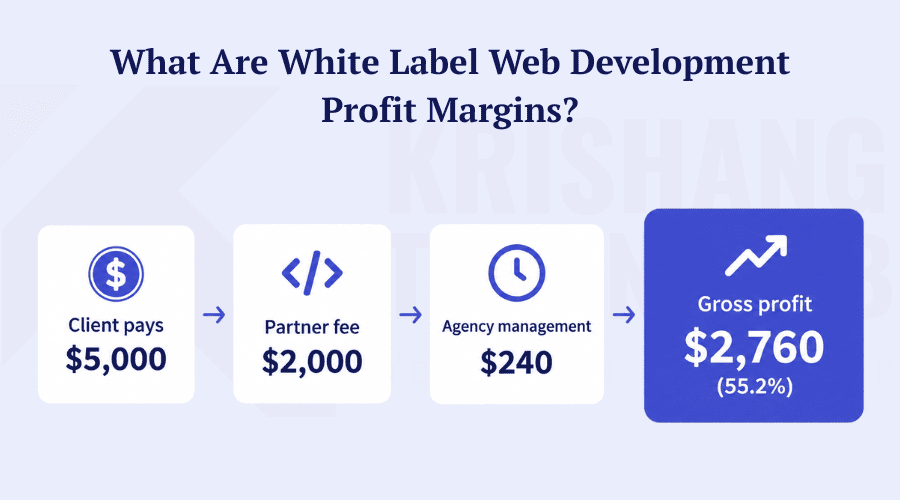
White label web development profit margins are the share of project revenue an agency keeps after paying a white label partner to build the site. The agency sells the project at its own price, the partner builds it under the agency’s brand, and the difference, minus management time, is the margin.
Understanding Profit Margins in Web Development Agencies
A profit margin is profit expressed as a percentage of revenue. Web development agency profit margins vary widely by niche, pricing model and team utilization, so benchmark against your own past projects rather than a generic industry figure. What matters is that you measure margin per project, not just per month. Tracking white label web development profit margins project by project shows which scopes pay, and our guide on how to outsource web development explains the cost side.
How White Label Development Affects Project Profitability
In-house delivery carries costs that are easy to miss: salary, benefits, software, equipment, management and paid time with no billable project. White label delivery replaces most of these with one partner fee per project. The table below shows the difference using illustrative numbers.
Assumptions: the agency sells a 10-page WordPress website for $5,000. An in-house developer costs $35 per hour fully loaded (salary, benefits, tools, management) and is billable 70% of the time, so each productive hour effectively costs $50. The project takes 70 development hours and 6 agency project-management hours at $40 per hour. The white label partner charges $2,000 for the same scope. Your partner’s rates will differ.
| Cost line | In-house delivery | White label delivery |
| Project price to client | $5,000 | $5,000 |
| Development cost | $3,500 (70 hrs × $50) | $2,000 (partner fee) |
| Agency project management | $240 (6 hrs × $40) | $240 (6 hrs × $40) |
| Total delivery cost | $3,740 | $2,240 |
| Gross profit | $1,260 | $2,760 |
| Gross margin | 25.2% | 55.2% |
In this example, white label web development profit margins reach 55.2% against 25.2% for in-house delivery, so the same project earns $1,500 more. The gain comes mainly from not paying for idle developer time.
Gross Profit vs. Net Profit for Digital Agencies
Gross profit is revenue minus the direct cost of delivering the project. Net profit also subtracts overheads such as rent, sales, marketing, software subscriptions and admin salaries. White label web development profit margins mainly show up in gross profit, and they can lift net profit too when white label delivery lets you grow revenue without adding overheads.
Track both numbers. A project with a strong gross margin can still lose money if revisions and client communication consume unplanned management hours.
7 Ways White Label Web Development Can Increase Agency Profits
White label web development can help agencies boost profitability in seven key ways: reducing fixed costs, increasing profit per project, serving more clients per team, minimizing delays, expanding the service menu, optimizing internal time, and generating more recurring revenue. Each one works on a different part of the formula behind white label web development profit margins.
1. Reduce Full-Time Hiring and Operational Costs
Hiring a full-time developer creates ongoing monthly expenses, even when there are no active projects to work on. Recruiting, onboarding, equipment, software licences and management time add to the salary. With a white label partner you pay per project or per block of hours, so the cost follows your sales.
2. Increase Profit Per Website Project
To increase profit per website project, either raise the price or lower the delivery cost. White label development lowers the cost of the development step without forcing you to cut your client price. Agencies that sell on strategy and results, not on development hours, usually keep the widest spread.
3. Take on More Clients Without Expanding Your Team
You can scale a web design agency without expanding your in-house team when development slows down growth. Your sales and design team can secure more projects, while a white label partner handles the additional development work. This makes white label web development an effective approach for agencies looking to grow efficiently. Explore the benefits of white label web development.
4. Minimize Project Delays and Delivery Bottlenecks
Late projects cost money through extended management time, delayed invoices and unhappy clients. A partner with a dedicated team can start a project the week it is signed, instead of waiting for an in-house developer to free up. Faster starts also mean faster final payments.
5. Expand Services Without Building Every Capability In-House
A design-led agency can add ecommerce, custom development or maintenance retainers without hiring a specialist for each. You test demand first, then decide whether a service is worth bringing in-house. This is a low-risk way to widen your offer.
6. Improve Team Productivity and Resource Allocation
Agency resource optimization means putting each person on the work that earns the most. Your senior people can focus on strategy, client calls, design direction and quality review, while routine builds go to the partner. Less context switching also means fewer mistakes.
7. Create Opportunities for Recurring Revenue
Every launched website is a chance to sell hosting, maintenance, security updates, SEO and content support. A white label partner that offers website maintenance and support lets you sell these retainers without staffing a support desk. Recurring revenue stabilizes cash flow and raises the lifetime value of each client.
Example: In-House Hiring vs. White Label Delivery
Assumptions: an agency with one developer is at capacity at 2 sites per month and wants to deliver 4 more per month. Each site sells for $5,000. A new full-time developer costs $5,600 per month fully loaded (160 hours × $35), and two are needed for 4 extra sites, so $11,200. The white label partner charges $2,000 per site. Agency management costs $240 per site in both cases. A slow month means only 2 extra sites are sold.
| Scenario | Extra revenue | Development cost | Management cost | Profit | Margin |
| Hire two developers, busy month (4 sites) | $20,000 | $11,200 | $960 | $7,840 | 39.2% |
| Hire two developers, slow month (2 sites) | $10,000 | $11,200 | $480 | -$1,680 | -16.8% |
| White label, busy month (4 sites) | $20,000 | $8,000 | $960 | $11,040 | 55.2% |
| White label, slow month (2 sites) | $10,000 | $4,000 | $480 | $5,520 | 55.2% |
White label web development profit margins hold at 55.2% in both months because delivery cost scales with sales. The hiring model is only competitive when the agency is reliably busy, and it loses money in a slow month. These numbers are illustrative, so replace them with your own.
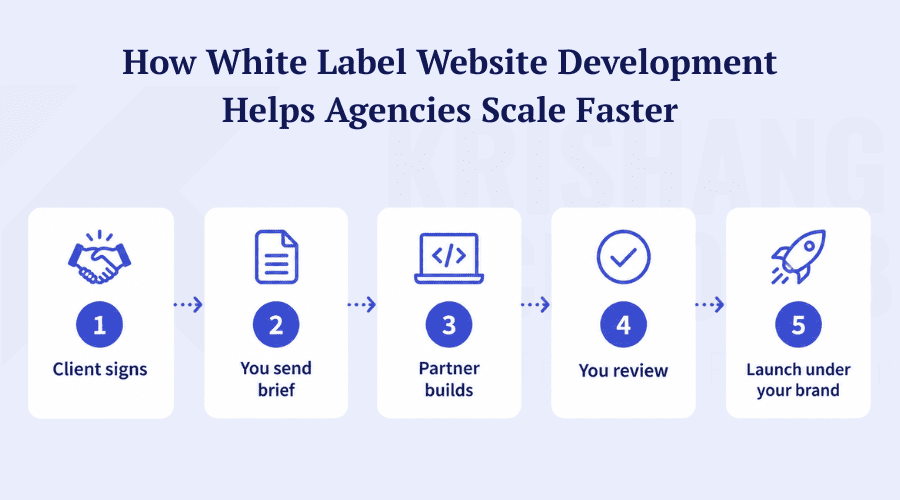
How White Label Website Development Helps Agencies Scale Faster
White label website development helps agencies scale faster by adding build capacity on demand, so the number of projects you can deliver is no longer capped by your in-house headcount. A white label web agency becomes an extension of your delivery team. Faster scaling also protects white label web development profit margins, because you add capacity only when projects are sold.
Handle More Projects During Peak Demand
Demand is rarely even. Seasonal campaigns, product launches and year-end rushes create spikes that one in-house team cannot absorb. A partner lets you say yes to the extra projects, then return to normal volume without layoffs.
Scale Development Capacity Without Permanent Payroll Costs
Permanent payroll is a commitment. Contract-style capacity, such as a dedicated team billed monthly or project-based pricing, lets you match cost to workload. Scalable web development services for agencies work best when the contract allows you to increase or reduce hours with reasonable notice.
Maintain Consistent Project Delivery
An established partner has documented processes, version control, staging environments and quality checks. That gives you more predictable timelines than a single overloaded developer, and it reduces the risk of one person’s absence stopping a project.
Focus Internal Teams on Sales, Strategy, and Client Relationships
The work clients value most, and pay most for is usually strategy, design direction and communication. When your team spends less time on routine builds, it can spend more on discovery calls, proposals, account management and upsells, which raise revenue per client.
Which White Label Web Design Services Can Agencies Offer?
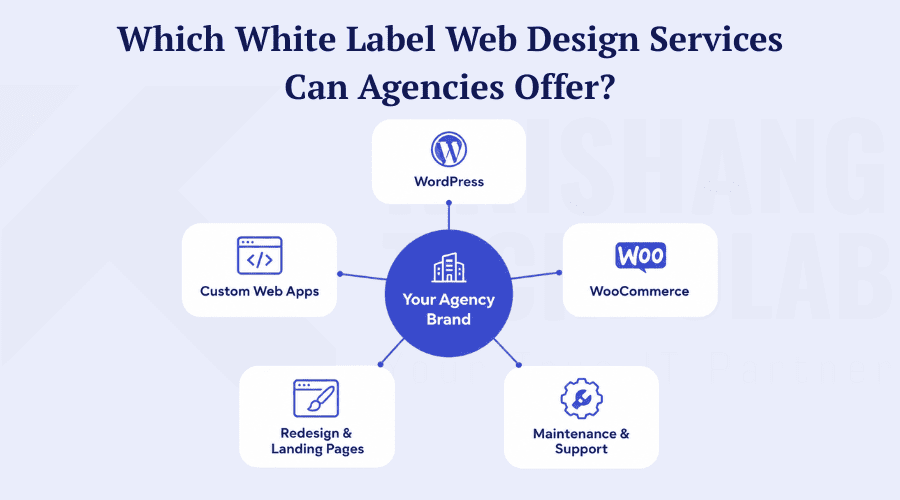
Agencies can resell WordPress development, custom websites, ecommerce, redesigns, landing pages and ongoing maintenance as white label web design services. The more of these you can offer under one brand, the more revenue you can earn from each client. See our full range of white label web design services.
WordPress Website Design and Development
WordPress is the most common starting point because demand is steady and projects are repeatable. A partner can handle theme setup, custom themes, page builders, plugin configuration and speed optimization. This is the core of white label WordPress website development.
Custom Website and Web Application Development
For clients who need more than a template, white label custom website development covers bespoke front-end and back-end work, CMS development and integrations. Larger scopes also include white label web application development, such as portals and dashboards. These projects carry higher prices and often higher margins.
Ecommerce and WooCommerce Development
Online stores need product catalogs, payment gateways, shipping rules and security. White label ecommerce website development and WooCommerce development let you serve retail clients without a specialist on payroll. Stores also create ongoing optimization and maintenance work.
Website Redesign and Landing Page Development
White label website redesign services suit clients with outdated, slow or poorly converting sites. White label landing page development is useful for agencies running paid campaigns because pages can be built quickly and tested against each other.
Website Maintenance and Ongoing Support
White label website maintenance services cover updates, backups, security monitoring, bug fixes and small content changes. Selling these as monthly plans turns one-off projects into recurring revenue.
| Service | Best for | Margin opportunity |
| WordPress development | Small and mid-size business sites | Steady volume, repeatable builds |
| Custom and web app development | Complex or specialized clients | Higher project value |
| Ecommerce and WooCommerce | Online retailers | Build fee plus ongoing optimization |
| Redesign and landing pages | Growth and campaign clients | Fast turnaround, frequent repeat work |
| Maintenance and support | Every launched site | Monthly recurring revenue |
How White Label WordPress Development Supports Agency Growth
White label WordPress development supports agency growth by letting you sell WordPress projects at scale without hiring a full-time specialist. WordPress projects are repeatable, which makes them well suited to outsourcing.
Deliver WordPress Projects Without Hiring an In-House Specialist
An experienced WordPress developer should have expertise in themes, plugins, website performance, security practices, and, when required, PHP development. Hiring one for a handful of projects a month is hard to justify. A white label web design WordPress partner gives you that expertise at a project price, and the benefits of white label WordPress development go beyond cost.
Expand Your WordPress Design and Development Services
If you currently offer only design, a partner lets you offer complete design-and-build packages. You can sell brochure sites, service-business sites, blogs, membership sites and stores, all under one brand and one point of contact.
Manage Multiple Client Websites More Efficiently
Agencies with many client sites face a steady load of updates, backups and small fixes. A partner can run these on a schedule, which frees your team to handle client communication. Consistent hosting and plugin standards across sites also reduce firefighting.
Improve Project Delivery With Repeatable Workflows
Repeatable workflows are where WordPress margins improve most. Agree on a starter theme, a plugin list, a content-intake form and a QA checklist with your partner. Each new project then starts from a proven base, which shortens build time and reduces revisions.
White Label Web Development vs. In-House Development
White label web development suits agencies with uneven, or growing workloads, while in-house development suits agencies with steady, high-volume work, and a need for tight day-to-day control. Many agencies use both: a small core team plus a white label web development company in USA for overflow and specialist work.
| Factor | In-house development | White label development |
| Cost structure | Fixed monthly salary and overheads | Variable, paid per project or per block of hours |
| Hiring and training | Recruiting, onboarding and training time | None, the partner is already staffed |
| Time to start a project | Depends on developer availability | Often within days, depending on the partner |
| Scalability | Limited by headcount | Capacity can be raised or reduced |
| Skill range | Limited to who you hire | Access to several specialists |
| Quality control | Direct, daily oversight | Depends on the partner and your review process |
| Communication | Same team, same tools | Needs clear briefs and a single point of contact |
| Best when | Workload is steady and high | Workload is uneven or growing |
Compare Hiring, Training, and Management Costs
Outsourced web development costs look like a single line item, while in-house costs are spread across median web developer salary, benefits, software, equipment, training and management time. Add them up before you compare. Compare white label web development profit margins with in-house margins only when both sides include the same management hours.
Compare Scalability and Project Flexibility
In-house teams are slow to scale up and painful to scale down. A partner can add a second developer next month and release them when the rush ends. That flexibility is most valuable to small and mid-size agencies with unpredictable sales.
Evaluate Quality Control and Communication
In-house work is easier to supervise, but outsourced work can match it with a clear process. Use written briefs, a staging site for review, a code standard and a defined revision policy. Quality problems in outsourcing usually come from vague briefs, not from the model itself.
Determine Which Model Fits Your Agency’s Workload
If you have enough steady work to keep a developer billable most of the month, hiring may give you more control at a similar cost. If your workload swings, or you want to test new services, white label delivery usually carries less risk. A hybrid model is a sensible middle path, and our comparison of an in-house team vs a remote or dedicated team can help you decide.
How to Choose the Right White Label Web Development Company
Choose a white label web development company USA by checking its technical skill, pricing clarity, communication, confidentiality terms and ability to grow with you. The cheapest quote is rarely the best, because rework and missed deadlines erase the savings and shrink white label web development profit margins.
Check Technical Expertise, and Portfolio Quality
Ask for live examples that match your projects, such as WordPress, WooCommerce or custom builds. Test a few sites for speed, mobile layout and accessibility. Ask who will work on your projects and whether you get a dedicated white label web development team, or a changing pool.
Compare Pricing and Project Scope
For affordable white label web development services, compare what is included, not only the price. Page counts, revisions, content entry, speed optimization, security configuration, training, post-launch support. Ask whether pricing is fixed per project, hourly or a monthly retainer. If you are comparing a white label web development company in USA with local options, compare the whole package, including time-zone overlap, and communication, not only the hourly rate.
Review Communication and Revision Policies
Choose a dependable white label web development partner that offers a dedicated point of contact, timely communication and a well-structured workflow. Before starting, clarify the number of revisions included, the cost of additional changes and the project-management tools they use. Also, ensure their working hours align with your clients’ business schedules.
Verify Confidentiality and Client Ownership
Get these points in writing before you start:
- A non-disclosure agreement and a clause that the partner will not contact your clients.
- Full ownership of code, design files and content passes to you or your client after payment.
- No partner branding in the code, admin area or footer.
- Clear terms on licences for premium themes and plugins.
Choose a Partner That Can Scale With Your Agency
Your needs will change as you grow. Ask how quickly the partner can add developers, whether they cover frontend, backend, CMS and maintenance, and how they handle several of your projects at once. Start with a small paid pilot project before committing to a large volume. Our guide to working with a white label website development partner covers the process in more detail.
When Should You Hire a White Label Website Developer?
Hire a white label website developer when demand exceeds your capacity, full-time hiring is not cost-effective, you need a skill you lack or you want to launch a new service quickly. If none of these apply, your in-house team may be enough.
When Your Agency Has More Projects Than Available Capacity
If you are turning down work, extending deadlines or paying overtime, you have a capacity problem. Hiring a white label web developer for the overflow protects both your revenue and your client relationships.
When Full-Time Hiring Is Not Cost-Effective
A developer is worth hiring full-time only if you can keep them billable. Otherwise, outsourcing protects your white label web development profit margins. If your pipeline is uneven, to hire white label web developers by project or by monthly block is usually cheaper than carrying a salary through slow months.
When You Need Specialized Development Skills
Some work needs a specialist for a short time, such as payment integrations, performance tuning, custom plugins or a complex WooCommerce setup. It is more efficient to hire a white label website developer with that experience than to train someone for one project.
When You Want to Launch New Services Quickly
A partner lets you test a new offer, such as ecommerce builds or maintenance plans, within weeks. If demand is strong, you can expand the partnership or bring the skill in-house later. If it is weak, you have not committed to a salary.
How to Calculate the ROI of White Label Web Development
To calculate white label development ROI, divide the profit from outsourced projects by the total cost of delivering them, including your own management time. Count every cost, or your white label web development profit margins will look better than they are.
Calculate the Cost of Delivering a Website Project
Start with the white label web development pricing you pay: the partner fee, plus add-ons such as extra revision rounds, premium plugins and hosting setup. Then add your own hours for briefing, review, client calls and testing, priced at your internal hourly cost.
Compare Revenue Against Outsourcing and Internal Costs
Compare the same project delivered two ways. Using the earlier assumptions, here is a quarter with 6 outsourced projects at $5,000 each.
| Line | Amount |
| Revenue (6 projects × $5,000) | $30,000 |
| Partner fees (6 × $2,000) | $12,000 |
| Agency management (6 × $240) | $1,440 |
| Profit | $16,560 |
| ROI ($16,560 ÷ $13,440) | 123.2% |
| Profit if built in-house (6 × $3,740 cost) | $7,560 |
On these assumptions, outsourcing earns $9,000 more over the quarter. Your own figures will differ, so run the calculation with real quotes and time records.
Measure Revisions, Management Time, and Project Overheads
Revisions and management time are the hidden costs. Log the hours your team spends on each outsourced project, count revision rounds and note the causes. If one client consumes twice the planned hours, your margin on that project falls even though the partner’s fee did not change.
Track Profit Per Project and Monthly Agency Profitability
Review four numbers each month:
- Profit per project and gross margin per project
- Average management hours per outsourced project
- Percentage of projects delivered on time
- Recurring revenue from maintenance and support plans
If white label web development profit margins drop on a project, check whether the cause is scope creep, unclear briefs or a partner problem.
Grow Your Agency With a Reliable White Label Development Partner
Strong white label web development profit margins come from replacing fixed developer costs with project-based costs, raising profit per project and letting you take on more clients without growing payroll. The gain depends on pricing discipline, clear briefs and a partner you can trust, so start with a pilot project and measure margin per project from day one.
If you want to add development capacity under your own brand, our team works with agencies on WordPress, custom, ecommerce and maintenance projects, with confidentiality and client ownership built in.
- Explore Our White Label Web Development Services: See the full range of builds and support plans.
- Hire a White Label Website Developer: Add a dedicated developer or team to your agency.
- Request a Project Quote: Send your brief and get an itemized price.
Frequently Asked Questions About White Label Web Development
Is White Label Web Development Profitable?
Yes, white label web development is usually profitable for agencies that price projects well and control management time. It turns a fixed developer salary into a cost paid per project, so margin holds in slow months. White label web development profit margins fall when partner fees are too close to your client price or when revisions run out of control.
How Much Do White Label Web Development Services Cost?
White label web development services cost different amounts depending on scope, platform, partner location and pricing model. Common models are a fixed price per project, an hourly rate or a monthly dedicated-team retainer. Ask for itemized quotes for the same brief from at least three partners, and check what is included in each.
Can a Small Web Design Agency Use White Label Developers?
Yes, small agencies often benefit most because they cannot afford to hire a full developer team. A small web design agency can partner with white label developers to handle bigger projects, expand into WordPress and ecommerce development, and reduce the financial risks of hiring in-house staff. Begin with a single project to evaluate the work quality and communication process before committing to more projects.
How Do I Hire a White Label Website Developer?
If you want to hire a white label website developer, define your scope, shortlist partners with relevant portfolios, request quotes and run a small paid pilot. Sign a confidentiality agreement, agree on revision limits, and confirm code ownership. Then set a repeatable brief template so each project starts clearly.
What Does a White Label Web Development Agency Do?
A white label web development agency builds websites, web applications and related features for other agencies, who resell them under their own brand. The white label partner works behind the scenes without being directly visible to the end client. It typically handles development, testing and sometimes maintenance, while you manage the client relationship.
Is White Label WordPress Development Worth It?
White label WordPress development is worth it when you sell enough WordPress projects to benefit from repeatable builds but lack an in-house specialist. It lowers hiring risk, and speeds delivery. It is less useful if you only sell one or two sites a year, where a freelancer may be enough.
How Can Agencies Maintain Quality When Outsourcing?
Agencies maintain quality by using written briefs, a staging site for review, a shared QA checklist, a clear revision policy and a pilot project before scaling. Inspect each project thoroughly before delivering it to the client, and document repeated problems so you can review them with your white label partner and improve future results.
Found this post helpful? Don't forget to share it with your network!