
Quick Overview: Hire software developer in the USA takes more than posting a job. This guide covers when to hire, which roles and hiring models fit, where to find talent, current costs, evaluation tips, legal requirements, and offshore comparisons, helping you build the right team without costly mistakes.
If you want to hire software developer in the USA, you are entering one of the most competitive talent markets in the world. The U.S. Bureau of Labor Statistics (BLS) projects software developer employment to grow much faster than the average for all occupations, and nearly every company, from a two-person startup to a regional bank, now depends on custom software to sell, operate, and compete.
That demand creates a real problem for business owners and technical leaders. Experienced engineers receive multiple offers, hiring cycles routinely stretch past a month, and a wrong hire costs far more than the salary alone: lost delivery time, rework, and a team that has to start over.
The good news is that hiring well is a process you can learn. This guide walks through every stage: why and when to hire, which developer roles you need, which hiring model fits your project, where to find candidates, what the process looks like step by step, what it costs, how to evaluate talent, and the legal points to check before anyone signs. Choosing the right hiring model early is the single decision that shapes your budget, your speed, and your control over the product, so we start there and work outward.
How to define what you need, compare full-time, freelance, staff augmentation and outsourcing options, set a realistic budget using current data, and avoid the mistakes that slow most hiring plans down.
Why Hire Software Developer in the USA?
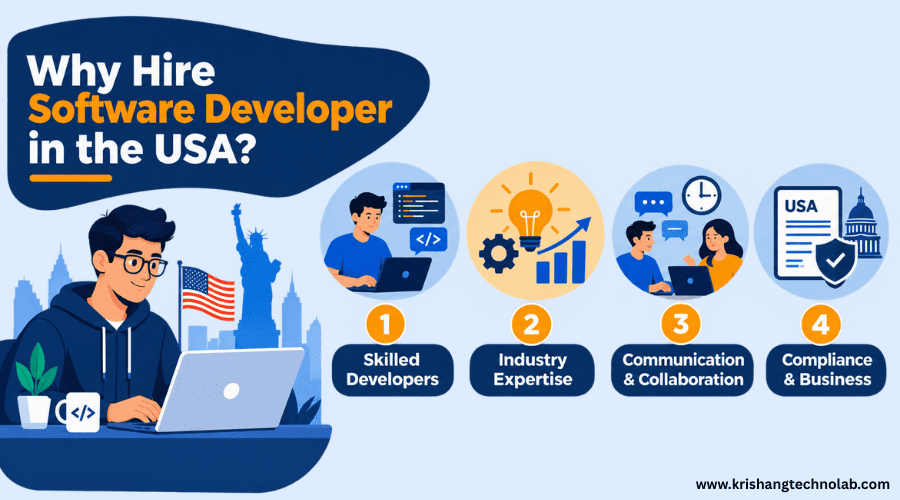
Hire software developer in the USA gives you access to deep technical talent, strong product instincts, and easy day-to-day collaboration with the rest of your business. It is not the only valid path, and later sections compare it with offshore options, but there are clear reasons many companies start here.
1. Access to Skilled and Experienced Developers
The U.S. has one of the largest pools of professional software developers in the world, with roughly 1.7 million people employed in the occupation according to BLS wage data. That scale means you can find specialists in almost any stack, from legacy enterprise systems to modern cloud-native architectures, along with people who have shipped products at companies of every size.
2. Industry Expertise and Technical Innovation
In the U.S., developers are generally embedded in sectors such as fintech, healthcare, logistics, e-commerce and defense technology. If you’re in a regulated or specialized space, hiring people who already know its workflows saves you months of onboarding. Being close to major tech hubs also means developers get to see new tools, practices and architectural patterns early.
3. Communication, Collaboration, and Time Zone Alignment
When your developers work in the same or an overlapping time zone, questions get answered the same day. Daily stand-ups, design reviews and live debugging sessions are simple to schedule, and product managers, designers and stakeholders can work with engineers in real time rather than through handoff documents. Shared language and cultural context also reduce the small misunderstandings that compound over a long project.
4. Understanding the US Business and Compliance Environment
Developers based in the USA are typically familiar with U.S. consumer expectations, accessibility standards, payment rules and privacy requirements such as state privacy laws and sector rules like HIPAA. That familiarity helps your team make compliant decisions earlier in the design phase, when changes are cheap. It does not replace legal advice, but it shortens the path to a product that fits the market you sell in.
When Should Your Business Hire Software Developer ?
You should hire software developers when software work is blocking revenue, efficiency, or customer experience and your current team cannot absorb it. Five situations come up most often for companies that want to hire software developer for their business.
Building a New Software Product
A new product needs architecture decisions, a first working version, and a path to iterate. Early-stage work benefits from a small, senior team that can make trade-offs quickly. If you are validating an idea, consider starting with a compact software development team rather than a large group, then expanding as the product proves itself.
Scaling an Existing Development Team
The backlog grows faster than your team can ship, quality degrades, bugs pile up, releases slow down, and engineers burn out. Adding developers only helps if there is onboarding, code review, and ownership in place to absorb them so we can scale in small increments and watch delivery metrics like cycle time, defect rates, etc.
Modernizing Legacy Software
Older systems that run on outdated frameworks or unsupported platforms become expensive to maintain and difficult to secure. Modernization often requires the kind of developer that can read the old code and also design a migration path, whether that’s refactoring in place, moving to the cloud, or gradually replacing the system. Larger organizations often bring in enterprise software development specialists to plan and run these migrations.
Developing Mobile or Web Applications
Customer-facing web and mobile application development projects require frontend craftsmanship, backend services, and ongoing maintenance for new devices and operating system updates. If you don’t have that mix of skills in house, it’s usually faster to hire targeted specialists than to try and retrain a general team.
Meeting Tight Project Deadlines
A fixed launch date, a contract milestone or a regulatory deadline can justify temporary capacity. In these cases, contract developers or staff augmentation often fits better than permanent hires, because you add skills for the duration of the push without long-term commitments. Be realistic, though: adding people late to a struggling project rarely speeds it up unless scope and ownership are clear.
Types of Software Developers You Can Hire
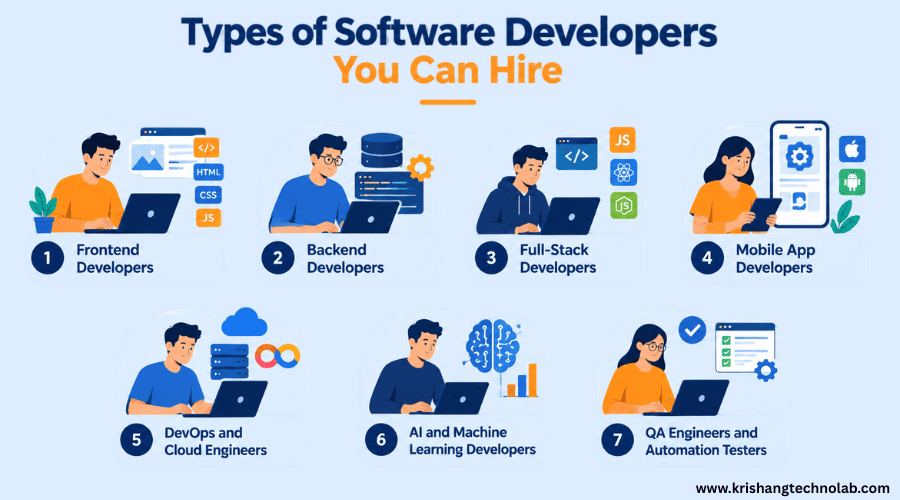
“Software developer” covers many specialties. Naming the role you actually need keeps your job post accurate and your candidate pool relevant.
1. Frontend Developers
Frontend developers are in charge of the user’s view and interactions (layouts, interactions, and accessibility). They usually do this with HTML, CSS, JavaScript or TypeScript and frameworks like React, Angular or Vue. Use one when you need to prioritize usability of your product, performance in the browser, or fidelity of the design.
2. Backend Developers
Backend developers build the server-side logic, databases, APIs and integrations that power an application, commonly in languages such as Java, Python, C#, Go or Node.js. Hire software developer one when you need reliable data handling, business logic, third-party integrations or scalable services.
3. Full-Stack Developers
Full-stack developers work across the frontend and backend. They are valuable for early products and small teams where flexibility matters more than deep specialization. Hire one when you are building an MVP or need one person who can carry a feature from database to interface.
4. Mobile App Developers
Mobile developers build native apps for iOS (Swift) and Android (Kotlin), or cross-platform apps with frameworks such as React Native orFlutter. Hire software developer one when your product depends on device features, offline use or app store distribution.
5. DevOps and Cloud Engineers
DevOps and cloud engineers automate deployment, manage infrastructure on platforms such as AWS, Azure or Google Cloud, and keep systems monitored and secure. Hire one when releases are manual and error-prone, infrastructure costs are climbing or uptime has become a business risk.
6. AI and Machine Learning Developers
AI and machine learning developers design, train, integrate and monitor models, including applications built on large language models. Hire software developer one when you have a defined use case, such as search, recommendations, forecasting or automation, and the data to support it. Expect higher pay for proven production experience, since this is among the most in-demand specialties. For a deeper look, read our guide on how to hire AI developers in the USA.
7. QA Engineers and Automation Testers
Quality assurance engineers design test plans, build automated test suites and catch defects before customers do. Hire one when releases are causing regressions, your developers spend too much time on manual testing, or you operate in an environment where reliability is non-negotiable.
Choose the Right Hiring Model for Your Business
The right hiring model depends on how long you need the work, how much management capacity you have and how much control you want over the product. The table below compares the six common options, followed by what each one means in practice.
| Hiring model | Best for | Main consideration |
| Full-time employees | Long-term product development | Salary and employment costs |
| Freelancers | Short-term or defined tasks | Availability and continuity |
| Contract developers | Temporary specialist needs | Contract duration |
| Dedicated teams | Ongoing development projects | Team management and integration |
| Staff augmentation | Extending an existing team | Internal project management |
| Outsourcing | End-to-end project delivery | Vendor selection and oversight |
Hiring Full-Time In-House Developers
Employees give you the deepest product knowledge, the most control and the strongest long-term alignment. They also carry the highest fixed cost, including salary, benefits, payroll taxes and management time. This model suits core products your business will maintain for years.
Hiring Freelance Software Developers
Freelancers are well suited to defined, short-term work such as a prototype, an integration or a performance audit. You pay for the hours or deliverables you need, but availability can change, knowledge may leave with the person, and you must manage classification and contract terms carefully.
Hiring Contract Developers
Contract developers are hired for a specific time frame, usually 3 to 12 months, to fill a specialist gap like a cloud migration, or a security review.They usually ramp up faster than new hires and you can extend or terminate the engagement based on the agreement.
Hiring Dedicated Software Development Teams
A dedicated team is a group of developers, often with a project manager and QA, assigned to your product for an ongoing period. You get capacity and continuity without recruiting each person, but you still need to provide clear priorities and integrate the team into your workflow.
Using IT Staff Augmentation Services
Staff augmentation adds vetted engineers to your existing team through a provider, while you direct their daily work. It works best when you already have technical leadership and a process, and need to expand quickly in a particular skill area.
Outsourcing Software Development
Software development outsourcing hands a project, or an entire product, to an external company that is responsible for delivery. It reduces your management load, but success depends on a clear scope, strong contracts and regular oversight of quality and progress.
Step-by-Step Process to Hire Software Developer in the USA
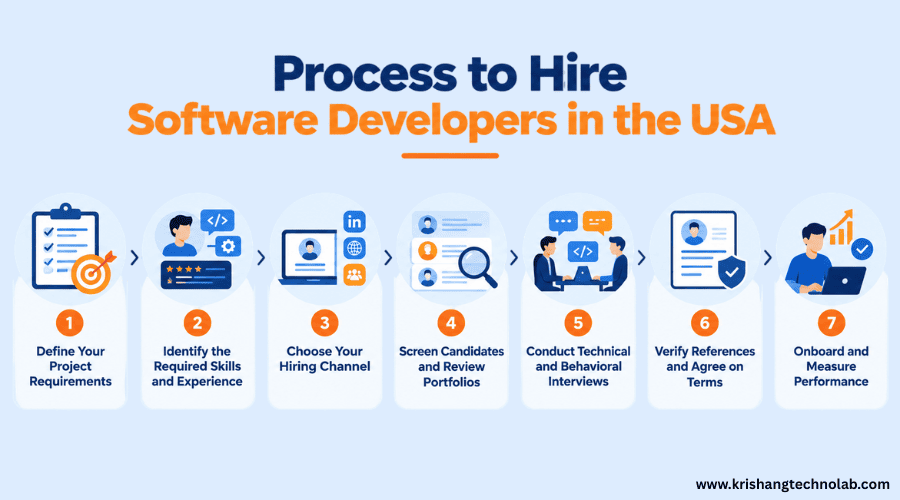
A clear software developer hiring process keeps you fast and fair. Plan for roughly five to seven weeks from job posting to accepted offer for a typical engineering role.
Step 1 — Define Your Project Requirements
Write down project goals, scope, technical requirements, timeline, budget and expected deliverables. Include what success looks like in the first 90 days. Vague requirements are the most common reason hires disappoint, because candidates and managers imagine different jobs. If you need help scoping, software development consulting can turn a rough idea into a clear requirements document.
Step 2 — Identify the Required Skills and Experience
Separate must-have skills from nice-to-have ones. List the programming languages, frameworks, architecture experience and domain knowledge the work genuinely requires, and the seniority level that matches the problem. Over-specifying a long list of tools shrinks your pool without improving quality.
Step 3 — Choose Your Hiring Channel
Compare job boards, referrals, recruiters, freelancers, and development partners against your budget and timeline. If you need someone in two weeks, a staffing partner or contractor is a more realistic option than a direct hire search. If you are building a core team, put money into referrals and targeted outreach.
Step 4 — Screen Candidates and Review Portfolios
Evaluate relevant experience, previous projects, communication skills, and technical fundamentals. A short screening call, a review of code samples or a portfolio, and a few consistent questions help you compare candidates fairly before investing in longer interviews.
Step 5 — Conduct Technical and Behavioral Interviews
Use practical assessments, architecture discussions, problem-solving questions, and collaboration scenarios. Interview questions should reflect the real work. Behavioral questions about disagreements, deadlines, and feedback reveal how someone will function on your team.
Step 6 — Verify References and Agree on Terms
Confirm work history and references where appropriate, then finalize compensation, responsibilities, confidentiality and intellectual property terms in writing. Make sure employment or contractor documents match the actual working relationship. Move promptly: slow offers lose strong candidates.
Step 7 — Onboard and Measure Performance
Provide documentation, access permissions, development tools, milestones, and clear performance expectations before day one. Set a 30-60-90-day plan, assign a point of contact, and review progress regularly. Good onboarding shortens time to first meaningful contribution and improves retention.
How Much Does It Cost to Hire Software Developer in the USA?
If you want to hire software developer in the USA, you can expect to pay a national median salary of about $136,000 for an employee. For a typical freelancer, it’s $82 to $130 per hour. Benefits and recruiting costs not included. (Figures are from BLS wage data (May 2025) and 2026 rate surveys.)
Hiring Cost Breakdown by Model
| Hiring model | Compensation structure | Additional expenses | Best use case |
| Full-time employee | Annual salary plus bonus or equity | Benefits, payroll taxes, equipment, recruiting | Core, long-term product work |
| Freelancer | Hourly or fixed price | Management time, platform fees | Short, well-defined tasks |
| Contract developer | Hourly or monthly rate | Agency markup, term limits | Temporary specialist needs |
| Dedicated team | Monthly team fee | Onboarding, vendor oversight | Ongoing development with limited internal staff |
| Staff augmentation | Hourly rate including provider margin | Internal project management | Extending an in-house team |
| Outsourcing | Fixed price or time-and-materials | Scope changes, QA review | End-to-end project delivery |
Factors That Affect Developer Hiring Costs
The price depends on seniority, specialization, location, remote vs. on-site, industry, company stage, and urgency to hire. Niche skills like machine learning, security, or low-level systems work cost more than common web design. Competitive metro areas pay a premium, while remote-friendly roles allow you to hire in lower-cost areas, often at a rate that is determined by the candidate’s market or your own pay bands.
How to Hire Developers Within Your Budget
- Hire for the skills the project requires now, and avoid paying a senior rate for junior-level work.
- Mix models: a small core team plus contractors for peaks.
- Start with a scoped pilot or MVP before committing to a larger team.
- Consider remote candidates and smaller markets to widen your pool.
- Compare total cost, including management time and rework, not only salary or hourly rate.
Essential Skills to Look for When Hiring Developers
The best developers combine technical depth with judgment and communication. Weigh these seven areas according to the role, since a junior frontend developer and a senior platform engineer need different mixes.
- Languages and frameworks: solid skill in your stack and the ability to pick up related tools. Depth in one stack matters more than a long list of tools.
- Problem-solving: they break vague problems into steps, ask questions and weigh trade-offs. Ask how they handled a hard bug or a failed project.
- Architecture and system design: for mid-level and senior roles, can they design systems that scale, handle failure and stay easy to maintain?
- Testing and code quality: they write tests, review code well and leave code easier to change.
- Communication and teamwork: they explain decisions clearly and disagree respectfully. This matters as much as technical skill.
- Security awareness: they know common vulnerabilities and how to protect sensitive data. This matters most in finance, healthcare and any product holding personal information.
- Adaptability: they keep learning and use new tools, such as AI coding assistants, with judgment rather than blind trust.
Common Challenges When Hire Software Developer in the USA
Most hiring problems are predictable, which means you can plan around them. Each challenge below comes with a practical response.
High Salary Expectations and Recruitment Costs
With a national median near $136,000 and much higher figures in major metros, budgets can be strained quickly.
Solution: define pay bands before you recruit, hire for the level the work requires, widen your search to remote developers, and consider contractors for temporary needs.
Competition for Experienced Technical Talent
Strong engineers are usually employed and receive frequent outreach.
Solution: offer a clear mission, interesting problems, a transparent compensation range and a fast process. Personalized outreach that shows you read their work beats generic messages.
Lengthy Recruitment Processes
Average time-to-hire has risen to around 41 days in the benchmark data cited earlier, and each extra interview round adds delay.
Solution: limit the process to the stages that give real signal, schedule interviews in blocks, and commit to a decision timeline you share with candidates.
Skill Gaps and Mismatched Expectations
A hire may look strong on paper but lack the specific experience your project needs, or expect a different role than the one you have.
Solution: write a precise job description, use realistic work samples, and set clear 30-60-90-day goals during the offer stage.
Retention and Developer Turnover
Losing a developer means losing context and restarting a hiring cycle.
Solution: invest in growth paths, fair pay reviews, manageable on-call load and good tooling, and ask for feedback regularly through one-on-ones.
Remote Collaboration and Project Communication
Distributed teams can drift without shared habits.
Solution: document decisions, agree on overlapping hours, use a single source of truth for tasks, and keep short, regular check-ins that focus on blockers rather than status theater.
US-Based Hiring vs. Offshore Software Development
Neither one is automatically better. Both U.S.-based and offshore teams have their place, depending on the project. The results depend on the expertise of the team, the complexity of the project, the management, and the overall cost, not just the location. A lot of companies run a hybrid, and that’s where searches for software development outsourcing in the USA often lead.
| Factor | US-based developers | Offshore developers |
| Hiring costs | Often higher labor costs | May offer lower labor costs |
| Time zones | Often easier for US teams | Depends on location |
| Talent pool | Access to US-based talent | Access to international talent |
| Management | Easier in-person collaboration when local | Requires clear remote processes |
| Best fit | Local collaboration and market familiarity | Cost flexibility and broader talent access |
Legal and Compliance Considerations When Hiring Developers in the USA
The classification of the worker, the location of the worker, and the way the engagement is structured determine the legal and tax obligations. The points below are a practical checklist, not legal advice; confirm specifics with an employment attorney and a tax professional before you hire.
Employee vs. Independent Contractor Classification
How you classify a developer determines taxes, benefits, overtime rules and liability. Federal agencies and courts look at the real relationship, including how much control you exercise, whether the person works independently, and whether the work is part of your core business. Several states apply stricter tests, so a person you treat as a contractor in one state may legally be an employee in another. Misclassification can lead to back taxes and penalties.
Employment Agreements and Contractor Contracts
Put the relationship in writing. Employment offers should cover title, pay, benefits, at-will or term status, and applicable policies. Contractor agreements should define scope, deliverables, rates, payment terms, termination, and who controls how the work is done.
Confidentiality and Intellectual Property Ownership
Secure a signed confidentiality agreement and an explicit assignment of intellectual property for all work created for you. Do not assume you own code written by a contractor without a written assignment, and clarify how open-source components and pre-existing code are handled. State rules on invention assignment and non-competes vary and are changing, so have counsel review your templates.
Data Security and Privacy Requirements
Determine who has access to production systems and customer data and enforce least-privilege access, device security, and offboarding practices. Depending on your industry and your customers, requirements could include state privacy laws, HIPAA for health data, payment card standards, or customer security questionnaires. Be sure to require contractors and vendors to do the same duties.
Work Authorization and Immigration Considerations, Where Applicable
Employers must complete Form I-9 to verify each employee’s identity and employment authorization. If you want to hire a candidate who needs visa sponsorship, such as an H-1B, the process involves deadlines, filing fees, and eligibility rules, so start early and work with an immigration attorney. Contractors have their own residency and tax-status questions.
Payroll, Tax, and State-Specific Requirements
Employees need payroll withholding, employer payroll taxes, unemployment insurance, workers compensation and compliance with state and local labour laws. Independent contractors are generally paid without withholding, and you may need to collect tax documentation and report payments. Hiring employees in another state means registration and tax duties in that state, so be sure to review the requirements before hiring remote employees across state lines. A payroll provider or employer-of-record service can help simplify this process.
Best Practices for Hiring and Retaining Top Developers
Hiring well is only half the job: the practices that attract strong developers are largely the same ones that keep them.
1. Write Clear and Specific Job Descriptions
State the problem the person will solve, the stack, the team structure, the seniority level and the pay range. Skip inflated requirement lists. Clear descriptions attract better-matched applicants and reduce time spent on poor fits.
2. Keep Interviews Structured and Efficient
Use a consistent set of questions and a shared scorecard, keep the number of rounds low and respect candidates’ time. Tell them upfront what each stage covers and when to expect a decision.
3. Offer Competitive Compensation
Benchmark pay against current market data for the role, level, and location, and be transparent about total compensation, including bonuses, equity, benefits, and flexibility. Underpaying leads to long searches and quick departures.
4. Provide Meaningful Technical Challenges
Developers stay where they can solve interesting problems and see their impact. Give people ownership of real components, a voice in technical decisions, and time to pay down technical debt.
5. Build a Positive Engineering Culture
Support blameless post-mortems, thoughtful code reviews, reasonable hours, and psychological safety. Culture shows up in how mistakes are handled and how decisions are explained.
6. Invest in Professional Development
Offer learning budgets, conference attendance, mentoring, and clear career paths for both individual contributors and managers. Developers who can see growth rarely need to leave to find it.
7. Establish Clear Goals and Feedback Processes
Set measurable goals, hold regular one-on-ones, and give feedback early and specifically. Review compensation and responsibilities on a predictable schedule so people are not forced to negotiate by resigning.
Why Partner With a Software Development Company?
Partnering with a software development company can be faster and lower-risk than assembling a team one hire at a time, particularly when you need several skills at once or lack engineering management capacity.
1. Access to a Ready-Made Team of Specialists
A good partner brings developers, designers, QA engineers and project managers who already work together. You skip months of recruiting and start with people who have solved similar problems.
2. Flexible Team Scaling
Needs change as a product matures. A partner can add a DevOps engineer for a migration, scale down after launch or add testing capacity before a release, without the long-term obligations of permanent hires.
3. Reduced Recruitment and Administrative Work
Sourcing, screening, payroll, equipment and replacement of departing team members are handled by the provider. That frees your leadership to focus on product strategy and customers.
4. Established Development and Quality Assurance Processes
Experienced firms bring tested workflows for planning, code review, automated testing, security checks and release management. Ask to see their documentation and sample reports so you understand how work is tracked.
5. When Outsourcing Is Better Than Direct Hiring
Outsourcing often makes sense when you need to launch within a defined window, when the project has a clear scope, when you need skills you will not need permanently, or when you lack technical leadership to manage engineers. Direct hiring is usually better for your core intellectual property and for work that needs deep, continuing product knowledge. If AI is part of your roadmap, this list of top AI software development companies in the USA shows how providers compare.
How to Choose the Right Software Development Partner
- Relevant experience: case studies and references in your industry and technology
- Transparent pricing: clear rates, change-request handling and what is excluded
- Communication: a named point of contact, overlapping hours and regular demos
- Security and IP terms: written commitments on data handling, access and ownership
- Team stability: how they handle turnover and knowledge transfer
- Trial option: a small paid pilot before a large commitment
If you want to compare hiring models for your own project, Krishang Technolab can help you define scope, assemble a team and start with a short, low-commitment engagement. Share your requirements and we will outline the options, timeline and budget range.
Conclusion — How to Hire the Right Software Developers in the USA
To hire software developer in the USA, work through the same sequence every time:
- Define requirements: goals, scope, skills, timeline and budget.
- Select the hiring model: full-time, freelance, contract, dedicated team, staff augmentation or outsourcing.
- Establish a budget: use current wage data, a median near $136,000 for employees and roughly $82 to $130 per hour for typical freelancers, and add benefits, recruiting and onboarding costs.
- Evaluate candidates: use portfolios, realistic assessments, system design discussions and a shared scorecard.
- Verify contractual details: classification, IP assignment, confidentiality, security and tax requirements.
- Plan onboarding: access, documentation, goals and feedback from day one.
The right answer is rarely the same for two companies, and it can change as your product grows. If you are weighing options for your own project, Krishang Technolab can review your requirements and recommend a hiring approach, team structure and timeline. Contact us to discuss your project.
Found this post helpful? Don't forget to share it with your network!