Quick Overview: Explore how to build startup software product ideas without overspending. This complete blog covers MVP development, hiring, tech stacks, and scaling, answering exactly how to build a software product on a budget so founders can launch lean and grow confidently.
You don’t need a big budget to build a strong product. Many founders believe that they need millions to build startup software product ideas that work. That’s not true. With the right plan, you can build something great while spending less. Most startups are cash-constrained, investor-pressured and facing rising costs for tools and talent. But tight budgets aren’t a weakness. It helps founders focus on what matters, and test ideas before they scale.
Strategic software product development for startups is about data-driven decisions, not guesses. Smart planning beats a large budget every time, since it keeps your startup product development on track without wasted spend. This blog will explore how to plan, build, and launch your product with low-cost software development practices. It includes validation, MVP building, hiring and scaling and gives you a clear startup software development roadmap that is budget-friendly.
What Is a Startup Software Product?
A startup software product is any digital tool, app, or platform that a new company creates to solve a problem for its users. It might be a mobile app, a web platform or a SaaS product development project. Always the same goal: solve a real problem and make money. Understanding this core purpose is the first step in discovering how to build startup software product ideas and software development ideas effectively.
Common Budget Challenges Faced by Startups
There are several financial challenges for startups as they grow:
- Funding rounds are scarce and cash flow is slow.
- Expensive skilled developers.
- Pressure to get it out fast ahead of competition.
- Unexpected costs from scope changes.
- Difficulty predicting startup software development costs in early stages.
Knowing these challenges early helps you to plan better. This way you won’t have any budget surprises. And it makes cost control easier too. So your startup can make smarter money decisions.
Why Smart Planning Matters More Than Large Budgets
A big budget does not guarantee success. Many well-funded startups fail. Because they do the wrong thing. Smart planning is about spending your money on what matters: solving user problems and validating demand. This is the essence of lean startup development.
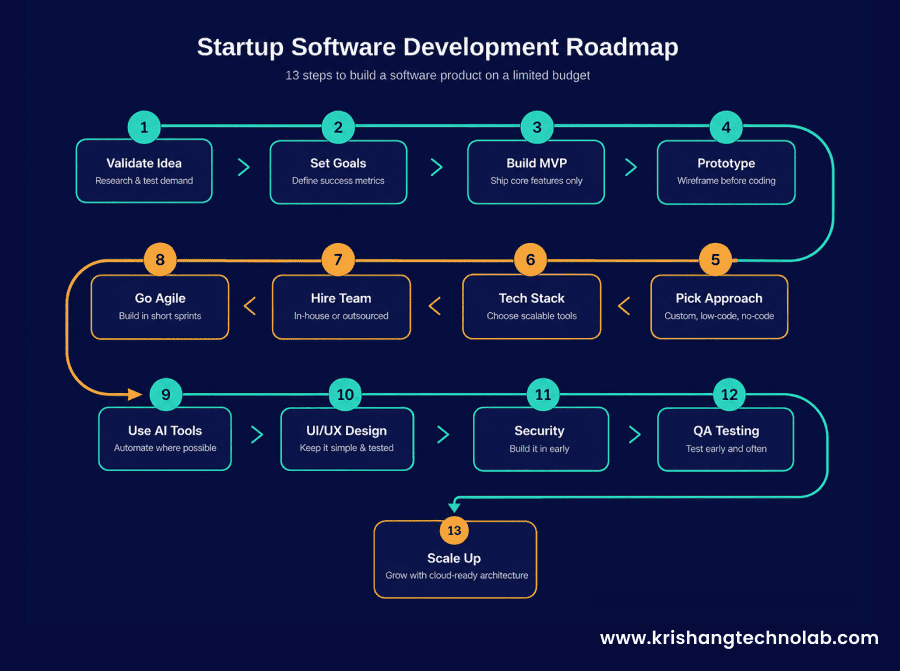
How to Build Startup Software Product Step by Step
This section will take you through the entire process of validating your idea and scaling your product. Follow along to keep costs low and avoid common pitfalls along the way.
1. Validate Your Product Idea Before Development
Prove there is a demand for your product before you write a line of code. This saves time and money. It’s also the first step to learn how to build startup software product ideas that last.
Conduct Market Research and Competitor Analysis
Look at what’s already there. Watch your competitors. Identify gaps in their offerings. This research informs your product strategy and stops you building something already in a crowded market.
Identify Your Target Audience and Pain Points
Know for whom you’re building. What problems do they face on a daily basis? Speak to potential users. And do surveys too. This step is to validate the product. It helps you make sure your product addresses a real problem.
Test Demand Before Investing in Development
Test the gauge with landing pages, advertising or pre-orders. That is a positive signal if people sign up or pay for something before it exists. This approach reduces risk before spending on full MVP development for startups.
Also Read About: How do you validate a startup idea without building a product?
2. Set Clear Goals, Requirements and Success Metrics
Understand your success goals prior to development. Set specific, measurable goals.
For example:
- Number of active users in 90 days
- Customer retention rate after 30 days
- Revenue targets for the first quarter
Write down your core requirements. Keep the list short. Adding each feature adds to the cost and time of the project. Also, well-defined goals help you stay focused on your startup product development roadmap. This helps prevent scope creep. Hence, they are important if you want to build startup software product ideas on a budget.
3. Build a Lean Minimum Viable Product (MVP)
Most founders that want to build startup software product ideas start with a lean MVP. Starting small allows them to test ideas quicker. They can also slash early development costs.
What Is an MVP and Why It Matters
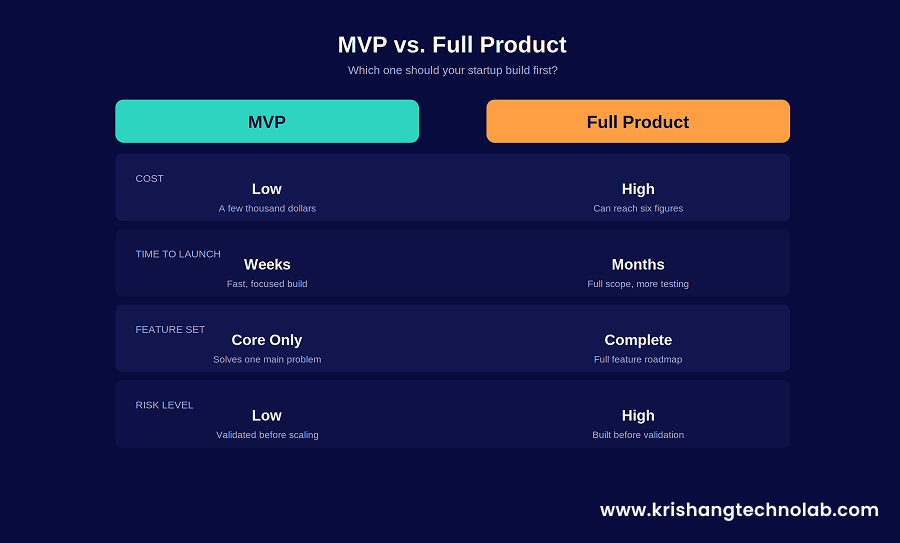
A minimum viable product (MVP) represents the most basic version of a product with essential features. The MVP solves the central problem. It contains just the features users really need. The approach allows startups to get feedback early. That’s the basis of affordable AI MVP development for startups.
Benefits of MVP Development for Startups
Building an MVP first offers several advantages compared to MVP vs full product development.
- Reduced initial development costs
- Time to market faster
- Initial user feedback to help guide future development
- Less risk of producing unwanted features
- Stronger case for startup fundraising
Besides, these benefits help startups to save money. And they save you time too. Plus, teams can find problems early. The product can be improved by analyzing real user feedback.
Also Read About: How do startups approach MVP development?
Focus on Essential Features Only
Don’t add “nice-to-have” features at the first stage. Focus on the features that solve the main problem. That keeps development simple. And it is still efficient. Also, a simple product is easier to test. It’s easier to improve, too. We can expand the feature set at a later stage. When you have real user feedback, you can make better decisions. Overall, it’s a way to reduce risk. It helps grow, too.
4. Create Wireframes and Prototypes Before Coding
Sketch your product before building it. Wireframes show the layout of screens. They also show the journey users take through the product. Prototypes allow users to click through a dummy version of your app.
This process is part of good prototyping. The approach helps teams discover design issues early. This way they can fix problems before they begin coding. That way you avoid costly fixes in code later on. Tools like Figma or Adobe XD make the process quick and affordable. In addition, these tools help teams build startup software product designs that users can easily understand.
5. Choose the Most Cost-Effective Development Approach
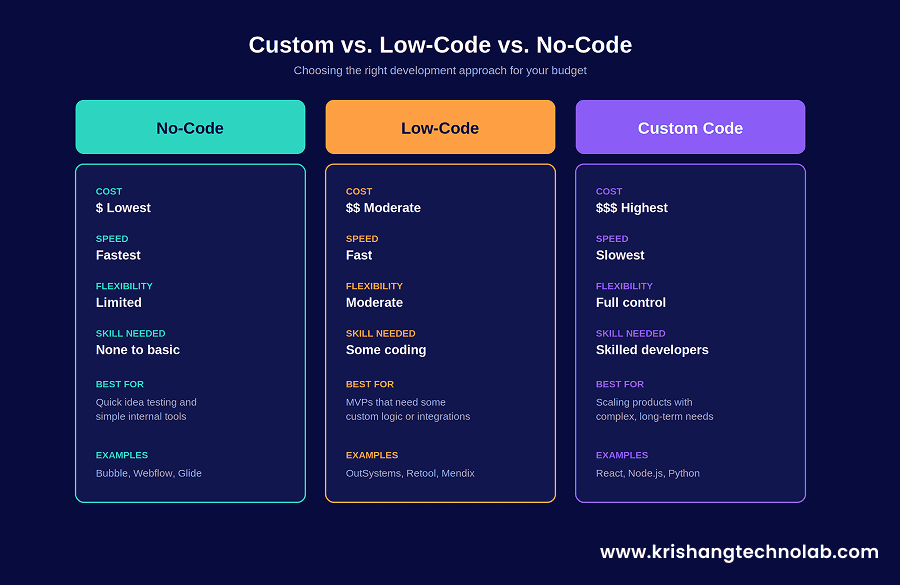
Your budget depends on the way you decide to build startup software product ideas. And your timeline gets affected too. So, it is important to pick the right approach. Choose from custom, no-code or low-code development.
Custom Development vs No-Code Platforms
Custom Development gives you complete control. It gives you flexibility too. However, it is usually more expensive. It might take longer as well. No-code development platforms such as Bubble or Webflow allow you to quickly build simple apps. Coding is not required from your side. Thus, they are a good choice for early-stage testing.
Low-Code Solutions for Faster Deployment
Low-code platforms are in the middle of custom code and no-code tools. They have organs of sight. It accelerates development. At the same time, they allow custom codes when needed. So teams can build faster. They can still retain flexibility.
Balancing Cost, Flexibility, and Scalability
Choose your approach based on your stage. For example, no-code or low-code tools are good for early validation. Once you gain traction, custom development can help to grow. Also, it can enhance startup scalability. In the end, pick the option that fits your goals. It should also meet your budget.
6. Select the Right Technology Stack
Your startup technology stack affects cost. It’s about speed. It is also a growth factor. So make wise choices with your tools.
Technologies may be chosen that are:
- Well-supported with strong documentation
- Easy to find developers for
- Scalable as your user base grows
- Cost-effective to host and maintain
Also Read About: Which AI tech stack should startups use for building scalable startup products?
Most of the teams use React or Vue for the frontend. Furthermore, Node.js or Python is used for the backend. Hosting is often on AWS or Google Cloud. Use tools your team already knows, if possible. It saves you time. It saves training effort as well. Such efficiency leads to lower costs. At the end of the day, it gets easier to build startup software product features. It also scales more rapidly.
7. Hire the Right Development Team Within Budget
The most significant difference is the team you choose. It affects how well you build startup software product ideas. It also affects your budget.
In-House vs Outsourced Development
You have direct control with an in-house team. This also helps with communication. It is more expensive, though. Wages are higher. The cost of outsourcing includes both the benefits and the expense of office space. Outsourcing development work can lead to significant cost savings. It also provides access to talent globally. It needs good communication, though. They also require good project management.
Also Read About: How do startups choose between in-house, remote, and dedicated development teams?
Freelancers vs Development Agencies
Freelancers tend to be cost-effective. They are good for small things. Precise definition is essential for these tasks. Agencies, on the other hand, provide a full dedicated development team for startups. It also provides a broader range of skills and support for project management. Agencies often produce more reliable and complex products. Hence, they offer better accountability.
Evaluating Technical Expertise and Experience
Always look at previous projects. Also check out client feedback. Also, before hiring, check your technical skills. Ask about experiences with similar products. If possible, select a team with a proven track record. A skilled dedicated developer can save money long-term by avoiding costly mistakes. That, in turn, improves product quality and reduces risk.
8. Adopt Agile Development Practices
In agile development, work is divided into small sprints. Sprints typically last for one to two weeks. This enables teams to move quickly on feedback. They can develop a plan and change it fast. It also reduces wasted effort. Keeps the budget under control. This approach is important when you build startup software product features in stages.
Benefits of agile for startups:
- Faster delivery of working features
- Easier to spot problems early
- Easier to fix problems early
- Better alignment between business goals and development work
- More flexibility to change direction if needed
Agile also improves communication in the team. It also makes for clearer work. Thus, teams remain focused on objectives. They are not confusing. Ultimately it mitigates risk and accelerates delivery.
9. Use AI and Automation Tools to Improve Productivity
AI tools are now speeding up coding. They also speed up design and testing work. So the developers can work faster. AI code assistants can help you write codes. They also help review codes. This allows for quicker development. Automated testing tools catch bugs. This saves time. It also saves cost. In summary, AI-powered software development enhances the software development lifecycle. It also helps teams to be more efficient.
10. Focus on User-Centric UI/UX Design
Good design keeps users hooked. Poor design turns users away. This principle is true even if the backend is robust. Thus, UI/UX is crucial. Keep interfaces simple. Make them intuitive. Also, test designs with real users before you build. Strong UI/UX design improves retention. It further lowers expenses related to redesign. As a result, products become more stable over time. Ultimately, better design leads to better user satisfaction.
11. Prioritize Security and Compliance Early
Security issues are an expensive activity to address after launch. So, design security into your product from the ground up.
This includes:
- Secure data storage
- Data encryption
- Proper user authentication
- Compliance with data laws, such as GDPR
- Regular security testing
Every point matters. One of each protects your product.
Fixes for security are cost-effective early on. It is also quicker. It costs a lot more to fix a breach later. So, early security planning reduces risk. Overall it protects the users and the growth of the business.
12. Implement Continuous Testing and Quality Assurance
Test your product continuously. Don’t just test pre-launch. So testing becomes part of the entire process. Automated testing finds bugs early. Manual testing checks for usability. So your product remains more stable. And it reduces costly fixes after release.
Continuous testing also improves product validation. It operates at all stages of the software development lifecycle. Also, user feedback on a regular basis helps you discover hidden problems. Automated tools might overlook these problems. This process is what keeps the quality high in the end. It also saves extra cost.
13. Plan for Scalability From Day One
Scalability doesn’t mean you have to build for millions of users from day one. Rather, it means building your product to scale easily. It should not require a full rebuild later.
Building Flexible Software Architecture
Give your system space to grow. So you don’t have to do a full rebuild later. Use modular code structures. Adding new features is simple.
Cloud Scalability Strategies
Cloud platforms help you scale up or down resources. They react to demand. That way you’re not paying for capacity you’re not using. You’re still prepared for traffic spikes.
Preparing for Future Growth
Look ahead. Don’t overbuild now. Also design an architecture that can support future growth. Don’t overdo the features you don’t need yet. This is ultimately flexible and economical for your system.
Effective Cost Management Strategies for Startup Software Development
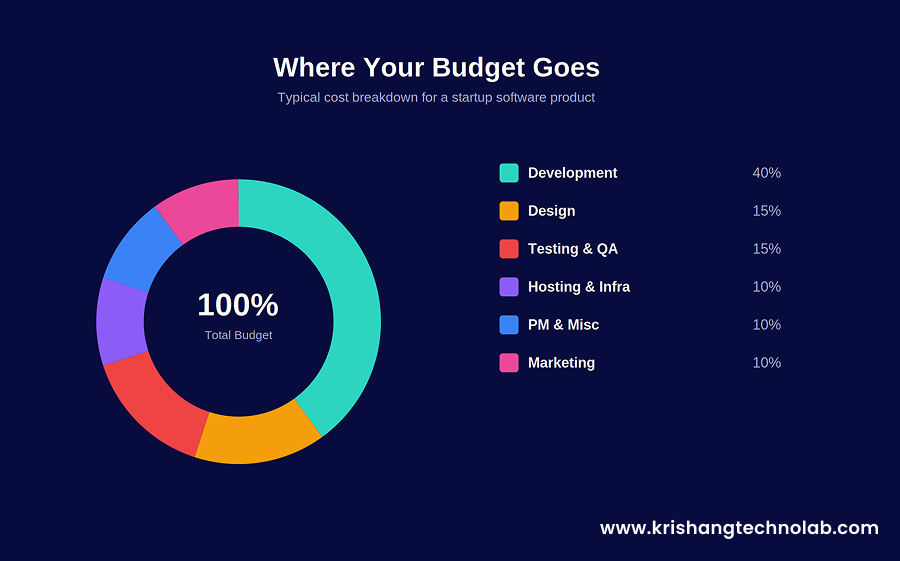
Keep your startup software development costs under control.
So, do the following:
- Build an MVP and then iterate based on real feedback.
- Use open-source tools and libraries when possible.
- Select cloud hosting with pay-as-you-go pricing.
- Outsource non-core tasks to cut overhead.
- Track spending weekly against your budget.
- Stay on your roadmap and don’t let feature creep.
Control cost through these steps. They also help concentration. Also, these cost-effective software development strategies help you to stretch your budget more. They achieve this while maintaining product quality. Whatever way you choose to build startup software product ideas this year, this ultimately applies.
Common Mistakes Startups Make When Building Software Products
Mistakes happen for well-funded teams too. Therefore, they struggle when they try to build startup software product ideas too quickly.
Skipping Market Validation
There are founders who begin building right away. They do this without looking if there is demand. So they spend time and money. They might build a product that no one wants.
Overbuilding Features Too Early
Some teams add too many features prior to launch. Such behaviour increases the cost. It also pushes back release. So they should focus on the core features first.
Choosing the Wrong Technology Stack
Some teams go for hot tools. They disregard practical needs. Consequently, growth slows down. Long-term costs also grow. Instead, choose technology that matches your team’s skills and your product needs.
Ignoring User Feedback
Some teams dismiss early adopters. They don’t receive critical feedback. The product fails to satisfy the user’s needs. And regular feedback loops in the MVP development process keep development aligned with real user needs.
Leveraging Emerging Technologies on a Startup Budget
New technologies make it easier to build startup software product ideas. No need for a large team. This allows startups to move faster and at lower cost.
Artificial Intelligence for Faster Product Development
AI tools accelerate coding. They also accelerate testing. They also enhance customer support. As a result, there is less manual work in the development process for an AI development company.
Cloud Services That Reduce Infrastructure Costs
With cloud hosting, you don’t need to have a physical server. It also brings down setup costs. Pay-as-you-go pricing keeps spending in check. Additionally, costs remain tied to actual usage.
Low-Code and No-Code Tools for Rapid Experimentation
Such tools allow teams to test ideas rapidly. They don’t need a lot of code, using Webflow Web Design, so they are useful for early validation stages.
API Integrations to Extend Product Capabilities
Avoid duplicating efforts for every feature. Instead, use APIs. For example, consider using APIs for payments, messaging, or authentication. So you save on development time. You also cut costs.
Automation Tools That Save Time and Money
Automation does monotonous work. These are test deployment and reporting. Automation also reduces manual efforts. This ultimately allows your team to focus on core product work.
Measuring Product Success After Launch
Once you’ve launched, measure these metrics.
So you can tell if your product is working:
- User retention rate through time
- Daily & Monthly Active Users
- Customer Feedback and Satisfaction
- Revenue growth and conversion rate
- Use feature usage data to inform future updates
Regular tracking helps you get a sense of how products are doing. It also shows what the user does. That way you can adjust your strategy if you need to. Ultimately, this information helps you continue to improve the product.
Building Long-Term Partnerships With Development Experts
As your startup matures, you may require long-term support. Therefore, you need to work with a trusted startup software development company or MVP development services provider. A trusted partner knows what you want to achieve. They also adjust to your changing needs. They also help you to scale your product. You don’t have to start from scratch every time. Find partners who communicate clearly. Also look at their proven experience. Lastly, select partners with flexible engagement models.
Conclusion
It is possible to create a high-quality product with a limited budget. So, getting the right approach is crucial. Begin with validating your idea. Make a lean MVP. Select the right tools and team for your stage. Keep the user feedback in focus. Build only a little. This also keeps your product simple and effective. Outsourcing software development company can provide extra hands if you need them. There is no need for the expense of a full in-house team. Lastly, with smart planning, you can build startup software product ideas that are affordable and effective.
FAQs
How much does it cost to build a startup software product?
Cost varies a lot. They depend on complexity, features and team location. A few thousand dollars can get you an MVP. A fully featured product can cost six figures. Clear requirements are therefore important. They help control costs early on.
What is the low-cost way to build a software product for a startup?
The most affordable approach uses a mix of methods. Includes development of MVP. It also has no-code and low-code tools that can be used for early testing. Outsourcing to skilled freelancers or agencies also helps keep costs down.
Should startups build an MVP first?
Yes. The first should be an MVP. It helps you validate your idea with real users. It reduces risk too. You don’t build features you don’t want. Most experts recommend this approach for creating startup software product ideas from scratch.
How can startups avoid overspending on software development?
Here are a few simple steps that startups can take to manage their spending. Follow a clear roadmap. Start with an MVP. Use open source tools. Opt for cloud hosting. Start with only the necessary features. Therefore, it keeps costs down.
What technology stack is best for a startup on a budget?
The best stack depends on the team’s skills. It also depends on the product needs. Popular budget-friendly choices are React or Vue on the frontend, Node.js or Python on the backend, and cloud platforms with the pay-as-you-go pricing model to help reduce the costs.
How do you know if your startup software product is successful?
Track the key metrics. These include customer feedback, active users, revenue growth and user retention. These numbers steadily improve and that is a sign of product success.
Found this post helpful? Don't forget to share it with your network!