Quick Overview: Custom software helps businesses move beyond one-size-fits-all tools. This guide explains digital transformation in simple terms, then shows six ways tailored software automates work, connects systems, improves customer experience, and scales securely. It also compares custom and off-the-shelf options and explains how to choose the right development partner.
Businesses today are expected to move fast. Customers want instant answers, teams want simple tools, and leaders want clear data. That pressure is why digital transformation in business has become a top priority for companies of every size, and why many are turning to custom software to get there.
The problem is that many companies try to transform using software that was never built for them. Traditional, ready-made tools are designed for the “average” user. As your business grows, adds new products, or changes how it works, those tools often start to feel like a tight pair of shoes.
This is where custom software comes in.Also known as tailor-made software or bespoke software. It’s built around the way your business really operates, instead of making your team fit into a generic product. Custom software solutions can simplify daily tasks, be flexible enough to adapt to change easily, and scale to accommodate more users and data over time. All of this can be achieved with planning ahead.
In this guide you’ll find out what digital transformation really signifies, how custom software helps it, where it applies best and how to begin by selecting the right custom software development services.
Understanding Digital Transformation in Modern Businesses
Digital transformation is the use of digital technology to change business processes and value delivery. It’s not just about getting new computers or putting files online. It is rethinking processes, tools, and customer experiences to be more effective in a digital world.
So why are so many companies throwing money at it? Mainly four reasons:
- Speed: Digital tools remove slow, manual steps.
- Accuracy: Fewer manual entries mean fewer mistakes.
- Customer expectations: People now expect online ordering, tracking, and support.
- Competition: Rivals who modernize first often win customers faster.
Digital business transformation done right has a positive impact on both sides of the business. Less time spent on in-house paperwork, more time spent on valuable work. Externally, customers enjoy faster service and smoother experiences. Custom software is often the engine behind these changes, because it turns a digital strategy into tools your team can actually use.
All of this depends on having the right digital infrastructure. Think of infrastructure as the “plumbing” of your business: databases, cloud hosting, networks, APIs, and the applications that connect them. If the plumbing is outdated or disconnected, even the best digital transformation solutions will struggle. That is why many business digital transformation services begin by looking at the systems a company already has.
Why Custom Software Is Essential for Digital Transformation
Every business has its own way of selling and serving and delivering. Custom software solutions are built around that reality. Here is why they matter so much during a transformation.
- Built for your exact requirements. Ready-made software includes features for everyone, which means you pay for things you never use and still miss things you need. Custom business software development starts with your workflow and creates only what is useful.
- More flexibility. When your process changes, you can change the software. With off-the-shelf products, you usually have to wait for the vendor or work around the limitation.
- Better alignment with business goals. If you want to deliver faster, reduce support costs, or keep your customers for longer, the software can be built to track and improve exactly those things.
- Greater control and efficiency. You decide how data is stored, who can see it, and how systems communicate with each other. That control gets rid of duplication and confusion.
- Long-term value. Custom software development solutions may cost more up front, but you don’t have to pay for recurring license fees for features you don’t need, and you can save on your total cost of ownership (TCO) over time. You also generally own the code as well, which reduces vendor lock-in.
A reliable custom software development company will usually start by studying your goals before writing any code. Enterprise software development services bring another layer of complexity for bigger organizations: thousands of users, strict compliance rules, and complex integrations from day one.
How Custom Software Drives Digital Transformation
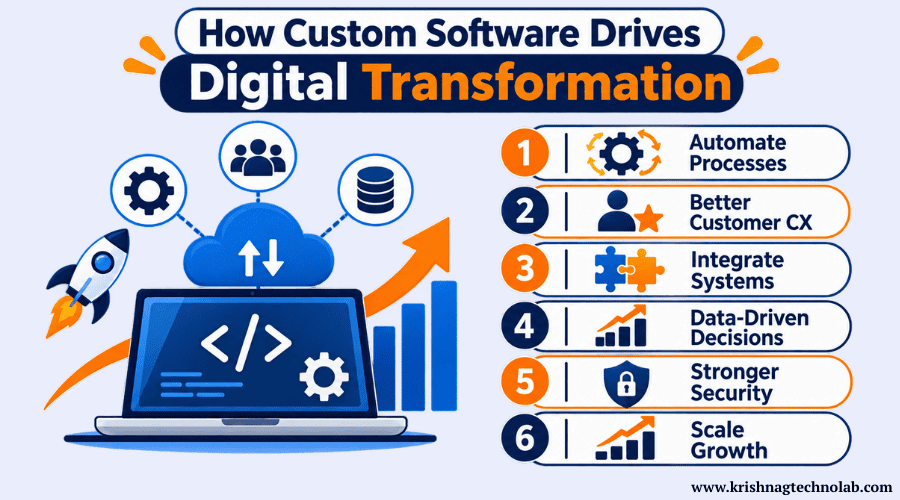
Here are the six main ways custom software turns digital transformation from an idea into real results.
1. Automating Business Processes and Workflows
Many teams are still copying and pasting data between spreadsheets, chasing approvals by email, and re-keying the same information into multiple systems. Business process automation is software that automates these repetitive tasks. A custom workflow automation tool can push an invoice to the right approver, send reminders, and update records without anyone lifting a finger. The result: fewer manual errors, faster turnaround, and a team free to focus on higher-value work. Business automation software development is often the quickest win in a transformation project. Simple RPA (robotic process automation) bots can also handle tasks like moving data between older systems.
2. Improving Customer Experience and Engagement
Your systems are slow or confusing to customers. Custom application development enables you to create customer portals, mobile apps, and customized dashboards that provide people with exactly what they need: order status, billing history, or support tickets. Thoughtful UX design and omnichannel access (same smooth experience on web, mobile, and chat) creates trust. This type of customer experience optimization makes people want to return.
3. Integrating Multiple Business Systems
Most companies run a CRM (customer relationship management), an ERP (enterprise resource planning), accounting software, and inventory tools, often disconnected from one another. Software integration services and smart system integration link them through APIs (application programming interfaces, which let programmes share data). Instead of five separate “islands”, you get one connected flow of information. This also removes data silos, the isolated pockets of information that slow teams down.
4. Enabling Data-Driven Business Decisions
Data-driven decision-making is making decisions based on facts rather than hunches. Custom software development services will provide you with real-time dashboards, auto-generated reports, and dashboards with analytics tailored to your KPIs. These business intelligence solutions help managers see problems earlier and identify opportunities sooner.”
5. Enhancing Business Security and Data Management
Secure custom software development lets you set role-based access (people only see what their job requires), encryption for sensitive data, audit logs, and backup rules that match your industry. Strong data security is not an add-on; it is designed from the start. Custom builds can also support compliance requirements such as GDPR or SOC 2. Enterprise software solutions are often chosen for exactly this reason.
6. Supporting Business Scalability and Growth
Scalable software solutions can handle more customers, more transactions, and more locations without breaking a sweat. Custom business software is built to scale with your plans, so it’s easier and less expensive to add a new product line, region, or team later than to replace the entire system. That’s one of the core strengths of enterprise software development. They are often built with microservices (small, independent pieces). This is a modular design. You can upgrade one feature without having to touch the rest.
Custom Software vs. Off-the-Shelf Software: Which Is Better for Businesses?
There is no single winner. The right choice depends on your needs. Here is a simple comparison.
- Customization and flexibility: Custom software fits your process. Off-the-shelf software offers limited settings.
- Integration: Custom builds connect to the exact tools you use. Ready-made products integrate only with what the vendor supports.
- Scalability and performance: Custom systems are sized for your expected growth. Packaged tools may slow down or require expensive upgrades at scale.
- Cost and maintenance: Off-the-shelf software, often sold as SaaS (software as a service), is cheaper to start and quick to launch. Custom software development cost is higher upfront, but you own the result and avoid per-user licence fees.
- Long-term value: Over several years, custom software often pays back through efficiency gains and fewer workarounds, which shows up as a higher ROI (return on investment).
Bear in mind that when considering custom software development costs, the price depends on the features, number of integrations, security requirements, and team size. A small, focused first version (called an MVP, or minimum viable product) is a common way to control cost while proving value. This is especially true with agile development, where software is built and improved in brief cycles.
Rule of thumb: If your process is standard (e.g., basic email or payroll), off-the-shelf is generally OK. If your process is different or a core part of how you compete, custom software solutions are worth serious consideration.
Industries Benefiting from Custom Software Development
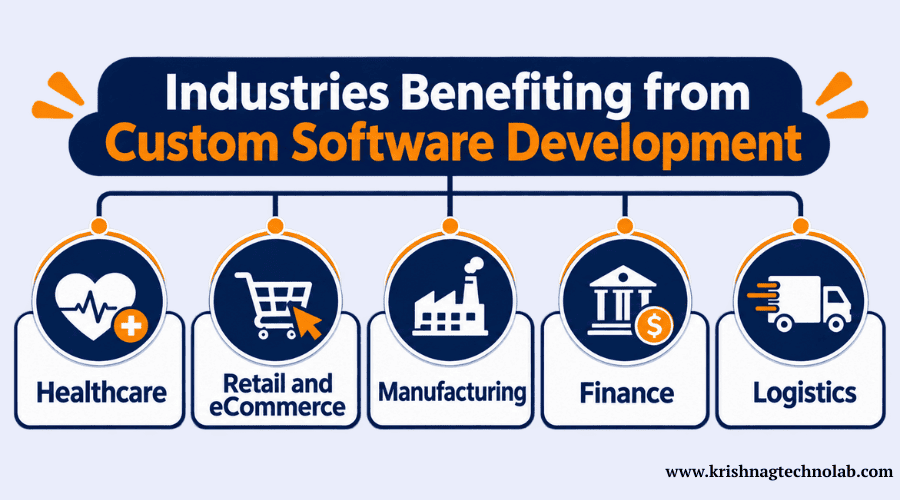
Almost any sector can gain from industry-specific software solutions. Here are five common examples.
Healthcare: Patient management systems, EHR (electronic health record) integrations, appointment scheduling, and automated record handling reduce paperwork and help staff spend more time with patients, while meeting privacy rules such as HIPAA.
Retail and eCommerce: Custom inventory management, POS (point-of-sale) connections, and personalized shopping platforms keep stock accurate and recommend products customers are likely to want.
Manufacturing: Production automation and supply chain tools track materials, machines, and orders in real time, helping reduce delays and waste.
Finance: Financial management platforms and secure transaction systems support accuracy, fraud detection, and regulatory reporting.
Logistics: Fleet management and delivery tracking solutions improve route optimization and give customers live shipment updates.
Read About: AI in Logistics
In each case, custom application development works because it reflects the rules and daily realities of that industry, something generic tools rarely capture fully. Larger enterprises in these fields often rely on enterprise software development services to manage the extra complexity.
Challenges in Digital Transformation and How Custom Software Helps
Transformation projects rarely go perfectly. These are the most common obstacles and how tailored software can address them.
- Legacy system limitations: Old systems are slow, hard to update, and sometimes no longer supported. Over time they also collect technical debt, the hidden cost of old shortcuts. Legacy software modernization rebuilds or upgrades them step by step, so the business keeps running during the change.
- Disconnected applications: When tools do not share data, teams re-enter information and reports disagree. Software integration services connect them into one reliable source of truth.
- Manual operational processes: Paper forms and spreadsheet chains are slow and error-prone. Automation turns them into consistent, trackable workflows.
- Data security concerns: More digital tools can mean more risk. Custom security rules, encryption, and access controls help protect sensitive information.
- Changing business requirements: Markets shift quickly. Software built in modular pieces can be adjusted without starting over.
A clear plan, realistic timelines, and a trusted custom software development partner can make these hurdles far easier to handle. Many digital transformation solutions fail not because of technology, but because of unclear goals, so define success early.
How to Choose the Right Custom Software Development Company
Picking the right team is one of the biggest decisions in your project. Use this checklist when comparing a custom software development company.
- Technical expertise and industry experience: Ask which technologies they use and whether they have worked in your industry. Experienced custom software developers will understand your terms and rules without lengthy explanations.
- Previous projects and client portfolio: Review case studies, references, and reviews. Look for results (time saved, revenue gained), not just screenshots.
- Customization and integration capabilities: Make sure they can connect the new software with your current CRM, ERP, or payment tools.
- Costs and timelines: Request a clear estimate that explains what is included, and ask whether the team starts with a discovery phase (a short planning stage). Confirm who owns the source code and documentation. Be careful with very low quotes; hidden extras can appear later.
- Maintenance and support: Software needs updates, security patches, and bug fixes. Ask what ongoing support looks like, how releases are tested (QA, or quality assurance), and what response times an SLA (service-level agreement) guarantees.
Instead of hunting for the “best custom software development company” in general, aim to find the best fit for your goals: one that communicates clearly, explains choices in plain language, and treats you as a long-term custom software development partner. Good custom software development services should feel collaborative from the first meeting.
The Future of Digital Transformation with Custom Software
Digital transformation technology keeps evolving. These trends are shaping what comes next.
Artificial intelligence and machine learning: AI software development services help systems learn from data, for example, predicting which customers may leave, drafting replies with generative AI, or automatically sorting support requests.
Cloud-based solutions: Cloud software development, including cloud-native design, means applications run on remote servers (such as AWS, Azure, or Google Cloud) instead of in your own office. It makes remote access, updates, and scaling much simpler.
Intelligent process automation: Traditional automation follows fixed rules. The next generation can read documents, understand context, and handle exceptions, expanding what business automation solutions can do.
IoT-powered operations: The Internet of Things connects sensors and devices, so a warehouse, factory, or vehicle can report its status automatically. Edge computing processes that data close to the device, so reactions are faster.
Predictive analytics: Instead of only showing what happened, predictive tools estimate what will probably happen next, helping with inventory planning, maintenance schedules, and demand forecasting.
Together, these technologies make scalable software solutions smarter and more responsive, which is why businesses that build a flexible foundation today will adapt more easily tomorrow.
Build Custom Software with Krishang Technolab
Krishang Technolab is an AI-driven software and app development company with 8+ years of experience, 1,000+ projects delivered, and 250+ customers across 25+ countries. From MVPs to enterprise platforms and AI-powered automation, its team works in agile cycles and builds security into every project, including GDPR, HIPAA, and SOC 2 requirements.
A good example is Platform Circle, where one custom platform replaced five separate project tools and shortened onboarding time. Have a similar idea? You can book a free consultation to talk it through.
Conclusion
One of the most practical ways to make digital transformation real is through custom software. Custom software development translates technology plans into tangible business results by automating workflows, connecting systems, enhancing customer experience, bolstering security, and scaling with growth.
“It is not only the technology; it is the right partner that matters. A good custom software development company will start with your goals, talk through options in plain English, and continue to support the software long after launch.
If you want to modernise your operations, start small: identify your biggest daily bottlenecks and then look into hire professional custom software development services that can help solve them. The right digital transformation solutions can help your business to work faster, serve customers better, and be ready for what’s next.
Found this post helpful? Don't forget to share it with your network!