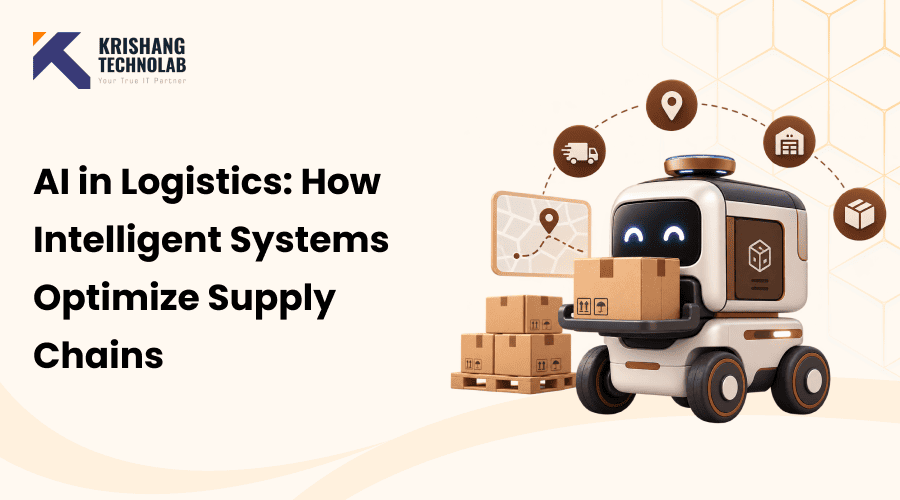
Quick Overview: Discover how AI in logistics transforms supply chain management through demand forecasting, route optimization, warehouse automation, and predictive maintenance. Explore key benefits, real-world applications, implementation challenges, and future trends shaping smarter, faster, and more resilient logistics operations.
AI in logistics is no longer a pilot project; it is an everyday technology. Today, artificial intelligence reads orders, predicts delays, and plans routes in seconds. As a result, shippers now treat AI and logistics as one connected strategy.
Public tools such as ChatGPT and OpenAI models made the technology familiar to every manager. Furthermore, many teams now test an AI chatbot for simple shipment status questions. Similarly, others open an AI chat window to query warehouse data in plain, everyday language.
Meanwhile, AI machine learning models learn from every shipment. They improve forecasts, cut empty miles, and flag risk early. But the results depend on the data being clean and the goals being clear. As a result, smarter planning now starts with better data.
This guide explains how AI for logistics works, where it pays off, and how to start. First, you will see how artificial intelligence in logistics shapes planning and delivery. Next, you will learn how demand forecasting changes inventory decisions. Finally, you will review risks, costs, and trends worth watching closely.
Strong AI in Logistics programs also share one clear, common trait. They link clear business goals with practical tools and skilled people. Therefore, readers will find steps they can apply this very quarter.
What Is AI in Logistics and Supply Chain Management?
AI in logistics and supply chain projects rely on software that studies data and takes action. Experts call artificial intelligence in logistics and supply chain management a form of logistics intelligence. In short, it turns scattered records into clear, timely decisions.
How Intelligent Systems Optimize Supply Chains
Modern AI in supply chain and logistics tools connects data, decisions, and action. For example, a leading AI logistics company builds these links from three layers: live data, forecasting, and automation. Supply chain software connects these layers to improve visibility, streamline workflows, and enable faster, data-driven decisions.
Real-Time Data Analysis and Decision-Making
AI in logistics platforms ingests GPS, sensor, and order data every second. Then AI/ML models powered by ML Development Services score each event and recommend the next action. For instance, a dispatcher sees a delay alert before the customer does.
Predictive Analytics for Smarter Supply Chain Planning
AI and machine learning turn history into forecasts for demand, delays, and costs. Next, artificial intelligence AI tools and AI ML Development Services compare scenarios and rank the best plan. As a result, predictive analytics replaces guesswork in weekly planning.
Intelligent Automation Across Logistics Operations
AI for logistics automates invoices, booking, and dispatch notes. Likewise, AI in warehousing assigns pick tasks and balances labor each hour. AI programming teams write rules that keep each workflow safe and auditable.
Key Applications of AI in Logistics and Supply Chain Optimization
AI in Logistics now covers the whole network. Here, artificial intelligence in logistics appears in eight practical use cases, from forecasting to supplier choice. These innovations help businesses improve efficiency, reduce operational costs, and make smarter, data-driven decisions across supply chains. Supply chain management software integrates these AI-powered applications to streamline operations and improve end-to-end supply chain visibility.
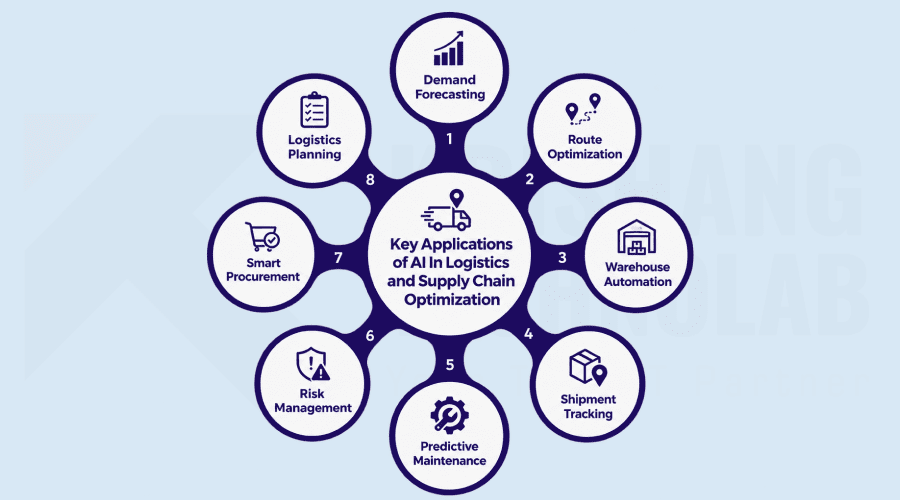
1. AI-Powered Demand Forecasting and Inventory Management
AI in supply chains and logistics begins with reliable demand forecasting. The models look at sales trends, weather, and promotions before setting inventory targets. Meanwhile, AI software engineering teams tune these models so planners can trust each forecast.
2. Intelligent Route Optimization and Transportation Planning
AI in logistics tools runs route optimization across thousands of stops. Next, they weigh traffic, fuel, weather, and delivery windows together. In this way, the AI and logistics planners save miles and meet the promised arrival times.
3. Warehouse Automation and AI-Powered Robotics
Robots now move pallets and pick items in busy fulfillment centers. Computer vision checks every order for errors before it leaves. In addition, AI software developers link warehouse automation to existing systems.
4. Real-Time Shipment Tracking and Visibility
Carrier feeds, GPS pings, and port data are used by AI for logistics systems. As a result, teams gain a clearer picture, so supply chain visibility improves further. Meanwhile, artificial intelligence in logistics predicts arrival times more accurately than static schedules.
5. Predictive Maintenance for Fleet and Logistics Equipment
Predictive maintenance reads engine, tire, and conveyor data to spot wear early. Fleet managers then schedule repairs before a breakdown. In fact, AI solution development for sensor data is a common first project.
6. AI-Driven Supply Chain Risk Management
Every day, AI in logistics and supply chain risk tools reviews news, weather conditions, and supplier records. Also, they flag port strikes, storms, and late vendors early. So teams have to reroute orders before supply chain resilience is impacted.
7. Smart Procurement and Supplier Management
Procurement teams are using AI to compare quotes, score suppliers, and highlight contract risk. “Spend data is already structured. So that’s where AI consultants usually start.” Moreover, dynamic pricing models guide fair freight rates.
8. AI-Powered Logistics Planning and Decision Intelligence
Logistics intelligence dashboards turn raw data into ranked options. A control tower shows cost, speed, and risk for each plan. For example, an AI consultation can map these views to your goals.
Key Benefits of AI in Logistics and Supply Chain Management
Businesses choose AI in logistics since the returns appear fast. Cost, speed, accuracy, and supply chain optimization all improve together. As a result, companies can streamline operations, enhance customer satisfaction, and build more resilient supply chains. SCM software and supply chain software management further strengthen these benefits by integrating AI-driven insights, improving operational visibility, and streamlining supply chain processes.
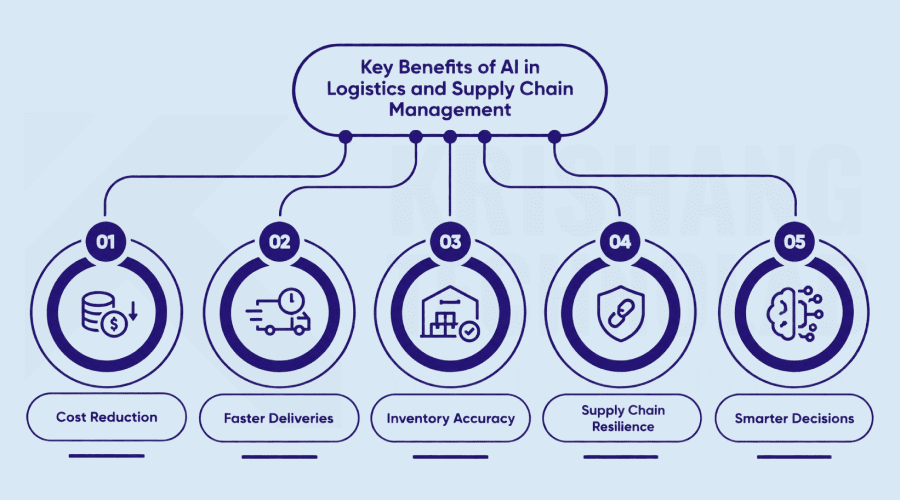
1. Reduced Logistics Costs and Improved Operational Efficiency
Better route optimization, fewer errors, and smarter staffing cut costs across the network. Many shippers buy AI development services to build cost models around their own lanes. Therefore, efficiency gains can appear early.
2. Faster Deliveries and Better Customer Experience
Better route optimization, fewer errors, and smarter staffing cut costs across the network. Many shippers buy AI development services to build cost models around their own lanes and evaluate the artificial intelligence development cost. Therefore, efficiency gains can appear early.
3. Improved Inventory Accuracy and Demand Planning
In addition, inventory counts stay accurate when systems update stock after every scan. AI and logistics teams then match demand planning to real sell-through. As a result, stockouts and excess stock both fall.
4. Greater Supply Chain Visibility and Resilience
AI in supply chain and logistics gives planners a live view of orders and inventory. Teams can test disruptions in a digital twin before they happen. Consequently, networks recover faster after shocks.
5. Data-Driven Decisions and Increased Productivity
Dashboards are the new spreadsheets. Managers can then decide with solid evidence instead of guesswork. An AI software development company can use these dashboards in the daily routine. As a result, artificial intelligence in logistics frees staff for higher-value work.
Real-World Examples of AI in Logistics and Supply Chain Optimization
Real-world results make AI in logistics easier to trust. Amazon and Walmart use AI to predict demand and to make inventory. These applications help businesses maintain optimal stock levels, reduce waste, and respond more effectively to changing customer needs. SCM management software further strengthens these efforts by integrating AI-driven demand forecasting, inventory tracking, and supply chain planning into a unified system.
How Leading Companies Use AI to Improve Logistics Operations
For example, Amazon forecasts demand and places stock near buyers. Walmart applies similar models to store replenishment. Meanwhile, top AI companies sell platforms that smaller carriers can rent. Other AI companies build niche freight tools.
Practical AI Use Cases in Transportation and Warehousing
For example, carriers use route engines, load matching, and automated dock scheduling. Warehouses use robots, vision checks, and dynamic slotting tools. An AI app development company often builds the driver and dispatcher apps.
Challenges of Implementing AI in Logistics
Adopting AI in logistics brings real hurdles. From day one, leaders need to look at data, legacy systems, security, and cost. SCM management software can improve data coordination and streamline logistics workflows. A clear implementation strategy helps businesses address these challenges, integrate AI smoothly, and achieve long-term operational benefits. Meanwhile, supply chain software can strengthen visibility, connect existing systems, and support more efficient supply chain operations.
Data Quality and Integration With Legacy Systems
Old warehouse management systems often store data in mismatched formats. Therefore, clean pipelines come first. AI software engineering teams often spend weeks mapping fields and fixing gaps before any model runs.
Implementation Costs and Return on Investment
First, hardware, software licenses, and skilled talent add up fast. A dependable AI development company should quote a pilot project before anything else. Similarly, an artificial intelligence development company should tie fees to measurable savings.
Data Security, Privacy, and Regulatory Compliance
For example, shipment data contains customer addresses, invoices, and trade information. Before launching, AI consulting companies vet access controls and privacy rules. Top AI consulting services can also conduct compliance gap audits on vendors. Regulators expect clear records.
Workforce Training and Change Management
In practice, staff accept new tools when they understand the benefit. AI strategy consulting can shape a training plan. Moreover, AI consultants coach managers to explain every alert and override. Change takes time and steady communication.
How to Implement AI in Your Logistics and Supply Chain Operations
A clear path moves AI for logistics from pilot to scale. Do these five steps in order. Every step makes it easier to accept artificial intelligence. SCM software helps teams coordinate logistics activities and monitor operational performance. This structured approach helps teams minimize risks, measure results, and expand AI adoption across logistics operations with confidence. Meanwhile, supply chain management software connects essential systems, improves data visibility, and supports informed decisions throughout implementation.
Identify Logistics Bottlenecks and Business Objectives
First, identify the delays, mistakes, and costs that hurt the most. Set one measurable goal for each AI use case. An artificial intelligence consulting firm can hold a short discovery meeting to help them decide which ones are most important.
Assess Data Readiness and Choose the Right AI Solutions
Verify the data quality, quantity, and ownership first. Then pick out the best AI tools for your needs. Request client references from top AI development companies before you decide. Meanwhile, AI consulting firms can audit your data before you buy.
Start With a Pilot Project and Measure Performance
Pick one lane, one warehouse, or one demand forecasting model for the pilot. Then measure cost, accuracy, and speed against a benchmark. A custom AI development company can create a lean prototype within weeks.
Integrate AI With Existing Logistics Systems
Connect the model to your TMS, WMS, and ERP through clean APIs. AI application development services can wrap the model in a simple dispatcher screen. Moreover, an AI application development company should document every data flow.
Monitor Results and Scale AI Adoption
Then analyze monthly results and retrain the models when data shifts. AI development service to update models. Finally, developing AI software in reusable modules makes scaling to new sites faster.
AI in Logistics: Key Technologies Powering Intelligent Supply Chains
Five core technologies power every AI in the logistics project. Each one solves a different part of the planning puzzle. Combined, these tools create one linked machine learning stack. Together, they enable real-time data analysis, smarter forecasting, and automated decision-making across the entire supply chain.
Machine Learning and Predictive Analytics
Models take past sales and backorders and make an educated guess at demand. Artificial intelligence software development is a matter of turning these models into usable tools. Teams often buy AI software development services for tuning and monitoring.
Generative AI and AI Agents
Professional Generative AI drafts customs forms and answers shipper questions. AI agents then act on those answers, such as rebooking a load. Teams compare OpenAI models with in-house tools and solutions from the Best Generative AI Development Company. Still, artificial general intelligence is only a research target for now.
AI Agent Development enables logistics automation across shipment exception handling, carrier coordination, route planning, and inventory updates. AI agents analyze real-time data, prioritize tasks, execute approved actions, and follow defined business rules. Integration with logistics platforms improves workflow accuracy, operational efficiency, and decision-making.
Internet of Things (IoT) and Real-Time Tracking
Sensors on trucks, pallets, and containers stream location and temperature. AI in warehousing uses the same feeds to track every pallet. As a result, AI in logistics teams react to exceptions within minutes.
Computer Vision and Autonomous Robotics
Computer vision reads labels, spots damage, and guides robots through aisles. Many AI software development companies now offer vision kits for warehouses. Some firms also develop AI software that lets robots learn new layouts.
Digital Twins and Intelligent Supply Chain Control Towers
A digital twin copies your network in software. Planners test new routes and stock rules without real risk. Artificial intelligence consulting services can scope the right twin for your size. Even a short AI consultation reveals quick wins.
The Future of AI in Logistics and Intelligent Supply Chains
Over the next decade, AI in logistics will move from advice to action. Agentic AI will lead a large share of this shift, supported by AI in Software Development to build smarter, more autonomous logistics solutions. Leaders should prepare now.
Autonomous Transportation and Smart Warehouses
Autonomous vehicles and drones will handle long, repetitive legs. AI and logistics planners will manage fleets from control screens. Meanwhile, smart warehouses will run most picking with little human travel.
Agentic AI and Autonomous Supply Chain Decisions
Also, agentic systems will negotiate rates, rebook loads, and reorder stock on their own. AI consulting companies already design guardrails and approval rules for these agents. Moreover, an AI development company will tune each agent to local rules throughout the AI Development Lifecycle.
Predictive, Adaptive, and Self-Optimizing Supply Chains
Networks will adjust plans every hour as new data arrives. The best AI development companies will deliver models that retrain themselves. At the same time, artificial intelligence development companies will compete on safety and transparency.
Sustainable Logistics Through AI-Powered Optimization
Shorter routes and fuller trucks cut fuel and emissions. Artificial intelligence consulting companies now track carbon per shipment for clients. In addition, AI/ML models plan load sharing and greener modes.
Conclusion: Building Smarter and More Resilient Supply Chains With AI
AI in Logistics now decides how goods move, wait, and arrive. The strongest results come from clear goals, clean data, and steady measurement. Therefore, start with one problem and prove value fast. Every shipment, scan, and signal can become useful data.
How early action teams benefit from AI in supply chain and logistics. Forecasting, routing, warehouse robots, and tracking each delivery gains alone. Together, they build a network that learns every day. However, tools alone never fix broken processes or unclear ownership.
Partners matter as much as models. A skilled artificial intelligence development company designs the data flow and the interface. An AI software development company then builds, tests, and maintains the tools. Meanwhile, AI software engineering ensures stability in every release.
Strategy also requires outside eyes. Trusted AI consulting companies challenge assumptions and create practical AI and logistics roadmaps. They also teach managers to challenge every output from a model. Strong governance also protects customers and brand trust over time.
Supply chains of the future will sense, decide, and adapt. Today’s AI in logistics leaders will be the pace-setters. Choose one pilot this month, measure it, and scale what works. Start small, learn quickly, and keep improving every month.
Frequently Asked Questions About AI in Logistics
How Is AI Used in Logistics?
AI finds the best delivery routes, predicts demand, runs warehouse robots, and tracks shipments. It also automates the paperwork and identifies risks in practice. Solid AI software engineering is the basis of strong artificial intelligence in logistics projects.
How Does AI Optimize Supply Chains?
It reads live data, predicts what happens next, and picks the best action. AI in supply chains and logistics therefore cuts delays and waste. Artificial intelligence software development teams package these models, often through an AI software development company.
What Are the Main Benefits of AI in Logistics?
The main advantages are lower cost, faster delivery, better accuracy, and improved visibility. Buyers also often add AI development services to tailor models to their lanes. An artificial intelligence development company can also train staff on new workflows.
Can AI Reduce Transportation and Warehouse Costs?
Yeah. Predictions of stock surplus reductions More efficient means of fuel saving: Continuous AI software engineering sustains models’ accuracy over time. They can also be fine-tuned by a trusted AI development company offering ongoing AI development services.
What Are the Biggest Challenges of AI Adoption in Logistics?
Poor data, high costs, security risks, and skill gaps are at the top of the list. AI consultants can map these risks early. Teams should compare the best AI development companies first. Then they should pick an AI development company with logistics references.
What Is the Future of AI in Supply Chain Management?
Expect autonomous agents, self-correcting plans, and greener networks. Firms will rely on artificial intelligence software development to build these tools. A strong AI software development company will deliver them faster. A capable artificial intelligence development company will keep them safe.
Found this post helpful? Don't forget to share it with your network!