Quick Overview: Explore the key differences in MVP vs full product and discover how startups can validate ideas, reduce development risks, and achieve product-market fit. This guide covers costs, timelines, benefits, challenges, and how to move from MVP to a full product using proven growth strategies.
Your choice of whether to build an MVP or a full product is one of the most important ones you’ll make when you start a business. This is a tough decision for many founders who want to impress users, attract investors and gain traction in the market as quickly as possible. But too much building too early can be a waste of time, money and resources.
The truth is most successful startups start small. They test their ideas, receive feedback from users and progress from Minimum Viable Product (MVP) to final product. Knowing the key distinctions between an MVP vs full product helps founders to make smarter decisions and avoid costly mistakes.
In this blog, we will discuss the major differences between MVP vs full product, when to opt for each of the approaches, and how to successfully transition from MVP to a full product.
What Is an MVP (Minimum Viable Product)?
The smallest form of a product is called the Minimum Viable Product (MVP). It adds value to users. They also enable founders to test key assumptions.
It is not about perfection.
Rather, the goal is to achieve:
- Customer verification
- Gauging real market interest early
- Early adoption
- User feedback and iteration
- More rapid learning cycles
This MVP definition for startups is based on Lean startup methodology. In other words, startups learn first and scale later.
Also Read About: What is the MVP development process?
Key Characteristics of an MVP
Typically, a successful MVP has:
- Essential features only
- Solving one main problem extremely effectively
- Fast deployment
- Feedback collection mechanisms
- Basic analytics tracking
Furthermore, several startups prefer to hire a well-experienced MVP development company. That way they can get off the mark quicker. They also help keep the product high quality.
Why Startups Build MVPs
Research in the startup industry indicates that many startups fail. And such failures often happen when they build products that don’t solve a real customer problem.
But an MVP helps reduce that risk. Teams can test demand earlier. That way they can avoid high costs.
Benefits are:
- Cutting development expenses effectively
- Faster launch
- Deeper understanding of customer needs
- Improved product-market fit
- Reduced business risk
And an MVP helps teams find out what users want. Additionally, MVP development for startups helps you make better decisions about which products to develop. It allows teams to improve the product over time. This is why MVPs are an important part of any early-stage startup product strategy.
What Is a Full Product?
A full product is a solution ready to go. It is designed to grow, to scale and to meet larger customer requirements over time.
A full product, unlike an MVP, includes:
- Advanced features
- Refined user experiences
- Enterprise-grade security
- Scalability infrastructure
- Effortless system integration
- Customer support capabilities
The difference is obvious when you talk about building a full product vs MVP. MVP is about validation. A full product is about scale and optimization.
Also Read About: What is custom software development?
Characteristics of a Full Product
A complete product typically contains:
- Comprehensive functionality
- Product scalability
- High-performance architecture
- Multiple user workflows
- Smart workflow automation
- Analytics and reporting
- Security and compliance features
Those capabilities also allow teams to support more users. They also enhance product performance and reliability. Thus, these factors are important in today’s software product development environments.
What Is the Difference Between an MVP and a Full Product?
It is important to understand the differences between MVP vs full product before making investment decisions. In other words, the choice can affect cost, risk and growth.
| Factor | MVP | Full Product |
| Cost | Low initial development investment | High development cost |
| Timeline | Fast launch (weeks or months) | Longer build cycle |
| Risk | Lower financial risk due to validation | Higher upfront risk |
| Scalability | Limited scalability initially | Designed for scale |
| Technical Debt | Often introduces temporary shortcuts | More structured architecture |
| Investor Perception | Shows learning velocity and validation | Demonstrates execution capability |
| Engineering Complexity | Lean development teams | Larger engineering scope |
Cost Difference Between MVP and Full Product
One of the major considerations is the cost differential between MVP and full product.
A typical MVP can cost so much less. This difference is because teams only look at the essential functionality.
But a full product requires investment in:
- System Design & Architecture
- Data Protection & Security
- Performance & Scalability
- Testing & Quality Assurance
- IT Infrastructure Management
- Continuous Maintenance & Support
Such work can often mean higher development costs. The product, however, is better placed to grow.
If you’re a company with a small budget, it’s usually best to start with an MVP. This is a path that many founders take first.
MVP vs Full Product Timeline for Startups
The MVP vs full product timeline for startups can be all over the place.
Typical MVP time line:
- 4-12 weeks
Typical full product timeline:
- 6 to 18 months and may extend further
On the flip side, the shorter MVP timeline helps teams move fast. It also allows founders to test their assumptions sooner. So they can start gathering real data and feedback from the users.
Should a Startup Build an MVP or Full Product?
A very common question from founders is:
Should founders build an MVP or full product first?
For most start-ups, the answer is simple:
Begin with an MVP. That’s why.
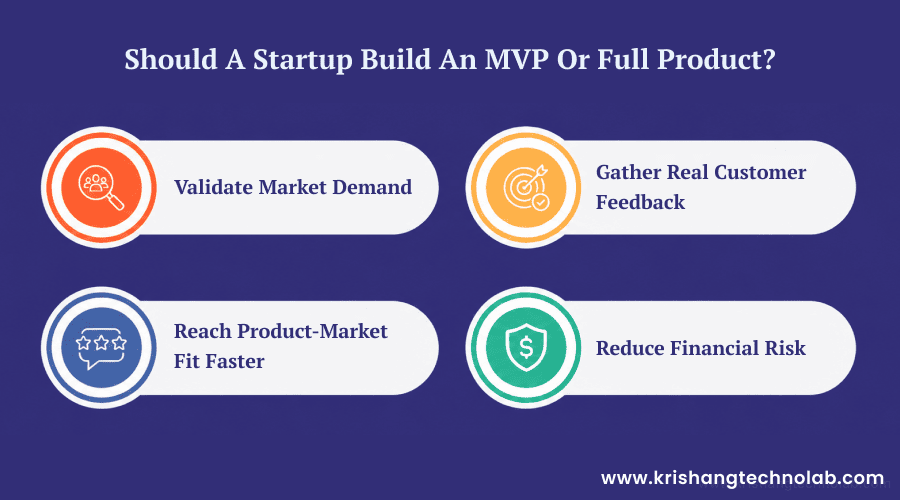
1. Validate Market Demand
Many startup failures occur because founders assume customers want a solution. But too often they don’t validate demand first.
Launching an MVP gives teams the ability to test assumptions quickly. This way the founders can find out what the market really wants.
Moreover, many founders use special startup MVP services to speed up this validation.
2. Reach Product-Market Fit Faster
The first thing you need to get to is product-market fit. However, often building too many features before validating demand delays learning. Therefore, startups should focus on early demand testing.
3. Gather Real Customer Feedback
Customer assumptions are typically incorrect.
But feedback from users and iteration allow founders to make better decisions. And they give you real insight into user behavior.
Founder iteration and user feedback give founders an understanding:
- Feature priorities
- Customer pain points
- Retention drivers
- Pricing opportunities
4. Reduce Financial Risk
Over-investing before validation is an unnecessary exposure. Instead, an MVP minimizes risk and maximizes learning. This also helps startups to make informed decisions before bigger investments.
What Are the Risks of Building a Full Product Too Early?
There are plenty of founders who don’t understand the risks of launching too early with a full product. But these risks can affect growth, cost, and success.
Common risks include:
Wasted Development Budget
Customers do not require some features. These features are expensive. That’s time and money wasted for teams. Money for extra features could improve the core product. That dampens early efficiency. Poor spending can also result in funding issues in the future. This too can lead to startups burning cash more quickly.
Delayed Market Entry
It takes a long time to develop. Rivals can grow in size during this period. Startups can miss market opportunities. Customer needs also can change. The product could be inappropriate for the market. Late launch can also diminish visibility. This situation makes it harder to attract users.
Poor Product-Market Fit
Teams develop the wrong product without user testing. It might not fit real needs. Weak growth could be a sign of lack of interest from users. That affects revenue. Product fit can be costly to correct after launch. It could be a big change.
Increased Technical Complexity
More features mean more parts in the system. This complexity adds to the work. And it makes future upgrades harder. Complex systems require more people. This adds to the cost. Testing is also getting tougher. And so releases would slow down.
That’s why many startups prefer to use an MVP development agency instead of developing a full product too early.
How Do You Go From MVP to a Full Product?
Moving from MVP to a full product demands a disciplined strategy. You take it one step at a time, really. So each level should be about learning, improving and scaling. That means the growth is steadier and more predictable.
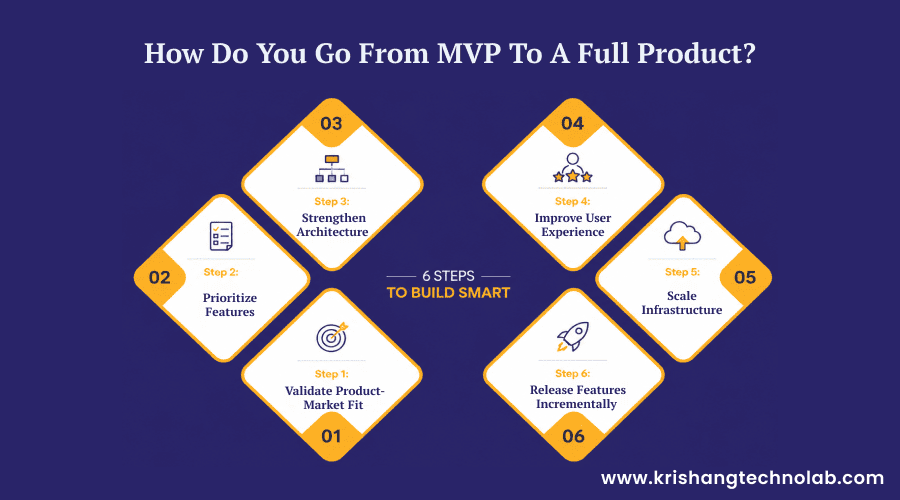
Step 1: Validate Product-Market Fit
Before you go adding more features, make sure people are using your product. Make sure people are using it first. And this step is crucial, since it demonstrates true demand.
Metrics to measure:
- Client Retention Strategies
- Improving the overall customer journey
- Revenue growth
- Referral rates
Step 2: Prioritize Features
Good feature prioritization makes it easier. Then select just the most relevant features. This allows a simple product. It also saves cost and effort. And drive real business value.
Concentrate only on:
- Frequently requested features
- Revenue-driving capabilities
- Improving Customer Retention
Step 3: Strengthen Architecture
Early MVPs are about speed. But they’re not ready for scale. The system needs to improve with usage. That’s why upgrades are necessary.
The system also needs to be stable. It should also be able to support more users without failure.
Startups can reinvent systems for sustainable growth by partnering with an expert MVP company that also helps hire a dedicated development team for a startup.
Step 4: Improve User Experience
With the product maturing, user expectations increase. Users also want to use it faster and smoother. This is why UX becomes so important.
Therefore, improvements must be ongoing.
Invest in:
- Designing intuitive and engaging user interfaces
- Performance optimization
- Accessibility
- Mobile responsiveness
Step 5: Scale Infrastructure
Scaling an MVP into a full product takes some planning. Then the systems will develop slowly. That reduces risk. The shift toward monolith vs microservices architecture influences how the product grows and handles complexity.
It also adds stability.
This includes:
- Cloud optimization
- Monitoring systems
- Strengthening system protection and data safety
- Database scalability
Step 6: Release Features Incrementally
No major releases. Instead, roll out updates incrementally. That reduces risk. It improves control too.
And teams also learn faster from users.
Gradual releases enable teams to:
- Test assumptions
- Reduce risk
- Tracking and analyzing system performance
- Gather feedback
This is often considered a best practice in the MVP to full product development process.
From MVP to a Full Product Roadmap
The transition from MVP to a full product is very clear.
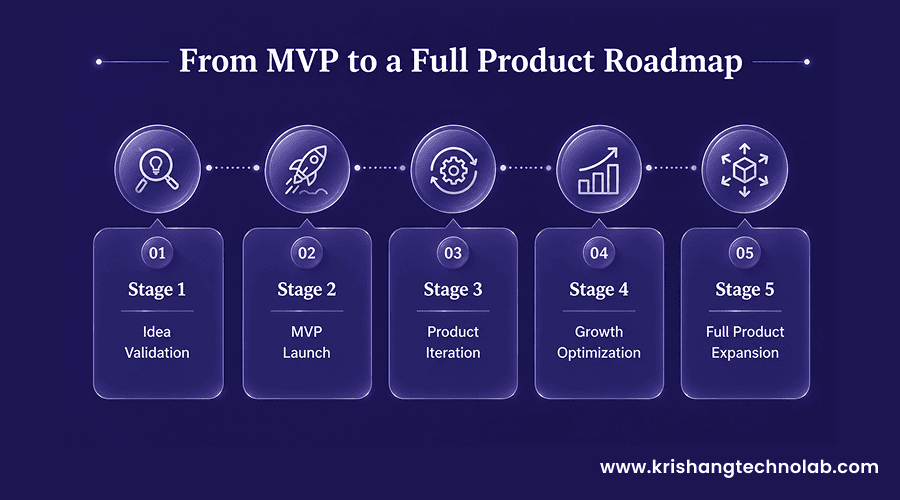
Stage 1: Idea Validation
Goal:
Confirm market demand.
The founders begin by seeking a real problem to solve. Then they speak with customers. Then they interview. They also learn about competition. Also, they do surveys and market research. These steps help test software development ideas early. This process helps teams to save time and money. The risk decreases and the odds of product success increase.
Stage 2: MVP Launch
Goal:
Collect customer feedback.
Then teams release the MVP. It offers just core features. These features solve the big problem. Then teams gather real feedback. They also watch user behavior. At the same time, they can see how customers are using the product. They also learn what the users need the most. So they know what to do next.
Stage 3: Product Iteration
Goal:
Improve based on user behavior.
Teams then go over analytics and feedback. They pay very close attention to what users do. Bugs are fixed fast. They also slowly enhance usability. Then they improve key features over time. Every update improves the product. Updates happen often. As a result, the product stays aligned with real user needs.
Stage 4: Growth Optimization
Goal:
Improve retention and monetization.
Then teams focus on retention. They’re trying to keep users hooked. They also make for better onboarding so new users can get started easily. They also experiment with pricing models. It change revenue strategies. They use data to track growth. They then often review the data. Thus, they discover new opportunities to improve.
Stage 5: Full Product Expansion
Goal:
Scale infrastructure and feature offerings.
The product is finally expanded after much validation and growth. Teams add new features. They enhance the system performance. They also improve scalability. They’re also more secure. They also provide integrations with other tools. Companies move into new markets. They also help you reach more people. Therefore, it is scalable for large-scale use.
This structured approach from MVP to a full product roadmap mitigates risk and supports growth. First, teams move step by step. Then they make decisions more definite. Finally, they make better use of resources. All of these factors contribute positively to long-term success.
Also Read About: What AI tech stack helps startups scale efficiently?
MVP vs Full Product Examples
Real-world success stories offer insightful perspectives on the MVP vs full product journey. These companies test their demand early. They also gather customer feedback. Then they build up incrementally into global products.
Uber (The Concierge MVP)
Uber started out as a simple concierge MVP called UberCab before it became a global ride-sharing platform. It worked in a town. Users ordered rides through a simple mobile app. At the same time, many operations were still running manually in the background.
- The MVP: An MVP that linked a handful of drivers with riders in San Francisco. A good deal of the work was also done by hand by the team. For instance, they did driver onboarding and ride coordination.
- The Full Product: A global transport platform that connects riders in real time. It also offers dynamic pricing and route optimisation. It also gives driver and rider ratings. They also provide multiple ride types, food delivery and freight services. It also applies advanced analytics. Today it’s in hundreds of cities around the world.
This “Concierge MVP” method allowed Uber to test the demand for on-demand transport. It also kept them from developing big systems too soon. And they could grow more easily.
Amazon (The Unbundled MVP)
Amazon wasn’t always the store for everything. Jeff Bezos, instead, focused solely on books. This helped test whether people would buy online.
- The MVP: A stripped-back online bookshop selling a few books. The website could take basic orders. It also made the operations easier. This helped Amazon test demand for e-commerce. It also didn’t have to deal with a lot of inventory up front.
- The Full Product: A global e-commerce platform with millions of products. The platform also includes Prime membership and allows third-party sellers to participate. It sells cloud services and AI recommendations. It also supports fast deliveries, logistic networks, streaming and personalisation tools.
This “unbundled MVP” approach helped Amazon prove its online retail first. Then it grew to cover many product categories. So it became a global market.
Groupon (The Frankenstein MVP)
Groupon only built the challenging stuff after testing demand.
- The MVP: A stripped-down WordPress blog. The team manually posted daily deals. They also created PDF coupons with a database tool. Then they sent the PDF coupons using email tools.
- The Full Product: A worldwide deal site with local deals. It also features mobile coupon scanning and merchant dashboards. It also offers push notifications and automated deal systems.
It was early on and didn’t build complex software; it built simple tools. This allowed them to test demand quickly. As a result, Groupon scaled its operations to become a global platform.
These examples show how startups move from minimum viable product (MVP) to a full product through steady improvement.
Best Practices for MVP to Full Product Development
There are few principles to successful startups:
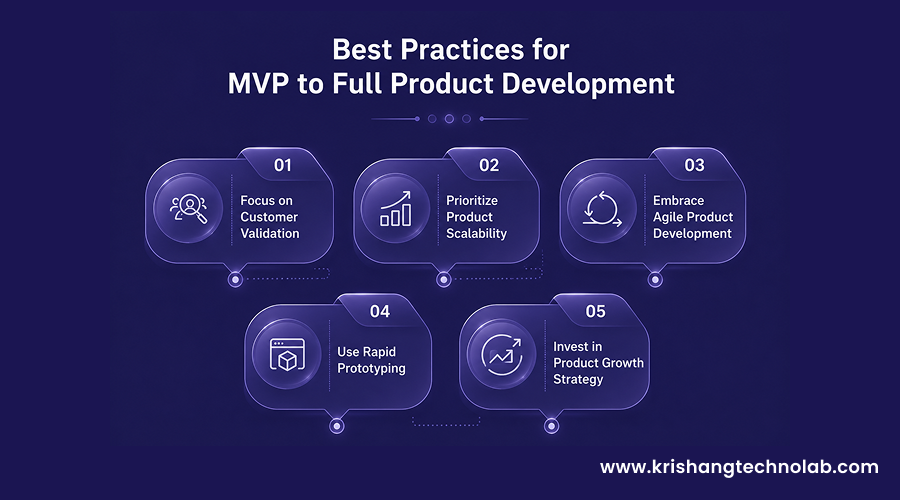
Focus on Customer Validation
Build what the customer needs, not what the founders think they need. Communicate early with your users. Speak to them often. You can also use comments to find real problems. This lowers risk. It also enhances product market fit. It also helps you stay in touch with user needs.
Prioritize Product Scalability
Design scalable systems that don’t need to be rebuilt. Choose a flexible architecture. Keep the code structure clean. Design for more users, features and data from the start, too. So the product can grow easily with increasing demand.
Embrace Agile Product Development
Short feedback loops improve decision-making. Teams should push incremental updates. Each release should, for example, test one change at a time. It also helps to get things fixed quickly. That means teams can respond to user needs immediately.
Use Rapid Prototyping
Test ideas before you put a lot of development into them. Begin with simple prototypes. Use them to explore ideas quickly. Also, this approach helps teams to learn fast. It also helps to reduce waste. This method leads to improved product direction earlier in the process.
Invest in Product Growth Strategy
Don’t plan growth post-launch. Plan growth with development. Get users early. Make that a priority. Also work on retention and monetization. Also, a clear strategy makes it easier to scale on a sustainable basis. This means more stability and predictability over time.
Many companies hire a Professional MVP agency to facilitate the transition from MVP to scale.
Also Read About: What is AI-powered software development for startups?
Can an MVP Become a Full Product?
Absolutely.
That’s how most successful startups start, actually.
The process of taking an MVP to a full product allows founders to:
- Analyze market needs and customer preferences
- Minimize potential risks
- Protect available funds
- Improve customer satisfaction
- Build sustainable growth
Airbnb, Dropbox, Uber are the examples of how a simple MVP can become a globally recognised platform.
Conclusion
The question of MVP vs full product is ultimately a question of risk versus validation.
For most startups, it’s smarter to launch an MVP first.
An MVP allows:
- Validate and confirm customer information
- Faster launches
- Lower costs
- Better product-market fit
- Reduced business risk
Once the demand is proven, founders can begin transitioning from MVP to a full product using real customer data, not assumptions.
Validation is the most successful path, followed by expansion, whether you are working with an internal team, an MVP development company during the validation stage, an expert MVP company to strengthen product architecture, or a professional MVP agency to support growth and scaling.
The road from MVP to a full product is not about building everything at once. The right thing to do at the right time is important.
Frequently Asked Questions
What is the difference between an MVP and a full product?
An MVP consists only of the core features. It is used to test and validate an idea on the market. The full product has advanced features. It is also more scalable and has a slicker user experience.
Should founders build an MVP or Full Product first?
Most startups should begin with an MVP. It provides upfront validation of demand. They reduces risk, too. It allows founders to collect user feedback before building a full product.
How do you go from MVP to a full product?
Start with the user feedback. Find out what users really want. Then rank key features. Improve the system in small increments. Then work out the product to create a more complete solution.
When should founders transition from MVP to a full product?
Once you get to product market fit, founders should move aside. This stage is when the user clearly wants the product. This phase is also when demand settles down. This phase is where scale begins to matter.
How much does it cost to build an MVP vs Full Product?
An MVP is cheaper because it offers fewer features. It only discusses validation. The full product costs more. It needs more work for development. It needs better scalability, and more features.
Can an MVP become a full product?
Yes, an MVP can be a full product. This is how several successful companies start. They iterate on the product over time. They add features that users ask for.
Found this post helpful? Don't forget to share it with your network!