Quick Overview: Choosing the right MVP Tech Stack is essential for building scalable, cost-effective, and high-performing products. This blog explains the key components of an MVP technology stack, explores the best frontend, backend, database, mobile, and cloud technologies, highlights common selection mistakes, and shares practical tips for choosing a future-ready stack for long-term success.
Choosing the correct Tech Stack is one of the most crucial decisions when creating a successful MVP. The technologies you select define the development speed, application performance, scalability, maintenance, and long-term growth of your business. A well-planned MVP Tech Stack enables startups to accelerate product launches, control development costs, and respond to changing market demands without creating technical debt. Whether it is Startup MVP Development or AI MVP Development, selecting the right technologies helps businesses build flexible, scalable, and future-ready products that can evolve with customer needs.
Choosing the right MVP Tech Stack is the cornerstone of future success, whether you are building a SaaS platform, mobile application, or web solution. The right tech stack for MVP development helps startups create scalable, cost-effective, and future-ready digital products while improving performance, flexibility, and long-term growth. This guide explores the best MVP Development Services, the key factors to consider when selecting an MVP Technology Stack, and how businesses can choose a scalable MVP Tech Stack that aligns with their product goals and development requirements.
What Does a MVP Tech Stack Mean in Development?
In simple terms, a technology stack is a combination of tools and technologies used to develop and operate an application, including programming languages, frameworks, databases, cloud services, and development tools. It helps startups build their core product faster, optimize development resources, and prepare for future growth. A well-planned software development stack creates a strong foundation for better performance, easier upgrades, and smooth changes as business needs evolve, especially in custom web application development where flexibility, scalability, and maintainability are essential for long-term success. Understanding What is Custom Software Development? helps businesses identify how tailored software solutions can support unique requirements and create scalable digital products.
Why Choosing the Right MVP Tech Stack Matters for Success
In addition, the best MVP development strategy is one where the selected technologies help validate the product in real-time and support future business growth. Choosing the right partner, such as an experienced MVP development company, can help startups select suitable technologies, reduce development risks, and build products that are ready for market validation.
Choosing the wrong technology can increase development costs, delay product launches, and create long-term maintenance challenges. By adopting scalable technology solutions, startups can move faster, collect valuable user feedback, and continuously improve their products with confidence.
Faster Product Development
To begin with, a good tech stack helps startups build products faster by using modular components, reliable frameworks, and efficient development tools. The best tech stack for MVP allows businesses to accelerate development, reach the market faster, and validate ideas quickly without compromising software quality.
Choosing the right approach, including cross-platform mobile app development, enables startups to create flexible applications that work efficiently across multiple devices while reducing development time and costs.
Cost-Effective Development
At the same time, reducing infrastructure costs, maintenance expenses, and licensing fees through an optimized technology approach helps businesses control overall development costs. A scalable MVP Tech Stack enables startups to utilize resources efficiently and deliver high-quality products within budget.
By partnering with a reliable software development outsourcing provider, businesses can access skilled developers, reduce operational expenses, and accelerate product development without compromising quality.
Scalability for Future Growth
A scalable tech stack allows a startup to add features, handle more traffic and integrate new technology without having to redevelop the application. When your business grows, the basis for building a scalable product is choosing the right MVP Tech Stack.
Better Performance and User Experience
Similarly, a modern MVP Tech Stack helps in building applications that are faster, more responsive, and more reliable across different platforms. It improves user experience, increases engagement, and ensures that applications perform consistently as user demand grows.
By leveraging React Native development services, businesses can create high-performance cross-platform applications with a smooth user experience while maintaining efficiency and scalability.
Easier Maintenance and Continuous Improvement
At the same time, launching an MVP is only the first step in the product journey. A flexible technology stack allows ongoing development, regular updates, feature improvements, and efficient bug fixing. An organized MVP Tech Stack helps teams manage code, testing, deployment, and future maintenance effectively.
Through reliable WordPress Website Maintenance Services, businesses can ensure regular updates, improved security, smooth performance, and continuous support while maintaining the quality and reliability of their digital products.
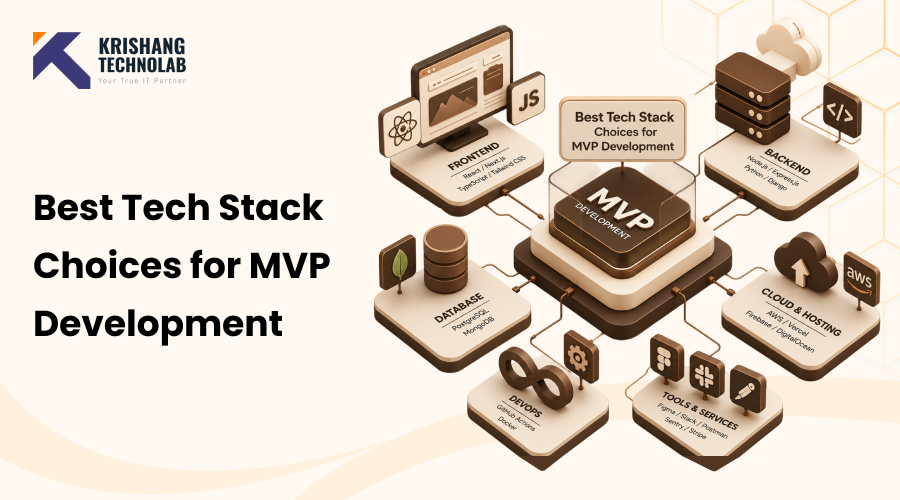
Best MVP Tech Stack Choices for Development
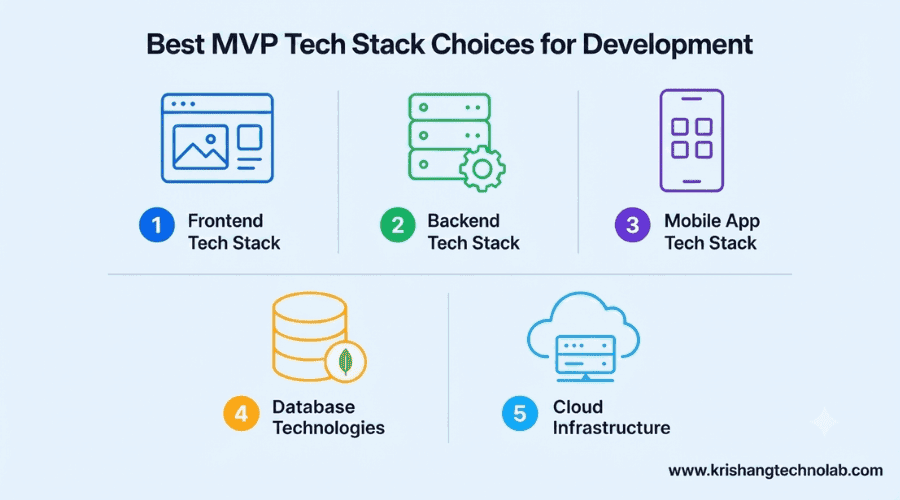
When choosing the right technologies, the technology selection process plays an essential role in building a successful MVP. Startups need a solution that enables faster development, smooth integrations, and easier maintenance. Instead of selecting technologies based only on popularity, businesses should consider their objectives, project complexity, and startup development needs to ensure long-term product success and future growth.
1. Frontend Tech Stack
The frontend is an important part of the Tech Stack, as it plays a key role in delivering a responsive and engaging user experience. Choosing the right technologies and understanding the Best Front-End Frameworks helps businesses select suitable solutions for building modern applications. With frameworks like React, Vue.js, and Angular, businesses can develop fast, scalable, and user-friendly interfaces. Partnering with a reliable ReactJS development company helps organizations build robust products, while expert Vue.js development and AngularJS Web development solutions enable businesses to create flexible frontend applications, implement future improvements easily, and support long-term product growth.
2. Backend Tech Stack
The backend is responsible for managing business logic, authentication, databases, APIs, and core functionality across the application. Startups often choose Node.JS Web development for building fast, scalable, and real-time applications. Laravel web development provides an elegant framework with powerful tools that simplify PHP-based application development, while Python development with frameworks like Django enables secure, efficient, and rapid application building.
Businesses can also leverage PHP web application development to create flexible and reliable solutions. Choosing the right backend technology helps startups build powerful applications that can scale effectively as business requirements and user demands grow.
3. Mobile App Tech Stack
Nowadays, many startups launch MVPs as mobile apps to reach wider audiences. A cross-platform Tech Stack reduces costs and ensures consistent Android and iOS experiences. Flutter and React Native enable high-performance applications from one codebase. Through Flutter app development, businesses can build scalable products efficiently. Expert Android application development and an iOS app development company help create user-friendly, future-ready mobile solutions.
4. Database Technologies
Every application needs to store data reliably, making database selection a crucial part of the overall MVP Tech Stack. The right database provides speed, security, scalability, and efficient data management. MySQL is ideal for traditional web applications, while PostgreSQL is well suited for complex business applications. The MongoDB tutorial helps developers understand MongoDB, an excellent NoSQL solution for applications with evolving data structures, making it a popular choice for scalable MVPs. Firebase is ideal for real-time synchronization and mobile-first applications.
5. Cloud Infrastructure
Meanwhile, Cloud services allow you to deploy and scale an MVP without having to pay for expensive physical infrastructure. The cloud-enabled technology stack helps startups to deploy applications faster, improve availability and manage resources efficiently. Hosting, storage, monitoring and security with AWS, Microsoft Azure and Google Cloud Scale.
Selecting the Best MVP Tech Stack for Success
The right technology choice for an MVP depends on a combination of business goals and technical requirements. Effective MVP technology planning helps startups align their budget, customer expectations, and product objectives while supporting both immediate validation and long-term growth. A well-structured approach enables teams to focus on scalable application development, reduce future maintenance efforts, and minimize additional development costs as the product evolves.
Understand Business Requirements
The MVP purpose should be clear before selecting any Tech Stack. Understanding users, features, and goals helps choose suitable technologies. With AI consulting services, businesses can define strategies and build efficient solutions for core problems. Startups can explore the AI Tech Stack for Startups Guide to understand tools, frameworks, and technologies for scalable AI solutions.
Evaluate Team Expertise
Additionally, A modern Tech Stack delivers better results when the development team has practical technology experience. Experienced professionals choose the right frameworks and practices to reduce development time, improve code quality, and minimize risks. Businesses can hire dedicated developers with the required expertise to optimize MVP development and support scalability. The Guide: How to Hire Dedicated Developers helps businesses select skilled professionals, evaluate expertise, and build efficient development teams.
Plan for Future Scalability
An MVP begins with minimum functionality, but successful products can grow quickly. A scalable Tech Stack allows businesses to add new features, support larger user bases, and integrate additional services without major architectural changes. Building a flexible Tech Stack for your MVP today reduces future redevelopment costs. Businesses can also explore an AI-Powered Software Development Guide to understand modern approaches for building scalable and future-ready products.
Consider Security and Integrations
Security should be incorporated into every Tech Stack from the beginning. Protecting business and user information requires secure APIs, encryption, data protection practices, and reliable authentication methods. As businesses adopt intelligent solutions, partnering with an experienced AI development company can help implement secure AI-driven features and scalable technologies.
Additionally, ChatGPT integration services enable businesses to add advanced conversational capabilities, automate workflows, and improve user interactions while maintaining secure third-party integrations. A well-planned approach should also consider payment gateways, analytics platforms, CRM systems, and cloud services to support future scalability.
Common Mistakes When Selecting a MVP Tech Stack for Development
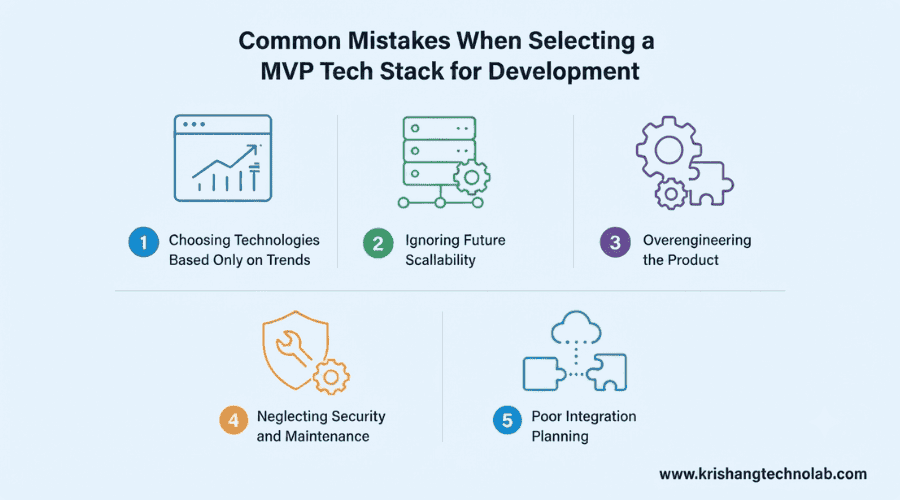
However, the best startup ideas can still fail if the wrong technology choices are made. Businesses can avoid common MVP development challenges by selecting a robust solution that supports faster development and long-term scalability. Choosing a future-ready technology stack at an early stage helps prevent costly redevelopment, reduces technical risks, and creates a stronger foundation for continuous product growth.
1. Choosing Technologies Based Only on Trends
But many startups adopt the latest frameworks because they are trendy. The right tech stack is a function of your business goals, project needs and your development team’s abilities not fads. Stability, performance and maintainability for an MVP with a tech stack you can be proud of.
2. Ignoring Future Scalability
Consequently, an MVP may launch with limited features, but successful products often grow quickly. Pick a tech stack that can’t scale for more users or new features, and you could end up spending a fortune redoing it. Build your Business confidently without disturbing existing operations. Begin with a scalable Tech Stack for MVP.
3. Overengineering the Product
One of the biggest MVP development mistakes is choosing an overly complex technology stack before validating the product idea. Unnecessary frameworks, services, or advanced architectures increase development time, maintenance efforts, and overall costs. Instead, use a lean technology stack to build, launch, validate, and improve the product efficiently.
4. Neglecting Security and Maintenance
Security should never be an afterthought during product development. A reliable Tech Stack protects data and ensures secure, efficient systems. Custom software development creates scalable solutions that are easy to maintain and enhance. A sustainable Tech Stack reduces technical debt and supports future growth.
5. Poor Integration Planning
In addition, the applications of today need payment gateways, analytics platforms, CRM systems, and third-party APIs. Future growth can be limited by a limited Tech Stack integration. The MVP needs a flexible tech stack for easy integrations and added functionality. It should adapt quickly to changing business needs and future requirements.
Future Trends in MVP Tech Stack
The technology landscape for MVP development continues to evolve, making the selection of a future-ready technology stack essential for building products that can adapt to changing market demands. A modern frontend architecture plays a crucial role in delivering engaging, responsive, and seamless user experiences. Today, cross-platform development frameworks such as Flutter and React Native enable startups to build applications faster across multiple devices while maintaining flexibility and performance.
In addition, modern application development practices such as microservices architecture, API-first design, and secure development techniques improve flexibility, maintainability, and overall application performance. By integrating advanced technologies through Machine Learning Development Services, businesses can create intelligent solutions, automate processes, and enhance product capabilities.
These approaches help startups adapt to changing market requirements, improve app security, enable seamless future upgrades, and build scalable digital solutions that support long-term business growth.
Conclusion
Choosing the right technology is essential for MVP development services. It improves development speed, product quality, and scalability. A strong technology stack selection process helps startups validate ideas faster. It also reduces costs and supports changing business requirements.
Smart technology choices build a reliable product foundation. The right frontend, backend, databases, and cloud services improve efficiency. They accelerate feature delivery and create future-ready applications. They also enable scalable digital products that support long-term business growth and lasting value.
Found this post helpful? Don't forget to share it with your network!