Quick Overview: This guide breaks down the top 6 supply chain MVP development company for startups and enterprises in 2026, comparing their expertise, tech stacks, and pricing. It also covers what a supply chain MVP is, why startups need one, and how to choose the right development partner for your project.
Supply chains don’t run on spreadsheets and phone calls anymore. From real-time shipment visibility to AI-driven demand forecasting, logistics and supply chain businesses are under constant pressure to digitize faster than their competitors. That pressure has made supply chain MVP development company one of the busiest corners of enterprise tech, and it’s also made it one of the riskiest places to spend a full development budget on an unproven idea.
That’s exactly why more founders, logistics operators, and enterprise innovation teams are turning to MVPs before committing to full-scale platforms. Instead of spending a year and a seven-figure budget building every feature imaginable, they’re launching a focused, functional version of their product first testing it with real users, real shipments, and real warehouse floors and then scaling what actually works.
A reliable MVP partner should bring the following:
- Proven experience shipping MVPs on tight timelines
- Real domain knowledge of warehousing, fleet, and freight operations
- Comfort with modern stacks AI/ML, IoT, cloud, and ERP integrations
- Transparent pricing and a clear post-launch support plan
Whether you’re searching for a supply chain app development company, a logistics MVP development company, or a supply chain software development company. You’re looking for a team that can turn your supply chain idea into a working, testable MVP quickly and efficiently.
This guide highlights six supply chain MVP development companies and what to look for when choosing the right development partner. The same lean, validate-first thinking applies whether you’re building a supply chain platform, a SaaS MVP, or an AI-powered MVP; the core principles carry across product types.
What Is a Supply Chain MVP?
A Minimum Viable Product (MVP) is the leanest version of your software that still solves a real problem for real users. It’s not a prototype you throw away. It’s a working product with just enough functionality to prove that people will actually use it before you invest in the full feature set.
For supply chain and logistics businesses, this approach matters even more than in most industries. Even a simple supply chain idea can involve warehouse staff, drivers, suppliers, customers, and numerous operational complexities. A supply chain MVP development approach helps validate core workflows with one warehouse, route, or supplier group before scaling company.
Whether you’re building a fleet-tracking tool or a supplier onboarding portal, the same lean, validate-first approach helps reduce risk and improve outcomes.
Common Supply Chain MVP Use Cases
- Inventory Management: real-time stock tracking, low-stock alerts, and SKU-level visibility
- Warehouse Management: pick-pack-ship workflows, bin location tracking, and staff task assignment
- Fleet & Vehicle Tracking: GPS-based location tracking, route monitoring, and driver behavior insights
- Order Management: order intake, status tracking, and fulfillment automation
- Demand Forecasting: AI-assisted prediction of future stock and staffing needs
- Supplier & Vendor Management: vendor onboarding, contract tracking, and performance scoring
Why Build a Supply Chain MVP?
1. Validate Your Product Idea Before Full Investment
An MVP lets you test your core assumption, say, that warehouse teams will actually adopt a new picking workflow with a small group of real users before you spend months building every module you imagined on a whiteboard.
2. Reduce Development Costs and Risks
Only building the essential features means smaller budgets, smaller teams and fewer places for expensive mistakes to hide. If something isn’t working, you find out early, when it’s still cheap to change direction.
3. Launch Faster and Gather User Feedback
A focused supply chain MVP development project can go from idea to working product in a few months rather than a year. That speed means you’re collecting real feedback from warehouse staff, dispatchers, or suppliers while your competitors are still in planning meetings.
4. Improve Product-Market Fit
Supply chain operations vary wildly between industries; a 3PL’s needs look nothing like a cold-chain food distributor’s. An MVP lets you learn what your specific market actually needs before you lock in a rigid feature set.
5. Scale Based on Real Business Needs
Once your MVP proves the concept, you can expand it, adding AI-based forecasting, IoT sensor integration, or multi-warehouse support based on how the product is actually being used, not on guesswork.
Whatever is more important for your business, the right MVP development company will help you get it without over-engineering the first release.
How We Selected the Best Supply Chain MVP Development Companies
To compile this list, we measured companies against six factors that matter most for supply chain and logistics projects in particular:
- Demonstrated track record of developing MVPs: experience launching products from ideation, not just extended staff augmentation
- Supply chain and logistics expertise: actual project experience with warehousing, transportation, or SCM software, not generic enterprise IT
- Modern technology stack: experience in AI/ML, IoT, cloud infrastructure, and system integration
- Client reviews and portfolio: verifiable case studies and 3rd-party reviews (Clutch, Gartner Peer Insights, DesignRush)
- Global delivery capabilities: supporting distributed teams, remote collaboration, and multiple time zones
- Scalability and post-launch support: a clear path from MVP to full production platform, including maintenance
The companies that can tick these boxes are the ones that can deliver real supply chain MVP development services and not generic software outsourcing with a supply chain label attached. Each of the six companies below qualifies as a legitimate supply chain MVP development company by these standards.
Top 6 Supply Chain MVP Development Companies
1. Krishang Technolab
Overview
Krishang Technolab is a custom software development company built around helping startups and growing businesses turn early-stage product ideas into working software fast. For supply chain and logistics founders specifically, the team combines hands-on supply chain software development experience with a lean, MVP-first delivery approach, meaning projects are scoped around the core workflow that needs to be validated, not padded out with speculative features.
The team specializes in AI-powered automation, cloud infrastructure, ERP integrations, and third-party APIs, enabling seamless connectivity with existing supply chain systems. Krishang Technolab supports startups, SMEs, and enterprises with fast, scalable software development outsourcing for building and validating supply chain MVPs.
The team has delivered projects for clients across the USA, UK, Canada, Australia, Singapore, Germany, Israel, and Dubai, giving them experience working across different time zones, compliance environments, and supply chain models.
In practice, this means Krishang Technolab operates as both a logistics MVP development company and a supply chain app development company, covering the full spectrum of warehouse, fleet, and order-flow products that startups typically need to validate first.
Core Expertise Areas
- Supply Chain & Logistics Software Development: full-scale builds for procurement, order flow, and distribution logic, tailored to the client’s specific supply chain model
- Logistics App Development: driver-facing and dispatcher-facing mobile app development for route management, delivery confirmation, and proof-of-delivery capturing
- Development of Warehouse Management Software: logic for bin-level inventory, pick-pack-ship workflows, support for barcode/RFID scanning, and staff task assignment
- Transportation Management Software Development: route planning, carrier selection, load optimization and shipment status real-time tracking
- Inventory & Order Management Systems: See stock levels as they happen, set automatic reorder triggers, and follow the order lifecycle from receipt to fulfillment.
- AI in Supply Chain Software: AI development for demand forecasting models, anomaly detection for delayed shipments or stock discrepancies, and AI-assisted route or load optimization (the same approach the team uses for standalone AI MVP development projects in the supply chain as well). chain as well)
- Third-party & ERP Integrations: Building MVPs that integrate seamlessly with existing ERP platforms, accounting tools, carrier APIs, and mapping or geolocation services.
MVP Development Process
- Discovery and workflow mapping: understanding the specific supply chain process the product needs to support before defining any features
- Feature prioritization: separating “must-have to validate the idea” from “nice to have later,” so the MVP stays lean and on budget
- UI/UX design for operational users: designing for warehouse floors, moving vehicles, and busy dispatch desks, not just office screens
- Agile, sprint-based development: regular demos and check-ins so the client can course-correct early rather than at final delivery
- QA and real-world testing: validating the product against actual operational conditions, not just clean test data
- Launch and iteration support: helping the client interpret early user feedback and plan the next build phase based on what the MVP reveals
More About: A Complete Step-by-Step MVP Development Process
Who They Work Best With
- Startups building a first supply chain or logistics product and needing to prove the concept before raising further funding or committing to a full build: the same MVP development for startups approach the team applies across industries.
- SMEs currently running operations on spreadsheets, WhatsApp groups, or disconnected tools who want to digitize a specific workflow first
- Enterprise innovation teams that need to hire dedicated developers to prototype a new initiative quickly, without diverting in-house engineers from the core platform roadmap
You can review examples of past product launches across industries in Krishang Technolab’s case studies and portfolio.
Key Services
- Supply Chain Software Development
- Logistics Software Development
- Warehouse Management Solutions
- Inventory Management Systems
- Transportation Management Solutions
- AI & Automation Integration
Why Choose Krishang Technolab
Krishang Technolab is a dedicated supply chain MVP development company that is designed specifically for a lean, validated-first delivery model, rather than being adapted from a general outsourcing approach.
- MVP-focused engagement model built for speed without sacrificing code quality
- Direct experience across inventory, warehouse, fleet, and order management use cases
- A discovery-first process that ensures the MVP tests the right assumption, not just a convenient one
- Flexible engagement models suited to startup budgets and enterprise governance alike
- Strong focus on post-launch scalability, so the MVP can grow into a full platform rather than being rebuilt from scratch
- Transparent, sprint-based communication, which matters when supply chain requirements shift as real users start testing the product
2. ScienceSoft
Overview
ScienceSoft is a US-based IT consulting and software development company with extensive experience in supply chain software development across industries such as manufacturing, retail, healthcare, and energy. Customers across pharmaceuticals, food retail, and other industries use its supply chain planning, visibility, WMS, and TMS solutions. The company is ISO 9001 and ISO 27001 certified for quality and security management.
Category: Supply Chain Software Development Company | Supply Chain MVP Development Services
Best For
Enterprises and mid-market companies needing supply chain consulting and development support, especially in regulated industries with strict compliance requirements.
3. Emerline
Overview
Emerline is a custom software development company (LeverX Group) specializing in full-cycle web, mobile, and enterprise software development for startups and established businesses. The company has successfully delivered tons of MVPs and prototypes across a range of industries. It holds AWS, Google Cloud and Microsoft partner status, as well as ISO certifications for quality and information security.
Category: Supply Chain App Development Company | MVP Development Company
Best For
Startups and mid-sized businesses looking for a flexible, full-cycle development partner that can take a product from initial MVP through to a scalable, production-ready platform.
4. PeoCode
Overview
PeoCode is a software development company offering custom web and mobile development, UI/UX design, and enterprise software solutions, including SCM and BPM tools. The company focuses on an MVP-first approach, helping clients define key features, avoid over-engineering, and launch faster.
Category: Logistics MVP Development Company | Supply Chain Software MVP Development
Best For
Early-stage startups that want a design-led approach to their MVP, with strong UI/UX as a core part of the delivery rather than an afterthought.
5. EPAM Systems
Overview
EPAM Systems is a large, publicly traded digital engineering and IT consulting company with a global delivery footprint spanning dozens of countries. EPAM works with enterprises across industries, including logistics, retail, and manufacturing, on large-scale software modernization, cloud migration, and custom platform development, often bringing significant engineering scale to complex, multi-system supply chain initiatives.
Category: Logistics Software Development Company | Supply Chain Software Development Company
Best For
Large enterprises and well-funded scale-ups that need substantial engineering capacity, deep technical specialization, and the ability to run complex, multi-team programs alongside an MVP effort.
6. Thoughtworks
Overview
ThoughtWorks is a global technology consultancy and a leader in delivering agile and lean software development practices, a pioneer in the emergence of modern agile methodology. The company works with organizations on product strategy, custom software delivery and digital transformation with a strong focus on iterative delivery, continuous testing and engineering craftsmanship for complex enterprise projects including supply chain and logistics platforms.
Category: Supply Chain MVP Development Company | Supply Chain Software Development Company
Best For
Enterprises that want a consultancy-led approach emphasizing agile process rigor, technical excellence, and long-term platform architecture over quick, low-cost delivery.
Also Read: Best Fintech MVP Development Companies for Startups
Features Every Supply Chain MVP Development Company Should Offer
1. Supply Chain Domain Knowledge
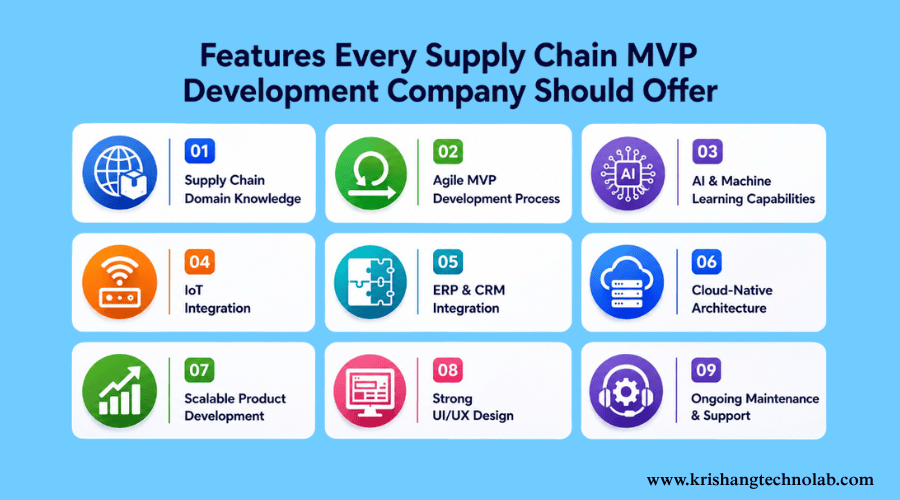
Understanding of real warehouse, fleet, and freight workflows, not just generic CRUD app development, so the MVP reflects how supply chains actually operate.
2. Agile MVP Development Process
Short, iterative sprints with regular demos so the product can adapt as user feedback comes in, rather than locking in requirements up front
3. AI & Machine Learning Capabilities
The ability to build in demand forecasting, anomaly detection, or route optimization even in a lightweight form from the earliest version of the product.
4. IoT Integration
Experience connecting software to GPS trackers, RFID tags, and warehouse sensors, since much of supply chain data originates from physical devices, not manual entry.
5. ERP & CRM Integration
The ability to connect the MVP to systems the client already runs, such as SAP, Oracle, NetSuite, and Salesforce, so the new product fits into existing operations instead of creating a data silo.
6. Cloud-Native Architecture
Built on AWS, Azure, or Google Cloud from day one so the MVP can scale in users, data volume, and geography without a costly re-architecture later.
7. Scalable Product Development
A code base and architecture designed to evolve into a complete platform, rather than a disposable prototype that must be rebuilt if the MVP is successful.
8. Strong UI/UX Design
More than a pretty picture in a pitch deck. Interfaces that warehouse staff, drivers, and dispatchers can actually use under real operational pressure.
9. Ongoing Maintenance & Support
A game plan on bug fixes, updates, and features to be built post-launch, because the real value of an MVP is in what you learn and build post-launch.
More Read: MVP Development Timeline
Technologies Used in Supply Chain MVP Development
- Artificial Intelligence (AI): automation, route optimization, anomaly detection
- Machine Learning (ML): demand forecasting, predictive maintenance
- Internet of Things (IoT): sensor-based tracking of goods, vehicles, and warehouse conditions
- Cloud Computing (AWS, Azure, Google Cloud): scalable hosting and infrastructure
- Blockchain: multi-party traceability and verification for complex supply chains
- GPS & Fleet Tracking: real-time vehicle and shipment location data
- RFID & Barcode Integration: automated inventory and asset identification
- APIs & ERP Integrations: connecting the MVP to existing business systems
- Business Intelligence & Analytics: dashboards and reporting for operational decision-making
How Much Does Supply Chain MVP Development Cost?
| MVP Type | Estimated Cost | Timeline |
| Basic MVP | $20,000–$40,000 | 2–3 Months |
| Medium Complexity | $40,000–$80,000 | 3–5 Months |
| Enterprise MVP | $80,000–$150,000+ | 5–8 Months |
Factors Affecting Cost
- Number of features included in the MVP scope
- Integrations with ERPs, carriers, or third-party APIs
- Technology stack (AI/ML and IoT typically add cost and time)
- Development team size and seniority
- Security and compliance requirements (especially in regulated industries)
- Overall project complexity and number of user roles/workflows
Related to Read: How Much Does MVP Development Cost in 2026
How to Choose the Right Supply Chain MVP Development Partner
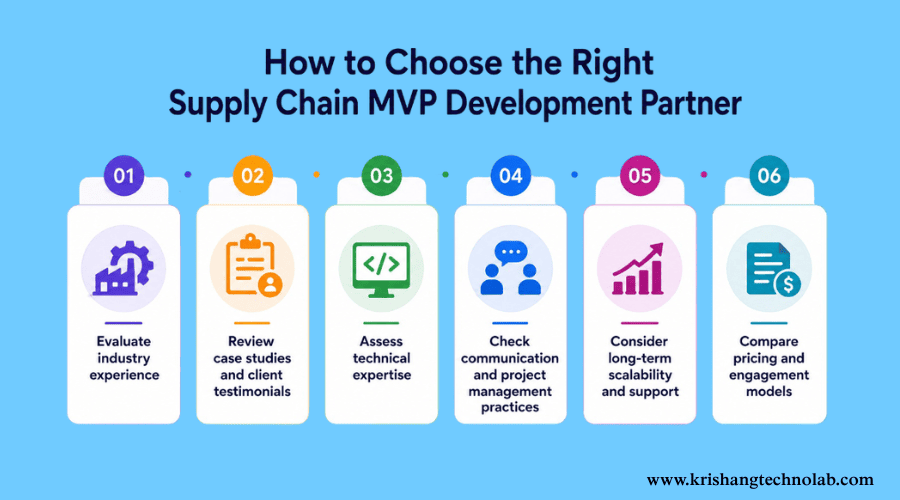
- Evaluate industry experience: has the company actually built supply chain or logistics software before, or is this a first attempt at the domain?
- Review case studies and client testimonials: look for verifiable results, not just marketing claims
- Assess technical expertise: confirm they can handle the integrations and technologies your MVP will need
- Check communication and project management practices: clear reporting and regular demos matter more in MVP work than in long, fixed-scope contracts
- Consider long-term scalability and support: ask directly how they handle the transition from MVP to full product
- Compare pricing and engagement models: fixed-price, time-and-materials, and dedicated team models each suit different project types and budgets
Conclusion
Supply chain and logistics products are too operationally complex to build blind. An MVP-first approach lets you validate real assumptions about workflows, user adoption, and integrations before committing a full budget to a platform that might miss the mark. Done right, it’s the fastest, lowest-risk path from idea to a product people actually use.
The partner you choose matters as much as the approach itself. Look for a team that has a practical grasp of supply chain operations, is proficient with modern technologies like AI, IoT, and cloud infrastructure, and has a track record of shipping, not just planning MVPs.
Krishang Technolab is a trusted MVP supply chain development company for businesses looking for an MVP-focused partner with direct experience across inventory, warehouse, and logistics software, supported by flexible engagement models suited to startups and growing companies alike.
That said, the right decision ultimately hinges on your project’s scope, budget, and long-term growth plans, so invest the time in evaluating case studies, asking detailed questions about their process, and selecting the partner best suited to translating your specific supply chain idea into a working product.
Found this post helpful? Don't forget to share it with your network!