
Quick Overview: This guide compares the top fintech MVP development companies for startups in 2026, breaking down what makes fintech MVPs different, key selection criteria, and detailed profiles of five leading firms Krishang Technolab, Itexus, S-PRO, Rootstrap, and Vention plus costs, timelines, and common hiring mistakes to avoid.
Building a fintech product is not like building a typical app. Every screen you ship touches money, identity, or trust, which means every screen is also a potential compliance headache. For a startup racing toward a seed or Series A round, the difference between a fintech MVP that impresses investors and one that quietly collects security debt often comes down to one decision: which of the many Fintech MVP Development Companies you choose to build it with.
This guide breaks down what makes a fintech MVP different, what to look for in a fintech MVP development company, and how to build a fintech MVP the right way before taking a close look at five of the top fintech MVP development companies startups regularly consider for the job, Krishang Technolab, Itexus, S-PRO, Rootstrap, and Vention. Whether you’re searching for a fintech product development company, a broader fintech software development company, or simply the best fintech app development company for your first release, this comparison will help you narrow it down.
What Is a Fintech MVP (and Why It’s Different from a Regular MVP)
A Minimum Viable Product is normally about shipping the smallest version of an idea that still delivers real value, so you can test it with actual users before investing further. In fintech, that same principle applies, but with an added layer: compliance can’t be bolted on later.
Anything that touches personal data, transactions, or regulated financial activity may need identity verification (KYC/AML), encryption, audit logging, and role-based access built in from day one, not added after a funding round forces the issue. Generic app development shops often treat these as “phase two” features. Specialized fintech partners build them into the architecture from sprint one.
Read About: The Complete MVP Development Guide for Startups
Why Startups Need a Specialized Fintech MVP Development Company
- Complexity of regulation: rules are dependent on product type, jurisdiction, and user base and are constantly changing.
- Security expectations: even an early-stage MVP handling money or personal data is a target.
- Investor scrutiny: a fundable MVP needs to look and behave like a real financial product, not a prototype.
- Speed pressure: founders often need a working product in weeks, not a year, to hit a fundraising window or conference deadline.
A dev shop that’s never built anything beyond a to-do app will typically underestimate all four of these. This is exactly why so many founders end up specifically searching for a fintech software development company or a fintech product development company, rather than a general-purpose agency, once they realize what’s at stake.
What to Look for in a Best Fintech MVP Development Company
Before registering with any fintech MVP development services provider, look for:
- Fintech-specific experience: not just “we can build an app” but demonstrated work in payments, banking, wallets, or lending.
- Security & Compliance language: awareness of PCI DSS, KYC/AML, and GDPR frameworks.
- A real MVP portfolio: Not just finished, polished deliverables, but evidence they can scope and ship a lean first version.
- Flexible tech stack: Ability to interface with banking APIs, payment gateways, and third-party financial infrastructure.
- Scalability thinking post-MVP: a partner that thinks about what happens after the first 100 users, not just launch day.
- Transparent Pricing: No surprises three sprints in, clear cost structure.
Keeping that framework in mind, here is how the top five stack up and why each could be the best fintech app development company or the right MVP development company for fintech startups depending on your specific priorities.
The Best 5 Fintech MVP Development Companies for Startups (2026)
1. Krishang Technolab — Best Overall Value for Startup Fintech MVPs
Overview: Krishang Technolab is a 2015 founded company based in Ahmedabad, India with a business presence in Leicester, UK. Over the last few years, the business has expanded to over 300 clients across the US, UK, Canada, Australia, and other markets. Clients range from Fortune 500 companies to early-stage startups.
Fintech relevance: Industry Verticals Krishang Technolab’s key industry verticals are FinTech, Healthcare, E-commerce, Real Estate, and Logistics. Fintech work is about combining intuitive UX with secured back-end systems to build products like digital wallets, investment platforms, and banking apps. Its team says it has experience of integrating third-party payment gateways and banking APIs into custom builds.
Services relevant to a fintech MVP:
- Custom software and SaaS MVP development
- Web and mobile app development (NodeJS, ReactJS, Laravel, PHP, AngularJS, Flutter)
- Dedicated MVP development services built specifically for startups validating a new product
- AI MVP development for founders who want machine learning or automation baked into their fintech product from day one
- UI/UX design and enterprise solution architecture
What clients say: The team is often described on independent platforms as responsive, professional and easy to work with. Long term clients mention a quick turnaround and flexibility to change when the requirements change in the project.
Leadership: Led by CTO Bharat Odedara and Founder Ramesh Gosiya, the company is creating AI-based custom software and fintech solutions. Some of the recent projects are developing fintech architecture in ReactJS for dashboards, trading platforms and payments.
Best for: Startups that want an experienced, cost-conscious partner capable of handling both the MVP build and the broader software/SaaS work that tends to follow it, with flexibility across a wide range of technologies. Because Krishang Technolab’s public case studies for fintech specifically are less documented than some larger competitors, it’s worth asking them directly for named fintech project references before committing to a larger scope.
2. Itexus — Best for Fintech-Only Specialization
Overview: Founded in 2013 and headquartered in Dover, Delaware, with development centers in Eastern Europe, Itexus is one of the few companies on this list that builds exclusively for the financial services industry rather than treating fintech as one vertical among many.
Fintech track record: Itexus has delivered more than 300 fintech projects for over 250 clients across 23 countries, with a dedicated fintech division that promises to ship MVPs in under four months. Notable work includes a PCI DSS-compliant crypto wallet and trading app for Coinstar (supporting 50+ digital assets) and a digital onboarding platform with automated KYC/KYB verification for a $19B-asset US credit union, cutting account opening from days to minutes.
Compliance posture: The company builds to SOC 2, PCI DSS, and ISO 27001 standards from the start of engagement and has a 4.9-star Clutch rating over 40+ reviews covering digital banking, lending, wealth management, insurance, and crypto use cases.
Best for: Startups that want a partner with zero divided attention, no e-commerce or healthcare side projects diluting focus, and that need compliance frameworks like KYC/KYB and PCI DSS built in from the very first sprint rather than retrofitted later.
3. S-PRO — Best for European and MENA Regulatory Expertise
Overview: Founded in 2014, S-PRO operates with engineering teams across Ukraine, Poland, and Germany and a business presence in the UAE, bringing together more than 200 specialists focused on fintech, IoT, and custom software.
Fintech focus: S-PRO’s fintech practice includes digital banking, crypto and Web3 products, and asset management platforms. The company has worked with FINMA-licensed businesses in Switzerland and has experience navigating financial regulations in the US, MENA and European markets, the report stated.
Cost transparency: For a regular MVP development the company says it can cost you from around $70,000. A full-fledged fintech app MVP will cost you on average from $100,000 to $250,000 depending on complexity and compliance requirements.
Best for: Startups building products that need to satisfy multiple regulatory regimes at once, for example, a fintech company targeting both European and Middle Eastern users.
4. Rootstrap — Best for Discovery-Led Early-Stage Validation
Overview: Founded in 2011 and headquartered in West Hollywood, California, Rootstrap is a nearshore software agency with a roughly 200-person team based largely in Latin America. The company reports having helped launch more than 750 digital products with a combined 100 million+ downloads.
Fintech relevance: Rootstrap has worked with FinTech, HealthTech and E-commerce clients and helped several startups to build MVPs that later raised seed money. Its process is based on a discovery phase that challenges and hones the product concept before development starts, rather than just dictating a fixed brief.
Notable outcomes: The company states its work has contributed to clients raising more than $1 billion in combined funding, with dozens of startups securing VC investment after building their MVP with Rootstrap.
Best for: Founders who are still refining their product idea and want a partner that will push back on assumptions during discovery, rather than one that just builds exactly what’s in the spec.
5. Vention — Best for Scaling Engineering Capacity Fast
Overview: Founded in 2002 and headquartered in New York (formerly operating as iTechArt), Vention is one of the larger players on this list, with more than 3,000 in-house engineers and consultants across 20+ global offices.
Fintech track record: Vention says it has delivered 200+ fintech products in 15+ years, working with both early-stage startups and established financial institutions. Client outcomes include contributing to $13 billion in acquisitions and 21 IPOs across its broader portfolio, with fintech-specific work covering payments, banking infrastructure and trading platforms.
Timeline: Most engagements move from kickoff to a working MVP within three to six months, with project starts typically possible within two weeks of signing.
Best for: Startups (or scale-ups) that already have a clear product roadmap and need to expand engineering capacity quickly, rather than starting from a blank slate.
Read About: Outsourcing MVP Development
Quick Comparison of Fintech MVP Development Companies
| Company | Headquarters | Team Size | Best For |
| Krishang Technolab | Ahmedabad, India (+ UK) | 300+ projects delivered | Cost-effective fintech MVP + SaaS builds |
| Itexus | Dover, Delaware, USA | 150+ engineers | Fintech-only specialization, compliance-first |
| S-PRO | Ukraine / UAE | 200+ experts | EU/MENA regulatory-heavy fintech |
| Rootstrap | West Hollywood, CA | ~200 (LatAm-based) | Discovery-led early-stage validation |
| Vention | New York, USA | 3,000+ engineers | Rapidly scaling engineering capacity |
Do you Know: Why 90 Days Is the New Standard for AI MVP Launch
How Much Does a Fintech MVP Cost? (Fintech App Development Cost Breakdown)
Costs vary widely based on complexity, compliance scope, and team location:
- Lightweight MVP (single core feature, minimal compliance): $30,000–$70,000
- Standard fintech MVP (KYC/AML basics, payment integration, multi-platform): $70,000–$150,000
- Compliance-heavy MVP (banking-grade security, multiple integrations, regulatory review): $150,000–$250,000+
Factors that push cost up include the number of third-party integrations (banking APIs, payment processors), the number of platforms (iOS, Android, web), and the depth of compliance work required for your specific market.
How to Build a Fintech MVP: The Development Process
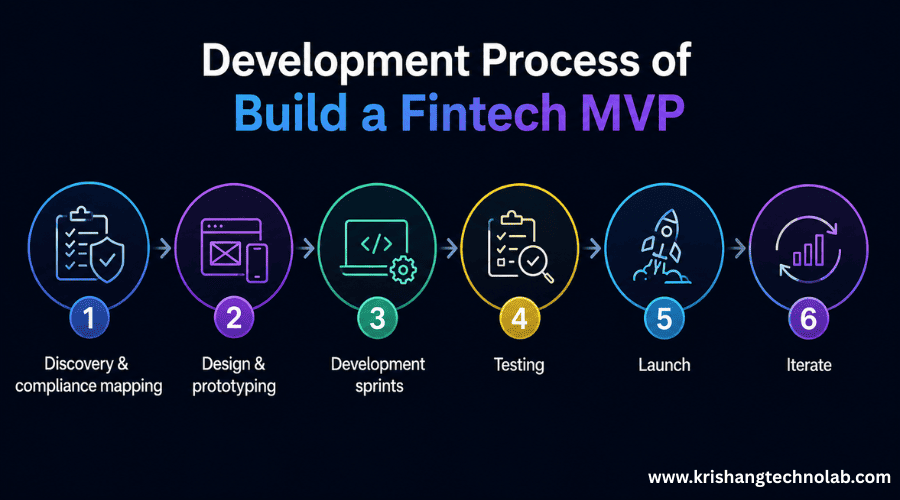
- Discovery & compliance mapping: define the core problem, target users, and applicable regulations
- Design & prototyping: wireframes and clickable prototypes to validate flows before writing code
- Development sprints: agile, iterative builds focused only on essential features
- Testing: functional QA plus security and compliance testing
- Launch: deploy to real users
- Iterate: refine based on real usage data and feedback
Related to Read: A Step-by-Step MVP Development Process
Common Mistakes Startups Make When Choosing an MVP Partner
- Prioritizing price over compliance expertise: a cheap MVP that fails a security review can cost far more to fix later.
- Skipping a security audit: even at MVP stage, an audit catches problems before they reach real users’ money.
- Not planning for scale: an MVP that can’t grow past its first cohort of users creates a costly rebuild later.
Why Krishang Technolab Stands Out as the Best Fintech MVP Development Partner
Krishang Technolab is one of the five Fintech MVP Development companies above that startups looking for an affordable, flexible and long-term partnership should take a closer look at. Here’s why it’s always the best for early-stage fintech founders in particular:
1. Built for startups, not just enterprises
While companies such as Vention and S-PRO usually serve large financial institutions and startups, Krishang targets early-stage companies mostly. And so the startups get a partner who can move at startup speed and work within startup budgets. And founders don’t have to wrangle enterprise-level overhead and pricing that tends to come with larger firms.
2. Full-stack flexibility under one roof
Most MVP-focused shops can be experts in just one area, such as mobile or web development. However, Krishang Technolab’s team works on web, mobile and SaaS product development using NodeJS, ReactJS, Laravel, PHP, AngularJS and Flutter. This flexibility is helpful for fintech founders who aren’t sure if they want to launch their MVP on web, mobile or both. So they can validate the product without having to go to one platform.
3. Genuine fintech domain exposure
Krishang’s fintech experience includes digital wallets, investment platforms and banking apps, and he has first-hand experience integrating third-party payment gateways and banking APIs, the very integrations most fintech MVPs require on day one.
4. Cost-effective without sacrificing responsiveness
Krishang brings you development that is affordable without compromising on responsiveness. Additionally, independent reviews regularly highlight fast turnaround times and communication that is responsive even after regular business hours. At larger, process-heavy development firms, it’s the opposite. Communication slows down as teams get bigger.
5. Room to grow with the same partner
Krishang Technolab also offers SaaS MVP development, enterprise solutions and continuous digital marketing/support so startups can stay with the same team far beyond MVP phase through scaling, feature expansion and beyond, rather than having to switch vendors once the MVP is validated.
6. Global startup focus, not a one-size-fits-all pitch
Krishang has specialised pages for fintech MVP development company and teams for startups in general, with region-specific support for founders in Singapore, Australia, Dubai and Germany, tailoring its strategy by market. For fintech founders developing AI-powered features, their AI MVP development service and option to hire Claude Code developers eliminates the need to add a separate AI vendor to the project.
A fair caveat: Krishang is a smaller firm than Vention, and its publicly available fintech case studies are less extensive than those of some larger competitors on this list. For startups with heavy, multi-jurisdiction regulatory requirements from day one, it’s worth directly asking Krishang for fintech-specific references and compliance experience relevant to your exact use case (e.g., PCI DSS, KYC/AML) before committing to a larger scope of work. For most early-stage fintech MVPs where speed, cost, and flexibility matter more than enterprise-grade compliance infrastructure, Krishang Technolab is a strong first call.
Final Thoughts
There is no “best” fintech MVP development companies; it will depend on your budget, timeline, and how much regulatory complexity your product carries. Krishang Technolab is a good overall choice for startups looking for an affordable, responsive partner for both MVP and full SaaS development. Rootstrap is great for early-stage discovery. When you need to scale fast around an existing road map, Vention is the best.
Pick the one you want, but judge them on the same basic criteria: real fintech experience, compliance fluency, a real MVP portfolio and transparent pricing. Get that right and your MVP won’t just launch; it will stand up to the scrutiny that comes next.
Found this post helpful? Don't forget to share it with your network!