Quick Overview: EOutsourcing MVP Development helps startups launch faster, cut costs, and access skilled global talent without building an in-house team. This guide covers the pros and cons of outsourcing MVP development, plus 2026 costs and how to choose the right partner.
Launching a startup in 2026 requires fast execution and smart decisions. You need to spend wisely. You want to make sure your idea works before you run out of runway. This simplest version of your product that works is called a minimum viable product, or MVP. The MVP still addresses a genuine problem for actual users. It’s all about your core value proposition. You test the demand for it. You also use these steps to gather feedback.
This is the concept at the heart of the lean startup methodology. Product validation for startups is now required before any serious funding round. That’s why having a strong MVP is a key part of your startup product development strategy. Many founders now choose outsourcing MVP development rather than building in-house. This enables organizations to lower hiring costs. And it also provides access to skilled talent on demand. Software development outsourcing speeds up the path from idea to working product.
This blog explores with you what MVP development outsourcing stands for. This also explains the 2026 cost. Lastly, it helps you choose the right partner so you can decide if outsourcing matches your startup goals.
What is Outsourcing MVP Development?
Outsourcing MVP development means hiring an external team, agency or freelance developers to design, build and launch your MVP. It’s not just with an internal engineering team that you do that. This external partner owns the technical architecture, coding, testing and deployment. They work very closely with your vision and product requirements.
The difference between outsourcing and in-house development is convenience vs control. In-house development means hiring full-time staff. These people work only on your product. This provides you with greater control on a daily basis. It’s more time and money to set up, though. It also takes HR effort. Outsourcing allows you to leverage a pre-existing team. This team already has the experience. You pay for it when you need it, too.
How MVP Outsourcing Works
The path to outsourcing is well-trodden through the MVP development process.
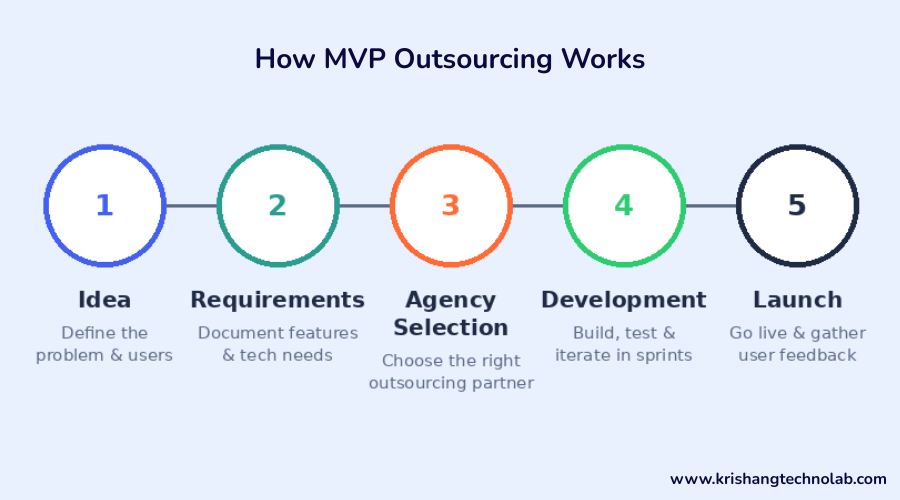
- Idea – You define the problem your product solves and who it is for.
- Requirement gathering – You and the outsourcing partner write down features, user flows, and technical requirements to build an MVP.
- Agency Selection – Determine and shortlist an AI MVP development agency or outsource MVP development company based on skill and fit.
- Development – The team develops, builds and tests your product in short time-boxed sprints. Also, teams often employ agile MVP development methods to improve efficiency.
- Launch – Your MVP goes live. You then start to collect actual feedback from users to decide what to do next.
Types of MVP Development Outsourcing
When you decide to bring in MVP development team support from outside your company, you have three basic models to choose from:
- Offshore outsourcing – You hire a team in another country through an offshore development center. This often has a large price advantage. Actually, offshore MVP development services are in demand with startups in North America and Western Europe, many of which partner with teams in South Asia or Eastern Europe.
- Nearshore outsourcing – You collaborate with a team located in a nearby country, usually just a few time zones away. This technique allows for cost savings and improves teamwork.
- Onshore outsourcing – You hire a team in your own country. It usually costs more, but it reduces the time zone and culture gaps.
Each of the models has their own trade-offs on cost, communication ease and talent availability. Later, we’ll explore these more below in MVP vs POC vs Prototype.
Why Startups Outsource MVP Development
Startups choose outsourcing MVP development for clear, practical reasons. It’s not just convenience or cost savings in isolation; it’s about speed and budget and access to talent.
Faster Time to Market
Outsourcing avoids the long process of hiring, interviewing and training engineers. A proven team can start building immediately. So your product gets to users faster. When you’re racing to test an idea before the money runs out or the competition beats you, that’s what matters most.
Cost Efficiency
Full-time in-house developers cost more than just their salary. You pay for benefits, equipment and office space as well. By outsourcing MVP development, you can avoid most of these fixed costs. Instead, you buy a clearly defined scope of work. This becomes critical for startup MVP development outsourcing where budgets are tight and runways are short.
Skilled Talent Access
Outsourcing provides you access to skilled professionals that are difficult to find or too expensive to hire locally. Maybe you need a particular tech stack. Maybe you need to know your way around mobile development or how to integrate AI. A reliable outsourcing partner probably has people who have solved problems just like yours, especially in AI MVP development for startups.
Reduced Hiring and Infrastructure Burden
It costs money and takes time to recruit engineers. It’s an additional cost, on top of building infrastructure for an internal team. Outsourcing takes a lot of that burden away. Instead of spending your limited resources on day-to-day operations, you can focus them on growth.
Focus on Core Business and Fundraising
As a founder you should be spending your time on strategy, customers and fundraising, not on the day-to-day of engineering. When you outsource your MVP build, you can focus on what only you can do – grow the business.
Pros of Outsourcing MVP Development
Outsourcing MVP development brings clear, definite benefits. Startups can reach the market more quickly, spend money more wisely, and draw on talent pools around the world.
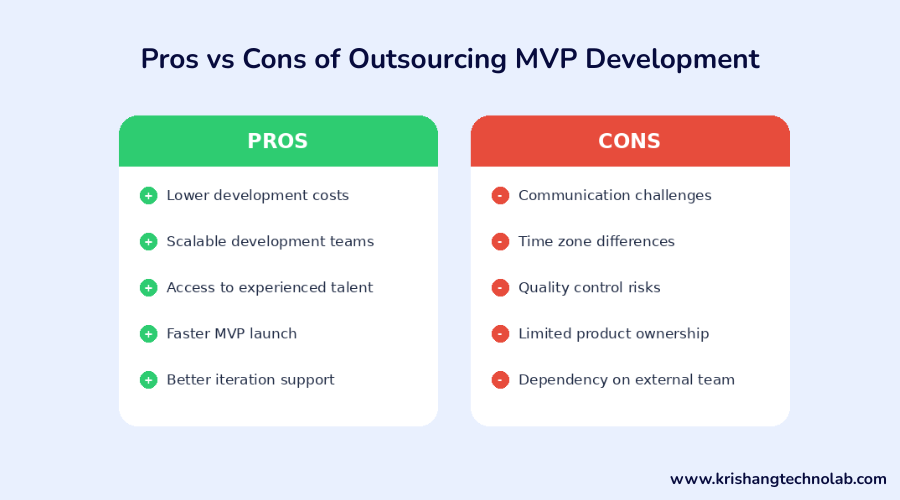
Lower Development Costs
Usually, this is the main reason for outsourcing MVP development. By working with teams in regions with lower hourly rate MVP developers, startups can cut their development costs by 40 – 60% without sacrificing quality if they choose the right partner.
Scalable Development Teams
An outsourcing partner can rapidly grow or shrink your team depending on project needs. Need an extra backend dev for two months? A good agency can add one quickly, without the long hiring cycle that would be required of an in-house team.
Access to Experienced Developers and Tech Stacks
Many reliable agencies have already built dozens of MVPs across diverse industries. You benefit from proven processes, reusable code, and developers who are already up to speed on modern tech stacks. It speeds up your prototype development services by a long way.
Faster MVP Launch
Shorter development time because a dedicated and experienced team works only on your product. Many custom MVP development service providers can deliver an MVP in 8 – 16 weeks, depending on its complexity, making the MVP development timeline predictable and efficient.
Better Product Iteration Support
Outsourcing teams are often well versed in agile MVP development. They can be easily adjusted based on the user feedback, which is crucial in the early testing phase of a startup.
Cons of Outsourcing MVP Development
Outsourcing MVP development has real benefits, but it also has its trade-offs. Before signing up with an outside team, founders should carefully consider these factors.
Communication Challenges
When you are working with an outside team, especially one in a different country, it can create gaps in communication. Language, terminology or even work culture differences can slow down decision-making if you don’t manage this up front.
Time Zone Differences
Offshore MVP development services can delay feedback due to time zone differences. If you ask a question at the end of the day, you might not get an answer until the next morning. This can create drag on fast-moving sprints.
Quality Control Risks
There is no in-house team watching every line of code. Such an arrangement could lead to a risk of uneven quality if the outsourcing partner is not choosy about testing and code review. That’s why it’s just as important to look into the agency’s process as it is their portfolio.
Also Read About: Which is better dedicated development team vs outsourcing for your project?
Limited Product Ownership Feeling
Sometimes, founders feel disconnected from a product primarily developed by an external team. This is often a sharper feeling than working with an in-house crew who have a passion for the company mission.
Dependency on External Team
You can create dependency if you get too dependent on one outsourcing partner for continued work. Such a situation makes it harder to insure development later or change vendors without chaos.
MVP Development Cost in 2026
Knowing MVP development cost 2026 figures helps founders set a realistic budget. This is important to do before you agree to any outsourcing partner or pricing model.
Average Cost Breakdown
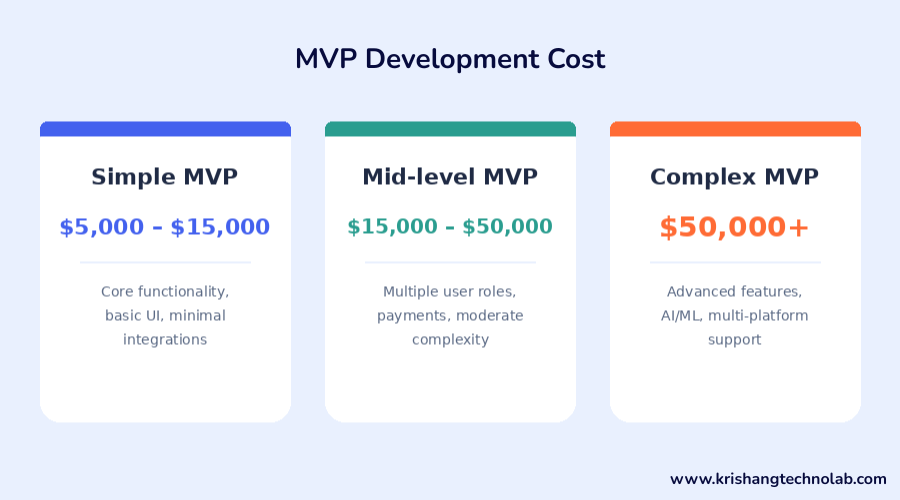
One of the top questions founders ask is “How much does it cost to outsource MVP development in 2026?” The exact amount depends on the scope, the region and the complexity. Therefore, prices may vary considerably. Here’s a rough MVP development cost breakdown for startups:
| MVP Type | Estimated Cost Range | Typical Features |
| Simple MVP | $5,000 – $15,000 | Core functionality, basic UI, minimal integrations |
| Mid-level MVP | $15,000 – $50,000 | Multiple user roles, payment integration, moderate complexity |
| Complex MVP | $50,000+ | Advanced features, AI/ML components, multi-platform support |
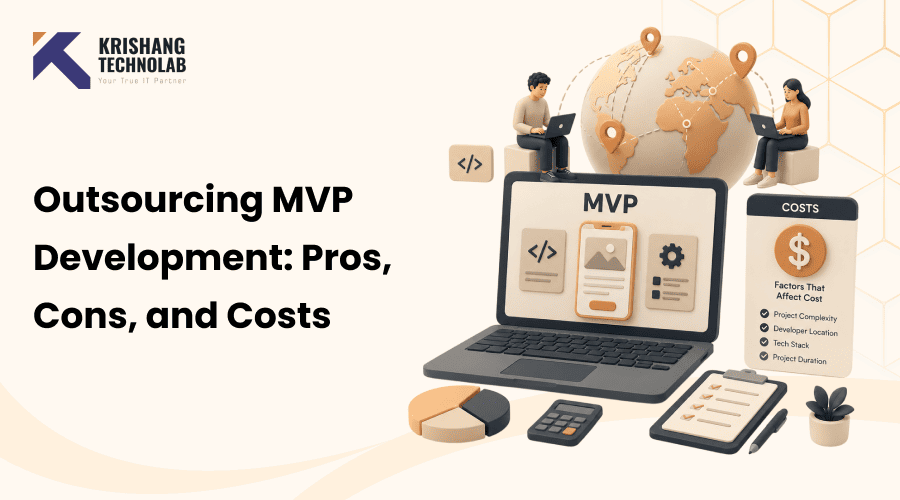
Factors Affecting MVP Development Cost
Various factors affect the final price:
- Feature complexity – Additional features require more time. Additional integrations require more time. And, thus, the overall MVP development cost increases.
- Tech stack – Some technologies need specialized dedicated developers. Thus, costs can go up.
- Team location – This is the classic offshore vs onshore for MVP development. Offshore teams tend to be less costly. So you might pay less.
- Timeline urgency – The shorter the time frame, the more costly it will be. For example, more developers may be required. You may need extra hours too.
Hidden Costs in Outsourcing
Besides the initial build, founders should also plan for the following ongoing costs:
- Maintenance – The first step is fixing bugs. It’s about servers. Updates were included. It also helps ensure that the product functions effectively.
- Scaling – More users often mean more work. Paid-for new features, as well.
- Rework and revisions – The user might ask for changes. Alternatively, a new product direction could require additional work.
Understanding the difference between dedicated development team cost and fixed price MVP development will save you from any nasty budget surprises. Besides, it allows you to plan costs early.
How to Choose the Right MVP Development Partner
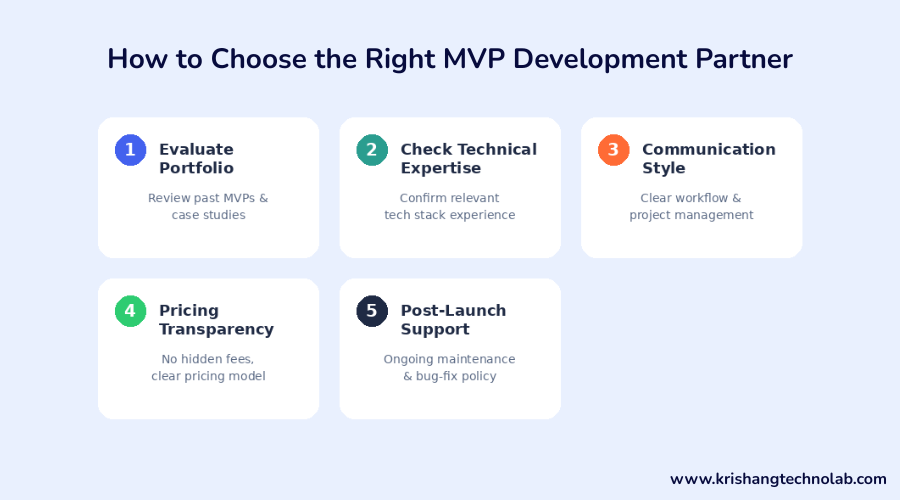
Choosing to outsource is as important as choosing the right partner. So do the following. They will help you to make decisions confidently on how to choose MVP development agency for startups.
Evaluate Portfolio and Case Studies
Look for agencies that have MVP experience. Also, choose teams that understand your industry. They should have experience with similar technical requirements. Read their case studies. They show what they have done. They also talk about how the team solved problems.
Check Technical Expertise
Ensure the team is aware of your tech stack. The project can involve mobile app development, AI integration, or SaaS MVP development. Also ask about similar projects. See what they were able to accomplish.
Communication and Project Management Style
Ask how the team functions. Then find out how often they post updates. Also check out tools they use, like Slack, Jira or Trello. Good communication keeps the project moving. In return, such transparency makes everybody’s work easier.
Pricing Model Transparency
Ask the agency to explain its MVP development pricing models. These are fixed-price, hourly or dedicated team types. Also, look for any hidden charges. Please read the contract very carefully before signing.
Post-Launch Support Availability
A good partner stays engaged after launch. And also ask about continued support. Refer to the bug-correction policy. Finally, ask how the team handles new feature requests once your MVP is out.
Conclusion
Outsourcing MVP development has obvious benefits. It saves costs. It also accelerates product launches. They also provide access to global skilled talent to build a startup software product. But there are some trade-offs. There can be a communication gap. Time zone differences can also slow work down. So strong vendor management is required.
Weigh the pros and cons of outsourcing MVP development carefully. Consider your budget. And consider your timeline. Finally, consider product complexity. This approach is the key to making the right decision. Outsourcing makes sense for early-stage startups. This statement is particularly true when you partner with an experienced MVP development agency such as Krishang Technolab. These agencies are technically strong. They also ensure that communication is clear. Also, they provide post-launch support.
In some cases, on the other hand, in-house development can be better. It is more secure, for instance, if you have stringent IP concerns. It also works well when you already have an engineering team. In the end, outsourcing can be a quick track and a wise one. It helps take an idea and turn it into a validated product by 2026.
FAQs
How much does it cost to outsource MVP development in 2026?
Cost ranges typically begin with a basic MVP for $5,000. A complex product could cost over $50,000. But the final cost is dependent on the features. It’s also dependent on the tech stack. Moreover, the outsourcing location affects the price.
Should startups outsource MVP development or build in-house?
It depends on your budget, timeline and technical resources. Usually it is faster to outsource. It’s also cost-effective for early-stage startups. But with in-house development, you’ve got more control. It’s a better fit for teams with technical founders or sensitive IP.
What is the difference between offshore, nearshore, and onshore MVP outsourcing?
Offshore outsourcing is about teams in distant countries. Consequently, it is often cheaper. But time zone differences can be greater. Nearshore outsourcing uses teams in nearby countries. So the work hours are usually similar. Onshore outsourcing, however, is hiring people in your own country. It’s easier to communicate, but it costs more.
How long does it take to build an MVP with an outsourcing team?
Most outsourced MVPs take 8-16 weeks to build. But the exact time frame depends upon the complexity of the project. The response time of the development team depends on the team.
What are the biggest risks of outsourcing MVP development for startups?
The main risks are the communication gaps. There is also variation in quality. Time zone differences can cause delays. Also, startups might rely too much on a third-party team. Please choose your outsourcing partner with care.
How do I choose the best company to outsource MVP development to?
First, refer to the company’s portfolio. Then verify its technical know-how. Check the style of communication, too. Please ensure that the pricing is clearly communicated. Finally, verify whether the company provides post-launch support.
Found this post helpful? Don't forget to share it with your network!