Quick Overview: AI MVP development in 2026 lets startups build and launch revenue-generating AI products in under 90 days. This guide covers the full development process, realistic cost breakdown, best tech stack, common mistakes to avoid, and how to choose the right AI development partner for your startup.
The rules of startup product development changed. In 2022, a well-funded startup could take 12 months to ship a product and still raise a Series A. In 2026, that same timeline is a death sentence. Investors want traction. Users expect intelligence. And the market moves faster than any roadmap. That is exactly why AI MVP development has become the go-to strategy for startups that need to move fast, validate early, and generate revenue before the runway runs out.
The founders winning right now are not the ones with the biggest teams or the largest budgets. They are the ones who understand how to build a lean, focused, revenue-testing AI MVP and launch it in under 90 days.
This guide clearly outlines the process, tools, costs, mistakes to avoid, and decision points that distinguish startups that generate revenue from those that waste their runway building something nobody wants.
What Is AI MVP Development and Why It Matters for Startups in 2026
An AI MVP (Minimum Viable Product) is the smallest version of an AI-powered product that can be put in front of real users to test whether a core assumption is true. It is not a demo or prototype. It is a working, deployable product stripped to the one feature that answers your most important question: will people pay for this?
Traditional MVP development focused on shipping basic software fast. AI MVP development takes that further by embedding intelligence into the core of the product from day one: predictive analytics, natural language interfaces, automation, recommendation engines, or generative outputs so that the value proposition itself is the AI capability.
So why does this matter in 2026? User expectations have evolved very much. When someone signs up for a new SaaS tool today, they want that tool to understand context, offer relevant suggestions, and automate repetitive steps. A product that doesn’t feel smart feels unfinished. The bar has moved.
Nearly 90% of startups fail due to poor market validation or lack of product-market fit. An AI MVP built around a testable core hypothesis helps founders avoid this by focusing development effort only on features that generate signal user engagement, willingness to pay, and retention.
If you are working with an AI development company at this stage, the goal is not to build a perfect product. The goal is to build the right question.
Why 90 Days Is the New Standard for AI MVP Launch
Ninety days is not arbitrary. It maps to how modern funding conversations, user patience, and team momentum actually work.
Marc Andreessen put it plainly: “The advantage now goes to founders who can validate product-market fit in 90 days, not 9 months.”
There’s a reason for this timeline in 2026. It’s simple:
With AI-assisted creation, timelines are significantly reduced.
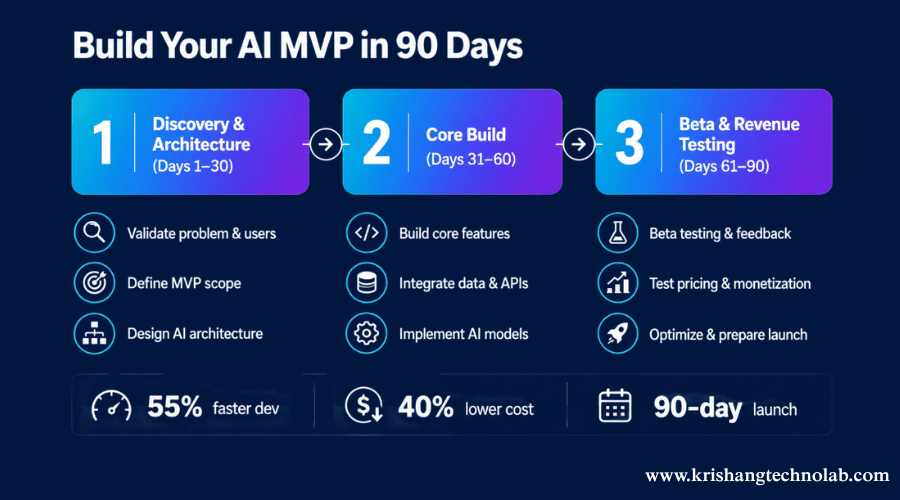
Workflows driven by AI usually cut traditional development times by 40 to 50 percent. A typical startup MVP that used to take 3 to 6 months can now be built, tested, and launched in 6 to 10 weeks when you combine AI automation with professional human engineering. Developers using AI coding assistants complete tasks 55% faster, according to a GitHub survey.
The cost of delay is no longer just time.
Every week of development without user feedback is a week of building on assumptions. In a market where competitors can ship fast using the same AI tooling you have access to, a 9-month runway to launch means someone else already found product-market fit and started acquiring customers in your space. If you want to understand how AI is changing the speed of the entire build process, the breakdown in this guide to AI-powered software development covers the tooling and workflow shift in detail.
Investor interest cycles are shorter.
Warm introductions and investor conversations have a limited duration. Founders who can walk into a follow-up meeting with real user data even from 50 users close faster than founders who show polished decks and nothing live.
The 90-day window breaks into three clean phases: 30 days for discovery and architecture, 30 days for core build, and 30 days for testing, iteration, and first revenue conversations.
Custom software development services built around this model keep scope tight, teams focused, and decision points clear.
Learn More About: Why MVP Development Matters for Startups in 2026
The 5-Phase AI MVP Development Process Startups Use to Hit Revenue Fast
Phase 1: Discovery and Problem Definition (Days 1–14)
This phase is about brutal scope reduction. The trick is to find the one problem that the AI can solve better than any existing solution and to find the smallest version of that solution that is worth testing.
Key deliverables: user persona documents, a problem statement, a competitive landscape, and a hypothesis statement that says, “We believe [user type] will [take action] because [AI solves X pain], and we’ll know it’s working when [measurable signal].”
Phase 2: Data Strategy and Architecture (Days 10–25)
AI products live or die on data. This phase defines what data the model needs, where it comes from, how it is cleaned and structured, and what the feedback loop looks like post-launch. Many founders underestimate data preparation costs; acquiring and cleaning data for a simple MVP can cost anywhere from $3,000 to $8,000 on its own.
The architecture decisions made here multi-tenant vs. single-tenant, vector database vs. relational, API-first vs monolith affect every scaling decision that comes after. For most AI MVP development in 2026, the standard backend stack is Python with FastAPI, a vector database for retrieval-augmented generation use cases, and an LLM API rather than a self-hosted model. Choosing the right AI tech stack for startups matters before you write a single line of code, not after. Part of the reason is knowing which technologies can stand up to the pressure of production.
If your product includes a mobile app, this phase also determines whether a cross-platform framework like React Native or Flutter fits or whether native development is justified by the app’s AI feature complexity.
Phase 3: Core Build (Days 20–55)
This is where the product is built, but the discipline is in what you refuse to build. Every feature request that does not directly test your core hypothesis goes into a backlog labeled “post-validation.” Third-party APIs can handle authentication, onboarding, and billing infrastructure. The engineering effort in this phase belongs to the AI feature, the data pipeline, and the user flow that proves the value proposition.
GitHub Copilot, Cursor, and similar AI coding assistants are standard in every professional custom software development workflow now. Teams report 30 to 50% reductions in coding time for repetitive patterns, authentication flows, CRUD operations, and API integrations that used to take days but now take hours.
Phase 4: Closed Beta and Iteration (Days 50–75)
Launch to 20–50 real users before the public release. These are not friends who will be polite. They are potential paying customers who match your ideal user profile. Structured feedback sessions, in-app event tracking, and direct interviews during this phase produce the data that decides whether you pivot, double down, or kill the product.
This phase is where AI consulting services add significant value helping teams read feedback signals correctly, distinguish preference data from behavior data, and avoid the common trap of building what users say they want rather than what the usage data shows they actually need.
Phase 5: Revenue Testing and Iteration (Days 70–90)
Before launching publicly, test willingness to pay. This means presenting a pricing page, running a pre-launch waitlist with pricing tiers visible, or asking beta users directly during exit interviews. Revenue signal at this stage does not require 1,000 customers. It requires enough signal to either validate continued investment or catch a fundamental pricing or positioning problem early.
Explore Related to Read: A Step-by-Step MVP Development Process
Top AI Tools and Tech Stack for MVP Development in 2026
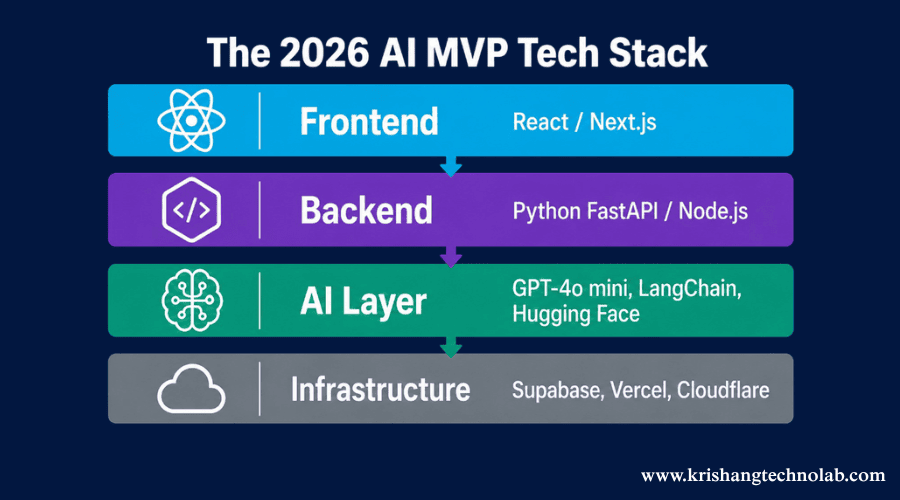
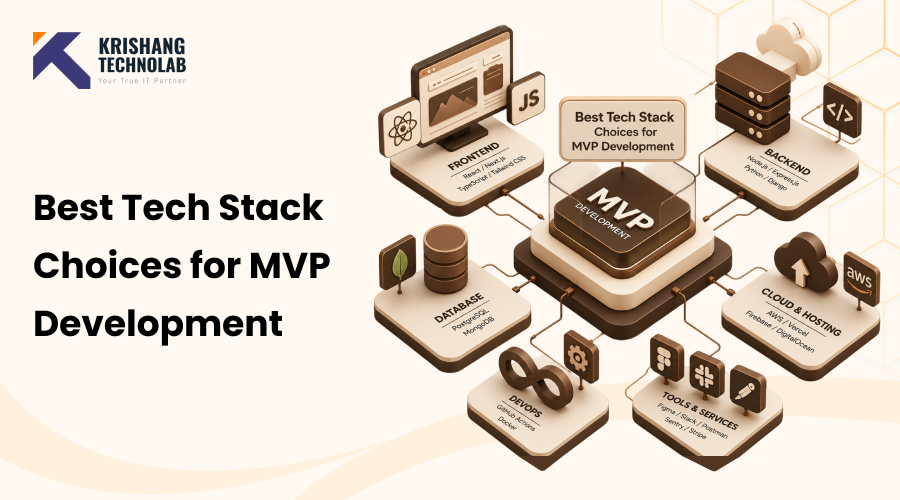
The standard AI MVP stack in 2026 is well-established. For most web-based products, the combination that delivers the best balance of speed, cost, and production scalability includes:
- Frontend: React or Next.js; large talent pool, extensive tooling, proven in production
- Backend: Python with FastAPI (for AI workloads) or Node.js / Laravel for standard SaaS logic
- Database: Supabase (PostgreSQL, authentication, file storage, and pgvector in one managed service) or PlanetScale
- AI Layer: GPT-4o mini for most MVP workloads at $0.15 per million input tokens, LangChain or LlamaIndex for orchestration, Hugging Face for open-source model access
- Infrastructure: Vercel for frontend, Railway or Render for backend, Cloudflare for edge performance
For teams building generative AI products, the LLM API + vector database pattern is the default starting point. Fine-tuning is almost never justified at the MVP stage; prompt engineering and retrieval-augmented generation can achieve 90% of the same result at a fraction of the cost and timeline.
AI coding tools across the build: GitHub Copilot (20 million+ users), Cursor, and Claude for code review and documentation. If you’re evaluating which AI coding platforms actually improve output quality and speed for product teams, the roundup of the best vibe coding tools is a useful reference before committing to a toolset. Teams that combine multiple assistants based on task types consistently outperform those locked into a single tool.
How Much Does AI MVP Development Cost in 2026?
Cost ranges vary widely depending on complexity, team composition, and whether AI features are built on third-party APIs or custom models.
- Simple no-code or API-first AI MVPs: $15,000 to $40,000 over 6 to 10 weeks
- Mid-complexity AI SaaS with custom data pipelines: $40,000 to $100,000 over 10 to 16 weeks
- Complex AI products with custom model training or fine-tuning: $140,000 to $300,000+
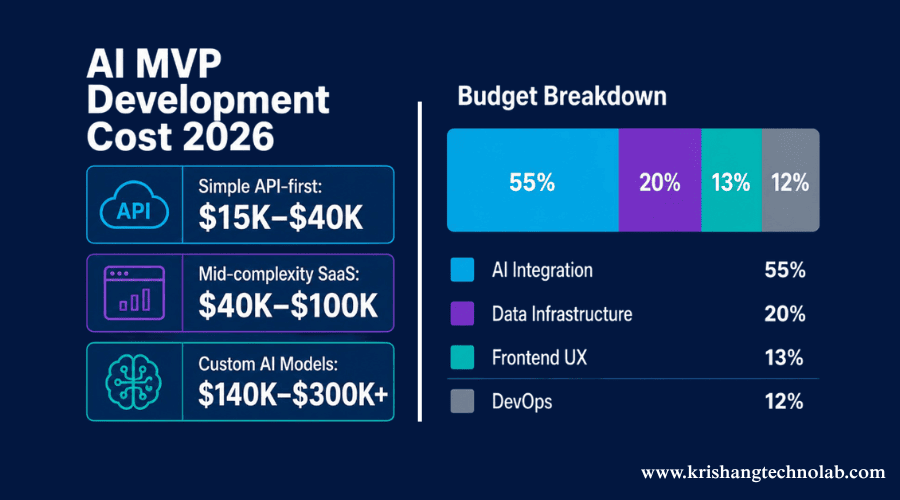
Where the budget typically goes for a mid-range AI MVP:
- AI integration and development (50–60% of budget): AI/ML engineer time, model fine-tuning, prompt engineering
- Data infrastructure (15–25%): vector databases, data cleaning pipelines, storage
- Frontend and UX (10–15%): interface, onboarding, responsive design
- DevOps and infrastructure (5–10%): CI/CD, cloud setup, monitoring
Outsourcing to an experienced offshore development center can reduce these costs by 40 to 60% without reducing output quality, but only when the partner has a proven track record with AI-specific development, not just general software delivery. A closer look at how to structure that hiring decision, including model comparisons and real cost ranges, is covered in depth in this guide to hiring dedicated developers’ costs.
One cost founders consistently underestimate is data preparation. Acquiring and cleaning data can cost $3,000 to $8,000 on simple projects and $10,000 to $90,000 for complex machine learning applications requiring extensive labeled datasets.
Explore More: What Is the Difference Between an MVP and a Full Product?
Common Mistakes That Kill AI MVPs Before They Generate Revenue
1. Building the model before validating the problem.
This mistake is the most common and costly error in the development of AI MVPs. Teams spend weeks fine-tuning models or building data pipelines before confirming that the problem they are solving is one real users will pay to solve. Validation costs almost nothing. Custom model development costs tens of thousands of dollars.
2. Scope creep disguised as “must-haves.”
Every feature that does not directly test your core hypothesis belongs in a backlog. AI products constantly attract feature ideas because the technology opens up so many possibilities. The founders who ship in 90 days are ruthless about what stays out.
3. Choosing the wrong monetization model at launch.
SaaS MVPs in 2026 will tend to charge on API calls, seats, or compute usage rather than flat subscriptions. If you’re going to market early with Stripe Billing or Paddle and you build your product around measurable usage events, it makes iterating on pricing so much easier post-launch.
4. Underestimating data quality problems.
81% of companies report struggling with data quality, and it consistently costs more to fix after building than before. A machine learning development team that identifies data quality risks during discovery protects the entire timeline.
5. Building for investors instead of users.
A polished demo that impresses investors but does not actually solve a user problem does not generate revenue. Build for the person who will use it daily.
How to Validate Your AI Product Idea Before Writing a Single Line of Code
Validation is the most underused phase in AI product development. Large language models are now helping founders validate faster than ever by running competitive analysis, identifying search demand, modeling personal needs, and stress-testing value propositions before a single line of code is written.
A practical pre-build validation checklist:
- Problem interview: Talk to 15 to 20 people who match your target user profile. Ask about the problem and not about your solution. Please. See the description of pain.
- Search demand analysis: Verify that people are looking for the solution using Ahrefs, Semrush, or Google Search Console. No demand searches usually mean no urgency to buy.
- Competitor gap mapping: Identify three to five existing solutions. Chart their weaknesses. Your AI MVP needs to be targeted at a specific gap, not the entire problem space.
- Willingness-to-pay signal: A simple landing page with a pricing table and a “join waitlist” form gives a real signal faster than any survey. Track how many visitors click the pricing tier vs. how many leave.
- AI-assisted validation: Use LLMs to simulate user interviews, generate objection trees, and identify edge cases in your core value proposition before the build starts.
Teams working with an AI consulting services partner at this stage often surface critical product risks in week one that would otherwise cost months of engineering time to uncover.
Real-World AI MVP Examples: From Idea to First Revenue in Under 90 Days
There are three patterns that always generate early revenue in the AI MVP category:
1. Vertical AI Agents:
A narrow automation tool that replaces one high-cost manual workflow in an industry. e.g., AI-powered extraction of invoices for accounting companies, drafting clinical notes for healthcare organizations, and generating job descriptions for HR teams. These products win because the ROI math is instant and easy for the purchaser to do.
2. Intelligent SaaS Add-Ons:
Teams that integrate AI capabilities into existing software workflows rather than asking users to adopt an entirely new tool see faster adoption. A ChatGPT integration layer on top of an existing CRM or project management tool, for example, can be built and revenue-tested within 60 days.
3. Data-to-Insight Products:
Companies sitting on proprietary data sets in logistics, real estate, healthcare, and finance can build AI MVPs that surface patterns from that data and sell access to the insights. The data moat becomes the competitive advantage, and the AI layer becomes the interface. To understand how AI in software development is enabling these patterns across industries, the use-case breakdown is worth reviewing before you define your product’s AI layer.
What these examples share: a single, specific, high-value problem solved by a narrow AI capability. No attempt to build a platform on day one.
When to Scale Your AI MVP Into a Full Product
The signal to scale is not time; it is evidence. Specifically, look for three things simultaneously:
- Retention: Are users coming back to the product without being prompted? In AI tools, 40% week-two retention is a meaningful positive signal for consumer products; 70%+ for B2B tools indicates strong product-market fit.
- Willingness to pay: Are users upgrading from free tiers or renewing paid plans on their own initiative? Organic renewal is the most honest signal of value creation.
- Referral behavior: Is the product being mentioned without prompting? In B2B AI tools, even two or three unsolicited referrals within the first 90 days indicate strong word-of-mouth potential.
When all three signals are present, it is time to invest in custom web application development for the full platform, rebuilding the data architecture for scale, expanding the feature set, hardening security and compliance, and building the team to support growth. Scaling before these signals are present is where most startup budgets disappear.
How to Choose the Right AI Development Partner for Your Startup
The partner question deserves more weight than founders typically assign it. Technical capability matters, but it is not the only dimension.
What to evaluate:
- AI-specific track record. AI development companies are not general web development agencies. Look for previous projects with AI or ML aspects in particular, not just slick web stuff.
- Discovery process: If a partner skips a formal discovery phase and goes straight to a proposal, they are putting their revenue before your result. The right partner asks tough questions about your problem, your data, and your assumptions before quoting a number.
- Communication and speed of iteration. You need fast feedback loops with a 90-day timeline. Ask specifically about how the team handles scope changes, how often they ship working builds for review, and how decisions are made when requirements are at odds.
- Post-launch support An AI MVP that launches isn’t done. Model performance degrades, user feedback surfaces new requirements, and infrastructure needs monitoring. Understand what ongoing support looks like before signing.
If you are evaluating vendors and want a structured framework for that process, the guide on how to choose an AI software development partner covers the specific criteria, portfolio review, discovery process, post-launch SLA, and red flags that separate reliable AI partners from generalist agencies claiming AI expertise.
Whether you work with an AI development company or build in-house with dedicated developers, the most important characteristic is alignment with what success looks like at day 90, not just what gets delivered.
Conclusion
The 90-day AI MVP development is not a deception. It is a disciplined methodology for generating real market signals before committing to full-scale product development. It works because it forces clarity: one problem, one user, one testable hypothesis, the smallest possible AI feature that proves the point.
The startups generating revenue in 2026 are not the ones with the biggest AI ambitions. They are the ones who launched something real, put it in front of users who matched their target profile, measured the right signals, and iterated quickly on what they learned.
The tools exist. The frameworks are proven. The 90 days are yours to use.
Found this post helpful? Don't forget to share it with your network!