
Quick Overview: Offshore software development offers cost savings, access to global talent, and scalability, while Offshore vs Onshore Software Development highlights how onshore development provides easier communication, cultural alignment, and greater project control. The right choice depends on your business needs, budget, and goals.
Choosing where your software gets built is one of the biggest decisions you will make before writing a single line of code. After all, it shapes your budget, your timeline, how your team communicates, and even how easily you can scale. Therefore, the debate around offshore vs onshore software development is not about which model is universally better. Instead, it is about which one fits your project, your budget and your business goals.
This guide breaks down both models and compares them across the factors that matter most. Finally, it gives you a practical framework for choosing the right software development outsourcing strategy.
What Is Offshore vs Onshore Software Development?
Both models are forms of offshore software development outsourcing. However, the difference comes down to geography: where your development partner is located relative to you. As a result, grasping the onshore vs offshore meaning and onshore vs offshore differences helps companies pick the right development model based on their budget, communication needs and project requirements.
What Is Offshore Software Development?
Offshore software development means hiring a development team or company in a distant country, usually in a different time zone, to build or maintain your software. A business in the United States or the United Kingdom, for example, might work with an offshore development team through professional offshore development services offered by an experienced offshore software development company in usa, Vietnam, the Philippines or Ukraine.
Companies typically access offshore software development services in one of three ways: hiring an offshore software development company for a complete project, building a dedicated offshore development center that works exclusively for them, or adding individual offshore developers to an in-house team. Offshore web development, mobile app development, QA testing and long-term maintenance are all common use cases.
The main draw is cost efficiency combined with access to a large talent pool.
What Is Onshore Software Development?
Onshore software development means that you’re working with a development team or company that’s based in your own country.An onshore development is when a Canadian company hires an agency in Toronto or a German company partners with a software house in Berlin.
The benefit of onshore software development services is that language, culture, business hours and legal systems are the same.Collaboration is like working with an in-house team, but at a premium price.
Key Differences Between Offshore and Onshore Software Development
The difference between offshore and onshore software development is based on few trade-offs :
- Location: Offshore teams are in another country and time zone, onshore teams are in yours.
- Cost:Offshore is usually cheaper per hour, onshore is more expensive.
- Communication: Onshore permits real time overlap and cultural familiarity, offshore requires more purposeful coordination.
- Talent access: Offshore gets you global, onshore keeps you local.
- Compliance: Onshore keeps you within one legal framework; offshore adds cross-border considerations.
Besides these two, you may also hear about a third option. Nearshore development sits between the two, using teams in neighboring countries or nearby time zones (for example, a US company working with a team in Mexico or Colombia). We cover how it compares with Offshore vs Onshore Software Development in the FAQ below.
Offshore vs Onshore Software Development: Key Differences Compared
Here is how the two models stack up across the areas that most affect project outcomes.
Development Costs and Pricing Models
First of all, cost is usually the first factor businesses compare. Although hourly rates vary widely by region and seniority, as a rough guide, onshore developers in the US or Western Europe often charge roughly $80 to $200 per hour. By comparison, offshore development rates in regions such as South Asia or Southeast Asia commonly fall between $20 and $60 per hour. Meanwhile, Eastern Europe sits in the middle.
Both options have similar pricing structures:
- Fixed price: Best for well defined projects with clear scope.
- Time and materials: Preferably with changing requirements.
- Dedicated team: A monthly fee for a team that works only on your product, popular with offshore providers.
The headline savings of offshore are real, but the full picture includes hidden costs, which we cover in the cost comparison section below.
Communication and Collaboration
Onshore teams share your language, communication norms and business culture. Misunderstandings are less likely, and quick calls or in-person workshops are easy to arrange. These factors are important when comparing Offshore vs Onshore Software development for your business.
Offshore teams can communicate just as effectively, but it takes more structure: clear documentation, defined channels, regular video calls and a strong project manager. Language fluency and cultural differences in how feedback is given can affect software development team collaboration, so vetting communication skills matters as much as vetting technical skills.
Time Zone and Work Schedule Differences
Without a doubt, time zone gaps are the most visible challenge of offshore development. For instance, a 9 to 12 hour difference can mean limited real-time overlap, slower answers to urgent questions and delayed decisions.
Nevertheless, well-run teams turn the gap into an advantage. Work handed off at the end of your day, for example, can be waiting for review the next morning. Moreover, many offshore providers adjust schedules to give you several hours of overlap each day. Therefore, this is an important consideration when evaluating Offshore vs Onshore Software Development.
Development Quality and Technical Expertise
Quality depends on the specific team, not the country. Strong engineers exist everywhere, and weak ones do too. Offshore markets such as India, Poland and USAhave large engineering communities with expertise in cloud, AI development, mobile and enterprise systems.Onshore teams can provide more detailed knowledge of local markets and regulations.
When deciding on Offshore vs Onshore Software development quality, focus on portfolios, client references, code review practices, testing processes and certifications, don’t assume location equals quality.
Project Management and Control
Onshore engagements mean it’s easier to manage hands-on, you can meet face-to-face, see workflows and make quick adjustments. Offshore engagements require more process discipline.Visibility is key, agile methods, sprint reviews, shared project boards and transparent reporting.
If you have limited experience managing remote teams, a provider that supplies its own experienced project manager can close the gap.
Data Security and Intellectual Property Protection
Security is a legitimate concern in any outsourcing relationship. Onshore partners operate under your country’s laws, so contracts, data protection rules and IP ownership are easier to enforce.
With offshore software development security, the question is less about the country and more about the provider’s practices. Look for ISO 27001 certification, SOC 2 compliance, secure development environments, access controls, NDAs and clear IP assignment clauses. IP protection in outsourcing should always be spelled out in the contract, regardless of location.
Benefits of Offshore Software Development
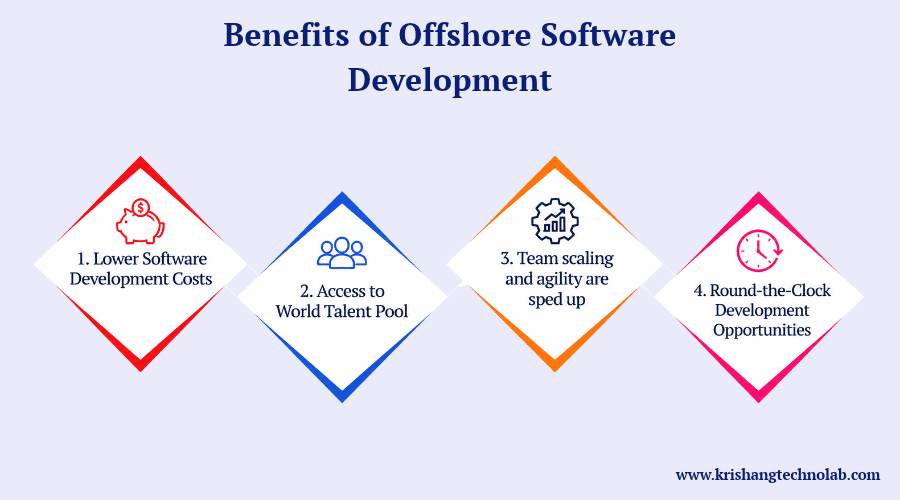
Lower Software Development Costs
The biggest advantage is offshore software development cost. Lower labor costs in many regions let businesses stretch budgets further, whether that means building an MVP faster, hiring a bigger team or investing more in testing and design. This can be the difference between launch or no launch for startups or cost-conscious projects.
Access to World Talent Pool
If local developers are scarce or costly, an offshore development team offers access to specialists in niche technologies like machine learning statistics, blockchain, embedded systems or legacy platform migration.With software offshore development, finding skilled professionals around the globe is a real option, as you are no longer limited to who you can find within commuting distance.
Team scaling and agility are sped up
One of the most practical advantages of offshore software development is its speed of scaling. Established offshore development companies can add developers, QA engineers or designers within weeks rather than the months local recruitment can take. When a project winds down, you can reduce the team just as easily, avoiding long-term hiring commitments.
Round-the-Clock Development Opportunities
Among the less obvious offshore development advantages is the follow-the-sun model. When teams are in different time zones, development, testing and support can happen almost 24 hours a day.This is especially helpful for products that require constant monitoring, rapid bug fixes, or worldwide customer support.
Benefits of Onshore Software Development
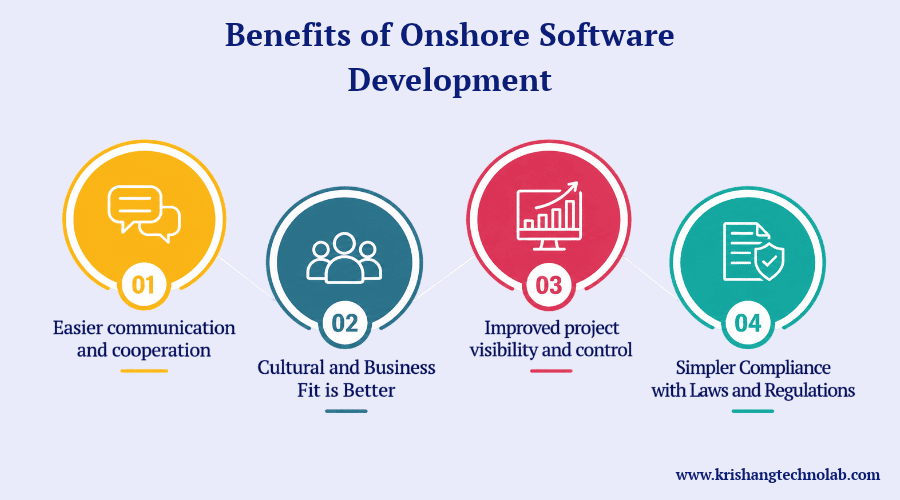
Easier communication and cooperation
The best pros of onshore software development are real-time communication and no language barriers.In the shared working hours, daily stand-ups, workshops and spontaneous problem-solving are part of the course.
Cultural and Business Fit is Better
An onshore development team knows your market, your customers and your business etiquette.For consumer products this means better instincts about what users expect, local payment methods, accessibility standards and design conventions.
Improved project visibility and control
In-person meetings, on-site discovery sessions, and simple audits are easy to perform with onshore software development services.And the transparency that comes with this is often more comfortable to stakeholders who prefer hands-on oversight.
“Simpler Compliance with Laws and Regulations
For industries such as healthcare, finance, government and defense, onshore software development outsourcing makes it easier to comply with regulations such as HIPAA, GDPR or local data residency laws. Contracts are covered by familiar legal systems and are easier to resolve disputes.
Offshore vs Onshore Software Development: Challenges to Consider
Offshore Development Challenges You’ll Encounter
Knowing the challenges of offshore software development helps you to plan around them:
- Time zone gaps that slow feedback and decision making.
- Communication and cultural differences that may lead to misaligned expectations.
- Quality inconsistency if the vendor is badly qualified.
- security and legal complexities across jurisdictions.
- Management overhead, such as extra documentation and coordination.
Good partners, clearly defined contracts and a structured communication plan can help manage these offshore outsourcing risks .
Common challenges with onshore development
Cost and capacity are the key onshore software development challenges:
- Higher rates are a burden on the budget, especially for long projects.
- Limited talent supply hubs with more competition also have a smaller talent pool, leading to slower hiring and higher salaries.
- Less scalability, since you can’t add people as fast or as cheap.
Moreover, onshore development costs sometimes rise in tight labor markets, making longer-term budgeting more difficult.
Offshore vs Onshore Software Development Cost Comparison
When considering offshore vs onshore software development cost, take into account more than just the hourly rate.
Factors influencing offshore development costs
Offshore software development cost depends on:
- Vendor country/region
- Developers seniority & tech stack
- Team size and involvement model
- Length and complexity of the project
- Reputation and Overheads of Vendors
- Foreign exchange rate
Cost Drivers for Onshore Development
Onshore software development cost influencing factors:
- Local and city Cost of living
- Demand for certain skills
- Agency size and brand positioning
- Employment Taxes and Benefits
- Urgency and scope of project
The Hidden Costs Businesses Should Account For
The cheapest quote isn’t always the cheapest overall cost. Search for:
- Management overhead: more time spent on coordination, documentation and meetings.
- Rework: Bad requirements or quality issues that work
- Travel: Site visits Workshops start
- Legal Compliance work: cross-border contracts, tax and data protection checks.
- Transition costs: knowledge transfer during vendor transition or going in-house.
- Tooling and security: Secure environments, VPNs and monitoring tools.
Which software development model has a better ROI?
Unfortunately, there is no single answer. On the one hand, offshore typically delivers a better return for large, well-defined, long-running projects where cost savings compound over time. On the other hand, onshore often wins on ROI for complex, fast-changing or highly regulated projects, where speed of communication and low risk of rework outweigh higher hourly rates.
A useful way to think about it: ROI is not just cost per hour. It is cost per working, shipped feature that meets your quality and compliance standards, along with vendor reliability.
Offshore vs Onshore Software Development: Which Is Better for Your Business?
Choosing between offshore and Offshore vs Onshore Software depends on your business goals, budget, project requirements, and communication preferences. The following table highlights the key differences to help you make an informed decision.
| Comparison Factors | Offshore Software Development | Onshore Software Development |
| Location | Development team is based in another country. | Development team is based in the same country. |
| Development Cost | Generally more affordable due to lower labor costs. | Usually more expensive due to higher local salaries. |
| Talent Availability | Access to a global pool of skilled developers. | Limited to the local talent market. |
| Communication | May involve language and time zone differences. | Easier communication with similar working hours. |
| Time Zone | Different time zones can support round-the-clock development. | Similar time zones make real-time collaboration easier. |
| Project Management | Requires clear coordination and communication processes. | Easier direct supervision and project coordination. |
| Cultural Differences | May require adjustments to working styles and business practices. | Better cultural and business alignment. |
| Scalability | Easier to expand teams with global talent. | Scaling may take more time and budget. |
| Quality of Work | Depends on the provider’s expertise and processes. | Depends on the provider’s expertise and processes. |
| Data Security | Requires careful evaluation of international data protection standards. | May offer simpler compliance with local regulations. |
| Best For | Businesses seeking cost savings, global expertise, and flexible scaling. | Businesses prioritizing direct collaboration, local expertise, and greater control. |
Offshore vs. Onshore Software Development Comparison Offshore development is an excellent option for companies who want to be cost effective, scalable and have access to global talent.Onshore development is the preferred option for businesses that want to engage in direct communication, work with local partners and have greater command over the development process.
Offshore vs Onshore Software Development: What is the best choice?
Use this 5-step framework for your software development outsourcing strategy.
Define Your Project’s Requirements and Budget
Be clear at the start. Your goals, features, timeline, and budget range:Fixed, well-defined projects work well with offshore teams, but exploratory projects with a lot of change may be better suited to onshore collaboration.
Evaluate Technical Expertise and Experience
Next, whether you are learning how to choose offshore software development partners or selecting an onshore development company, check portfolios, case studies in your industry, client reviews, team composition and the technologies they use daily. Also, ask to meet the actual developers, not just the sales team.
See Time Zone Compatibility and Communication
Then, ask how many hours of overlap the team can provide, what communication tools they use, and how they report progress. Since their responsiveness during the evaluation phase is a great preview of the working relationship, be sure to test them out.
Verify compliance and security standards
Certifications, data handling, access control, AI Consulting Services, and terms of IP ownership are important considerations. If you’re in a regulated industry, make sure the vendor has experience with those specific requirements.
Look for long-term support and scalability
Finally, don’t just think about the launch. When you evaluate Offshore vs Onshore Software Development vendors, ask whether they will provide support for maintenance, updates and growth. Can they add developers quickly? Ultimately, a partner who can scale with you saves the pain of switching later.
When Should You Choose Offshore or Onshore Software Development?
Key reasons to choose offshore development:
When to go offshore:
- Budget is main constraint
- You need to build a team fast
- You need specialized skills that are hard to come by locally
- Well defined and documented project scope
- You can work with asynchronous or partially overlapping schedules
- You need ongoing development or support across time zones
When Onshore Software Development Is the Better Choice
Select onshore when:
- The project is very complex or fast moving
- You need to work together face-to-face frequently
- Regulatory or data residency rules are stringent
- Cultural fit and local market knowledge are important
- The project is small and short so the savings would be small .
Which Model is Best for Startups, SMEs and Enterprises?
- Startups: Offshore is often the way to go to build an MVP on a limited runway.Some founders do a hybrid. Onshore product lead, offshore engineering.
- SMEs: A mixed model is good.Keep the strategy and product ownership close and outsource the development to control cost.
- Enterprises: Big companies generally use both.Sensitive or regulated systems are kept in-house or onshore while scalable workloads such as QA, maintenance and feature development are moved to an offshore development center.
Conclusion
Offshore development wins on cost, talent access and scalability. Onshore development wins on communication, cultural alignment, control and compliance. Neither is automatically better. Krishang Technolab helps businesses choose the right development approach based on their project requirements.
Your decision should rest on four factors: budget, project complexity, communication needs and scalability. A well-defined project with a modest budget points toward offshore. A complex, regulated or fast-evolving product points toward onshore. Many businesses land on a hybrid model that combines the strengths of both.
The best choice is the one that matches your business requirements, and the right partner matters more than the location on the map.
You’re ready to start building your software, right? Chat with our team about offshore & onshore software development services that are customized to meet your goals, budget and timeline.
Frequently Asked Questions (FAQs)
What is the difference between onshore and offshore software development?
Offshore development involves a team in a distant country, usually with a large time difference. Onshore development involves a team in your own country.Offshore tends to be cheaper and more scalable, while onshore is easier to communicate with and easier to comply with.
Is offshore software development cheaper than onshore development?
Yes, generally. Offshore hourly rates are usually 40 to 70 percent lower. However, there are some hidden costs such as management overhead and rework that can narrow the gap. Therefore, compare the total cost of the project and not just the rates.
What are the benefits of offshore software development?
The key advantages include cost savings, access to a worldwide talent pool, quick scaling of teams, flexibility and the possibility of round-the-clock development.
What are the cons of Onshore software development?
Onshore development is generally more expensive, has a smaller talent pool and takes longer to scale.In competitive markets, finding good developers locally can be slow and expensive.
What is better for startups: offshore or onshore software development?
For early stage startup with a constrained budget and a defined MVP, offshore is often a better solution.Startups in regulated industries, or that need lots of day-to-day interaction, may go for an onshore or hybrid model.
How to choose the right software development outsourcing model?
Work out your budget, scope and timescales. Then rate vendors on technical expertise, communication, security standards and scalability. Run a small pilot project if possible before committing to a long engagement.
What is the difference between offshore, onshore, and nearshore development?
Onshore teams are in your country, nearshore teams are in nearby countries with similar time zones (such as a US company working with Latin America), and offshore teams are in distant countries with large time zone differences. Nearshore usually balances cost and convenience, falling between the other two on price.
How to Manage Offshore Software Development Teams?
Know exactly what you want and what you will accept. Work in sprints, using agile . Regular video check-ins are recommended. – Agree on overlapping working hours; Leverage common project management and code review tools Define KPIs and assign a project manager.Think of the offshore team as your team, not some other vendor.
Found this post helpful? Don't forget to share it with your network!