Quick Overview: Explore the differences between AI and automation, their similarities, and real-world applications. Learn how AI-powered automation improves business efficiency, key implementation steps, challenges, and future trends like generative and agentic AI transforming modern business operations.
Businesses are increasingly using automation to boost productivity, reduce manual labour, and optimise their systems. AI and automation are often used to refer to the same thing because both aim to make things faster and more efficient. They do, however, do different things and have different abilities.
The main goal of automation is to do things over and over again by following rules that have already been set. Artificial intelligence (AI), on the other hand, adds the ability to learn, make decisions, and change. Automation and machine learning collaborate to enhance operational efficiency. As they evolve, they can tackle more complex tasks and improve their performance over time.
As technologies like generative AI and agentic AI continue to develop, businesses are moving from simple automation to more complex systems that can manage themselves. With these innovations, businesses can now automate a wider range of tasks beyond the traditional, repetitive ones. These workflows can now also be decision-driven and have more than one step.
This guide will talk about the main similarities and differences between AI and automation. It will also talk about how agentic and generative AI are changing the future of intelligent automation.
What is Automation?
Technology can be used to make things run on their own, without someone having to help them all the time. Automation lets systems do things quickly, correctly, and consistently, which means people don’t have to do the same thing over and over again.
This is common for things like automatic order confirmations, scheduled emails, and recurring bill payments. Automation makes it easier for businesses to do things like process data, keep records up to date, and manage workflows.
Businesses should automate tasks that need to be done a certain way or that they do a lot of times. This saves time and money, and it lets teams work on more important things.
Types of Automation
There are different kinds of automation, and businesses use them in different ways.
1. Business Process Automation
focuses on making work tasks like approvals, onboarding, and managing documents easier that happen every day. It can enhance team collaboration and reduce delays.
2. Workflow Automation
The text links various tools and facilitates smooth transitions between tasks. For example, workflow automation can assign a new lead to a sales representative and arrange follow-up calls as soon as the lead is received.
3. Robotic Process Automation (RPA)
Software bots can mimic human actions on computers. These bots are capable of copying data, filling out forms, and generating reports independently.
4. IT Automation
Helps with technical tasks like updating software, keeping an eye on the system, and making sure it’s safe. This saves IT teams time and makes the system more reliable.
Various forms of automation enable companies to operate more efficiently, rapidly, and intelligently. Automation is becoming an important part of modern business operations as more companies use digital tools.
What is Artificial Intelligence (AI)?
Artificial intelligence (AI) refers to the area of technology that empowers machines to think and behave like humans. AI systems can learn from data, identify patterns, and make decisions, distinguishing them from traditional automation. As a result, businesses are now able to manage complex tasks, achieve better outcomes, and adapt to changing circumstances.
Artificial intelligence is used in many fields to boost productivity, make customers happier, and help people make smart choices. By automating tasks such as chatbots and recommendation systems, AI enables businesses to perform more intelligently.
Types of Artificial Intelligence
Artificial intelligence comes in a few different types that are often used in business and technology:
- Machine Learning – allows systems to gradually improve their performance by learning from data without the need for explicit programming.
- Natural Language Processing (NLP) – Enables machines to comprehend and respond to human language, facilitating applications such as chatbots and virtual assistants.
- Computer Vision – Enables systems to interpret images and videos, commonly applied in areas such as facial recognition and quality inspection.
- Predictive Analytics – Utilises data to predict trends and outcomes.
These technologies serve as the fundamental basis for contemporary AI applications.
Examples of AI
Artificial intelligence has become a crucial aspect of our everyday lives. Below are some common examples:
- Chatbots used for customer support
- Recommendation systems used on shopping platforms
- Voice assistants integrated into smartphones
- Fraud detection in the banking sector
- Personalised marketing and content recommendations
The examples provided demonstrate how AI allows businesses to function more efficiently while also improving user experiences.
Related to Read: Tech Stack for AI Startups
What is the Difference Between AI and Automation?
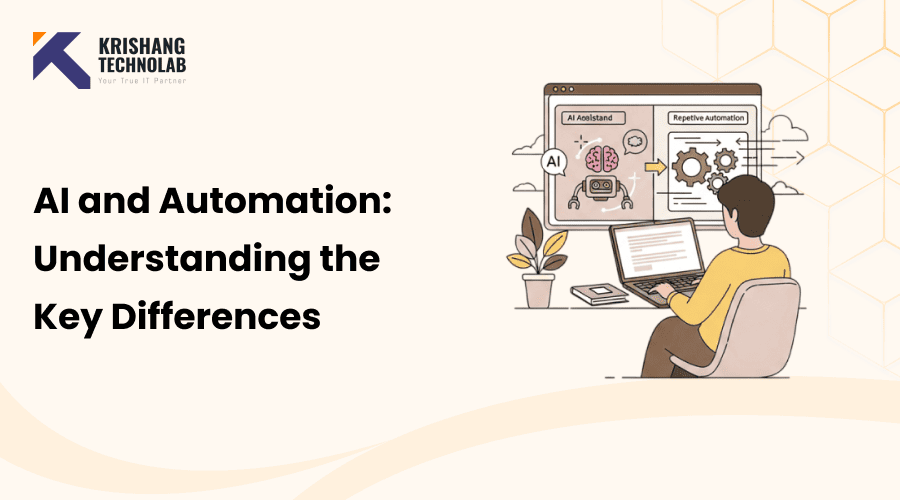
Automation and AI are often talked about together because they both make business run more smoothly and cut down on the amount of work that needs to be done by hand. However, they serve distinct purposes. Automation is the process of doing things based on rules that have already been set. AI, on the other hand, has the ability to learn, think, and make decisions.
Artificial intelligence (AI) is designed to deal with complex situations that need analysis and the ability to adapt. Automation is best for tasks that are done over and over again and can be predicted. When you combine AI and automation, you get smart workflows that make operations more productive and efficient.
Similarities Between AI and Automation
- Improving Efficiency and Productivity: Both Artificial Intelligence and automation are designed to increase efficiency and productivity. They help businesses reduce manual effort, speed up processes, and minimize errors, allowing teams to focus on higher-value tasks.
- Task Execution: At a fundamental level, both AI and automation involve machines performing tasks. These tasks can range from simple operations to more complex business processes, reducing the need for manual intervention.
- Supporting Digital Transformation: AI and automation play a key role in digital transformation. Organizations use these technologies to modernize operations, enhance customer experiences, and improve overall performance.
- Scalability and Operational Growth: Both technologies help businesses scale operations more effectively. They enable organizations to handle increasing workloads without significantly increasing resources.
Differences Between Artificial Intelligence and Automation
Automation vs AI differ primarily in intelligence, adaptability, and decision-making capabilities. Automation follows predefined instructions, while AI learns from data and improves over time.
Here’s a side-by-side comparison to provide a clearer overview of their differences.
AI vs Automation Comparison
| Feature | Automation | Artificial Intelligence (AI) |
| Definition | Rule-based task execution | Intelligent systems that learn and adapt |
| Learning Capability | Does not learn | Learns from data and improves over time |
| Decision Making | Follows predefined rules | Makes data-driven decisions |
| Task Complexity | Best for repetitive tasks | Handles complex and dynamic tasks |
| Data Handling | Works with structured data | Works with structured and unstructured data |
| Flexibility | Limited flexibility | Highly adaptable |
| Improvement Over Time | Requires manual updates | Self-improving with new data |
| Use Cases | Workflow automation, scheduling, data entry | Chatbots, predictions, recommendations |
By combining automation and artificial intelligence (AI), businesses can create smarter workflows that are both efficient and adaptable.
Read About: Artificial Intelligence Statistics for Small Business 2026
How is AI Used in Automation?
AI is transforming traditional automation by making it more intelligent, flexible, and capable of handling complex tasks. While automation follows predefined rules, artificial intelligence enables systems to learn from data, make decisions, and adapt to changing conditions. This combination, often referred to as AI-powered automation, helps businesses automate not just repetitive tasks but also more advanced workflows.
By integrating AI into automation, organizations can improve accuracy, reduce manual intervention, and optimize operations. This approach allows businesses to move beyond simple automation and create smarter, more efficient processes.
AI-Powered Automation Explained
AI-powered automation combines automation tools with artificial intelligence technologies such as machine learning development, natural language processing, and predictive analytics. This allows systems to analyze data, understand context, and make decisions automatically.
For example, traditional automation might route support tickets based on keywords. AI-powered automation, however, can understand the intent behind a request and assign it to the right team more accurately. Over time, the system learns from past interactions and improves its performance.
AI-powered automation helps organizations:
- Handle complex workflows
- Reduce manual decision-making
- Improve accuracy and efficiency
- Adapt to changing business needs
This makes AI-powered automation especially valuable for dynamic and data-driven environments.
Types of AI in Automation
There are several ways AI is used to enhance automation:
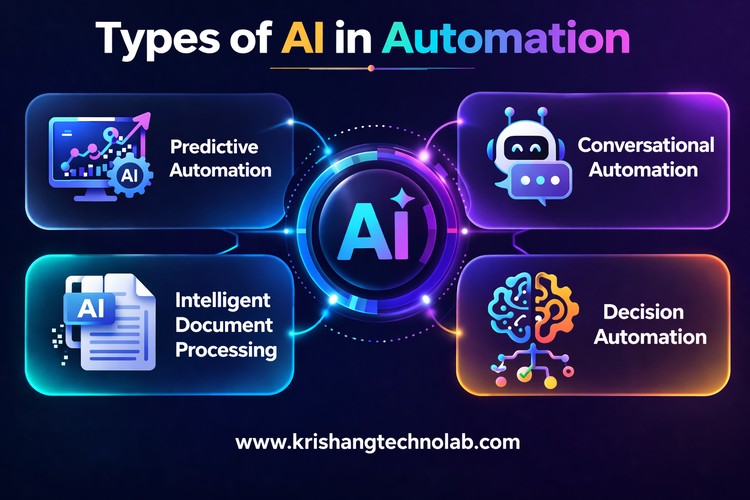
1. Predictive Automation
Predictive automation uses AI to analyze historical data and forecast outcomes. Businesses use this to predict customer behavior, demand trends, or system failures and trigger automated actions.
2. Conversational Automation
Conversational automation uses AI-powered chatbots and virtual assistants to handle customer interactions. These systems can understand natural language and respond intelligently.
3. Intelligent Document Processing
AI can extract and process information from documents such as invoices, contracts, and forms. This reduces manual data entry and speeds up workflows.
4. Decision Automation
AI helps automate decision-making by analyzing data and recommending actions. This is commonly used in finance, marketing, and operations.
Real-World Examples of AI and Automation
AI and automation are widely used across industries to improve efficiency and productivity.
- Customer Support: AI-powered chatbots automate responses, route tickets, and provide 24/7 support, improving customer experience.
- Marketing Automation: AI analyzes customer behavior and automates personalized email campaigns, recommendations, and content delivery.
- HR and Recruitment: AI screens resumes, schedules interviews, and automates onboarding processes, reducing manual work for HR teams.
- Finance and Accounting: AI automates invoice processing, expense tracking, and fraud detection, improving accuracy and efficiency.
- IT Operations: AI monitors systems, detects anomalies, and automatically resolves issues, helping maintain system performance.
These examples show how AI with automation work together to create smarter, more efficient business operations.
Read About: Why 72% of Companies Prefer Dedicated Developers
How Can You Start a Business with AI-Based Automation?
Getting started with AI-based automation doesn’t have to be complex. By following a few simple steps, businesses can gradually introduce AI and automation into their workflows and improve efficiency.
1. Identify Your Business Need
Start by identifying repetitive or time-consuming tasks. These processes are ideal candidates for AI-based automation and can deliver quick results.
2. Research Available Technologies
Explore AI & automation tools that match your business requirements. Consider factors like features, scalability, and integration with existing systems.
3. Select Your Tool
Choose a solution that fits your needs, budget, and future growth. A user-friendly and scalable tool helps ensure long-term success.
4. Implement
Begin with a small project and test your automation. This allows you to refine workflows before expanding across your organization.
5. Monitor and Optimize
Track performance and continuously improve your automation. Regular optimization helps maximize efficiency and business value.
Read More About: A Complete, In-Depth Guide to Mastering AI Communication
Challenges of AI-Based Automation and How to Overcome Them
While AI-based automation offers significant benefits, businesses may face several challenges during adoption. Understanding these challenges and how to address them can help ensure a smoother implementation.
1. High Implementation Costs
AI-based automation can require upfront investment in tools, infrastructure, and training. This can be challenging, especially for small businesses.
How to overcome: Start with small, high-impact use cases and scale gradually. Many cloud-based AI tools also offer flexible pricing.
2. Data Quality and Availability
AI systems rely on data to learn and make decisions. Poor-quality or limited data can affect performance.
How to overcome: Focus on collecting clean, structured data and gradually improve your data management practices.
3. Integration with Existing Systems
Integrating AI automation with current tools and workflows can be complex.
How to overcome: Choose solutions that support easy integration and start with systems that are easier to automate.
4. Skills and Knowledge Gap
Teams may lack experience with AI & automation technologies.
How to overcome: Provide training, start with user-friendly tools, or work with experts during the initial phase.
5. Change Management and Adoption
Employees may resist adopting new technologies due to uncertainty or fear of change.
How to overcome: Communicate benefits clearly and involve teams early in the implementation process.
By addressing these challenges early, businesses can successfully adopt AI and automation and unlock long-term efficiency and growth.
The Future of Artificial Intelligence and Automation
The future of artificial intelligence and automation is moving toward smarter, more autonomous systems that can handle complex tasks with minimal human intervention. As AI technologies continue to evolve, automation is no longer limited to repetitive workflows, it’s becoming more intelligent, adaptive, and capable of decision-making.
Businesses are increasingly using AI-powered automation to improve productivity, enhance customer experiences, and optimize operations. From predictive analytics to intelligent assistants, AI is enabling organizations to automate processes that once required human judgment.
Emerging innovations like Generative AI model development and autonomous AI agents are also shaping the future. These technologies can generate content, analyze data, manage workflows, and even make recommendations in real time. As a result, businesses can scale faster while reducing operational costs.
In the coming years, artificial intelligence and automation will continue to play a key role in digital transformation. Organizations that adopt these technologies early will gain a competitive advantage, improve efficiency, and unlock new opportunities for growth.
Why Choose Krishang Technolab for the Best AI Software Development Services?
Krishang Technolab delivers tailored Artificial Intelligence solutions designed to help businesses automate processes, improve decision-making, and drive innovation. Our team combines technical expertise with practical business understanding to build scalable and efficient AI-powered applications.
What sets Krishang Technolab apart:
- Custom AI Solutions – Built specifically for your business needs
- End-to-End Development – From strategy to deployment and support
- Scalable Architecture – Solutions designed to grow with your business
- Industry Expertise – Experience across multiple business domains
- Cost-Effective Development – High-quality solutions within your budget
Whether you’re looking to implement AI-powered automation, develop intelligent applications, or integrate AI into existing systems, Krishang Technolab helps you turn ideas into powerful, real-world solutions.
Conclusion
AI and automation are transforming how businesses operate by improving efficiency, reducing manual work, and enabling smarter decision-making. While automation focuses on rule-based tasks, artificial intelligence (AI) adds learning, adaptability, and intelligence. Together, AI and automation create powerful solutions that streamline workflows and enhance productivity.
With advancements in Generative AI, businesses can now automate more complex and creative tasks, moving beyond traditional automation. As these technologies continue to evolve, organizations that adopt AI-based automation early will be better positioned to scale, innovate, and stay competitive in the future.
Found this post helpful? Don't forget to share it with your network!