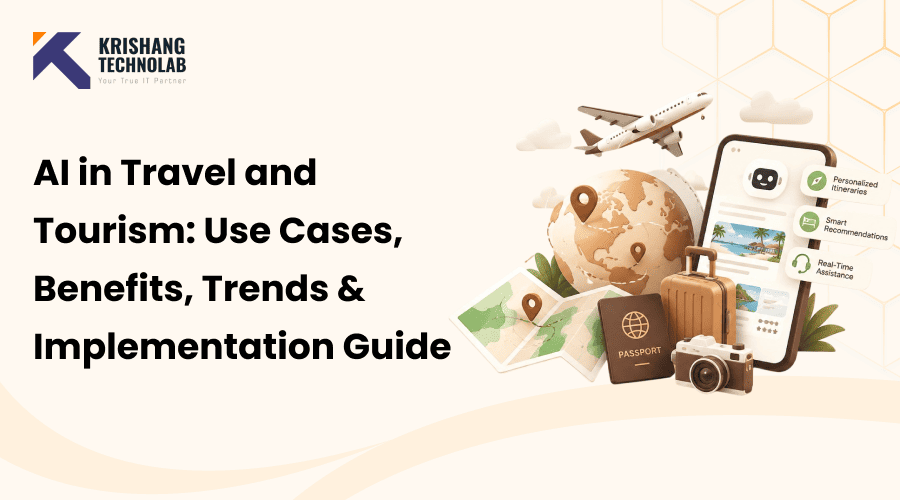
Quick Overview: AI in travel and tourism is transforming booking, personalization, and customer service across the industry. This guide covers real use cases, key benefits, emerging trends, and a practical implementation roadmap to help travel businesses adopt AI in travel and tourism effectively.
AI in travel and tourism is changing how people plan their trips. It’s also changing the way they book trips. Smart tools now do the planning, support and pricing on a daily basis. Indeed, the global AI-in-tourism market is projected to hit $13.38 billion by 2030, expanding at a CAGR of nearly 29%. AI travel technology learns from the data and improves with time. This guide includes real-life AI use cases in travel. It also includes benefits, risks and a simple way to start using AI in the tourism industry at your business.
What Is AI in Travel and Tourism?
AI in travel and tourism means using smart software to plan, book and manage travel. It leverages machine learning, generative AI and real data. AI in travel industry tools study patterns fast. They tell you what a traveler wants next. Artificial intelligence in travel affects almost every touchpoint of the booking process.
Several technologies power AI in today’s AI in tourism industry systems. These are the major building blocks of modern AI and tourism tools:
- Machine learning studies old data to predict demand and stop fraud.
- Generative AI creates content, and holds real conversations with travelers.
- Natural language processing (NLP) powers chatbots, and live translation.
- Predictive analytics forecasts bookings, prices and cancellations.
- Recommendation systems suggest hotels, flights, and activities based on past behavior.
- AI agents complete tasks like booking without human help.
Also Read About: How Is AI Transforming Software Development Through Use Cases and Benefits in 2026?
It is this combination of tools that is enabling tourism AI today. Studies on artificial intelligence in tourism and hospitality industry use show this space keeps growing fast. Machine learning in the travel industry is now a normal part of daily work for airlines, hotels, and agencies.
How Is AI Transforming the Travel Industry?
Looking at the whole trip, you can see how AI is changing the travel industry. AI is a tool for travellers before, during and after their trips. How AI is used in the travel industry breaks down into three simple stages:
- Pre-travel – AI recommends destinations, makes travel plans and compares prices.
- During travel – AI gives real-time translation, alerts, and quick rebooking help.
- After travel – AI studies feedback, and personalizes future offers.
This demonstrates how AI improves customer experience in travel at every step. Airlines use machine learning to schedule crews. They also use it to predict when maintenance will be needed. Hotels use AI to predict occupancy, and schedule staff. The use of AI in travel industry operations goes far beyond simple chat support. AI in travel and tourism now shapes both the front-end experience and the back-end operations of most large travel brands.
Top AI Use Cases in Travel and Tourism
The clearest way to understand AI use cases in travel is to look at daily operations. Most travel companies start with one use case. And then they grow from there.
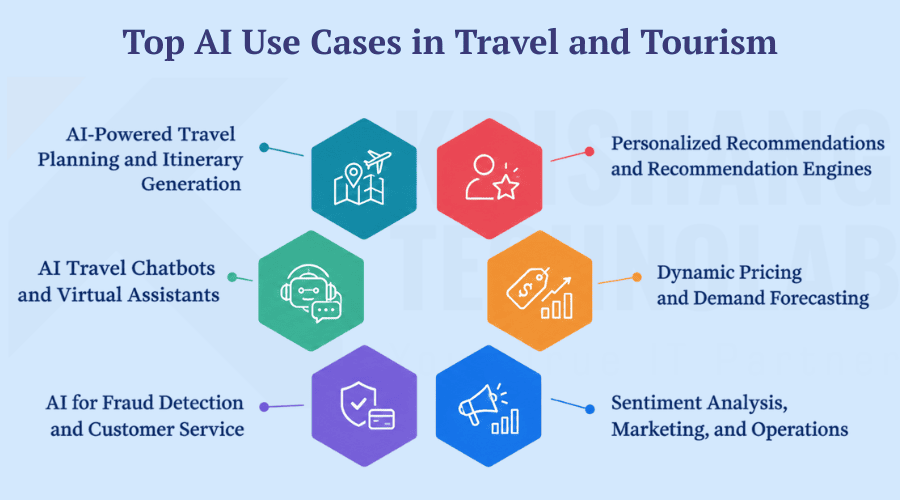
AI-Powered Travel Planning and Itinerary Generation
AI itinerary planners generate an entire trip plan within minutes. It uses your dates, budget and interests. It chooses your flights, hotels and local places. This technology is one of the most evident examples of AI in tourism used by everyday travelers. An AI trip planner saves you hours of manual research work.
Personalized Recommendations and Recommendation Engines
Recommendation engines analyze your previous bookings, and clicks. They recommend hotels, flights and activities that match your taste. This is a core part of machine learning in travel industry work. A strong AI travel recommendation engine can boost both bookings and customer satisfaction. Many travel brands develop this feature through custom machine learning development for travel platforms that work customized to their booking data.
AI Travel Chatbots and Virtual Assistants
An AI travel chatbot responds to booking questions 24/7. It quickly handles cancellations, refunds and simple policy questions. A more sophisticated AI travel assistant does more. It will automatically notify you of gate changes and delays. Indeed, the use of conversational AI in tourism often leads to better overall support ticket volumes for businesses. Many of these tools are built through custom ChatGPT integration for travel chatbots that work built for travel platforms.
Dynamic Pricing and Demand Forecasting
AI-driven dynamic pricing adjusts rates in real time. It considers demand, competitor pricing and how far ahead the booking is made. Demand forecasting work closely relates to this approach. Predictive analytics in tourism is used to predict future peaks by looking at past booking data. This approach is an enormous help to businesses in planning staff and inventory well in advance.
AI for Fraud Detection and Customer Service
Machine learning algorithms can rapidly detect unusual booking or payment patterns. This use case has grown as the use of AI in travel industry payment systems expands worldwide. AI-powered support handles most routine questions. That leaves human staff to address more difficult, more personal problems.
Sentiment Analysis, Marketing, and Operations
With NLP tools, you can scan thousands of reviews simultaneously. They quickly learn the praises and familiar gripes. The same technology is also used for smarter ad targeting and email marketing. It also automates the back office planning and scheduling. This reduces the manual admin work across the whole business.
Generative AI in Travel and Tourism
Generative AI in travel does more than older, rule-based AI tools. It creates content and holds real, natural conversations. With a simple request, a generative AI travel assistant can generate an entire trip plan. It can also change that plan while you’re talking. The same technology also powers generative AI itinerary planners, automated travel content writing and AI agents that can almost independently search for and book trips. Many companies start their journey with specialized generative AI development for travel apps work before moving on to more advanced features.
But generative AI has real limits, too. It can make mistakes, called hallucinations. It may give old prices or wrong visa rules. But it’s human review first, before any cash is paid. These tools often store personal information, so privacy and data safety are important. Good artificial intelligence in travel and transport design sees data protection as a must, not an afterthought.
AI Use Cases by Travel Business Type
Different parts of the travel world apply AI in tourism in their own way, and each one deserves a general development services partner for travel businesses, a partner who understands its specific booking flow.
AI for Travel Agencies
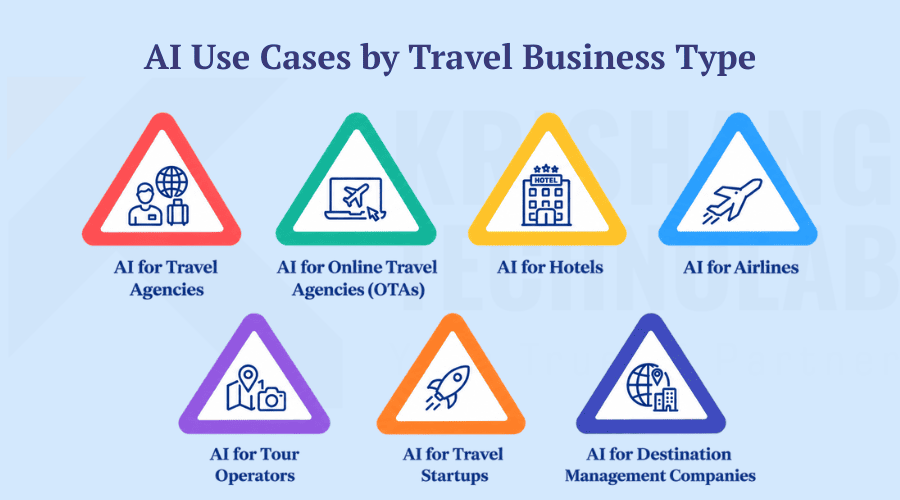
Thanks to AI, travel agencies can plan detailed itineraries in minutes, not hours. Beyond planning, agents use these tools to personalize service for each client, tracking past trips and preferences. This allows smaller agencies to take on bigger platforms by providing faster, more personal travel advice without having to hire more staff.
AI for Online Travel Agencies (OTAs)
Recommendation engines, and dynamic pricing tools are the backbone of OTAs’ ability to stay ahead of the competition. These systems analyze millions of searches a day, adjusting prices, and suggestions in real time. This combination helps OTAs get more bookings by matching each visitor with options that fit their budget, and travel history.
AI for Hotels
Hotels apply AI to match rooms and chat with guests so that they can find the right room quickly based on their stated needs. In addition to bookings, hotel staff use AI to predict occupancy and staff planning, and to customize in-stay offers such as room upgrades, enhancing guest satisfaction without the administrative burden.
AI for Airlines
Airlines use AI to predict fares and to manage delays, especially when flights are irregular because of weather or mechanical issues. Machine learning algorithms also help airlines plan crew schedules, and flag maintenance needs in advance, avoiding costly last-minute disruptions, while keeping passengers up to date with automated, real-time updates.
AI for Tour Operators
Tour operators are using AI to automatically plan complex itineraries with multiple stops, saving hours of manual planning work. And they create travel packages for groups, based on mutual interests, and budgets. That allows smaller operators to offer bespoke experiences that previously required a dedicated planning team to coordinate.
AI for Travel Startups
New travel startups are often AI in travel and tourism-capable from day one, building these capabilities into their core products to stand out in a crowded field. Many will try out their idea first with lean AI MVP development for travel startups before committing to a full build, keeping early costs low while proving real demand.
AI for Destination Management Companies
These companies use tourism and artificial intelligence together to forecast visitor numbers well ahead of peak seasons. AI also helps pair travelers with local experiences that match their interests, the weather and the level of crowds, giving destinations a chance to spread out visitor traffic and relieve the crush at hot spots.
AI for tourism works best when tied to one clear goal, not applied everywhere at once, across all these types.
Benefits of AI in Travel and Tourism
The benefits of AI in travel and tourism go way beyond convenience. And real numbers support these claims. By late 2025, Phocuswright found that 58% of active U.S. travelers used AI for at least some of their trip planning. Some 39% said they used it just for travel research, and millennials are behind much of that shift. The global AI-in-tourism market is projected to reach $13.38 billion by 2030, expanding at a 28.7% annual rate, a trajectory that lines up with research tracking AI’s growing footprint across the hospitality and tourism sector.
Better Customer Experience
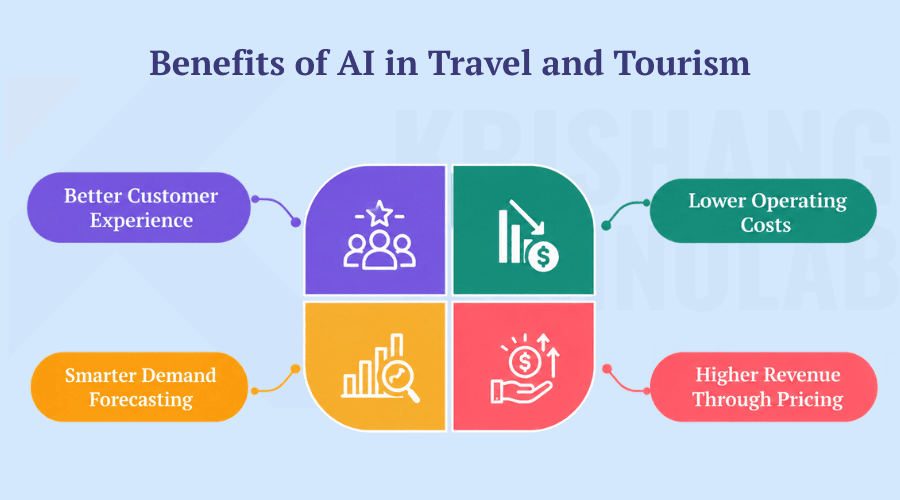
AI in travel is transforming customer experience: faster responses, smarter and context-aware recommendations. AI tools remember past interactions, and preferences, so support feels faster and more personalized to the traveler. This reduces the frustration that can happen when changing bookings and builds a stronger sense of loyalty to the brand over time.
Lower Operating Costs
Artificial intelligence can also perform routine tasks such as answering common questions, issuing refunds and updating booking records without human intervention. Over time this dramatically reduces manual work, and releases staff for higher-value activities. Many companies also pair this automation with ongoing software development consulting for AI systems, which helps keep costs predictable as their standard artificial intelligence systems scale.
Smarter Demand Forecasting
The impact of artificial intelligence in tourism industry operations shows up most clearly in better planning around seasonal demand. Businesses know well in advance when busy periods are coming and can adjust staffing, pricing and inventory accordingly. Thus, it solves the problem of overstaffing in the slow periods and understaffing in the peaks of sudden demand throughout the year.
Higher Revenue Through Pricing
Dynamic pricing and personalized offers combine to help drive sales across all booking channels. These are common AI travel industry trends businesses report seeing today, since small pricing adjustments based on real demand data often lead to measurably higher revenue per booking without discouraging price-sensitive travelers.
Also Read About: What Are the Artificial Intelligence Statistics for Small Businesses in 2026?
Challenges of Implementing AI in Travel
The use of AI in travel and tourism is not always easy. The first hurdle is often data quality. Older systems store data in separate, unconnected locations. That makes AI training harder than it needs to be. Good data science consulting for travel data at the beginning can fix a lot of this friction early on.
Privacy and legal rules also mean more work. That’s especially important for companies serving travellers from many countries. Technical integration takes real effort too. Linking new AI tools to GDS, NDC and payment systems is not usually a quick task. Models will need to be checked and retrained on an ongoing basis, and these costs should be reflected in budgets. The investment is wasted if staff don’t trust and use these tools every day.
AI Travel Software Development and Services
To turn these ideas into real tools, you need an AI travel software development company. An AI travel development agency can also help with the planning and implementation process. The full-service provider of AI travel software development services generally provides:
- Custom AI travel app development for web and mobile platforms
- Round-the-clock AI travel chatbot development for instant support
- Personalized AI itinerary planner development for custom trip plans
- Data-driven AI travel recommendation engine development for personal matches
- Full-cycle AI travel assistant development for complete trip management
- Seamless AI booking platform development for end-to-end reservations
A good partner also offers AI consulting for travel businesses, guiding them in selecting the right use case before writing any code. Krishang Technolab is empowering travel businesses with precisely this kind of phased, low-risk approach to AI travel solutions.
How to Build an AI Travel App or Platform
Building an AI travel app development project follows a clear path. Strong custom web application development for booking platforms practices matter at every step, since AI features must connect cleanly to real booking data:
- Step=1: Define the exact business problem AI should solve
- Step=2: Pick one or two high-impact AI use cases to start
- Step=3: Collect and clean the data needed to train the AI
- Step=4: Choose the right AI or LLM technology for the job
- Step=5: Design a user experience that feels natural, not bolted on
- Step=6: Connect travel APIs, GDS systems, and payment processors
- Step=7: Build and test the AI features before any public release
- Step=8: Launch the platform, then monitor, and retrain over time
How Much Does AI Travel Software Development Cost?
The cost of work with an AI travel software development company varies greatly. It costs less to build and launch a simple chatbot. A full AI booking platform costs more because it involves many integrations, and more testing. Getting solid software development services for travel apps early on helps you avoid budget surprises later in the process. Working with an experienced AI development agency can also help you plan the development scope and costs effectively. The overall cost will also depend on the number of features, data needs, integrations, platform choice and ongoing maintenance.
How to Choose an AI Travel Software Development Company
It is very important to choose the right AI travel app development company. Look for real travel industry experience, not just coding skills. Check their AI travel software development services, and past AI projects closely. Many businesses also look to hire AI developers for travel projects directly when they need to grow an in-house team fast. Krishang Technolab combines experience in the travel space, AI skills and ongoing support after launch.
Also Read About: How to Choose the Right AI Software Development Partner?
Future of AI in Travel and Tourism
Looking ahead, the future of AI in tourism points to more independent, and capable systems. Soon, agentic AI might plan, and book entire trips with little human input. Voice assistants will enable rapid planning while multi-tasking. Multimodal AI, which reads text, voice and images together, is also growing fast. Working with an experienced AI development company for travel or a travel technology agency helps businesses to be ready for these shifts in the artificial intelligence travel industry patterns.
How Businesses Can Start Using AI in Travel
Businesses don’t need to do it all at once. Most teams starting out do well with a simple path. Many bring in hiring prompt engineers for AI workflow support early to speed up the first drafts of AI prompts and workflows.
Identify the Problem
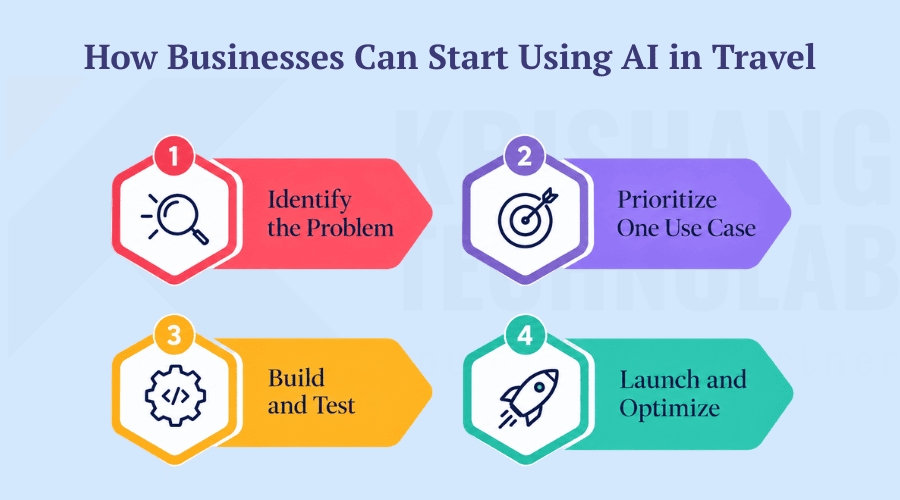
Start by finding your biggest pain point, whether that’s slow customer support, weak personalization or inefficient pricing. Search for patterns in frontline staff and customer complaints. This groundwork ensures that the AI investment addresses a genuine problem rather than being merely a technology for technology’s sake.
Prioritize One Use Case
Don’t try to fix everything at once; choose the one AI feature that solves this problem best. Focusing down early makes the project easier to manage, test and measure. Once the initial use case demonstrates its value, incorporating additional AI capabilities becomes a more secure option.
Build and Test
Build the tool, slot it into your existing systems and test it thoroughly with real users before any public launch. Some teams hire ChatGPT developers for conversational AI at this stage to move faster on conversational features. Early testing by real travelers identifies problems before they impact real bookings.
Launch and Optimize
If you can, start small, with some users. Then watch the results closely, and iterate on the tool over time. Startups launching a new travel product often start with SaaS MVP development for travel startups to prove the idea before a full build, keeping early costs low while validating demand.
Most successful AI in travel and tourism projects follow this simple, staged path.
Conclusion
AI in travel and tourism is no longer just an idea for the future. It is changing how people plan, book and enjoy trips today. AI in the travel industry is now influencing almost every aspect of the traveller journey, from chatbots to dynamic pricing. Early adopters in AI in travel and tourism are often faster, with lower costs and happier customers. The best next step is simple: pick one clear use case, test it, and request a quote for AI travel software development to see what’s realistic for your budget and timeline.
FAQs About AI in Travel and Tourism
What is AI in travel and tourism?
At its core, its software that learns from travel data, not just rules to follow. Generative AI, predictive analytics and machine learning all team up to automate trip planning, provide personalized recommendations and take care of those booking and customer service tasks that used to require a person on the other end.
How is AI used in the travel industry?
Airlines, hotels, and online travel agencies use it in a few practical ways: chatbots to help support, dynamic pricing that changes with demand, itinerary generation, fraud detection, forecasting, and recommendations based on what a traveler has actually searched for or previously booked.
What are the benefits of AI in tourism?
The obvious one is 24/7 support, but the bigger wins show up elsewhere. The more data a system has, the better its recommendations become. Bookings become faster. Businesses can predict demand rather than speculate about it. Automation quietly reduces operational expenses in the background.
What are the most common AI use cases in travel?
Travelers directly interact with chatbots and itinerary planners, which is why they receive the most attention. Even when users don’t see it, there is just as much work going on behind the scenes with dynamic pricing engines, recommendation systems, and fraud detection tools.
How does generative AI help the travel industry?
It’s like the difference between a scripted chatbot and one that actually talks. Generative AI is able to create itineraries from a single request, write personalized copy and allow travel assistants to answer whatever a traveler asks, instead of choosing from a menu of preset answers.
How much does it cost to develop an AI travel app?
There’s no one number here and if someone gives you a number without asking you questions first, they’re guessing. A simple chatbot is a fraction of a full booking platform with live pricing and multiple system integrations. Most of it is determined by scope.
How do I build an AI travel app?
Begin with the real problem you want to solve, not the technology you want to use. Choose a use case that has real impact, choose the AI tool that fits it, plug in your travel APIs and test it well before anyone outside your team touches it.
What is an AI travel assistant?
It’s an enhanced version of a chat bot. It’s not just a question-and-answer tool; it also manages the trip, alerts users to changes, and handles bookings without requiring human intervention at every step.
How can travel agencies use AI?
Smaller agencies in particular benefit here. AI is able to construct a client’s itinerary in minutes and remember their preferences to tailor the next trip, something that would take a dedicated agent hours to do manually.
What is an AI travel software development company?
It’s a development partner that builds these tools from scratch, chatbots, recommendation engines, booking platforms, shaped around what a specific travel business actually needs rather than a one-size-fits-all product.
Found this post helpful? Don't forget to share it with your network!