Quick Overview: AI-powered software development is transforming how applications are built, tested, and deployed. This guide explores top tools, platforms, and use cases for startups and enterprises, highlighting benefits, challenges, and future trends to help businesses build smarter, faster, and more scalable software solutions.
The field of software development is changing faster than ever. AI-powered software development is at the center of this change. It is a paradigm shift that is changing how applications are built, tested, deployed, and maintained.
More and more businesses are using AI-powered software development services to make apps that can grow, are smart, and are ready for the future.
Now, developers can finish tasks that used to take weeks or even months, like coding, debugging, and iterating, in a fraction of the time. Developers no longer work alone; they now work with smart systems that can write code, find bugs, run tests automatically, and even suggest ways to improve the architecture.
For new businesses, working together means getting products to market faster and at a lower cost. For businesses, it means better scalability, efficiency, and innovation on a large scale.
In this comprehensive guide, we will explore:
- What AI-powered software development really means
- How it is transforming the development lifecycle
- The top tools and platforms available today
- Key use cases for startups and enterprises
- Benefits, challenges, and future trends
Many businesses are hiring AI software developers to stay competitive in a world where AI is becoming more popular.
Understanding AI Powered Software Development
AI-powered software development means using AI technologies like machine learning (ML), natural language processing (NLP), and automation throughout the entire process of making software.
Traditionally, software development followed a linear approach:
- Requirement gathering
- System design
- Coding
- Testing
- Deployment
But with AI, this process is always happening, changing, and getting better. AI systems can spot patterns, learn from old data, and help developers right away.
Key Capabilities
1. Code Generation
With just a few simple commands, AI tools can create whole functions or even whole modules, which cuts down on the amount of work that needs to be done by hand.
2. Code Completion
Predictive coding suggests the next lines of code, which makes it easier for developers to type and makes them more productive.
3. Bug Detection and Fixing
AI can find weaknesses, logic errors, and inefficiencies, and it can even fix them on its own at times, which significantly reduces the time developers spend on debugging and enhances the overall quality of the software.
4. Automated Testing
AI makes test cases, runs them, and finds edge cases that human testers might not see.
5. DevOps Automation
AI makes CI/CD pipelines easier to use, automates deployments, and keeps an eye on how well the system is working.
6. Documentation Generation
AI can create technical documents in seconds, saving hours of writing by hand.
Why AI Powered Software Development is a Game-Changer
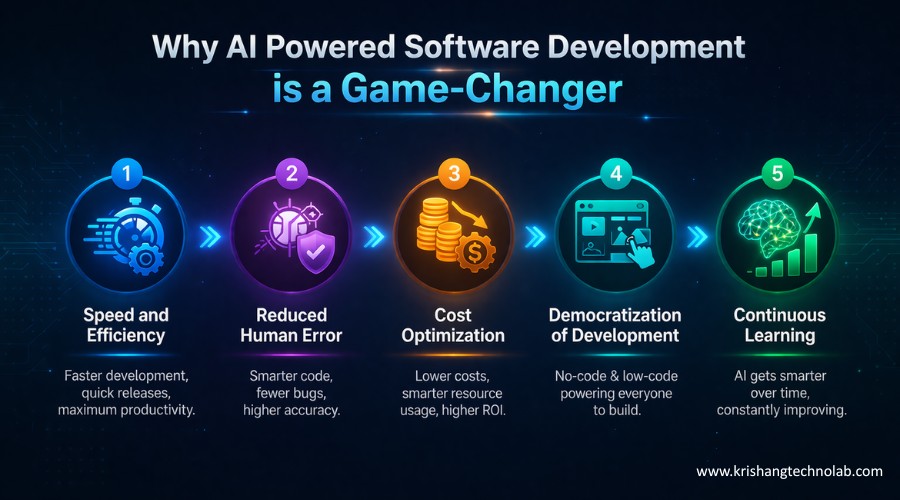
1. Speed and Efficiency
Writing boring code, setting up environments, and fixing common bugs are things that AI can do for you. Developers can focus on solving hard problems instead of doing boring tasks.
2. Reduced Human Error
AI tools use trained datasets and tried-and-true coding patterns to cut down on bugs and make code better, which ultimately leads to more reliable software and increased efficiency in the development process.
3. Cost Optimization
Small teams can help new businesses make good products, and big businesses can cut their costs by a lot, which lets them use their resources better and put money into other growth areas.
4. Democratization of Development
People who don’t know how to code can make apps with no-code and low-code platforms. This opens the door to new ideas in all fields.
5. Continuous Learning
As time goes on, AI systems get better by learning from large datasets and interacting with developers. This lets them make better suggestions.
AI Tools for Startups
Start-ups often hire prompt engineers and vibe coding developers to make AI-powered products quickly and keep improving them.
1. GitHub Copilot
A programming helper powered by AI that works like a pair programmer and suggests lines of code in real time.
Features:
- Context-aware code suggestions
- Supports multiple programming languages
- Integrates with popular IDEs
Benefits for Startups:
- Reduces development time
- Helps junior developers write better code
- Speeds up MVP creation
Use Case:
A SaaS startup can use Copilot to quickly build front-end and back-end APIs and components without having to start from scratch.
2. Replit Ghostwriter
An AI-powered development environment made for quick prototypes.
Features:
- Built-in IDE with AI support
- Real-time debugging assistance
- Collaborative coding
Benefits:
- Perfect for remote teams
- Eliminates setup complexity
- Enables rapid experimentation
Use Case:
A founder who works alone can build and test product ideas in the browser without having to set up any environments.
3. Bubble
A visual programming platform that allows users to build full-stack apps without coding.
Features:
- Drag-and-drop UI builder
- Database integration
- API connectivity
Benefits:
- Ideal for non-technical founders
- Faster MVP development
- Lower development costs
Use Case:
A startup can prove that an idea is effective by making a working product in days instead of months.
4. Vercel AI SDK
A toolkit for building AI-powered web applications.
Features:
- Easy integration with AI models
- Optimized for frontend frameworks
- Real-time streaming capabilities
Benefits:
- Helps build AI-native apps
- Reduces backend complexity
- Speeds up feature development
5. OutSystems
A low-code platform that combines AI with enterprise-grade scalability.
Features:
- Visual development tools
- AI-assisted coding
- Cloud deployment
Benefits:
- Bridges gap between startup and enterprise
- Enables rapid scaling
AI Platforms for Enterprises
Enterprises are increasingly adopting enterprise AI development services and AI digital transformation services to modernize their systems and stay competitive.
1. IBM Watson
A comprehensive AI platform offering NLP, automation, and analytics.
Features:
- Chatbots and virtual assistants
- Data analysis tools
- Industry-specific solutions
Enterprise Use Case:
Banks use IBM Watson for fraud detection and customer service automation.
2. Microsoft Azure AI
A cloud-based AI ecosystem integrated with development tools.
Features:
- Machine learning services
- Cognitive APIs
- DevOps integration
Benefits:
- Scalable infrastructure
- Strong security and compliance
3. Google Vertex AI
A unified ML platform for building, deploying, and scaling models.
Features:
- AutoML capabilities
- Model training and deployment
- Data pipeline integration
Use Case:
Retail companies use it for demand forecasting and recommendation systems.
4. Amazon CodeWhisperer
An AI-powered coding tool designed for cloud environments.
Features:
- Real-time code suggestions
- Security scanning
- AWS integration
Benefits:
- Enhances developer productivity
- Improves code security
5. DataRobot
An automated machine learning platform for predictive analytics.
Features:
- AutoML
- Model deployment
- Performance monitoring
Use Case:
Healthcare companies use it for patient risk prediction.
Enterprises increasingly hire AI developers and specialized teams to implement large-scale AI solutions securely.
AI Across the Software Development Lifecycle
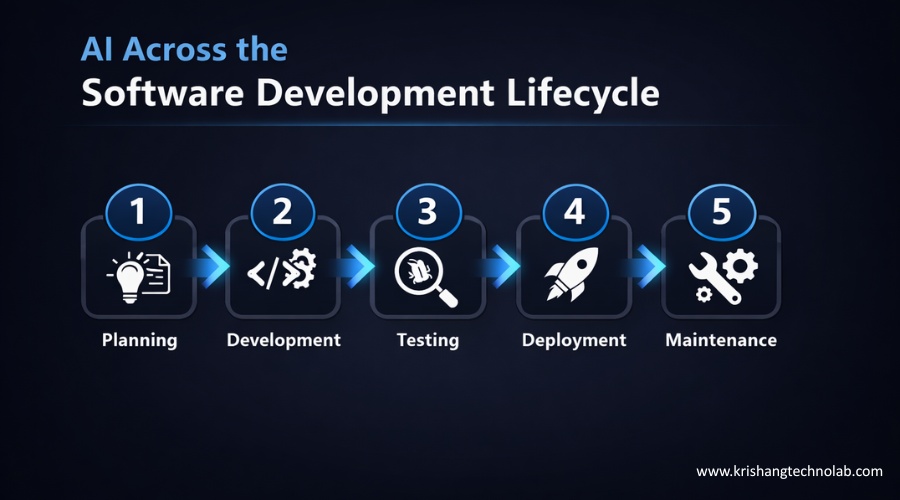
1. Planning
AI analyzes requirements, predicts timelines, and identifies risks.
- Estimate timelines
- Predict risks
- Suggest optimal strategies
2. Development
AI tools generate code, suggest improvements, and speed up coding.
- Code generation
- Code optimization
- Real-time suggestions
Generative AI consulting services help you find AI opportunities and come up with smart plans for success.
3. Testing
AI automates test case creation, detects bugs, and improves quality.
- Generating test cases
- Automating execution
- Identifying edge cases
4. Deployment
AI optimizes CI/CD pipelines and ensures smooth, reliable releases.
- Automate CI/CD pipelines
- Optimize deployment strategies
- Monitor system performance
5. Maintenance
AI monitors performance, detects issues, and enables predictive fixes.
- Detecting anomalies
- Predicting failures
- Suggesting improvements
Organizations often hire software developers and AI specialists to manage different stages of the development lifecycle efficiently.
Startups vs Enterprises: Key Differences
| Aspect | Startups | Enterprises |
| Speed | Rapid iteration | Structured processes |
| Budget | Limited | High |
| Tools | No-code, AI assistants | Full AI platforms |
| Team Size | Small | Large |
| Focus | MVP and growth | Stability and scalability |
Read About: Tech Stack for AI Startups
Real-World Use Cases of AI Software Development
1. E-commerce
AI powered software development enables:
- Personalized recommendations
- Chatbots for customer support
- Inventory management
2. Healthcare
AI helps build systems for:
- Predictive diagnostics
- Patient monitoring
- Treatment recommendations
3. Finance
Applications include:
- Fraud detection
- Risk analysis
- Algorithmic trading
4. SaaS Products
AI enhances SaaS platforms with:
- Automated support
- Smart analytics dashboards
- User behavior tracking
Read About: One-Product Stores Are Back Why Micro-Brands Win in 2026
Challenges of AI Powered Software Development
- Over-Reliance on AI: Developers may become too dependent on AI tools, potentially weakening core programming skills.
- Security Risks: AI-generated code may introduce vulnerabilities if not properly reviewed.
- Data Privacy Concerns: Handling sensitive data requires strict compliance with regulations.
- Integration Complexity: Integrating AI tools with legacy systems can be technically challenging.
- Skill Gap: Teams need training to effectively use AI tools and understand their limitations.
Choosing the right AI development agency is critical to overcoming these challenges.
Future of AI Powered Software Development
The future of AI powered software development is incredibly promising.
- Autonomous Development: AI systems will be capable of building entire applications with minimal human input.
- Self-Healing Systems: Applications will automatically detect and fix issues in real time.
- Fully Automated DevOps: From code commit to deployment, everything will be automated.
- AI-Driven Architecture: AI will design system architectures optimized for performance and scalability.
- Hyper-Personalized Applications: Applications will adapt dynamically to user preferences and behavior.
Best Practices for Using AI in Development
- Start Small
- Combine Human Expertise with AI
- Review AI-Generated Code
- Focus on Security
- Train Your Team
Transform Your Ideas into AI Solutions with Krishang Technolabs
At Krishang Technolabs, we specialize in delivering end-to-end AI powered software development services tailored for startups and enterprises.
Our team helps businesses:
- Build custom AI-powered applications
- Develop scalable SaaS platforms
- Integrate AI into existing systems
- Accelerate product development with modern tools
- Transform ideas into market-ready solutions
Whether you’re looking to hire AI developers, hire prompt engineers, or build a complete AI-driven product, we provide the expertise and flexibility to support your goals.
Partner with Krishang Technolabs to turn your vision into intelligent, scalable software.
Conclusion
Using AI to create software is not just a trend; it’s the future.
It accelerates the process of getting new products to market, cuts costs, and helps startups quickly come up with new ideas. Businesses can grow, work more efficiently, and stay ahead of the competition in a world that is becoming more digital with this.
When AI is used in the development lifecycle, companies can be more creative and productive than ever before, as it allows for faster prototyping, data-driven decision-making, and enhanced collaboration among teams.
Not only will people change lives, but they will also be in charge of the next wave of technological change, coming up with new ideas that can make business operations even better and speed up the digital transformation, such as implementing AI-driven solutions that enhance decision-making and streamline processes.
Found this post helpful? Don't forget to share it with your network!



)