

Quick Overview: Explore the best Next.js alternatives in 2026, including Astro, Remix, SvelteKit, Nuxt, and Gatsby. Compare features, performance, and use cases to choose the right framework for building fast, scalable, and modern web applications.
Things change quickly in web development. Next.js has been one of the most popular frameworks in the React ecosystem for a long time, but more and more developers are looking into Next.js alternatives that offer better performance, a simpler architecture, and a better experience for developers. As developers look for faster, easier-to-use, and more flexible solutions, modern frameworks like Astro, Remix, SvelteKit, Nuxt, and Gatsby are becoming more popular.
Choosing the right framework can have a big effect on how well your project works, how easy it is to scale, and how easy it is to keep up with. In fact, this principle is true whether you’re making an enterprise app, a blog, a SaaS platform, or a startup.
This in-depth guide will look at the top five modern Next.js alternatives, compare their pros and cons, and help you choose the one that works best for you.
Why Look for Next.js Alternatives?
Next.js is still a great full-stack framework, but it’s not always the best choice for every project. Some developers have noticed that the framework is getting more complicated and that there are more trade-offs as it changes.
Even with these problems, many businesses still use Next.js by hiring Next.js developers. This method helps deal with complexity while keeping performance and scalability.
Here are some common reasons why developers seek other options:
1. Increasing Complexity
Next.js has become more powerful with new features like the App Router, Server Components, and new ways to get data. However, these changes have also made it harder to learn.
2. Performance Concerns
Next.js works very well, but some newer frameworks ship with less JavaScript and load faster.
3. Overkill for Simple Projects
Next.js can be too heavy for the following:
- Blogs
- Marketing sites
- Documentation platforms
4. Vendor Lock-in
Some developers prefer frameworks that let them deploy their apps in more ways because Next.js is closely tied to Vercel.
5. Better Developer Experience Elsewhere
New frameworks are putting a lot of emphasis on modern architecture, speed, and simplicity.
Quick Comparison: Top Next.js Alternatives
| Framework | Best For | Performance | Learning Curve |
| Astro | Static & content sites | ⭐⭐⭐⭐⭐ | Easy |
| Remix | Full-stack React apps | ⭐⭐⭐⭐ | Medium |
| SvelteKit | Lightweight apps | ⭐⭐⭐⭐⭐ | Easy |
| Nuxt | Vue full-stack apps | ⭐⭐⭐⭐ | Easy |
| Gatsby | Static & SEO-focused sites | ⭐⭐⭐⭐⭐ | Easy |
5 Best Next.js Alternatives in 2026
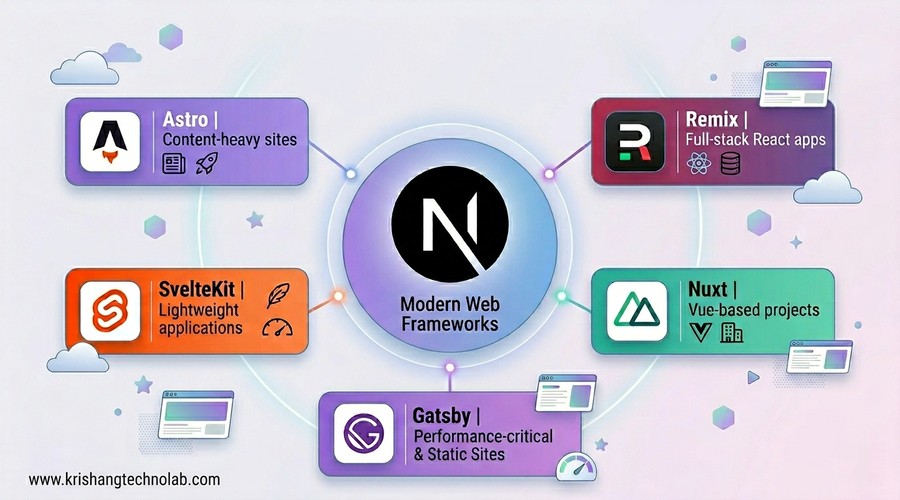
1. Astro — Best for Performance & Content Websites
Astro is a modern web framework that focuses on performance and is made to build fast, content-driven websites with as little JavaScript as possible. It is different from other frameworks because it uses a static-first approach. This means that it makes lightweight HTML by default and only loads JavaScript when it needs to.This means that by default, it makes light HTML and only loads JavaScript when it needs to.
Island Architecture is one of Astro’s best features. It lets developers hydrate only the parts of the page that are interactive. This makes the bundle much smaller, speeds up loading, and makes the overall user experience better. Astro is very flexible for teams and projects of all sizes because it can work with more than one UI framework at the same time, such as React, Vue, and Svelte.
When it beats Next.js:
SEO and speed are very important on blogs, documentation, marketing sites, and other sites with a lot of content. Astro is great for these types of sites. You can get smaller bundles and faster page loads with Astro than with Next.js, especially if you don’t need a lot of client-side code.
Notable features:
The platform offers no JavaScript by default, utilizes island architecture, supports multiple frameworks, enables static generation, provides SSR support, includes built-in Markdown and MDX, and delivers better performance.
Considerations:
Astro works best for websites that are all about content. Frameworks like Next.js or Remix may be better for complex full-stack apps or those that require a lot of interaction.
Getting started:
Astro is one of the best modern Next.js alternatives for teams that value performance, SEO, and ease of use.
2. Remix — Best Full-Stack React Alternative
Remix is a full-stack React framework that follows web standards, has a server-first architecture, and handles data in a way that is easy to understand. It moves most of the logic to the server, which makes it faster, more reliable, and easier to maintain than many modern frameworks that rely on client-side rendering.
Remix focuses on progressive enhancement, which means that your app will work even before JavaScript loads. You can get to them faster and better, and they’ll work better on networks or devices that are slower. It also comes with built-in data loading and nested routing to help you better understand how complex business applications are put together.
When it beats Next.js:
Remix is great for SaaS platforms, dashboards, and apps that have a lot of forms and require a lot of user interaction. Remix usually has more predictable data flows and easier mutation handling than Next.js.
It performs especially well when:
- Applications rely heavily on forms
- Server-side logic is important
- Consistent performance across devices is needed
- You want simpler data fetching and mutations
Notable features:
Streaming SSR, loaders for getting data, actions for changing data, progressive enhancement, forms without client-side JavaScript, and built-in error handling are some of the features that this app has.
Considerations:
If you’re used to server components and App Router patterns, Remix uses a different way of thinking than Next.js. It may take developers some time to get used to loaders and actions.
Getting started:
Remix is a great choice for teams that want to make interactive, data-driven apps that need to be fast, reliable, and able to grow over time.
Learn About: Next.js Internationalization for Building Multilingual Websites
3. SvelteKit — Lightweight and Fast
SvelteKit, a new full-stack framework built on Svelte, prioritizes speed, ease of use, and smaller bundle sizes. Svelte compiles components at build time, which makes applications run faster and sends less JavaScript to the browser. This approach is different from React-based frameworks.
SvelteKit comes with built-in server-side rendering, static site generation, and API routes. It’s not too heavy or hard to set up, so it’s easier to make quick apps with it. SvelteKit has a clean syntax and some extra code that makes it easier for developers to get things done and keep them running smoothly. This is because it helps you code better and lowers the chance that you’ll make a mistake while you’re working on something.
When it beats Next.js:
Lightweight apps, startups, and projects that need to run quickly are all good uses for SvelteKit. SvelteKit usually has smaller bundle sizes and faster runtime performance than Next.js, especially for apps that don’t need a big ecosystem.
It performs especially well when:
- You want smaller JavaScript bundles
- Performance is a top priority
- You prefer simpler syntax
- You’re building lightweight applications
Notable features:
Compile-time optimization, built-in routing, support for SSR and SSG, smaller bundle sizes, API routes, quick builds, and little boilerplate.
Considerations:
Compared to Next.js, SvelteKit has a smaller ecosystem. Teams that have put a lot of time and money into React may also have to learn how to use Svelte.
Getting started:
SvelteKit is one of the best modern alternatives to Next.js because it lets developers make fast, lightweight apps with a simpler development process.
4. Nuxt — Vue-Based Next.js Alternative
Nuxt is a full-stack framework that works with Vue.js, enabling developers to create modern web applications with a well-defined structure. It supports server-side rendering, static site generation, and hybrid rendering, similar to Next.js. Its flexibility makes it an excellent choice for applications of various sizes.
Nuxt is all about convention over configuration. It comes with built-in routing, layouts, and data-fetching patterns. This speeds up the setup process, lets developers make apps that can be scaled quickly, and keeps project structures in order.
When it beats Next.js:
Nuxt is great for teams that like Vue better than React or want a more organized way to build things. It works best for websites that are focused on SEO, enterprise platforms, and apps with a lot of content.
Nuxt performs well when:
- You prefer Vue ecosystem
- You need built-in structure and conventions
- SEO and performance are priorities
- You’re building scalable applications
Notable features:
File-based routing, SSR and SSG support, automatic imports, built-in layouts, server API routes, a strong Vue ecosystem, and hybrid rendering.
Considerations:
You need to know Vue to use Nuxt. When teams switch ecosystems, they may have to learn new things if they are already using React.
Getting started:
If you’re a developer looking for a structured, scalable, and Vue-based alternative to Next.js, Nuxt is a great option.
5. Gatsby — Static Site Generator for Scalable Websites
Gatsby is a framework based on React that helps you make websites that load quickly, can grow with your business, and are good for SEO. It creates static sites, meaning it builds pages in advance to enhance loading speed and improve site performance. Gatsby’s robust data layer utilizes GraphQL, enabling developers to retrieve data from APIs, CMS platforms, databases, and various other sources.
This is why Gatsby is great for websites with a lot of content and headless CMS architectures. It says in the text that Gatsby supports server-side rendering and incremental builds, which make it easier for teams to work on bigger projects.
When it beats Next.js:
Gatsby is great for websites that have a lot of content, like marketing sites and documentation sites. When it comes to static content and SEO-focused projects, Gatsby often works better than Next.js.
Gatsby performs especially well when:
- You’re building content-driven websites
- You need fast static page generation
- You’re using headless CMS platforms
- SEO is a top priority
Notable features:
Static site generation, a GraphQL data layer, a plugin ecosystem, image optimization, incremental builds, headless CMS integration, and good SEO.
Considerations:
Gatsby can be complicated because of its GraphQL data layer. For very large sites, build times may also go up, but incremental builds can help with this problem.
Getting started:
Gatsby is still a great choice for teams that want to build fast, content-rich, and scalable websites. It is a good alternative to Next.js.
Also Read: Tech Stack for AI Startups
How to Choose the Right Next.js Alternative
| Framework | Best For | When to Choose | Key Strength |
| Astro | Content-heavy websites | Blogs, documentation, marketing sites, SEO-focused projects | Minimal JavaScript & excellent performance |
| Remix | Full-stack React apps | Dashboards, SaaS platforms, form-heavy apps | Server-first architecture & predictable data handling |
| SvelteKit | Lightweight applications | Startups, performance-focused apps | Smaller bundle size & faster runtime |
| Nuxt | Vue-based projects | Enterprise apps, SEO platforms, scalable websites | Structured architecture & Vue ecosystem |
| Gatsby | Content-heavy & SEO-focused websites | Marketing sites, blogs, documentation, eCommerce | Static generation & fast performance |
If you’re still not sure if you should switch frameworks, you can get help from experts who offer Next.js consulting services to look at your options.
Future of Next.js Alternatives
The web development ecosystem is shifting toward:
- Server-first frameworks
- Smaller JavaScript bundles
- Better performance
- Simpler architecture
Frameworks like Astro, Remix, SvelteKit, Nuxt, and Qwik are pushing the boundaries of modern white-label web development.
Why Choose Krishang Technolab for Your Next.js Alternative Project
It’s just as important to choose the right development partner as it is to choose the right framework. Using modern frameworks like Astro, Remix, SvelteKit, Nuxt, and Qwik, Krishang Technolab helps businesses make apps that can grow and work well.
Krishang Technolab knows full-stack development, performance optimization, and scalable architecture, and they use these skills to make sure that your project is built to last. Whether you’re moving from Next.js or starting from scratch, the team can help you in a reliable and effective way.
Final Thoughts
Next.js is still a strong and popular option, but depending on your project’s needs for performance, scalability, and developer experience, newer Next.js alternatives like Astro, Remix, SvelteKit, Nuxt, and Gatsby may be a better fit.
Each framework has its own strengths, such as performance, ease of use, scalability, or the experience of the developer. You can choose the right solution and build modern web apps faster and more efficiently if you carefully think about what you need. For businesses evaluating architecture decisions or planning migrations, Next.js development services can also help streamline the development process and reduce long-term technical challenges.
Found this post helpful? Don't forget to share it with your network!