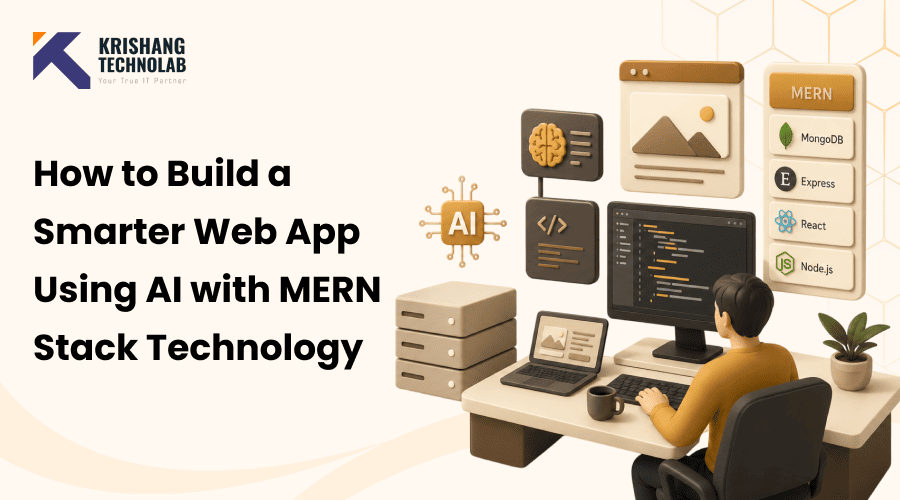
Quick Overview: This piece covers how to build smarter web apps using AI with MERN Stack technology, combining MongoDB, Express.js, React.js, and Node.js. It walks through AI-powered MERN Stack web application development, from choosing the right APIs to real-world use cases across industries.
Businesses today want apps that think, not just apps that work. Hence, AI with MERN stack has become one of the most searched combinations among the developers and business owners. This blog will explain in simple language how to combine artificial intelligence with MongoDB, Express.js, React.js, and Node.js. It’s a simple goal: to build smarter, faster, and more intelligent web applications.
Why AI-Powered Web Applications Are the Future
AI-powered web application development is no longer an option for growing businesses. In fact, over 77% of companies are already using or looking at AI in some form or other, studies show. This trend is proof of AI with MERN stack being a future-ready solution for any digital product. Alternatively, companies without an in-house team can explore ready-made AI web development solutions for a quicker start.
What Is the MERN Stack and How Does AI Fit In?
MERN stack development is a combination of four JavaScript technologies: MongoDB, Express.js, React.js and Node.js. This stack is popular with developers, as it lets them develop the whole application, including frontend and backend, using a single programming language. That one-language approach reduces complexity and gets AI in MERN Stack projects to launch a lot faster. This MERN tech stack is why AI integrations with MERN have become the preferred approach for modern digital products.
Also Read About: Which Is Better Full-Stack vs MEAN Stack vs MERN Stack?
Each layer in this stack carries its own weight once AI enters the picture:
- MongoDB is built to manage structured and unstructured data, making it a great choice for chat logs, embeddings, and user profiles. The same flexibility is the reason it works well in scalable AI with MERN Stack projects.
- Express.js is used to build safe, minimal APIs to connect the frontend with AI services and it handles routing, authentication and middleware management behind the scenes.
- React.js drives the interface side of things, powering chatbot windows, smart search bars and other responsive elements users actually interact with. Most teams do not have this skill set in-house, which is why they usually hire React developers to speed things up.
- Node.js is the connector to external AI APIs like OpenAI or Gemini and directly connects them to the backend. Getting this integration right takes real skill, which is why plenty of companies choose to hire Node.js developers instead of trying to figure it out on their own.
Combine those four pieces and what you get is custom web application development that’s easy to build and easy to maintain long after launch. It’s no coincidence, either, that this integration ties back to why Node.js and React work well together in so many modern projects.
Why Developers Choose AI with MERN Stack
Speed, flexibility and scalability in one JavaScript ecosystem. This trend is why developers continue to choose AI with the MERN Stack. Teams that jump tend to experience 30-40% less development time. A few things account for it:
- Single JavaScript ecosystem: Front-end and back-end are written in the same language, meaning fewer bugs and a more seamless experience for developing AI applications.
- Rapid AI feature development: Modular components allow you to bolt on a chatbot or smart search feature without gutting the rest of the app. Teams that onboard a provider offering full-stack AI development services tend to move even faster.
- Scalable architecture: This stack scales horizontally with relative ease as traffic and AI request volumes grow, which is a major reason businesses rely on an AI web app development company when they’re planning for years ahead, not just months.
- Easy integration: Integrating with AI APIs, LLMs and vector databases is typically a matter of a few HTTP requests in Node.js.
- Real-time processing: Live chat responses and streaming AI text feel instant instead of laggy, which matters more than people expect.
AI Technologies and Features You Can Add to AI with MERN Stack
MERN stack development is closely associated with several AI technologies. Here are some of the most common use cases for AI in software development:
- Large Language Models (LLMs) are most often found in chatbots and smart assistants and are a major part of what is fuelling wider generative AI development trends at the moment.
- Behind sentiment analysis, summarization, and customer support that actually feels responsive is the heavy lifting of natural language processing (NLP).
- Computer vision helps identify products and analyse images that can be helpful in healthcare as well as in eCommerce.
- Speech recognition introduces voice commands and improves accessibility.
- Recommendation engines reveal products or content that people are more likely to desire, and that alone tends to move the needle on engagement and sales.
- By leveraging machine learning development services, predictive analytics enables businesses to anticipate customer behavior, reduce churn, and accurately estimate future demand.
Beyond these core technologies, most businesses end up layering in a few extra features. AI chatbots and virtual assistants, semantic smart search, automated content generation, document processing with OCR and workflow automation quietly reduce repetitive manual work.
Popular Use Cases Across Industries for AI with MERN Stack
This one is sitting it out, almost without industry. Here’s how different sectors are using AI with MERN Stack:
- eCommerce: Retailers use it to deliver personalized recommendations and smart search. And there’s a tangible payoff: personalisation can increase sales by up to 20%. That’s why many partner with an AI software development company to get those features right the first time.
- Healthcare: symptom checking, image analysis
- Fintech: Platforms use it for fraud detection and chatbot support.
- Education: Used by platforms to create personalised learning paths for individual students.
- HR, legal, real estate, travel, and logistics: These sectors use AI with MERN Stack to automate, review documents, and predictively plan.
Step-by-Step Guide to Building an AI-Powered MERN Web Application
AI-powered SaaS development isn’t nearly as daunting as it sounds once you break it into stages. A structured process gets teams to launch faster and sidesteps the mistakes that tend to show up when people skip straight to coding.
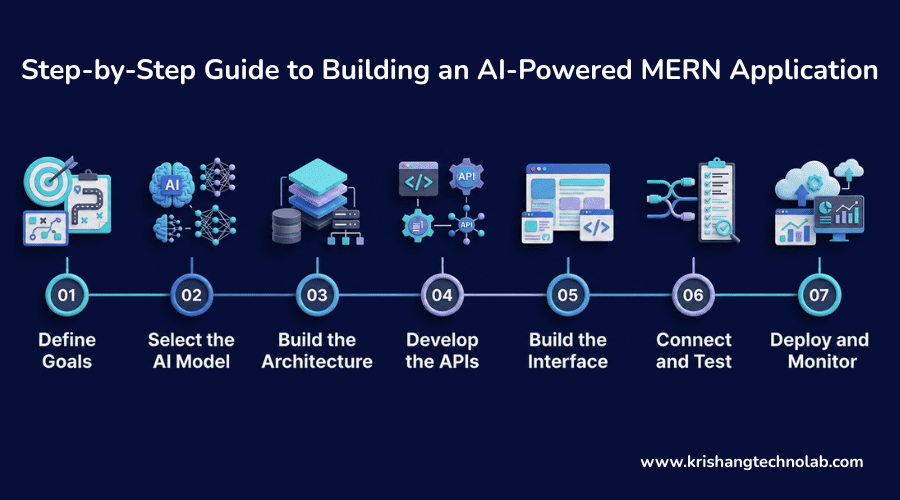
Define Goals
Before you write any code, be specific about what the app actually needs to do and why. Teams that don’t do this often find themselves redoing features midway and that costs a lot more than the planning would have.
Select the AI Model
Whether you choose OpenAI, Gemini, Claude or an open-source model depends on your budget, how much accuracy your use case requires, and frankly, how well the tooling fits into your team’s existing workflow.
Build the Architecture
Build the MERN project with a folder structure that separates the frontend, backend, and AI service layers from the beginning. If nobody in the team has done this before, then it’s worth hiring a MERN full stack developer for this stage.
Develop the APIs
Here, Express.js is used to communicate between the front-end and the AI services. Routing, authentication and error handling must be rock solid so that requests can flow through the system without breaking under real traffic.
Build the Interface
That’s where React components come together to show AI-generated content in a way that actually feels natural to use, whether that’s a chatbot window, a live search bar, or a dashboard displaying model output.
Connect and Test
You wire the AI models into the backend. Store their responses in MongoDB. Test for accuracy. None of it goes live. It’s a lot less costly to catch bugs now than to fix them after launch.
Deploy and Monitor
It’s not just about launching on cloud infrastructure. Watching performance afterwards is the way to catch latency problems, cost increases and accuracy drift before users see them.
Best AI APIs and Frameworks for MERN Stack Development
| AI API / Framework | Type | Best Used For |
| OpenAI API | LLM API | Chatbots, ChatGPT integration, reasoning tasks |
| Google Gemini API | Multimodal LLM API | Text, image, and audio-based features |
| Claude API | LLM API | Accuracy-sensitive apps (finance, healthcare, legal) |
| LangChain | AI orchestration framework | Multi-step reasoning, RAG, prompt chaining |
| Hugging Face | Open-source model hub | NLP, image recognition, custom models |
| TensorFlow.js | ML framework | Browser or Node.js-based lightweight ML |
| Pinecone / ChromaDB | Vector databases | Semantic search, recommendation systems |
Get the right combination to make or break AI integrations with MERN projects. For a clearer picture, it helps to compare different AI tech stack options for startups.
Designing an AI-Ready MERN Stack Web Application Architecture
A reliable MERN stack development services approach doesn’t stuff everything into one place. It divides the application into different layers, each doing one job well.
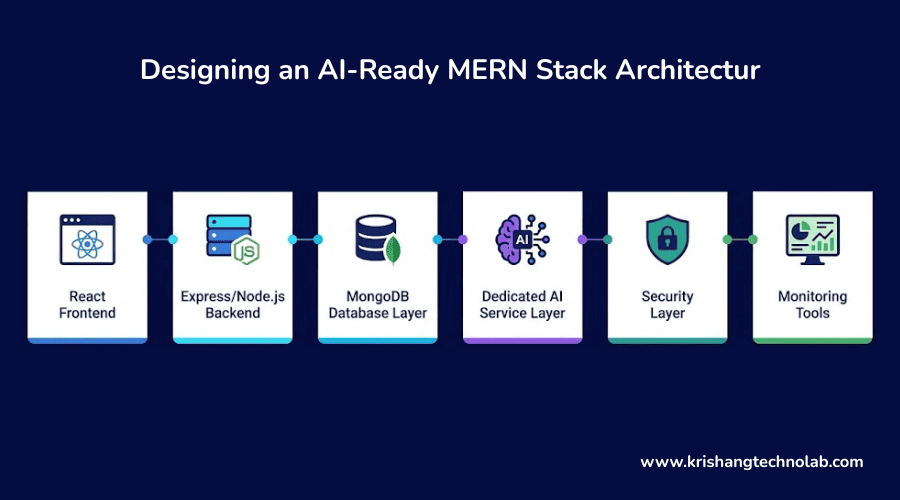
React Frontend
The frontend is what users really see and touch. This is where chatbot windows, dashboards and smart search bars all live, and it needs to stay responsive even while AI responses are still loading in the background. A reliable ReactJS development company helps build fast, interactive, and scalable frontend experiences that deliver smooth user interactions.
Express/Node.js Backend
The logic runs here. Routing, authentication and middleware all of that is done in this layer, which is the bridge between the React front-end and whatever AI services and databases sit behind it. With reliable Node.JS web development services, businesses can create scalable, secure, and high-performance backend systems that efficiently connect applications with advanced technologies.
MongoDB Database Layer
This is where chat logs, embeddings and user profiles are going. MongoDB’s schema flexibility lets you store neatly structured records and the messier content (often unstructured) that AI generates.
Dedicated AI Service Layer
This layer connects to external AI APIs such as OpenAI, Gemini or Claude. It manages requests, formats responses, and separate the AI logic enough that switching models does not necessitate touching the core application code.
Security Layer
The security layer is where authentication and encryption occur to protect API keys, user data, and AI request traffic. Getting this right is as vital to remaining compliant as it is to eliminating obvious vulnerabilities.
Monitoring Tools
These tools keep track of response times, error rates and usage patterns. That visibility is what enables teams to catch a problem before users encounter it themselves.
Challenges of Integrating AI with MERN Stack
It can get complicated very quickly when you’re dealing with a large amount of data and response latency can quickly complicate matters. AI API prices can escalate quickly as well. A few more challenges tend to pop up too:
- Basics of prompt engineering.
- Privacy compliance.
- Scaling intelligent web applications under heavy traffic.
Understanding how AI software development truly works ahead of time prevents teams from creating expectations that don’t hold up in real conditions. Many businesses rely on a trusted web application development agency to handle the complexities involved.
Best Practices for Developing an AI-Powered MERN Web App
There are some habits that distinguish the projects that go well from the ones that do not:
- Use precise prompts with context.
- Store API keys securely using environment variables.
- Cache frequent AI responses to keep costs down.
- Use background processing for anything long-running.
- Monitor AI usage on a regular basis.
- Keep AI logic modular, so swapping models doesn’t mean rebuilding the whole app.
None of these are complicated by themselves, but together they make AI automation significantly easier to sustain. Internal security expertise is often hard to come by. That’s why so many businesses turn to an AI consulting agency for help with rate limiting, endpoint security and cloud scalability.
Future Trends in AI with MERN Stack Development
AI growth using the MERN stack is continuing and it’s now easier than ever to stay on top of the curve with the help of an experienced AI development company. Here are some of the trends impacting the future of MERN AI integrations:
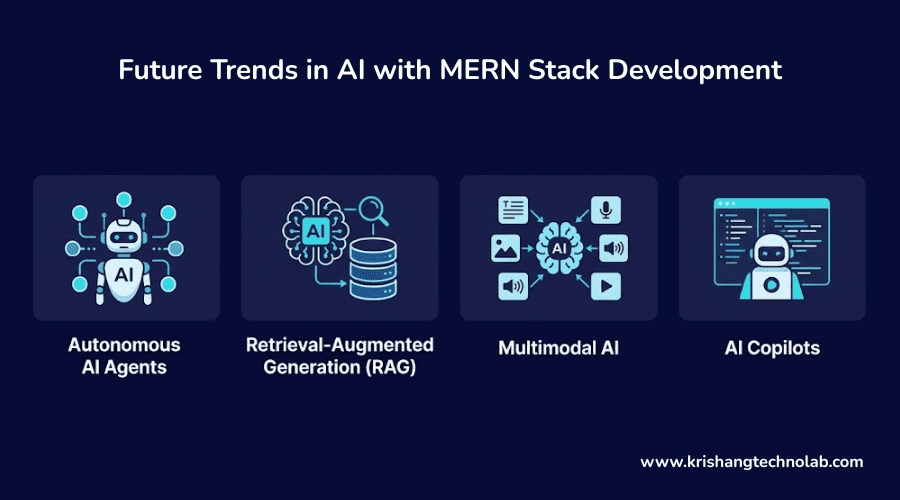
Autonomous AI Agents
These agents can accomplish multi-step tasks autonomously, from data collection to performing actions, without human guidance at each step. As AI with MERN Stack projects mature, this kind of autonomy is becoming a bigger part of the roadmap.
Retrieval-Augmented Generation (RAG)
RAG fetches relevant data before answering, making answers more specific and accurate. It’s quickly becoming the go-to AI for MERN Stack projects that need grounded, fact-based output.
Multimodal AI
Multimodal AI works with text, images and audio all at the same time, instead of just one format. This flexibility opens up new possibilities for AI use cases with MERN Stack applications in healthcare, eCommerce, and customer support.
AI Copilots
AI copilots live inside business apps, helping users in real time, whether it’s writing content, answering questions or guiding a workflow. One of the more requested features among companies adopting AI is to build these into a MERN stack development project.
Choosing the Right AI with MERN Stack Web App Development Partner
The success of an AI with MERN stack project depends on choosing the right partner. Some businesses hire AI developers internally, others work with an AI development company instead. Both paths can work, but it’s the team behind them that often makes or breaks a project. For projects that require industry-specific needs, businesses often turn to a custom software development agency or a specialized MERN stack development agency.
When sizing up a partner, don’t just look at the pitch. Refer to their technical portfolio and industry experience. Just as important is their hands-on expertise with LLMs, vector databases and custom APIs. For instance, teams looking for MERN stack developers should check for real AI integration experience instead of just taking it at face value. Teams looking to hire MERN Stack developers, for instance, should confirm that every MERN developer on the team has real AI integration experience rather than take it at face value. For more specialized needs, some businesses go straight to hiring dedicated MERN developers. A good partner also sticks to a scalable development approach, often backed by an AI product development agency, and keeps offering AI consulting services well after launch. Alternatively, some businesses just hire AI engineers directly and manage support in-house.
Final Thoughts
AI with MERN stack provides businesses with a truly flexible way to build intelligent, scalable applications and this is true across almost every industry. The fact that there is one JavaScript ecosystem makes it easier to integrate AI, and features like chatbots and smart search are doing real work to drive engagement and long-term success. The next step is simple: define clear AI goals, pick the right API and hire AI developers who know their way around AI with MERN Stack projects. For businesses that do not have the internal resources to do this work, they can always rely on an AI web development agency or full-stack development agency.
Frequently Asked Questions
What is AI with MERN Stack?
It’s the art of combining technologies like LLMs and NLP with MongoDB, Express.js, React.js, and Node.js to give web applications the intelligence and interactivity that a regular build wouldn’t have on its own.
Which AI API is best for MERN Stack?
The right choice ultimately depends on your project’s requirements. If you want a chatbot, go to OpenAI. Gemini is great for multimodal tasks and has a reputation for careful, reliable reasoning in applications where accuracy is important.
How much does AI-powered MERN development cost?
There are no such numbers here. A basic chatbot integration could cost a few thousand dollars, but an enterprise project deploying multimodal AI and custom infrastructure could easily run into the hundreds of thousands. Most of that gap is down to team experience and feature scope.
Is MERN stack suitable for enterprise AI applications?
Yes, and this is one area where it truly excels. The architecture can scale to larger user populations and more complex data sets without crashing and can better support concurrent AI services than many alternatives.
Should I hire AI developers or build an in-house team?
It’s mostly a matter of budget and timeline. Hiring a MERN full stack developer or working with an already established AI development company tends to get the projects moving faster than building a team from scratch, which can take months before anyone writes usable code.
Found this post helpful? Don't forget to share it with your network!