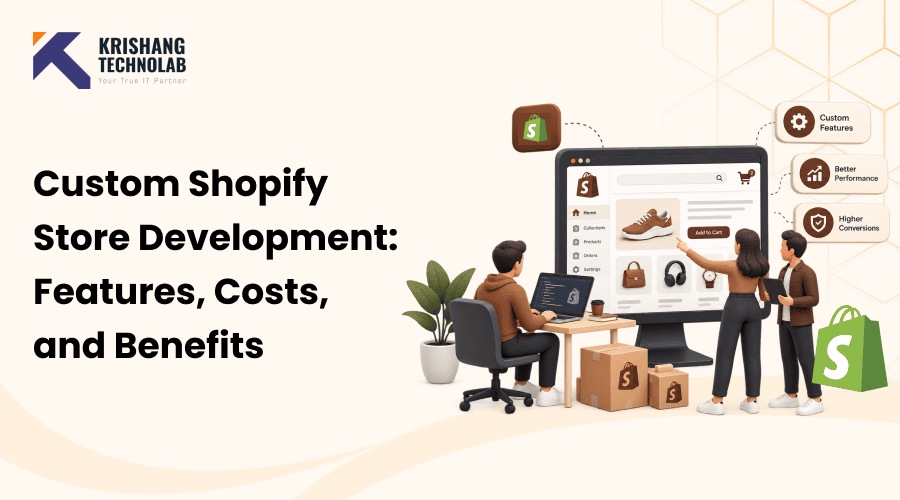
Quick Overview: Custom Shopify store development helps businesses create scalable, high-performing ecommerce stores with custom Shopify themes, responsive design, advanced features, seamless integrations, Shopify SEO, mobile optimization, personalized shopping experiences, conversion optimization, custom apps, and powerful analytics.
Every online brand requires a store that cuts through the noise. Custom Shopify Store Development helps businesses gain that edge. To begin with, a custom build is more than a generic template — it’s a way to truly reflect your brand. Beyond that, it also supports the exact features your business needs to grow with the help of dedicated Shopify development services.
A lot of companies begin with a basic Shopify theme. However, they soon find they have no real design flexibility and limited function. That’s why we increasingly see brands opting for custom builds as they scale. In this way, you can build a store that is customer-centric, through proper Shopify ecommerce development, rather than a template.
Before you buy, this guide tells you everything you need to know. First, let’s clarify what Custom Shopify Store Development actually means. Then, we’ll go over the features that make it valuable. Next, we’ll talk about practical costs, including how much Shopify custom development costs in the real world. Finally, we’ll cover the benefits and help you decide.
Whether you’re building a new brand or revamping an existing store, this guide will help. After all, even experienced shop owners are constantly learning new things. Along the way, you’ll learn how custom Shopify website development differs from off-the-shelf themes, and how to build a custom Shopify store the right way. You’ll also learn what the real price of creating a Shopify store is.
What Is Custom Shopify Store Development?
Custom Shopify Store Development means to create a store which is not just default theme settings. Developers write custom code instead of relying on templates. This code fits your brand, your workflow and your customers. This, in turn, makes the store feel unique and not generic like a typical Shopify website development.
A consistent theme however limits your customisation. You can change colours and fonts, but the structure is often fixed. Custom Shopify website development eliminates those restrictions entirely. Developers are able to create new layouts, custom checkout flows, and unique product pages.
This kind of E-commerce Development & Solutions approach also allows much deeper changes in the backend. You can connect specialised applications, automate tasks and integrate external systems to create a more flexible and scalable store. This is why companies with complex requirements generally choose this route, as it is one of the major benefits of custom Shopify development. However, simpler stores may not need this level of investment right away.
It’s worth noting that Shopify store development is already built on a flexible foundation. And that flexibility is precisely what makes custom work possible. With expert Shopify custom development, developers simply extend what the platform offers you.
Why Choose Custom Shopify Store Development?
Every business has a story to tell, a workflow of its own, and a customer base of its own. A custom-built Shopify store captures that individuality much better than a generic template ever would. By choosing to Hire Shopify Development Experts, you can create a design that truly reflects your brand, layouts built around your specific customers’ shopping and browsing habits, and a shopping experience that feels more personal and engaging. Not only does this type of personalisation look good, but it also helps build trust and keep visitors on your site longer, which naturally leads to better conversion rates.
Custom development also gives you room to grow beyond aesthetics. A custom-built store can grow with your business, handling more products, traffic, and features without grinding to a halt or requiring a complete overhaul. It also tends to run faster and more efficiently because the code is not weighed down by unnecessary bloat from off-the-shelf themes. With Professional Website Maintenance Services, you can also keep your store running smoothly as it evolves, while custom solutions make it much easier to connect your store with the other tools you rely on, whether that’s inventory systems, CRMs, marketing platforms, or payment gateways. This creates a smoother, more connected operation from the back end to the front end.
Key Features of a Custom Shopify Store
A custom Shopify store brings together several features that generic themes simply can’t offer. Each feature works toward a common goal: creating a faster, more personalised, and more profitable shopping experience for every visitor. To achieve the right balance of functionality, performance, and design, businesses can Hire Dedicated Shopify Experts to build a store tailored to their specific needs.
Custom Shopify Theme Design
First, the custom Shopify theme development process starts with a design that reflects your brand’s identity, including specific colours, fonts, and layouts, all through dedicated Shopify theme customisation. Choosing the Right Shopify Theme can make a significant difference here, since developers can create a genuinely custom Shopify theme tailored to your audience and products rather than relying on a generic template. As a result, your store becomes easier to navigate, more visually appealing, and distinct from the competition.
Mobile-Responsive Store Design
Responsive design is no longer an option, as most shoppers browse using smartphones today. To Optimize Shopify for Mobile Conversions, custom builds allow you to create your Shopify website exactly how you want it, ensuring that all pages flow seamlessly across different screen sizes and devices. This means easier browsing, smoother navigation, and a hassle-free checkout experience, no matter how your customers access your store.
Custom Product and Collection Pages
Generic products often have product pages that look the same across many shops. With Shopify store customisation, you can present images, specifications, and reviews in a way that best suits your catalogue. You can also work with a Professional Web Design Agency to create collection pages that offer customers a streamlined and engaging way to discover the right products.
Advanced Navigation and Search
As your product range grows, however, basic theme navigation can quickly become limiting. To address this, following 9 Tips for Better Shopify Navigation — such as custom filters, predictive search, and well-structured categories — can create a smoother product discovery journey. In turn, a clear navigation structure lets shoppers find what they want faster, stay engaged with your store, and move more easily toward checkout.
Custom Checkout Experience
Similarly, a customised checkout removes unnecessary steps and common friction points. Here, developers can add custom fields, upsells, or branded design elements anywhere in the flow. Consequently, this creates a better experience, fewer abandoned shopping carts, and more conversions.
Third-Party API and App Integrations
In addition, the Shopify API lets you connect your store to CRMs, ERPs, marketing platforms, and more. This third-party Shopify integration automates the flow of data between systems, thereby eliminating any chance of error from manual entry. As a result, companies save hours of valuable time making sure all platforms stay in perfect sync.
Custom Shopify App Development
Today’s applications may not always fulfilll special or complex business requirements. Tools for Custom Shopify App Development That Match Your Workflow These might be loyalty schemes, booking systems or specialist inventory management features.
Personalized Shopping Experience
Beyond that, custom development can enable dynamic content based on location, behaviour, or purchase history. In practice, this means offering shoppers recommendations and offers that actually match what they want. Over time, this type of personalisation builds loyalty and encourages more repeat purchases.
SEO-Friendly Store Structure
Clean code and a logical site structure play an important role in search engine rankings. As part of Advanced SEO Services, Shopify stores can be structured with optimized URLs, metadata, and page speed from the beginning. This creates a stronger technical foundation for improving visibility and growing organic traffic over time.
Performance and Speed Optimization
Slow-loading websites can lose potential customers within seconds. The Shopify Speed Optimization Guide shows why lean, well-structured code matters, especially when compared with bloated themes packed with unnecessary features. Custom development removes this excess code, resulting in a faster, more responsive store that keeps visitors browsing and reduces premature exits.
Analytics and Conversion Tracking
Understanding customer behaviour requires accurate tracking at every stage of the shopping journey. By setting up Google Analytics 4 on Shopify, businesses can gain valuable insights into how visitors browse products, interact with the store, and move through the checkout process. These insights help identify customer drop-off points, improve conversion strategies, and make marketing campaigns more effective.
Multilingual and Multi-Currency Support
Finally, businesses selling internationally need flexible language and currency options built in. Here too, custom development can easily add multi-language content and automatic currency conversion across regions — meaning a comfortable and familiar shopping experience for customers everywhere.
Custom Shopify Store Development Process
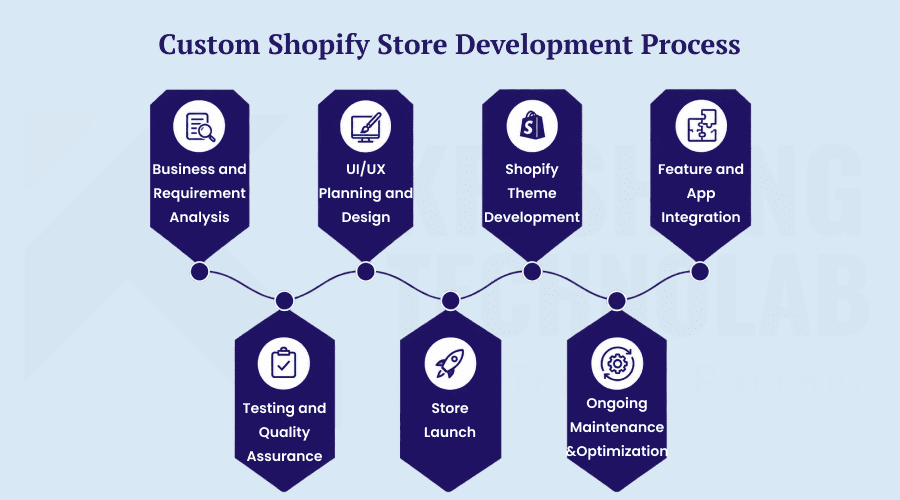
Building a successful online store, in turn, involves a structured approach. We consult with you through each stage of the process, from defining your business objectives to providing ongoing post-launch support, ensuring that the final store aligns with your vision, customer needs, and long-term growth objectives.
1. Business and Requirement Analysis
First, the goal is to understand your business goals, your target audience, and your competitors. Before any design can begin, the development team collects detailed requirements to understand the scope, features, and general direction of the store.
2. UI/UX Planning and Design
Next, designers generate wireframes and visual layouts, keeping the brand consistent and usable throughout. The aim is a clean, intuitive interface that guides your customers through browsing and checkout, while also showing the personality of your brand.
3. Shopify Theme Development
Developers can transform an outdated store with Modern Website Redesign Services, creating a custom theme from the ground up with unique layouts, visual styles, and functionality. This gives your store a distinctive look, smoother performance, and greater flexibility without the restrictions commonly found in ready-made templates.
4. Feature and App Integration
Following that, this step includes payment gateways, shipping calculators, CRMs, marketing apps, and more. In doing so, it links your store to the most important business systems, resulting in smoother operations and a better overall customer experience.
5. Testing and Quality Assurance
Before going live, the store is tested across a lot of browsers and devices. This ranges from core features and page load speeds to the checkout flow and how the layout holds up on different screens, catching problems early, before launch.
6. Store Launch
Once testing wraps up, the store opens. At this stage, performance is tested again to make sure everything is working well, integrations are solid, and the shopping experience is stable for real customers.
7. Ongoing Maintenance and Optimization
After launch, the store is maintained with regular updates, performance reviews, and feature enhancements. As your business grows, this constant optimisation keeps your site loading quickly, staying secure, and delivering a great user experience.
How Much Does Custom Shopify Store Development Cost?
How much does custom Shopify development cost? The price will depend on the design complexity, the features you need and integrations you’d like to setup. A simple custom Shopify store project is in the few thousands of dollars range. More complex builds with a lot of features can cost much more to build custom apps.
Factors That Affect Shopify Development Cost
Overall, the price depends on many factors, such as the complexity of the store, the number of products, the required features, compatibility with other apps, and the expertise of the developer. In addition, ongoing help and maintenance are typically part of the price of a custom Shopify store.
Shopify Development Cost by Store Type
Likewise, Shopify website development cost depends heavily on the type of store. While simple catalogues are cheaper, multi-vendor marketplaces, subscription models, or highly customised B2B stores increase the cost, since they require more development time, more advanced features, and more specialised integrations.
| Feature | Custom Shopify Store | Pre-Built Theme |
| Design flexibility | High | Limited |
| Branding | Fully customizable | Theme-dependent |
| Performance optimization | Customizable | Depends on theme |
| Functionality | Highly flexible | Limited by theme/apps |
| Scalability | High | Moderate |
| Development cost | Higher | Lower |
| Development time | Longer | Faster |
When Should You Invest in a Custom Shopify Store?
If you feel your current setup is limiting, lacks unique functionality, or can’t support the design your brand really needs, then it’s time to consider a custom build. After all, templates don’t scale as fast as growing companies often need them to.
Specifically, it’s a good idea to build custom if you need complex integrations, you’re in a high-growth phase of your ecommerce business, or you want more control over how your customers experience your store. When comparing a custom Shopify store versus a pre-built theme, these scenarios ultimately require a level of flexibility that pre-built themes simply can’t offer.
How to Choose the Right Shopify Development Partner
Start by researching a developer’s experience with Shopify and checking out their previous projects. You will have a good idea of their designing capabilities, technical skill and if their custom Shopify store development services are a good fit to your brand’s vision.
Check their portfolio and evaluate their technical skills, communication style, and availability for support. Having the pricing and scope of the project and Shopify custom theme development services up-front helps you avoid surprises and have a smoother long-term working relationship.
Common Mistakes to Avoid in Custom Shopify Development
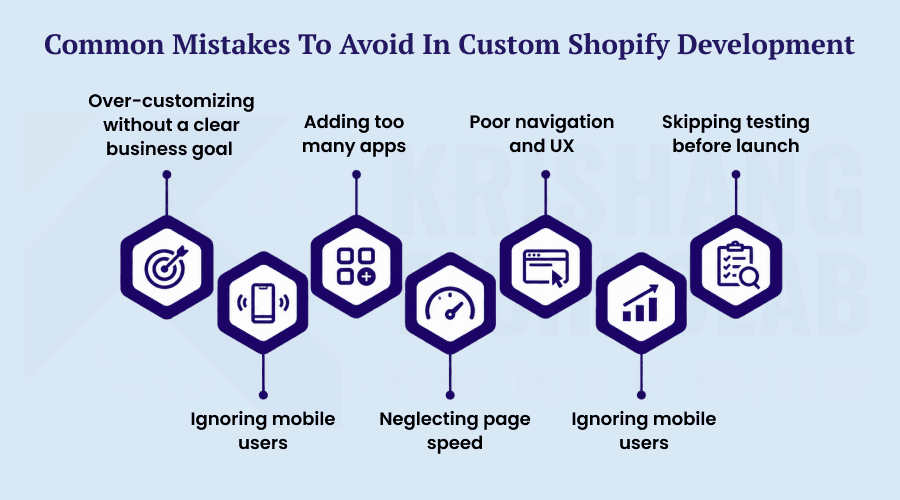
Custom development provides great flexibility, but if you don’t plan well, you lose those advantages. By avoiding these common pitfalls, you’ll be able to keep your store fast, easy to use, scalable, and in line with actual business goals rather than needless complexity.
1. Over-customizing without a clear business goal
costs money and complexity. They add features not because it makes sense for the business, but because they can do it. Customisation must solve a real problem or significantly improve the customer experience.
2. Ignoring mobile users
Most shoppers are browsing on their phones, so a mobile optimised store is a must or you’ll lose a lot of sales. Today responsive design, fast mobile load times and easy navigation are must haves, not optional.
3. Adding too many apps
Too many third-party apps slow down your store and cause conflicts between scripts. Each app should have a purpose. Unnecessary tools have just added bloat to the system and have not necessarily improved functionality or customer experience.
4. Neglecting page speed
Slow pages annoy customers and hurt search rankings. Performance optimisation is the most important part of the development process. Unoptimised images, too many scripts and heavy themes all result to bad speed.
5. Poor navigation and UX
Shoppers hate cluttered layouts, confusing menus and ineffective calls-to-action and they also increase bounce rates. With intuitive navigation and well-thought-out UX design, it’s easy for customers to find products and check out smoothly.
6. Not planning for scalability
Cluttered layouts, confusing menus and inefficient calls-to-action, not only irritate the shoppers but also increase the bounce rates. “The intuitive navigation and well thought out UX design allow customers to easily find products and make purchases.”
7. Skipping testing before launch
If you go live without testing you might have broken links, checkout errors and bad compatibility with devices. Full testing on browsers and devices helps to find problems early and to build a smooth experience for real customers.
Is Custom Shopify Store Development Worth the Investment?
Custom development is more expensive initially but is often more valuable over the long term because it works better, is more flexible and creates a store around your real business needs, not assumptions.
Brands that emphasise scalability, frictionless customer experience and reliable performance get the best ROI. When those priorities align, custom development is a smart, strategic business move.
Frequently Asked Questions
How much does it cost to build a custom Shopify store?
Price varies by complexity of design, features and integrations required. Basic stores are cheaper, but the price is inflated by more advanced builds with custom apps and third-party integrations. Getting quotes With a clear scope of work you will be able to set a realistic budget for your business.
How long does custom Shopify development take?
The majority of custom projects are a few weeks to a few months depending on scope. Simple stores are faster, complex builds with custom apps or integrations take longer. The overall schedule is also impacted by client feedback turnaround and extensive testing.
Is custom Shopify development better than using a Shopify theme?
What is the right approach really depends on what you are aiming at. Themes are a good fit for simple stores with simple needs, while brands that want a unique look, custom functionality, and a more personalised shopping experience usually get more value from custom development. Ultimately it is a question of what you can afford, what you want to achieve and how flexible your business needs to be.
Can I add custom features to my Shopify store?
Yes, developers are able to build custom checkout flows, loyalty programs, subscriptions and personalised recommendations. These features are custom-coded for your store so they work seamlessly and outperform cobbling together multiple generic third-party apps.
Can a custom Shopify store be optimized for SEO?
Yes, custom builds can result in better SEO in many cases with faster load speeds, clean code, proper URL structure and better site architecture. You also have more control over things like schema markup, image optimisation and mobile responsiveness than you do with standard themes.
Can Shopify integrate with my existing business software?
Yes. Custom build can integrate with your CRM, inventory systems, accounting tools, marketing platforms. It removes manual work, maintains data being up-to-date across systems and creates easier procedures, provided the software already installed has open APIs to connect to.
Is custom Shopify development suitable for small businesses?
It is contingent upon stage of growth and goals. Small businesses often choose themes to begin with, but those with established branding, specific functionality requirements or plans for rapid growth will benefit more from investing in customisation early on, to avoid expensive migrations later.
Conclusion
Custom Shopify store development lets you build a unique online identity that reflects your brand, instead of using a template that came with the store. Your store is custom-built to work the way your business really works, from flexible designs and better performance to smooth integrations with the tools you already use. Control extends to scalability where your store can grow with your product catalogue, customer base and evolving business objectives without the shackles of pre-built themes.
That said, the advantage of custom development is to choose the right features for your situation, not for the sake of complexity. Design choices and functionality and integrations are best aligned with concrete business objectives that make every investment support long-term growth instead of unnecessary overhead.
If your current store is holding you back, or you are ready to scale and need a shopping experience built explicitly around your customers, custom Shopify development is worth serious consideration. Work with an experienced Shopify development partner to explore what a custom solution could do for your business.
Found this post helpful? Don't forget to share it with your network!