
Quick Overview: Learn how to choose a custom software development partner by comparing technical expertise, industry experience, pricing models, development processes, security practices, and post-launch support to find the right software development company for your business.
Choosing a custom software development partner shapes your budget, timeline, and product quality. However, many proposals look similar at first glance. You therefore require a straightforward way to evaluate them.
A strong software development company studies your business before suggesting any technology. Also, it explains risks, costs, and trade-offs in plain language. As a result, you can make decisions with confidence.
This guide covers expertise, process, team quality, pricing, security, ownership, contracts, and long-term maintenance. You will find a scorecard, warning signs, and an eight-step checklist.
The advice suits founders, technology leaders, and procurement teams. For example, a startup may need a quick pilot, while an enterprise may need strict governance.
Sometimes the best team isn’t the biggest or the cheapest vendor. Instead, its skills and working style should match your goals.
Before reaching out to any vendor, please take a moment to outline the expected business outcome. Then, ask every candidate for evidence rather than promises. Your ultimate decision will therefore be based on facts.
What does your business actually need from custom software?
Before you request a quote, picture a normal working day in your company. For example, notice where staff copy data twice or wait for approvals. These small delays reveal what your new system must fix. As a result, your project begins with real problems instead of a long feature wishlist.
Next, decide which results matter most over the coming year. You might want quicker orders, fewer mistakes or clearer reports. However, trying to solve everything at once often drains money and patience. Therefore, choose two or three priorities first. Then, add further improvements once your team trusts the first release.
- List costly problems, then share them with custom software development companies, a software engineering company or your Custom Software Development Partner.
- Define core features for software application development services, custom software services and software engineering services.
- Describe daily users, their devices and frustrations.
- Set goals and ask a software dev company about software development services for startups.
- Compare ready-made tools with custom software development services and custom software services.
Identify the Business Problems Your Software Needs to Solve
First, list the delays, errors and manual tasks that cost you money. Then, note how often each one really happens. A good custom software development partner will question this list. Next, share it with custom software development companies. Also, ask each software engineering company what it would fix first. As a result, you can compare their thinking early and fairly. Finally, rank each problem by the time and money it wastes.
Define Your Software Requirements and Core Features
Next, separate essential features from optional ideas. For example, mark which reports, user roles and system links you need first. This brief lets software application development services estimate work accurately. Also, both custom software services and software engineering services should start with this brief. Therefore, keep it short and very clear. Then, update it whenever your team agrees on changes. In addition, describe how you will know each essential feature works correctly.
- Separate essential features from optional ideas.
- Mark which reports, user roles and system links you need first.
- Use this brief so software application development services can estimate work accurately.
- Share it as the starting point for custom software services and software engineering services.
- Keep it short and very clear.
- Update it whenever your team agrees on changes.
- Describe how you will know each essential feature works correctly.
Identify Your Target Users and Their Expectations
First, describe exactly who will use the product daily. For instance, include office staff, field teams, managers and customers. Then, talk with them about their devices, habits and frustrations. Also, watch how they complete common tasks today. As a result, you may notice hidden steps. These insights guide simpler screens, so people can learn the new system with less effort. Finally, invite a few users to test early designs and share honest feedback.
Set Clear Project Goals, Budget and Timeline
First, set measurable goals, such as faster order processing. Also, agree on a budget and launch date. In many cases, software development services for startups begin with a focused MVP. However, if cash is tight, a software dev company can phase the work. Therefore, ask which software development services for startups include discovery. Then, fund the most valuable features first. In addition, keep some money and time aside for unexpected changes.
Decide Between Custom Software and Off-the-Shelf Solutions
First, remember that not every problem needs a new build. For example, ready-made tools often handle routine work well. However, custom software services fit unique processes, complex integrations and competitive advantages. Admittedly, custom software development services cost more at first. Yet custom software services can remove licence limits. Therefore, compare both options carefully over several years before you finally decide.
| Factor | Custom Software | Off-the-Shelf Software |
| Fit | Built around your processes | Built for common business needs |
| Upfront cost | Usually higher | Usually lower |
| Ongoing cost | Hosting, maintenance and upgrades | Subscription or licence fees |
| Setup time | Often takes months | Often ready much sooner |
| Flexibility | Changes follow your priorities | Limited to the vendor’s options |
| Integrations | Designed for your existing tools | Depends on available connectors |
| Ownership | Set by your contract | The vendor keeps ownership |
| Best for | Unique or complex workflows | Routine, standard tasks |
Look for Relevant Industry Experience and Technical Expertise
Look for projects that resemble yours in complexity. A reputable software engineering company will be able to explain its technology stack choices. Ask about cloud platforms, APIs, DevOps, and legacy modernization. For intelligent products, an AI software development company should discuss data quality and model testing. Its AI development experience must go beyond simple demos.
Furthermore, AI software development services from any AI software development company should come with clear test results. An IT software development company should understand your current systems.
Evaluate Their Software Development Process and Methodology
A clear process shows how an idea becomes working software. Therefore, ask each vendor to explain every stage, from the first workshop to the final release. For example, request sample plans, test reports and weekly progress updates. Also, check who approves changes and how risks reach you. As a result, you can spot weak planning early. Then, choose a team whose working rhythm suits your own staff and decision makers.
Understand Their Project Discovery and Planning Process
A discovery phase should clarify users, scope and technical risks. A reliable custom software development partner delivers written findings before coding starts. Software application development services use this step to map user flows. Also, ask who will attend these early workshops. For example, your daily users can point out steps that managers often miss. As a result, the team can correct wrong assumptions early. Then, review the findings together and approve the priorities.
Check Whether They Follow Agile or Other Development Methodologies
A software engineering company should know that Agile suits changing requirements, while Waterfall suits fixed scope. So, ask why their method fits your software development project. Also, find out how often you will see working features. For instance, many Agile teams share progress every two weeks. However, regular reviews need time from your side too. Therefore, name someone who can give feedback and make quick decisions.
Evaluate Sprint Planning, Milestones and Progress Tracking
Request sample sprint plans and status reports. Also, check that each milestone has a clear goal and due date. For example, a report should show finished work, open tasks and current risks. As a result, you can notice delays before they grow. Then, agree on how often the team will update you. In addition, ask to see a working demo at the end of each sprint. If a deadline slips, the team should explain why and share a revised plan.
Understand Their Approach to Code Reviews and Quality Assurance
Every change should pass peer review and testing. Effective software engineering services combine manual checks with automated tests to reduce technical debt. Also, ask who reviews the code before release. For instance, a second developer can catch errors that the author missed. In addition, testers should check common tasks and unusual cases.
As a result, fewer serious problems are likely to reach your users. Furthermore, ask how the team records, ranks and fixes each defect. Finally, request a sample test report so you can see what gets checked.
Check Their Deployment and Release Management Process
Finally, ask how releases move through CI/CD pipelines. Software-as-a-service products need safe, frequent releases. Software development as a service plans should name who handles them. Also, ask what happens if an update fails. For example, the team should restore the previous version quickly. In addition, schedule major changes outside your busiest hours. Then, confirm who will watch the system after each release.
Assess the Quality and Experience of Their Development Team
The people behind your project matter more than a polished sales presentation. So, ask to meet the developers, designers, testers and technical lead before signing. For instance, discuss a real challenge from your own business and listen carefully to their answers. Also, check how long the team has worked together. As a result, you will understand their skills better. Finally, confirm that these same people will actually build your product.
Identify the Developers Who Will Actually Work on Your Project
Sales experts probably won’t write your code, even at a mobile software development company. Before you hire software developers, meet the people assigned to your account. Whether you hire software developers or hire dedicated developers, check their project history. Also, ask each person about similar work they completed recently.
For example, a good developer can explain a hard problem and how they solved it. As a result, you learn more than a résumé shows. Then, confirm how many hours each person will give to your project every single week.
Evaluate the Experience of Their Software Architects and Technical Leads
Interview the architect on the scalability and integration choices before you hire AI developers. A good custom software development partner will explain trade-offs in plain language, not jargon. If you hire AI engineers, ask the lead how models will be watched. A software engineering company should answer with facts. In addition, ask the lead to sketch a simple view of your future system. For instance, they can show how data moves between each part. Also, ask what could fail as demand grows. As a result, you can judge their planning skills before any major design decision is finally made.
Check Their UI/UX Design and Quality Assurance Capabilities
Review wireframes, prototypes, and test plans. Experience in device testing and the app store is required for a mobile software development company. Also, ask how designers learn what your users need. For example, they may test a clickable model before developers write code. Then, find out how testers record problems and check fixes. As a result, you can catch confusing screens early and avoid expensive changes after the product reaches real customers.
Understand Their Team Structure and Communication Process
Verify ownership of priorities, risks, and approvals. When you hire dedicated developers, define reporting lines from the first day. You can hire AI developers within the same team. AI development tasks still need one clear owner. Furthermore, agree on how often both teams will meet. For instance, a short weekly call can cover progress, blockers and next steps. Also, choose one shared place for decisions and documents. As a result, everyone can find the same information. Then, set a clear route for raising urgent concerns quickly.
Ask About Developer Availability and Team Replacement Policies
People may leave during long projects. It would be beneficial to request notice periods, knowledge transfer steps, and replacement timelines in writing. Before you hire dedicated developers, also agree on who covers leave. In addition, ask how a new person learns your project. For example, written guides and recorded walkthroughs can shorten the handover period.
Also, check whether another team member already understands each key task. As a result, one absence will not stop progress. Finally, confirm who pays for training any replacements.
Review Their Portfolio, Case Studies and Client Testimonials
Start with the portfolio and look for similar scale and workflows. Then, check whether case studies describe problems, decisions and measured results. Speak with past clients of each mobile software development company. Ask how your potential software development partner handled delays. For mobile or smart tools, ask an artificial intelligence software development company for client proof. Also, ask whether you can try a live product similar to the one you plan to build. Finally, compare reviews from several sources and look for repeated praise or complaints.
- Look for projects with similar scale and workflows.
- Check whether case studies describe problems, decisions and measured results.
- Speak with past clients of each mobile software development company.
- Ask how your potential software development partner handled delays.
- For mobile or smart tools, ask an artificial intelligence software development company for client proof.
- Try a live product similar to the one you plan to build.
- Compare reviews from several sources and look for repeated praise or complaints.
Evaluate Their Communication and Project Management Capabilities
Good communication saves expensive rework. A good custom software development partner will establish contact and response times. Nearshore software development companies may share more of your working hours. Nearshore software development services usually offer more overlap. Offshore software development services can widen your talent pool.
Nearshore software development services and offshore software development services both need written updates.
Compare Software Development Costs and Pricing Models
Prices can differ widely, even when two proposals appear to describe the same product. Therefore, check what each quote includes before comparing the totals. For example, one vendor may cover design and testing, while another charges separately. Also, ask about hosting, licences, upgrades and maintenance fees. As a result, you can plan a realistic budget early. Then, select the pricing model that matches how clearly your requirements are defined today.
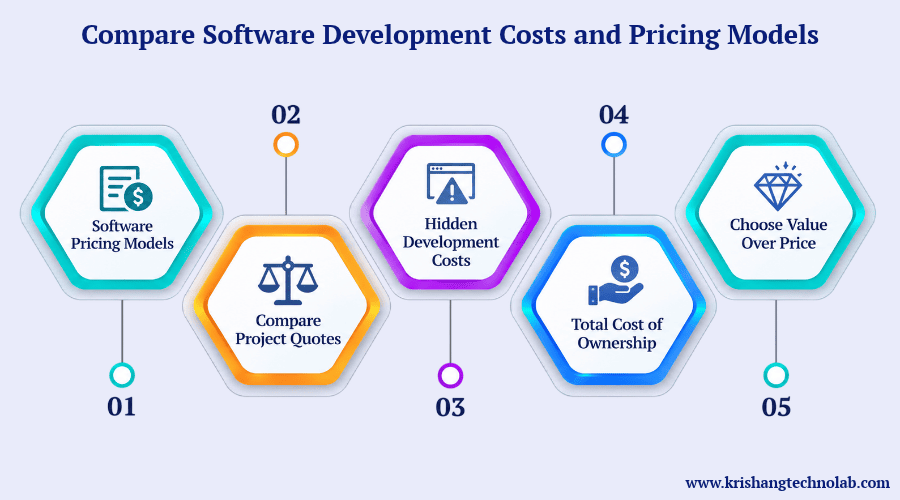
1. Understand Software Pricing Models
Fixed-price rewards have a stable scope. Time-and-material pricing suits change, whereas a dedicated team suits ongoing product work. Software development outsourcing services may offer all three. Outsourcing software development services should state what each rate covers. Also, ask how each model handles a change halfway through the project. For example, you may need a new report or payment option. As a result, you will see which arrangement gives enough flexibility while still keeping your monthly spending under control.
2. Evaluate Project Quotes
Next, compare estimates against the same requirements. Custom software development companies should list assumptions, deliverables, testing effort, and exclusions. Please provide all software development services companies with the same brief before they submit their pricing. Software development outsourcing companies should show team roles.
In addition, place the quotes side by side in one simple sheet. For instance, compare design, development, testing and launch tasks separately. As a result, missing items become easier to spot. Then, ask each vendor to explain any large difference in time or price.
3. Uncover Hidden Development Costs
Furthermore, check licenses, cloud hosting, third-party APIs, and data migration. These raise your bill for custom software development. Even if you hire dedicated developers, AI development brings model usage and data costs. An AI white label plan from an artificial intelligence software development company may have additional fees.
Also, ask which costs repeat every month and which you pay only once. For example, a payment service may charge for each transaction. Therefore, request a written list of expected fees, so your finance team can plan ahead without unwelcome surprises.
4. Assess Total Cost of Ownership
Estimate three years of hosting, upgrades, and maintenance. A reliable custom development partner will address these costs upfront. Furthermore, think about how your needs may grow during those three years. For instance, more users can increase hosting and licence fees. As a result, a cheap first build may become expensive later. Therefore, compare both starting costs and yearly running costs.
5. Prioritize Value Over Cost
However, a bargain price can leave little room for testing or written guides. Thus, rework can erase the early savings. Instead, judge each quote by what you receive for the money. For example, check the team’s experience, testing plan and support after launch. Also, ask why one price is much lower. Then, choose the offer that gives clear value and fewer risks.
Check Their Software Security, Data Privacy and Compliance Practices
Security must start during design. Ask your custom software development partner about encryption, access control and safe coding practices. You should also request evidence such as ISO 27001 certification or SOC 2 reports. Do not share sensitive information until both sides sign an NDA. Also, ask which team members can view your data and how access is removed. For example, a developer who leaves the project should lose access immediately. In addition, confirm how quickly the vendor will report a security incident.
- Make sure security starts during design.
- Ask your custom software development partner about encryption, access control and safe coding practices.
- Request evidence such as ISO 27001 certification or SOC 2 reports.
- Sign an NDA before sharing sensitive information.
- Ask which team members can view your data and how access is removed.
- Remove access immediately when a developer leaves the project.
- Confirm how quickly the vendor will report a security incident.
Clarify Intellectual Property and Source Code Ownership
Your contract should assign intellectual property and source code to you. However, vendors may reuse libraries they already own. An AI white label deal should also say who owns prompts, models and outputs. Please confirm the agreement with any AI software development company. Also, ask for access to the code repository from the start of the project. For instance, your own account should control hosting, domains and other key services. As a result, you can move to another team without losing important work.
Evaluate Their Post-Launch Support and Maintenance Services
Your software will need attention long after the first release goes live. For example, users may report unexpected errors, while security updates and new devices create fresh demands. Therefore, ask exactly what happens after launch and who handles urgent problems. Also, check response times, working hours and monthly support fees. As a result, you can avoid unpleasant surprises. Finally, put every promise in a written agreement before the project begins.
Check Their Software Maintenance and Technical Support Plans
Once launched, you need monitoring, security patches, and updates. Compare the custom software services fees in each plan. Also, ask exactly what each monthly support plan includes and what costs extra. For example, small design changes may not count as maintenance. As a result, you can avoid surprise bills later. Then, check how unused hours work and whether you can change plans when your needs grow or shrink.
Understand Their Bug Fixing and Issue Resolution Process
Next, ask how the team ranks defects by severity. Critical failures must have an owner and an escalation path named. In addition, ask how users should report a problem and track its progress. For instance, a shared ticket system keeps every update in one place. Also, agree on how quickly the team will respond. As a result, urgent faults receive attention first, while smaller issues safely join a planned release.
Evaluate Their Software Upgrade and Scalability Capabilities
User growth, data, integrations—talk about it. Experienced custom software development services plan upgrades before performance drops. Also, ask how the team will test whether your system can handle more traffic and data. For example, they can copy a busy sales day in a safe test area. As a result, weak points appear early. Then, you can plan improvements before real customers face slow pages or errors.
Check Their Service-Level Agreements (SLAs)
An SLA should state uptime, response time, and remedies. Your custom software development partner should put each one in writing. Furthermore, check how the vendor measures and reports each promise. For instance, a monthly report can show downtime and response times. Also, ask what happens if the team misses a target. As a result, both sides understand their duties. Then, review the agreement regularly as your business and system change.
Ensure Long-Term Technical Support and Product Continuity
Finally, require current documentation and shared repository access. Thus, another software dev company could take over safely. In addition, ask how the team shares knowledge among its members. For example, clear setup guides can help a new developer start quickly. Also, keep copies of important accounts and access details in a secure place. As a result, your product can continue running even when people or vendors change.
Choose the Right Software Development Engagement Model
The engagement model decides how you pay, manage work and handle changes. Therefore, think carefully about how stable your current requirements are before choosing one. For instance, a small and well-defined task may suit a fixed price. However, an evolving product often needs more flexibility. Also, consider how much time your managers can give each week. As a result, you can pick an arrangement that fits your budget and control.
| Engagement Model | Best For | Budget Control | Flexibility | Your Management Effort |
| Fixed-Price | Small, well-defined projects | High, with an agreed price | Low | Low to medium |
| Time-and-Material | Changing requirements | Needs regular tracking and limits | High | Medium to high |
| Dedicated Development Team | Long-term product work | Predictable monthly cost | High | Medium |
| Staff Augmentation | Filling skill gaps in your team | Depends on people and hours | High | High |
Fixed-Price Development Model
First, this model works well for small, well-defined projects. However, new features often require written approval, revised costs, and a fresh date. A software development company can use it for a small first release. Also, agree clearly on what finished work looks like before development starts. For example, list the screens, features and tests included in the price.
As a result, both sides share the same expectations. Then, set payments against clear milestones, so you only pay after you have checked each completed stage.
Time-and-Material Development Model
Here, you pay for actual effort. This flexibility is well suited to software development as a service arrangement that has shifting priorities. In addition, ask for regular written reports showing hours spent and work completed. For instance, a weekly summary can reveal where your budget goes. Also, set a firm spending limit that needs approval before anyone exceeds it. As a result, you keep flexibility without losing sight of overall project costs.
Dedicated Development Team Model
The same people stay focused on your product plans month after month. Hire dedicated developers when you need continuity and profound product knowledge. You can also hire AI engineers this way. Furthermore, plan enough meaningful work to keep this skilled team busy each month. For example, prepare a ranked list of features and improvements in advance. Also, appoint one manager to set priorities. As a result, the team wastes less time waiting and gradually builds a deeper understanding of your business.
Staff Augmentation Model
This model lets you hire software developers into your internal team. For example, you can hire AI developers while keeping management control. Also, check whether your own team leaders have enough time to guide the new people properly. For instance, someone must assign tasks, review work and answer questions daily. As a result, added specialists can contribute sooner. Then, plan how they will share their knowledge before they finally leave your team.
How to Choose the Best Engagement Model for Your Project
Match the model to scope certainty and management capacity. Software development outsourcing services work best when ownership stays clear. Your custom software development partner should explain why one model fits. Finally, write down what you know today and what may still change. For example, a clear, small task differs greatly from a completely new product idea.
Also, consider starting with a short trial. As a result, you can test the working relationship before committing to a longer and costlier agreement.
Conduct Technical Due Diligence Before Making a Decision
Before you hire dedicated software developers or sign, review sample code, architecture diagrams, and test reports. A serious custom software development partner can share safe, anonymized examples. Check how an artificial intelligence software development company validates outputs. Confirm which AI coding tools touch your data. Have every AI software development company describe its safeguards against AI development errors.
Compare Potential Software Development Partners Using an Evaluation Scorecard
Use it to rate each custom software development partner. Next, weigh each rating by how much that factor matters to you. A scorecard helps you judge every vendor against the same standards. Therefore, agree on the criteria and their weights before the first presentation. For example, give security more weight if you handle sensitive customer data. Also, ask each reviewer to score vendors separately. As a result, strong opinions will not sway the whole group. Then, compare the final totals, discuss any large gaps and record why you chose the winner.
| Criterion | Weight |
| Technical expertise and relevant experience | 30% |
| Process and communication | 25% |
| Security and compliance | 20% |
| Total cost of ownership | 15% |
| Post-launch maintenance | 10% |
Understand the Contract Terms Before Signing an Agreement
Read carefully and review scope, payments, acceptance criteria, and change requests. Your agreement for outsourcing software development services should also include warranties and liability as well as confidentiality. Confirm termination rights and handover duties. Your custom software development partner should return code, data, and credentials promptly.
Red Flags to Watch Out for When Choosing a Custom Software Development Partner
Some custom software development partner warning signs appear long before development begins. So, watch each vendor during sales calls. If you notice several, pause talks and request written evidence before moving forward. Also, note whether they answer your questions clearly or avoid important details. Finally, compare their promises with what the written proposal actually includes.
- Instant quotes without discovery questions
- Guaranteed deadlines despite unclear scope
- Unnamed developers or hidden subcontractors
- No written testing or security process
- Reluctance to transfer source code
- Slow, vague, or inconsistent replies
Step-by-Step Checklist for Choosing the Right Software Development Partner
Choosing a vendor becomes easier when you follow a simple order of steps. First, understand your needs, and then research companies that can meet them. Next, interview teams, compare proposals and check references carefully. Also, test your preferred option through a small project when possible. As a result, you can reduce risk before making a larger commitment. Use the eight steps below to guide your team from research to kickoff.
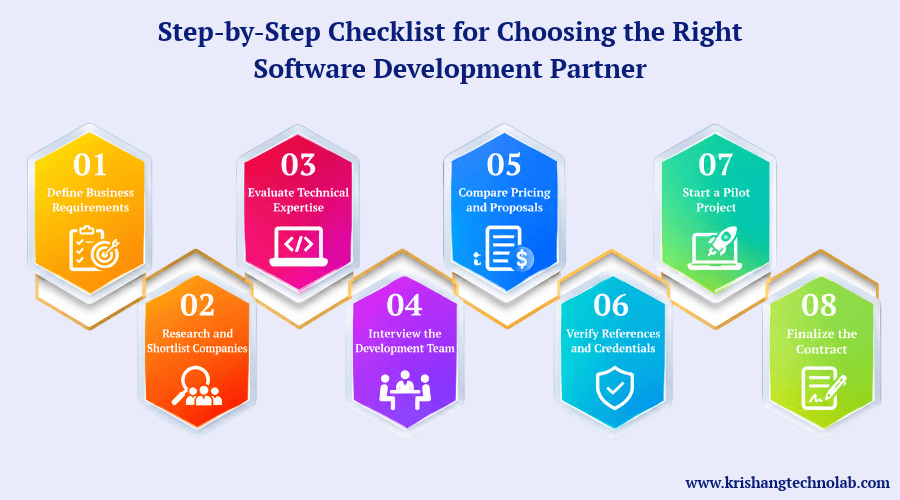
Step 1: Define Your Business and Technical Requirements
First, list your business goals, users, features, system links and limits. Then, separate must-have items from ideas that can wait. For example, secure login may be essential, while custom charts can come later. Also, note your budget, deadline and data protection rules. As a result, vendors can respond to the same needs. Finally, choose one internal decision maker who can answer questions, settle disagreements and approve changes without long delays.
Step 2: Research and Shortlist Potential Development Companies
Next, search for software development services companies through referrals and review platforms. Then, select three to five suitable candidates. If site visits matter, search for software development companies near me. Also, widen your list with nearshore software development companies and software development outsourcing companies. For each one, check services, industry work and client feedback. As a result, you can remove poor matches early and spend your time on serious options.
Step 3: Evaluate Technical Expertise and Relevant Experience
Then, match each portfolio to your business needs. Your chosen IT software development company needs hands-on practice with your technologies. For smart features, shortlist AI software development companies with proven work. Also, ask each team to explain a similar past project, including its hardest problem. As a result, you can see how they think. Finally, check whether the people who completed that work are still available to join you.
Step 4: Interview the Proposed Development Team
Before you hire AI engineers or other developers, ask them to solve a realistic problem. For example, describe a slow task from your daily work. Then, listen to the questions they ask before suggesting an answer. Also, ask who will lead design, testing and AI development. As a result, you can judge their skills and communication together. Finally, record your own team’s honest feedback while the discussion is still fresh.
Step 5: Compare Proposals, Pricing and Engagement Models
Next, compare assumptions, scope, timelines and payment terms side by side. Software development outsourcing companies should price the same requirements, so you can judge their offers fairly. Also, check what each quote leaves out. For example, hosting or support may carry extra fees. Then, review how each engagement model handles changes. As a result, you can choose the offer with the best overall value rather than simply the lowest price.
Step 6: Validate References and Conduct Technical Due Diligence
Then, speak with past clients and inspect delivery samples. For example, ask whether deadlines, budgets and communication matched the original promises. Also, review sample code, test reports and system diagrams with a trusted technical expert. In addition, verify certifications, security practices and team stability. As a result, you can confirm important claims before signing. Finally, record any concern and ask the vendor to explain how they will address it.
Step 7: Start with a Discovery Phase or Pilot Project
Once you have your finalists, run a short paid pilot. For example, ask the team to build one useful feature with clear success measures. This test shows how your custom software development partner really works. Also, watch how they share progress, handle feedback and report problems. As a result, you learn from real behaviour rather than sales promises. Then, decide whether to continue, adjust the current plan or stop completely.
Step 8: Finalize the Contract and Begin Development
Finally, agree on clear terms covering scope, payments, code ownership, security and support. Then, set a kickoff date with the people who will deliver the work. Also, agree on meeting times, reporting methods, milestones and access rights. For example, name who approves each completed stage. As a result, everyone knows their role from the very start. In addition, review early progress together and fix any communication problems before they grow.
Conclusion
In summary, the right custom software development partner understands your problem before proposing code. So start with clear requirements and measurable goals and an honest budget.
Next, compare experience, process, and team quality. Furthermore, examine pricing, security, ownership, and maintenance. As a result, you avoid decisions based on sales language alone.
A simple, weighted scorecard keeps your evaluation fair and consistent. Reference checks and technical due diligence confirm important claims. A paid pilot then shows how people work under real conditions.
Furthermore, judge the total cost of ownership over your product’s whole life. Use exact contract language to protect your source code.
Smart AI software development services require extra care. AI Software Development Company. White Label AI Solutions. Hire AI engineers after checking their past models. Ask AI software development companies about privacy and oversight by humans. The same level of care should be applied to all aspects of AI development. Check these points before you hire AI developers or buy an AI white label product.
Overall, choose a software development partner that communicates openly and challenges weak assumptions.
Start today by writing a one-page project brief with your goals and limits. The best custom software development partner will show clear thinking from the first conversation.
Frequently Asked Questions (FAQs)
How Do I Choose the Right Custom Software Development Partner?
Define your goals, then shortlist each custom software development partner that fits. Next, compare experience, process, security, pricing and client references. Also, meet the people who will do the work. Finally, test your selected custom software development partner through a small paid project.
What Should I Look for in a Custom Software Development Company?
A mobile software development company or web team needs relevant projects and transparent communication. Also, an AI software development company should explain data protection, model accuracy and monitoring. In addition, check its testing process, code ownership terms and support after launch before you sign.
How Much Does It Cost to Hire a Custom Software Development Partner?
The cost to hire a custom software development partner depends on scope, complexity, integrations, team size and location. Therefore, request a detailed estimate. If you hire software developers by the hour, also set a budget limit and review spending monthly.
What Questions Should I Ask a Software Development Company Before Hiring?
Ask your custom software development partner who will build the product. Also, ask how the team tests work, protects data and handles changes. Then, confirm who owns the code. If you plan to hire AI engineers, request examples of tested working models.
How Do I Evaluate the Technical Expertise of a Software Development Partner?
Review architecture, code and case studies from your custom software development partner. Also, check data skills and AI white label experience before you hire AI developers. In addition, an AI software development company should show how it measures accuracy and handles errors.
Should I Choose a Local or Offshore Software Development Partner?
A local custom software development partner can offer easier meetings, while remote teams may lower costs. If you search for software development companies near me, also check nearshore software development companies. Then, compare skills, shared working hours, communication and support before deciding.
Found this post helpful? Don't forget to share it with your network!