
Quick Overview: This blog looks at dedicated developers and in-house developers and compares their costs, flexibility, and productivity. Find out how US startups hire dedicated developers to quickly and cheaply build software while deciding whether to use in-house or outside teams to help their businesses grow.
In today’s competitive startup ecosystem, founders face a key choice: hire dedicated developers and in-house developers. This choice has an impact on how quickly things get done. It also has an effect on costs and growth. Many US startups now hire dedicated development teams. This gives them an advantage.
Why should you hire dedicated developers? This topic is a common question for startups. The answer is easy. Dedicated teams provide you more options, more skills, and lower costs. Because of this, they often do better than teams that work in-house. At the same time, founders should compare dedicated developers vs in-house developers’ costs. This makes sure that the choice is within their budget and meets their needs. Many companies look at both dedicated developers and in-house developers to see which type of team gives them more freedom and faster results.
When to hire dedicated developers or build an in-house team is another important question. Startups can make smart hiring choices by weighing the pros and cons. Following a step‑by‑step process to hire dedicated developers ensures that the right talent is brought on board efficiently. So, this method makes people more productive. It also keeps costs down.
What Are Dedicated Developers?
Dedicated developers are professional software engineers who work only on your project. They can work from home, from another country, or as part of a professional dedicated development team. A lot of US startups hire developers USA because they have specialized skills that are hard to find in the area. Dedicated teams can change their plans effortlessly. They help startups grow quickly without having to hire full-time developers.
When building MVPs or launching products quickly, startups often want to know how to hire dedicated developers. Understanding the benefits of hiring dedicated developers can help them focus on their core strategy instead of managing hiring, payroll, and other HR tasks.
What Is an In-House Development Team?
An in-house development team, on the other hand, is made up of full-time employees who work for your company. These developers are fully on board with your company’s culture and product strategy. In-house teams are great at keeping things aligned and going over time. But they cost more because of salaries, benefits, and office space.
When US startups grow quickly, they sometimes have trouble deciding between in-house and dedicated developers. In-house teams may not be as flexible if they grow quickly or have specialized skills. They give you control over the development process and team dynamics, but they might not be able to change as quickly as your business needs, especially if the project requirements evolve rapidly or if new technologies emerge that require different skill sets.
Also Read About: Which team model is best for a startup in-house vs remote vs dedicated developers?
Dedicated Developer vs In-House Developer: Key Comparison
This comparison shows the differences between dedicated developers and in-house developers who work for a company. This helps startups make smart hiring decisions.
| Feature | Dedicated Developer | In-House Developer |
| Cost | Lower; no benefits, office space, or recruitment fees. Can reduce expenses by 40-60% compared to hiring full-time in-house developers. | Higher; includes salary, benefits, taxes, and infrastructure. True cost can exceed base salary by 25-40%. |
| Recruitment | Fast; dedicated developers are often pre-vetted and ready to start quickly. | Slow; hiring senior developers can take 3-6 months. |
| Control | Indirect; managed via SLAs, KPIs, and project managers. | Direct; full day-to-day oversight of tasks and workflows. |
| Scalability | High; easy to add or replace dedicated developers as needed. | Low; scaling requires long hiring cycles or layoffs. |
| Expertise | Access to niche global talent (AI, Blockchain, etc.). | Limited to local talent and internal upskilling efforts. |
| Culture | May take time for the developer to align with brand values and processes. | Deeply integrated into company values and mission. |
| Time to Market | Faster; dedicated developers can start delivering results in weeks. | Slower; onboarding and ramp-up can take months. |
| Flexibility | High; can quickly adjust workload or skill sets per project. | Low; adjusting roles or responsibilities is slow and costly. |
Why Savvy US Startups Prefer Dedicated Developers for Rapid Growth
Startups in the US are under a lot of stress right now. They need to get their products out quickly. They also need to cut costs and stay ahead of the competition. So, many people prefer dedicated developers to regular in-house hires. US startups often evaluate dedicated developers and in-house developers before scaling their tech teams to choose the most efficient model. These are the main reasons.

1. Cost-Effectiveness of Dedicated Developers
It costs less to hire a dedicated developer than to build a team in-house. Startups would rather not spend more money. These costs include benefits, taxes, office space, and hiring fees. According to reports, an in-house developer can cost 25% to 40% more than their base salary. Dedicated developers, on the other hand, usually cost 40-60% less.
Because of this, they are beneficial for startups that want to grow quickly while keeping their costs low. When planning their tech budget, many founders compare the costs of hiring dedicated developers to those of hiring in-house developers.
2. Access to Specialized Talent
Startups often need developer with specific skills. AI, blockchain, and advanced front-end frameworks are some examples. It can be difficult to find these skills in your area. By hiring professional dedicated developers, startups get fast access to a global talent pool. This also keeps the hiring process from taking too long and allows startups to manage a remote dedicated development team efficiently.
Dedicated developers with experience can bring skills that in-house teams might not have. This means that startups can make better products more quickly.
3. Faster Project Delivery
Dedicated developers only work on your project. This approach makes delivery faster. Developers who work in-house may have to do more than one thing at a time. Dedicated developers, on the other hand, use structured workflows and agile methods.
Because of this, startups get faster sprints, more frequent releases, and better responsiveness. Agile methods help projects go quickly from planning to production. They keep the quality up all the time.
4. Risk Reduction and Flexibility
Hiring full-time developers lowers the risks that come with full-time work. Startups don’t have to deal with long-term salaries, layoffs, or resources that aren’t being used. They can quickly add or remove developer from their development team.
For instance, offshore dedicated developers versus in-house developers let startups quickly change their staff. Startups can also use IT staff augmentation services to help their own teams. This keeps you from making long-term commitments. These are some of the reasons startups choose offshore developers, as it provides flexibility, access to specialized skills, and cost-effective solutions without the overhead of a full in-house team.

When to Choose In-House Developers for Full Control and Efficiency
Dedicated developers give you more options, lower costs, and faster delivery. But there are times when it is better for startups to hire developers in-house. For instance, projects that deal with sensitive data may need teams that work in-house. In-house developers also keep information private. Dedicated developers and in-house developers each have their strengths, but some projects need the control and coordination of an in-house team.
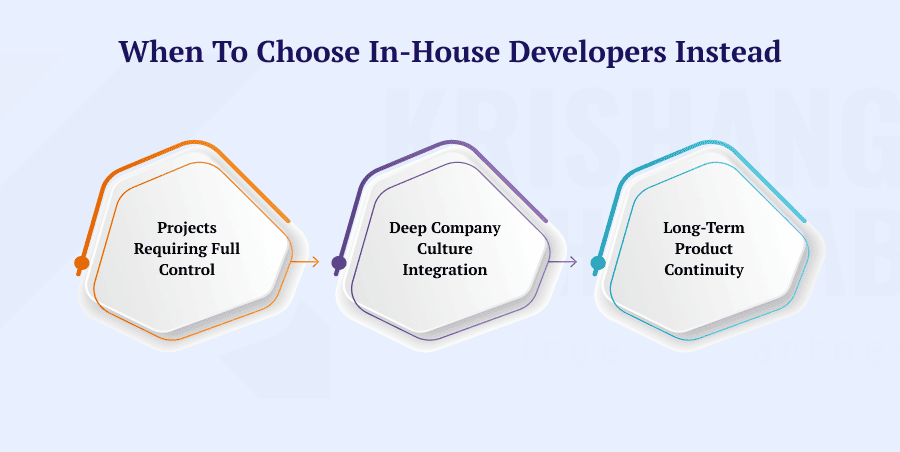
1. Projects Requiring Full Control
If your startup’s project needs sensitive data, proprietary algorithms, or core business logic, in-house developers give you full control. You can see workflows right away. This keeps things private. It also makes you less dependent on outside contractors. To put it simply, you are still in charge.
2. Deep Company Culture Integration
In-house developers are part of your organization. They quickly learn your company’s goals and values. Because of this, working together gets better. Talking to each other is way easier. The amount of ownership grows. It might take external developers longer to adjust. In other words, in-house developers fit your culture faster.
3. Long-Term Product Continuity
Projects that require regular maintenance and updates benefit from in-house developers. Besides that, they keep institutional information. This helps them keep their eyes on the big picture. Because of this, startups need in-house teams to build out their main products. They also help your goods grow over time.
How to Hire Top Dedicated Developers for Startup Success
Getting the right developer to work for your startup can make or break its growth. Many US startups hire dedicated developers to quickly find skilled workers. This method also makes it less costly to hire a full-time team in-house. This blog will show you how to hire the right developer. We also give you tips on how to make the hiring process go more smoothly.

Choosing Between Hire Options
There are several ways that startups can find tech workers. You can hire dedicated developers, work with developers who are based in another country or work from home, or build your own team. Each choice has clear advantages:
- Hire dedicated developers to speed up projects, gain specialized skills, and save money.
- Build an in-house team if your budget allows it and you want a strong cultural fit.
- Software Outsource development team if you need flexibility and global expertise.
Some projects, for instance, need expert help right away. Some developer work better with a permanent team. Also, combining options can help new businesses that have different needs. This plan also strikes a balance between cost and speed.
Evaluating Professional Skills
Not all developers are equally skilled. So, when you hire professional dedicated developers, pay attention to these things:
- Technical knowledge: The developer should be familiar with your tools and tech stack.
- Communication: It’s very important for teams that work from home or overseas to communicate well.
- Business alignment: Developers need to know what your startup’s goals and vision are.
Some startups also hire full-stack engineer to do professional software development work for them. These teams start with clear workflows, flexible methods, and quality checks. So, they make sure that the results are always the same. Additionally, they can expedite project completion. They can also help keep projects from getting behind schedule.
Also Read About: How to avoid common mistakes when hiring developers?
Best Practices for Integration with Your Startup
After hiring dedicated developers, it’s important to make sure they work well together. To get more done, do the following:
- Onboarding: Show developers your product, how things work, and what you value.
- Project management: Use tools like Jira, Trello, or Asana to track progress.
- Collaboration tools: For smooth communication, use Microsoft Teams, Slack, or Zoom.
If you use these tech team scaling tips, your dedicated developers can work like a team in your office. They will get things done quickly because of this. Regular check-ins also help everyone stay on the same page and fix problems more quickly. Lastly, to keep the team motivated, celebrate small victories. Providing feedback often also helps developer do better.
Common Pitfalls When Hiring Dedicated vs In-House Developers
Choosing between dedicated developers and in-house developers can be challenging for startups. Both choices have their good and bad points. Knowing about these problems will help you make smart hiring choices and avoid costly mistakes.
| Pitfall | Dedicated Developers | In-House Developers | Solution / Mitigation |
| Communication | Remote teams may face miscommunication or delays. | Usually aligned, but rapid scaling can cause misalignment. | Use Slack, Teams, Zoom, and regular check-ins. |
| Time Zone | Differences Teams in different regions may delay collaboration. | N/A | Set overlap hours and use project management tools like Jira or Trello. |
| Cultural & Process | Misalignment May take time to understand company culture and workflows. | Early-stage teams may have unclear processes. | Conduct onboarding, document workflows, share goals, and provide feedback. |
| Access to Skills | Global access to niche skills (AI, blockchain, cloud). | Limited to local talent; upskilling required. | Combine in-house with dedicated developers for specialized projects. |
| Cost & Utilization | Cost-effective; pay only for work done, no long-term salary commitment. | Expensive; salaries, benefits, and possible underutilized staff. | Forecast projects, consider a hybrid team. |
| Security & IP | External teams may pose risks for sensitive data. | Full control over proprietary information. | Use NDAs and secure workflows; hybrid teams for sensitive projects. |
| Time to Market | Faster delivery; focus on your project exclusively. | Slower; onboarding and training take time. | Combine dedicated and in-house developers for speed and control. |
Conclusion
Your startup’s priorities will help you decide between dedicated developers and in-house developers. Dedicated developers can save you money, give you more options, and bring unique skills to the table. So, they are great for projects that need to move quickly. On the other hand, in-house developers give you better control and fit with your company’s culture. They also help things stay the same over time. Because of this, they are suitable for important or sensitive work.
Hiring experienced developers from Krishang Technolab is often the best way for US startups to grow quickly, get the right skills, and keep costs down. So, take a close look at your project’s needs and goals. After that, you need to choose between hiring dedicated developers and in-house developers inside your company. This is how your startup can grow in a professional and effective way.
FAQs: Dedicated Developers vs In-House Developers for Startups
What is the difference between dedicated developers and in-house developers for startups?
Dedicated developers are professionals who work for other companies. They only work on your project. They usually work from home. Developers who work in-house are full-time employees. They are a part of the culture of your startup. Startups often look at both dedicated developers and in-house developers to see which one is faster, more flexible, and cost-effectiveness.
How do dedicated developers help startups save on software development costs?
Hiring dedicated developers costs less. You save money on hiring costs, salaries, benefits, and office space. For instance, startups can save 40-60% by not hiring a full-time team. Many companies compare the costs of hiring dedicated developers and in-house developers to find the best option for their MVPs or as they grow.
When should a startup hire in-house developers instead of dedicated developers?
For projects that involve private information, in-house developers are the best choice. They are also great for algorithms that are not public. Another reason is that they fit in well with the company’s culture. In-house developers are good for keeping products up to date over time. They give you full control over your workflows and intellectual property (IP).
Can startups combine dedicated and in-house developers for better results?
Yes! Many new businesses in the US use a hybrid model. They maintain a core in-house team for control and culture. They also hire developers with specific skills for special projects. This method also speeds up the completion of projects. Additionally, it could save you money.
How do startups ensure effective communication with dedicated developer teams?
Startups can totally use tools like Jira, Trello, or Asana. Video calls on Zoom or Teams are a great way to stay connected with the team. Starting with onboarding provides you with a comprehensive understanding of workflows, company goals, and the product’s purpose. This really helps improve communication. It helps everyone understand each other.
What are the common pitfalls of hiring dedicated developers versus in-house teams?
Dedicated teams might have trouble with time zones. It can also be hard to communicate and understand different cultures. Teams that work in-house have to pay more. They hire more slowly and may have limited access to niche skills. But proper onboarding can lower risks. NDAs, hybrid teams, and clear project plans are also good ways to get better results.
Found this post helpful? Don't forget to share it with your network!