
Quick Overview: Compare Dedicated Developers vs Staff Augmentation across cost, management, scalability, onboarding, security, and flexibility. Discover how dedicated development teams, IT staff augmentation, and hiring dedicated developers fit different project needs and long-term goals.
For any growing business, making a choice between Dedicated Developers vs Staff Augmentation is a big decision. Choose the wrong one and you’ll delay your launch, blow your budget and frustrate your team. So, you need a clear picture of both models before you get engaged.
In-house recruitment can take considerable time, which is why many businesses are turning to dedicated developers to access skilled talent faster. Moreover, it’s hard to find software engineers with the right skills and recruitment costs are rising. As a result, businesses now look to remote dedicated developers and offshore development partners for faster results.
Two models dominate this space. The first is the dedicated development team model. The second is IT staff augmentation. In addition, both models let you hire skilled engineers without building a large permanent team. Each model offers real benefits, but each fits a different situation.
This guide explains Dedicated Developers vs Staff Augmentation and how each model works. Specifically, it compares management, cost, onboarding, scalability, knowledge retention, and security. It also covers when to hire dedicated developers, when to opt for staff augmentation and how a hybrid approach works. You will also find a step-by-step hiring process, cost ranges, and red flags to avoid.
Understanding Dedicated Developers vs Staff Augmentation
Hiring dedicated developers means you are getting experienced engineers who will work on your project exclusively and become part of your team. Also, you get access to specialised talent with your dedicated development team and your partner handles payroll, HR and equipment. The model is also flexible, cost-predictable and has easy access to experienced remote developers. Overall, in Dedicated Developers vs Staff Augmentation, this model offers the deepest commitment to your product.
How the Model Works When You Hire Dedicated Developers
Tell us about your project scope, technology stack and timeline and we will match you with dedicated developers who are suitable for your project. Then, once approved, they are integrated into your workflows and communication tools. The monthly cost is still predictable for budgeting purposes. You can also find dedicated developers in India specialized for your needs who work remotely at an affordable price. Furthermore, any dedicated developer vs staff augmentation review should start with this setup.
Typical Team Roles in a Dedicated Development Team
A dedicated development team can comprise skilled specialists depending on your project goals, budget and timeline. Form a flexible team of dedicated developers and other specialists that grows with your product. The most popular positions are frontend, backend and full-stack developers, QA engineers, UI/UX designers, DevOps engineers and project managers. Likewise, a dedicated development team vs staff augmentation comparison should include these roles.
- Front-end, back-end, and full-stack developers
- QA and test automation engineers
- UI/UX designers
- DevOps engineers
- Project manager or team lead
- Business analyst
What Is Staff Augmentation?
IT staff augmentation allows companies to bring skilled professionals into their existing teams for a specific period. Additionally, this approach helps businesses quickly access the expertise they need while keeping their core team structure and management processes in place. In short, staff augmentation is the flexible side of Dedicated Developers vs Staff Augmentation.
You manage these experts, they have processes to quickly close any skills gap. Furthermore, this extended team model is flexible and scalable and allows companies to use staff augmentation services to get specialized developers without having to hire them as a permanent employee. Consequently, staff augmentation vs dedicated developers often comes down to control.
How IT Staff Augmentation Works
With IT staff addition, you decide what skills are needed, what part they play, and how long they work for you. The provider gives you pre-screened candidates and you interview to find the right one. Augmented developers work within your management and processes, once onboarded. In addition, you usually pay hourly or monthly rates until the project ends. As a result, staff augmentation vs dedicated team is mostly a question of who runs daily work.
Common Use Cases for Staff Augmentation
Adding to your staff is a good way to meet short-term or specific needs. As a result, companies can quickly fill skills gaps and grow their team without the long hiring process. It also works well for teams who already have strong technical leadership in place. Next, the examples below show when dedicated developers or staff augmentation fits best. Case studies that are used a lot:
- Filling a rare skill gap with AI developers or blockchain experts
- Meeting a tight release deadline
- Covering leave or staff attrition
- Testing a technology before a full commitment
Dedicated Developers vs Staff Augmentation: Key Differences
In either case, businesses can hire more engineers without having to hire full-time workers. Staff Augmentation Management vs Dedicated Developers Pricing Flexibility; Onboarding; Knowledge Retention and Security.
In short, Dedicated Developers vs Staff Augmentation comes down to these six factors. With these key differences in mind, you’ll be better equipped to pick the engagement model that best aligns to your project requirements, technical leadership, budget, timeline and long-term development goals.
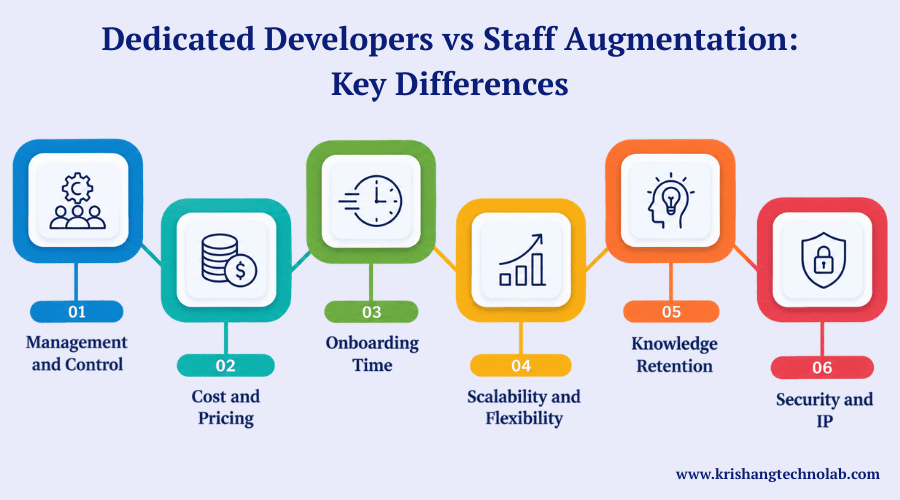
1. Management and Control
First, with a dedicated team, the provider often supplies a project manager. You set goals, and the manager handles daily coordination. In contrast, staff augmentation puts full management on you. Your leads assign tasks, review code, and track output. Therefore, in Dedicated Developers vs Staff Augmentation, choose staff augmentation only if you have strong internal managers.
2. Cost and Pricing
The cost of dedicated developers is usually a fixed monthly fee per person. In Dedicated Developers vs Staff Augmentation pricing, this model works for long projects as costs are still foreseeable. Meanwhile, staff augmentation uses hourly rates, which is okay for short tasks. But hourly billing can mount up quickly on long assignments. Both models cost less than hiring in-house developers.
3. Onboarding Time
In fact, staff augmentation usually starts faster. For example, providers often place one developer within days. In dedicated vs staff augmentation terms, a dedicated team takes longer to form because it needs matching and setup. Even so, most providers deliver a team within one to three weeks. In short, speed favors augmentation, while depth favors dedicated teams.
4. Scalability and Flexibility
Next, scalability is another split in dedicated teams vs staff augmentation. Staff augmentation is easily scalable up and down. Therefore, you add or release individuals as needs dictate. Dedicated teams scale too, but in planned steps. For example, you can add a designer or tester next quarter. As a result, both models beat traditional recruitment on flexibility.
5. Knowledge Retention
Indeed, dedicated developers stay with your project for months or years. They learn your product, codebase, and business rules in detail. Augmented developers are able to leave as soon as their work is done, taking knowledge of the project with them.
Furthermore, good documentation and good hand-over processes will help you keep important information in your team. As a result, documentation and handover plans reduce this risk. Knowledge retention often decides Dedicated Developers vs Staff Augmentation for long projects.
6. Security and IP
For example, dedicated teams sign an NDA and IP agreement with one provider. Consequently, this makes ownership clear. In contrast, with staff augmentation, contractors may come from several sources.
Thus, you must check each contract carefully. Plus, always confirm that all code belongs to you. Finally, staff augmentation vs dedicated development team risk is not equal on security.
Comparison Table: Dedicated Developers vs Staff Augmentation
The table below compares dedicated developers and staff augmentation models on the key parameters including management, pricing, onboarding, scalability, knowledge retention, security and project duration.
Therefore, use it to compare both models against your business needs. It shows dedicated software developers vs staff augmentation at a glance. In the sections below we dig a little deeper to give you a better understanding of how each approach fits with different development requirements.
| Factor | Dedicated Developers | Staff Augmentation |
| Management | Provider-led, with your input | Managed by your team |
| Pricing | Fixed monthly fee | Hourly or monthly rate |
| Onboarding | One to three weeks | A few days to two weeks |
| Scalability | Planned scaling | Fast, individual scaling |
| Knowledge retention | High | Low to medium |
| Security and IP | Single agreement | Multiple contracts |
| Best for | Long-term products | Short-term skill gaps |
| Typical duration | Six months or more | Weeks to a few months |
Dedicated Developers vs Staff Augmentation: Comparing Project Requirements
Your product may need steady progress and deep context over many months. If most of the points below match your situation, it is time to hire dedicated developers. This model rewards patience, clear goals, and open communication. In Dedicated Developers vs Staff Augmentation, long-term products favor the first model.
- Your product or platform needs steady growth over several years
- You lack an internal technical manager
- You want predictable monthly costs
- You need a team that knows your business deeply
- You expect your development team to grow gradually as your project evolves.
When to Choose Staff Augmentation
In contrast, staff augmentation makes sense when your needs are short, clear, and specific. It also fits companies with strong in-house leadership. So, choose it if the points below match your situation. Otherwise, in Dedicated Developers vs Staff Augmentation, the dedicated model may serve you better.
- You need one or two specialists quickly
- Your project lasts under six months
- Your managers can direct extra engineers
- You want to fill a temporary talent gap
Dedicated Developers vs Staff Augmentation: Hybrid Model Options
Instead, in hybrid, dedicated developers and extra IT staff members work together to meet changing needs of projects. For example, a core team could work on making goods for a long time, while trained workers could do short term work.
This answer is flexible, so the company can keep the understanding of the product inside and add more development tools without having to hire full time workers. Therefore, dedicated engineers vs staff augmentation does not have to be an either-or choice.
How to Hire a Dedicated Developer: Step-by-Step
If you follow a clear hiring process you can avoid problems, save time and find the right technical talent. Here is how to hire dedicated developers successfully: define the project requirements. Then conduct technical interviews and review applications. Finally, assess the test period.
First, settle Dedicated Developers vs Staff Augmentation before you start these steps. Work through these five steps in order, and you will assemble a reliable team that moves your goals forward.
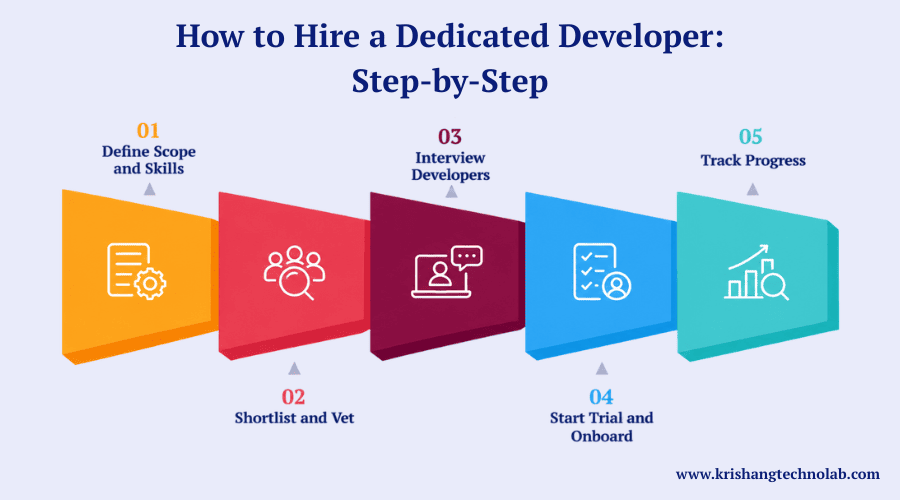
1. Define Scope and Skills
Define the goals, the tech stack and the deadline of the project. Next, decide on the number of employees and the seniority of each. Remember, the better the brief, the better matches you will get. This helps to prevent scope creep later.
2. Shortlist and Vet
Ask the provider for three to five similar profiles. Review all resumes, portfolios and sample code. Also, find out what they think about goods that are similar to yours. “Limit the filter to only developers that fit your skill and time zone requirements.”
3. Interview Developers
Interview all the candidates yourself. Test technical depth with a on the spot coding challenge or design discussion. Also consider communication skills as working remotely means you need to be constantly and clearly updating people. Lastly, ask how they operate to deadlines and feedback.
4. Start Trial and Onboard
Start with a short pilot of about ten working days. Give access to tools, documentation and your team channels. Also, have a kickoff call to align on goals. A trial allows you to try it on before a long commitment.
5. Track Progress
Set KPIs and do sprint reviews every week. Monitor velocity, bug counts and delivery to milestones. So you detect problems early on. And do monthly reviews to reset the size of the team and priorities.
Cost to Hire Dedicated Developers
Costs vary by region, skills and team size. The ranges below represent typical market rates. Actual quotes depend on your project, so always request a detailed proposal. Real quotes will differ, so confirm the exact rates with each vendor.
- India: roughly $2,500 to $5,000 per developer each month
- Eastern Europe: roughly $4,500 to $8,000 per developer each month
- United States: roughly $10,000 to $15,000 or more each month
For example, staff augmentation in India often runs between $20 and $50 per hour. Therefore, an offshore development center can cut costs sharply compared with local hiring. Moreover, offshore dedicated developers vs staff augmentation shows a clear cost gap.
When you compare Dedicated Developers vs Staff Augmentation on cost, look at total project spend, not just rates. Also consider hidden costs like management time, tools, rework, etc. Fixed price contracts suit small, defined scopes. Time and material contracts suit projects that evolve.
Dedicated Developers vs Staff Augmentation: What to Check Before Hiring
Choosing the right software development outsourcing partner is important for the success of the project. Prior to hiring dedicated developers or expanding your internal IT team, check a provider’s technical expertise, talent vetting process, data security, pricing transparency, communication, and post-hire support.
A good partner will provide you with skilled developers, clear contracts, flexible engagement options and responsive support. Furthermore, this choice matters more than dedicated developers vs IT staff augmentation.
1. Proven Expertise in Dedicated Development Teams
Find a software development partner with real life case studies. Read reviews on Clutch or GoodFirms. Ask for client references within your industry, as well. Your tech stack experience is most important.
2. Vetting Process for Remote Developers
Ask how the provider vets talent. Good partners will test your coding skills, your english communication and your problem solving. This way you only interview qualified candidates and save valuable time.
3. Data Security and IP Protection
Make sure the provider signs an NDA and an IP assignment agreement. Ask about secure networks, policies for access and devices, and secure software development practices. Look also for standards like ISO 27001 or where applicable GDPR.
4. Transparent Pricing Without Hidden Fees
Get every fee, rate, and tool charge in a signed proposal. Compare fixed price, time and material and monthly models. Ask also about notice periods and replacement terms. Transparent pricing has no unpleasant surprises.
5. Post-Hire Support and Communication
Check response times, time zone overlap, and escalation paths. Good partners assign an account manager. Likewise, they replace underperforming developers quickly. On day one, trust is built through consistency of updates.
Red Flags to Avoid
Some providers over-promise, under-deliver. So, spot these red flags early in Dedicated Developers vs Staff Augmentation deals, before you sign any contract. Avoiding common mistakes when hiring developers can save you months of lost time and budget. Each item on this list deserves a direct question during your first call.
- No trial period or exit clause
- Vague contracts about IP ownership
- Refusal to let you interview developers
- Prices far below the market average
- Poor communication during the sales phase
- No client references or case studies
Why Hire Dedicated Developers From Krishang Technolab
Krishang Technolab delivers dedicated development teams and staff augmentation services from India. Hire dedicated developers for web, mobile, cloud and AI projects. Each developer goes through technical and communication screening before joining your team. As a result, Dedicated Developers vs Staff Augmentation is your choice, not a vendor limit.
Moreover, you choose the engagement model that fits your goals. Start small with augmented talent, or build a full dedicated team from day one. Plus, pricing stays transparent, and every project runs under an NDA with clear IP ownership. Whether you pick a dedicated developer or staff augmentation, the team adapts to your goals.
In addition, you can interview developers and run a trial before you commit. Ultimately, that cuts the risk and builds trust from the start. As a result, you gain a reliable software development company for the long term.
Conclusion: Dedicated Developers vs Staff Augmentation
Your goals, your timeline and how much management you can handle will determine whether you choose Dedicated Developers or Staff Augmentation. In fact, each model wins in some cases and loses in others. Therefore, they each solve different problems. In short, Dedicated Developers vs Staff Augmentation has no universal winner.
Predictable costs Deep product knowledge from dedicated developers hence are good for long term products and growing business. Staff Augmentation Offers Agility and Speed This is great for short projects and urgent skill gaps
If you’re looking to hire dedicated developers, start with a clear scope and a short trial. Then meet regularly to review progress and adjust the team as necessary. Likewise, if you choose staff augmentation, define the task and the exit date in advance.
Remember, a hybrid approach can work well too. Often the best cost/control balance is a small core team plus a few specialists. Moreover, this model protects your core knowledge, while you keep the flexibility. Indeed, dedicated team vs staff augmentation is rarely an all-or-nothing choice.
But most of all, choose a partner you can trust. Be sure to check their vetting process, security practices and pricing before you sign. Finally, review any contract line by line and take references.
Looking to hire dedicated developer talent for your next project? Moreover, Krishang Technolab can connect you to engineers who are experts in your stack and within your budget. Request a quote today and start building with confidence.
Frequently Asked Questions: Dedicated Developers vs Staff Augmentation
What is the difference between dedicated developers and staff augmentation?
Dedicated developers form a full team led by a vendor project manager, so ownership sits with the team. Staff augmentation adds single experts to your staff, and you manage them. In short, one offers structure and the other offers control.
How Does Dedicated Developers vs Staff Augmentation Compare in Cost?
Staff augmentation often costs less per hour, since you pay only for specific skills under time-and-materials pricing. But there are hidden costs of management and of repeat onboarding. A monthly retainer for a dedicated team stays easier to forecast on long projects.
What Are the Benefits of Dedicated Developers vs Staff Augmentation?
Hire dedicated developers when you build a SaaS platform or another product with a clear, steady roadmap. The team learns your domain, keeps the knowledge and grows with every release. The most value comes to startups that have two years of planned work.
How long does it take to hire a dedicated developer?
Most vendors share a vetted shortlist within a few working days. Interviews and contract review then take one to two weeks. Add a short trial period, and full output usually arrives four to six weeks after the project start date.
Can I switch from staff augmentation to a dedicated team later?
Yes. Many firms start with two contractors and later build a hybrid model around them. This path keeps codebase context and proves the working fit early. Confirm the switch terms in writing before you sign the very first staffing contract.
How do I protect my IP with a remote development team?
Sign NDAs, limit repository access and agree to a written security plan before starting work. Get clear terms on code ownership in your contract. Audit rights and periodic access reviews should also be asked from the vendor by fintech and healthcare companies.
How Do You Choose Between Dedicated Developers vs Staff Augmentation?
Offshore teams usually cost less. Nearshore teams are more in the same time zone so you can have daily calls. Offshore for lower rates and a well-defined job. If you want fast feedback, meet with your product team several times a week, go nearshore.
What is the minimum contract length for dedicated developers?
Most providers set a minimum engagement length of three to six months. Staff augmentation contracts run shorter and often renew monthly. Always confirm the notice period, replacement policy, and exit terms before you sign, because small clauses shape later costs.
Found this post helpful? Don't forget to share it with your network!