

Quick Overview: Dedicated development team pricing depends on region, seniority, and engagement model. USA rates run $100 – $250/hr, nearshore $30 – $75/hr, offshore $15 – $70/hr. This guide breaks down real 2026 costs, hidden fees, pricing models, and what businesses should know before hiring a dedicated team.
You know the problem with dedicated development team pricing if you’ve ever asked three vendors for a quote and gotten three wildly different numbers. One agency charges $4,500 a month. Another quotes $15,000. A third doesn’t give you a number, period. They are not lying; they are just quoting different things. Momentum toward this model is also building: A majority of businesses now expect to lean more heavily on external development resources going forward, and dedicated teams have become one of the primary ways companies scale engineering without the overhead of full in-house hiring. This guide breaks down exactly what drives dedicated development team pricing in 2026, what real numbers look like across the USA and offshore markets, and how to compare quotes so you’re not stuck overpaying or underestimating your budget.
What Is a Dedicated Development Team?
A dedicated development team is a small group of developers, QA engineers, and often a project manager who work exclusively on your product, week after week, as if they were sitting inside your own company. That’s the real difference between this setup and hiring a freelancer for a one-off gig. A freelancer does the job and then goes to the next client. A dedicated team sticks around, learns your codebase, understands why certain decisions were made six months ago, and shows up to your sprint planning like anyone else on the roster.
In fact, that’s why you’ll see a very different price when you look at dedicated development team pricing vs. what you’d pay a freelancer or fixed-scope agency. You’re not just buying hours of code. You’re paying for someone who knows the history of your product and continues to build on it instead of starting cold every time. Many companies choose to hire dedicated developers who work as an extension of their existing staff for exactly this reason, since juggling a rotating cast of contractors gets messy fast once a product grows past its early stage.
Dedicated Team vs. Staff Augmentation vs. Fixed-Price Outsourcing
| Model | Cost Structure | Best For |
| Dedicated Team | Fixed monthly or hourly rate, long-term | Ongoing product development, evolving roadmaps |
| Staff Augmentation | Hourly, per-person, short or long-term | Filling specific skill gaps temporarily |
| Fixed-Price | Outsourcing Total project price, defined scope | One-off projects with a locked scope |
Think of it this way: a dedicated team hands you the steering wheel. You decide what gets built next, in what order, and how priorities shift week to week. A fixed-price contract reverses that arrangement. You set the budget and let the vendor drive. You give up control for predictability. Staff augmentation is somewhere in the middle. It lets you bring in a specialist or two right into your own team, without having to build out a whole external unit. Some businesses go for software development outsourcing with a fixed project scope and price when they already know what they want to build and they do not expect much change in the requirements. This type of project is particularly well-suited to it. That works a lot less well once the roadmap starts shifting every few weeks, which is when a dedicated team tends to earn its keep instead.
Dedicated Development Team Pricing: USA Rates in 2026
If you are a US-based company, your dedicated development team pricing will be in one of three buckets depending on where the team is located: onshore, nearshore or offshore. Here’s what the numbers actually look like right now.
USA Onshore Rates (2026)
US dedicated developers are the most expensive but have the smallest communication gap and easiest compliance story. Mid-market US development firms generally bill between $120 and $250 per hour. Top-tier enterprise consultants can charge $400+/hour for specialized work. A typical five-person onshore team of a combination of developers, QA and a project manager often ends up costing between $95,000 and $180,000 a month, including overhead. When companies want their engineers to be based in the country specifically, they often prefer to hire dedicated developers in the USA so that working hours and communication are fully aligned.
| Team Type | Hourly Rate (USD) |
| US mid-market agency | $120 – $250/hr |
| Senior US freelance/indie | $85 – $150/hr |
| Enterprise specialist consultants | $250 – $400+/hr |
USA Companies Hiring Nearshore Dedicated Teams
Nearshore provides the middle ground for companies that want a lower dedicated development team cost but do not sacrifice real-time overlap. Offshore teams in Latin American markets such as Mexico, Argentina, Colombia and Costa Rica are far more aligned with US business hours, reducing the coordination lag that can be created by offshore teams. The overlap is one of the reasons many companies are opting to hire remote developers in a compatible time zone, rather than going for a full offshore shift.
USA Companies Hiring Offshore Dedicated Teams
The low-cost offshore dedicated development team pricing is where the lion’s share of dedicated team hiring takes place globally. India and South Asia normally charge $15 – $45 an hour. Eastern Europe is $35 – $70 an hour. The Philippines is $10 – $49 an hour with good English skills. The trade-off is usually a larger time zone difference, especially for companies working with India or Southeast Asia. Offshore development centers are usually favored over individual contractors by businesses wanting a structured, long-term offshore presence because of the control over process and retention they provide. India in particular remains one of the largest offshore engineering markets and many US and UK companies specifically seek to hire dedicated developers in India for the combination of cost savings and depth of technical talent.
Blended Monthly Cost by Region (5-Person Team)
| Location | Monthly Cost (USD) |
| USA (onshore) | $95,000 – $180,000+ |
| Latin America (nearshore) | $25,000 – $55,000 |
| Eastern Europe | $30,000 – $60,000 |
| India / South Asia | $12,000 – $25,000 |
This is the number most buyers really need before they start comparing vendors. A realistic range per month for a functioning team, not just a per-developer hourly rate.
Dedicated Development Team Cost by Role and Seniority
Region is the biggest lever on dedicated development team pricing, but seniority isn’t far behind. A rough rule of thumb is that a mid-level developer costs about twice as much as a junior, and a senior will be two to three times the junior rate.
| Role / Level | Rate Range | Best Suited For |
| Junior Developer (0 – 2 years) | $15 – $40/hr | Routine features, bug fixes, and UI tasks under senior guidance |
| Mid-Level Developer | $25 – $70/hr | Most feature work handled independently with light oversight |
| Senior Developer | $45 – $150+/hr | Architecture decisions and complex problem-solving, with less management overhead needed |
| DevOps Engineer | 20 – 40% above baseline rate | Infrastructure, CI/CD pipelines, deployment automation |
| AI/ML Engineer | 50 – 100% above baseline rate | Machine learning models, generative AI features |
Below the table, businesses building AI-driven products often choose to hire AI developers with machine learning and generative AI expertise rather than stretching a general-purpose developer across unfamiliar territory. For projects that need one generalist who can move between the front end and back end, choosing to hire full stack developers can sometimes reduce headcount and total cost.
Also Read About: How hiring dedicated developers can reduce your development costs?
5 Dedicated Development Team Pricing Models Explained
You could have two vendors with almost identical teams, yet they would charge you entirely different amounts. If you want to compare dedicated development team pricing from various proposals and get the most accurate results, you need to know these models.
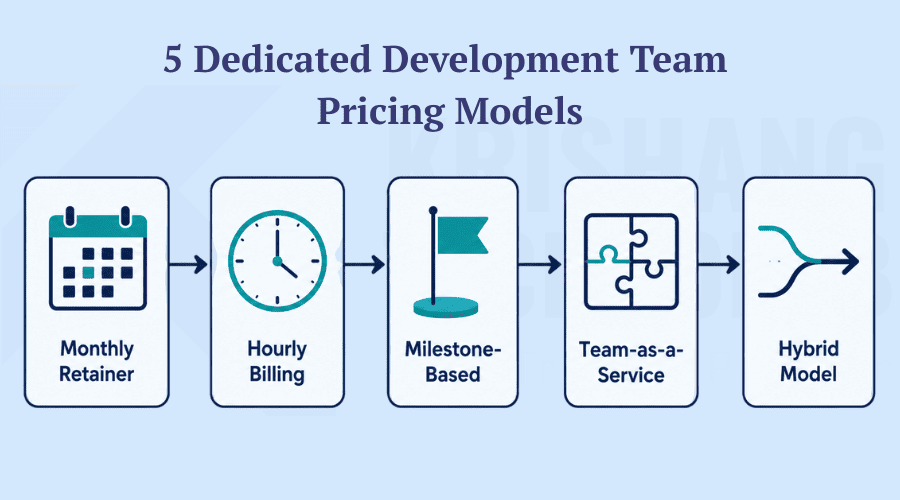
Monthly Retainer
Set a recurring fee for a developer, or full team working exclusively on your product. This is the most popular model for long-term dedicated team engagements. The budgeting can be done predictably.
Hourly Billing
You pay for the actual hours spent. It is useful for short-term, or fluctuating workloads, but it tends to be less ongoing and to create weaker team commitment in the long run.
Milestone/Phase-Based Payment
The project is broken into phases with defined deliverables. Payment is made after the approval of each phase. This reduces risk on larger builds.
Team-as-a-Service (All-Inclusive)
One all-inclusive rate for salary, benefits, equipment and management overhead. This is the most transparent model, but typically the least flexible.
Hybrid Models
A blend, such as a retainer for the core team monthly and hourly billing for overflow work during busy times.
What Factors Affect Dedicated Development Team Pricing?
The dedicated development team pricing is more than a location. Before you compare quotes, it helps to understand the full list of variables at play:
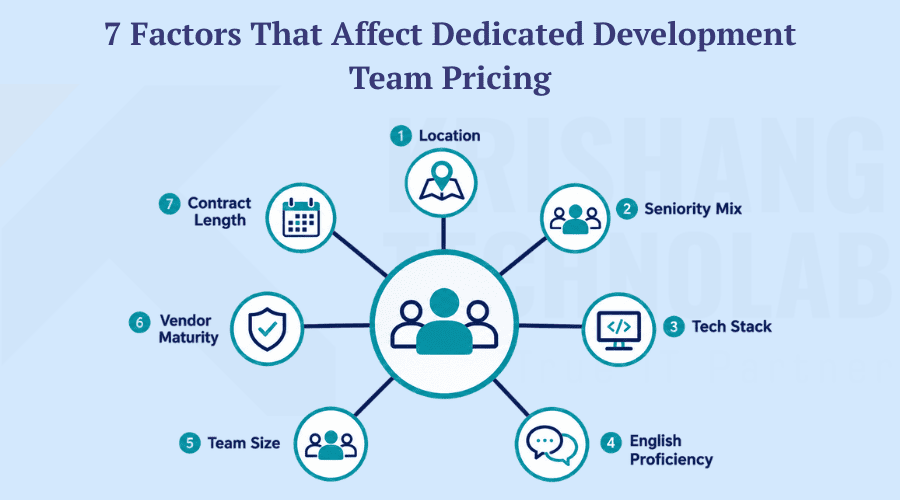
- Geographic location – The biggest factor in differences in hourly rate.
- Seniority mix – the proportion of junior and senior people on the proposed team.
- Tech stack specialization – AI/ML, DevOps, and security work are worth a premium over standard full-stack development.
- English proficiency and communication overhead – Better communication reduces rework, and hidden coordination costs.
- Team size and composition – Bigger teams need more layers of management;
- Vendor process maturity – QA, onboarding and delivery support included or separately billed.
- Contract length and commitment level – The longer the contract, the better the rates tend to be.
Hidden Costs to Ask About Before You Sign
Most price guides end with the headline rate. The number you see quoted often doesn’t represent your total dedicated development team cost in reality. What’s missing from the first quote is usually the following:
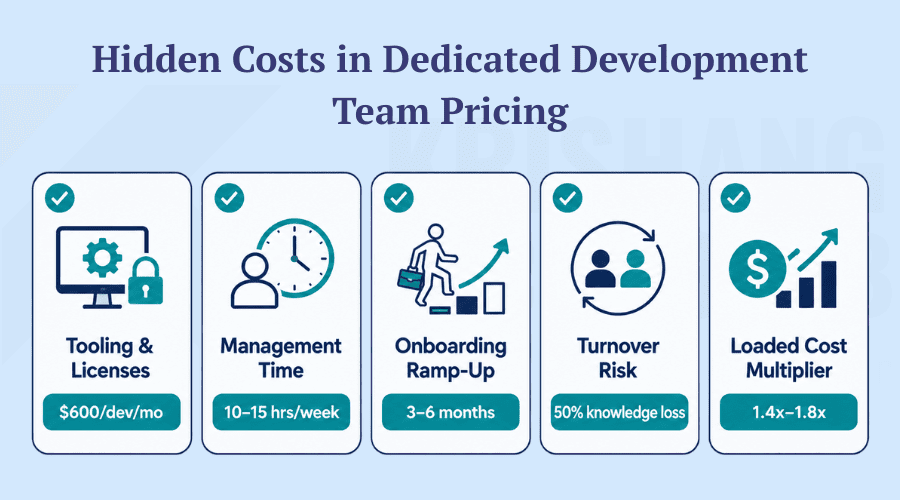
- Tooling and licenses – IDEs, cloud hosting and AI-assisted coding tools can add ~ $600 per developer, per month, and not every vendor rolls this into the rate.
- Your own management time – Working with an external team, especially an offshore one, can take up 10-15 hours a week of your lead architect’s or product owner’s time.
- Onboarding and ramp-up – For new team members it usually takes three to six months to get them fully productive, even on a dedicated team.
- Turnover risk – Losing a key developer can cost 50% of their annual value in lost knowledge and delay, so replacement guarantees are important in a contract. Vendors with a larger, more structured global capability center usually have deeper backup benches to weather this kind of turnover without affecting your roadmap.
- The loaded cost multiplier – When you factor in management overhead, onboarding, communication time and attrition risk, your true cost is usually 1.4 to 1.8 times the headline hourly rate.
Always ask a vendor directly what’s included in their quoted dedicated development team pricing, specifically HR, benefits, equipment, QA, and project management, before comparing it to another proposal.
Is a Dedicated Development Team Cheaper Than In-House Hiring?
Yes, for most growing companies. And the gap is bigger than people think. Hiring a single senior US developer can cost $30,000 in fees alone and a new in-house hire usually takes three to six months to become fully productive. Whereas traditional in-house recruitment requires 40 or more days per role, dedicated team providers maintain active talent pipelines and can usually assemble and onboard a working team within two to four weeks.
| Model | Time to Start | Ongoing Overhead |
| In-house hire | 40 + days per role | Salary, benefits, HR, office costs |
| Dedicated team | 2 – 4 weeks | Single monthly or hourly invoice |
| Freelancer | Days | Low, but no continuity or process |
If you are deciding between hiring a dedicated team or individual contractors, it is worth considering the cost, quality and long-term reliability of dedicated developers vs freelancers before you commit to either option. This shift to external teams is echoed across the industry, with most businesses now looking to increase, rather than decrease, their reliance on external development resources.
Also Read About: In-house team vs Remote team vs Dedicated team which model is the best for a startup?
How to Budget for a Dedicated Development Team
Once you understand the pricing models and cost drivers described above, you will see that the budgeting process is a five-step exercise, not a guessing game.
- Define your team composition – Determine the number of developers, QA engineers and PMs you actually need and the right seniority mix for your product stage. If you don’t know where to start, looking at the options to hire software developers by skill set and experience level can help you scope a realistic team shape.
- Choose your engagement model – Retainer, hourly, milestone-based or hybrid-based on your workload predictability.
- Choose your region – Balance budget with desired amount of overlap in time zones and ease of communication.
- Add a 15 – 20% buffer – To cover the hidden costs we mentioned above, rather than being blindsided by them later.
- Get everything in writing – Never sign anything until you know exactly what is included in the quoted rate.
Choosing a Dedicated Software Development Company
Whether you’re looking at a dedicated software development company for the first time, or you’re replacing a vendor that’s falling behind, pricing should never be discussed without considering process maturity. If you have a low hourly rate but a team that has no QA discipline, no onboarding process and no reliable ownership, it will usually cost you more in rework than a slightly more expensive rate from a team that gets it right the first time. When you hire a dedicated development team, ask to see how they do QA, code review, and support for delivery, not just the numbers on the invoice. This is the typical recommendation Krishang Technolab gives to any business for all proposals and for any agency they ultimately choose.
A look at a provider’s full software development services can also tell you a lot about whether QA and delivery support are considered core parts of the engagement or an afterthought.
Agencies like Krishang Technolab structure dedicated development team pricing around transparent monthly or hourly rates with QA, project management and onboarding from the very beginning, rather than adding them as separate line items later on. If you’re looking at dedicated development team services, it’s worth asking any agency, including Krishang Technolab, to walk you through exactly what’s bundled into their number before you sign; most providers will let you request a quote once they understand your team requirements.
Conclusion
Dedicated development team pricing isn’t a single number; it’s a mix of region, seniority mix, pricing model, and what a vendor actually bundles into the rate. A realistic 2026 budget is somewhere between $8,000 and $45,000+ per month. US onshore teams are at the high end of that range, and offshore teams in India, the Philippines and Eastern Europe are the most budget-friendly path to a full team. Not every business that gets best value is necessarily the one chasing the lowest hourly rate; it’s the ones that compare dedicated development team pricing against what’s actually included: QA, onboarding, management overhead and retention support.
Before you sign with any dedicated software development company, make sure the number you’re looking at is the real number, not just the headline rate. Use the pricing models, regional rate tables and hidden-cost checklist above to help. Once you have a clear budget range in mind, you can hire dedicated developers matched to your team size and tech stack with a much better sense of what a fair quote actually looks like.
Frequently Asked Questions
How much does a dedicated development team cost in 2026?
Dedicated Development Team Pricing $8,000 – $45,000+ per month for a small-to-mid-size team (dependent on region and seniority mix) Offshore rates range from about $15/hr to US-based specialist rates of $250+/hr.
What is the average hourly rate for a dedicated developer?
In India and South Asia, a dedicated developer charges $15 – $45/hr. A mid-market agency in the US will charge $120 to $250/hr. Eastern Europe and Latin America will fall in between.
Is a dedicated team cheaper than hiring in-house?
Normally, yes. Hiring in-house comes with recruiting fees, benefits and a ramp-up period of three to six months. A dedicated team can usually be put together and onboarded in two to four weeks for a predictable monthly cost.
What’s the difference between a dedicated team and staff augmentation?
A dedicated team is a self-sustaining unit working only on your product on a long-term basis, while staff augmentation means bringing individual specialists into your existing team structure for a certain period of time.
How long does it take to onboard a dedicated development team?
Most established vendors can build and onboard a team of three to six engineers in two to four weeks after signing a contract, versus 40 or more days for a single in-house hire.
What’s included in dedicated development team pricing?
A full quote should include developer salaries, QA, project management, equipment or tooling, HR and retention support, and onboarding. Always check in writing what is and isn’t included in the rate.
How do I choose between onshore, nearshore, and offshore dedicated teams?
Choose onshore for minimal communication gap and easiest compliance, nearshore for a balance of cost savings and real-time overlap and offshore for the lowest dedicated development team cost when a wider time zone gap is workable.
Does pricing vary by industry or project complexity?
Yes, it is. Dedicated development team pricing for standard full-stack development is usually 20 – 100% lower than for specialized work such as AI/ML engineering, or security-heavy products, due to a smaller pool of qualified specialists.
Found this post helpful? Don't forget to share it with your network!