

Quick Overview: Explore Dedicated Development Team vs Managed Team, comparing dedicated teams, managed development services, costs, control, scalability, risks, benefits, and project suitability to choose the right software development model.
Every growing business reaches a point where a decision on the delivery model becomes hard to avoid. Should you hire a dedicated development team, or engage a managed team through a software partner? The Dedicated Development Team vs Managed Teams question sits at the center of that choice, and getting it wrong can waste months of budget and momentum.
A dedicated development team model gives you a fixed group of engineers who work as an extension of your in-house team. A managed team, by contrast, hands the outcome to a software partner who staffs the project as needed. Both models promise faster delivery, yet they operate on very different principles of control, cost, and accountability.
This guide breaks down the Dedicated Development Team vs. Managed Team debate from every angle that matters, covering dedicated development team vs managed teams advantages and disadvantages alongside real dedicated development team vs managed teams examples. You will find clear definitions, a side-by-side comparison table, detailed pros and cons, and a risk management breakdown. We also touch upon concrete decision points, including how dedicated development team vs managed teamwork in practice, so you know exactly which model is right for your backlog, timeline and budget.
By the end, you will understand not just what each model means, but which one fits your next software project. Let us start with the basics before moving into the full comparison.
What Is a Dedicated Development Team?
A dedicated development team is a software development team working for a single client only. Some providers also call this a team extension model or an extended development team, since the group functions as a direct extension of your in-house team. They work full time on your project, and because the same developers stay on the work, they build deep product knowledge over time.
This works for companies that have a steady backlog and an existing product owner who can do the prioritising. Businesses that want to hire a dedicated development team members get direct communication in daily stand-ups and full ownership of the code after the contract is finished. The client plans everything, so the engagement type resembles staff augmentation more than full outsourcing.
Companies already familiar with how to manage an in-house team are the quickest to adapt to this arrangement. A step-by-step hiring guide for dedicated teams covers onboarding in more detail, and pairing it with the right hire software developers page puts rate comparisons in one place too. Still, the model works best for long-term projects rather than short, one-off tasks.
What Is a Managed Team?
A managed team, sometimes called managed services, is a model where a software partner owns the outcome. Instead of renting hours, you are paying for progress against an agreed scope. The provider brings in whichever discipline the work needs, from design to backend engineering.
This structure suits businesses with a defined project and a deadline rather than an ongoing backlog. You do not manage stand-ups or daily priorities, similar to how software development outsourcing works. You look at milestones and accept increments as the provider delivers them, usually following scrum or kanban cycles internally.
Managed teams offer skill diversification because of the large pool of specialists maintained by the provider. This flexibility is attractive for companies that do not have the capability to manage a team in-house, which is also why many businesses turn to an offshore development center for full-service coverage. We have a structured communication schedule around deliverables, not a constant daily check-in.
Dedicated Development Team vs Managed Team: Key Differences
Choosing between these two engagement models becomes easier once you compare them side by side. Whether a managed team or dedicated team fits your project depends on several factors, and the table below breaks down how a dedicated development team differs from a managed team across the ones that matter most to decision makers.
| Factor | Dedicated Development Team | Managed Team |
| Definition | A team reserved exclusively for your project, working as an extension of your in-house staff | A partner who owns delivery and staffs the work as needed |
| Control | You direct the backlog and daily priorities | The provider decides what ships and when |
| Team Composition | Same fixed developers throughout the project | Mixed disciplines brought in as the work requires |
| Cost Structure | Fixed monthly rate, billed even during quiet periods | Billed against milestones or agreed outcomes |
| Best For | Long-term, ongoing projects with a steady backlog | Short-term projects with a clear scope and deadline |
| Communication | Direct, daily involvement through stand-ups and sprints | Structured check-ins tied to deliverables |
| Management Overhead | You manage the team and set priorities | Provider manages the team; you approve outcomes |
| Ownership | Receive the complete codebase with full IP rights and ownership from the very beginning. | Ownership transferred at project handover |
The comparison shows that no model is better than the other. A dedicated development team suits continuous work with a defined backlog, while a managed team suits short-term projects with a clear scope. If you’re weighing outsourcing entirely, setting up a global capability center is worth considering too. Ultimately, your choice comes down to control, budget structure, and how much day-to-day management you want to do.
Dedicated Development Team vs Managed Team: Cost Comparison
Cost is often the deciding factor in the dedicated teams and managed development teams decision. Comparing Dedicated Teams and Managed Services, or Dedicated Team versus Managed Services as some call it, Dedicated team costs look cheaper on paper because pricing stays fixed at a monthly rate upfront. Whether you lean toward Dedicated Team or Managed Services, you still pay in quiet periods because the capacity is reserved even if you are not using it.
A managed team looks more expensive per day, but you are paying for sequencing, accountability, and outcomes. Dedicated development team pricing varies widely by region and engagement length, and businesses exploring nearshore or offshore talent often hire dedicated developers in India for lower rates. ROI calculations should always include hidden management time, not just the invoice total.
Hidden Costs to Watch For
Too many companies overlook hidden costs when evaluating delivery models. The list below outlines costs and risks that are not always included in the initial quote, but have an impact on the total project spend over time.
- Recruitment expenses if you build a managed extended teams from freelancers instead of a vetted provider
- Idle capacity charges on a dedicated team during slow sprints
- Onboarding time lost whenever developers rotate off a managed engagement
- Contract termination fees tied to notice periods on dedicated contracts
- Tooling and infrastructure costs not included in the base rate
Dedicated Development Team: Pros and Cons
Every delivery model carries trade-offs, and a dedicated development team is no exception. Weighing a Dedicated Team and Managed Services side by side, the sections below outline the clear advantages this model offers, followed by the practical downsides you should weigh before signing a long-term contract.
Advantages of a Dedicated Development Team
There are several benefits of having a dedicated team that make it attractive for companies running long-term software projects. These advantages explain why so many businesses choose this software development partner model once their backlog becomes steady and predictable.
- No recruitment expenses, because the provider has already vetted the talent
- Cost-effective pricing compared with hiring an equivalent in-house team
- Quick and easy setup, since developers bring existing domain expertise
- Full ownership of code, documentation, and project artefacts at handover
- Direct communication through daily stand-ups and sprint reviews
- Team members adjust to your existing tools and culture rather than forcing change
Disadvantages of a Dedicated Development Team
A dedicated development team also carries real drawbacks worth reviewing early. Short projects rarely justify reserved capacity, and time zones can slow communication, a factor that shapes the in-house vs remote vs dedicated team decision for many businesses. Distributed staffing through hire remote developers is one way to reduce that friction. Know these limits before committing long-term.
- Not ideal for short-term projects with a narrow, well-defined scope
- Time zone differences can slow down communication and daily collaboration
- Cultural conflicts may surface if the provider operates in a different region
- Unused capacity still gets billed even during quieter project phases
- Requires a product owner internally to manage priorities effectively
Managed Team: Pros and Cons
A managed team suits a different type of business than a dedicated model does. The following sections cover the advantages and disadvantages, so you can judge whether this IT staffing model fits your next project.
Advantages of a Managed Team
Managed teams appeal to companies that want progress without taking on daily management duties. These benefits explain why the model works well for short-term and multi-discipline projects.
- The capacity to ramp the team up or down as project requirements change.
- Skill diversification across design, backend, and mobile disciplines under one contract
- Predictable cost structure tied to milestones rather than hourly billing
- Extension of your in-house team without the overhead of new hires
- Suitable for remote projects, since providers already work across distributed teams
Disadvantages of a Managed Team
There are some disadvantages to a managed team worth going over early. Success depends on establishing clear goals before work begins, and freelance specialists may drop out mid-contract. Vendor lock-in is another real risk, since switching providers mid-project can be costly. Businesses should keep these limitations in mind when choosing a managed team for key delivery work.
- Requires clear goals and milestones before development starts
- Risk of project abandonment if freelance specialists leave mid-contract
- Less day-to-day control over which developer works on which task
- Communication follows a fixed schedule rather than constant real-time contact
- Provider accountability varies depending on contract quality and reputation
Risk Management: Dedicated Team vs Managed Team
Risk management is often pushed aside until midway through a project, when something goes wrong. Clear contracts, compliance standards, and early accountability help avoid costly problems down the road, a discipline closely tied to a software project manager’s responsibilities on either delivery model. In the case of choosing between a Dedicated Development Model and a Managed Team, here are five risk factors worth reviewing.
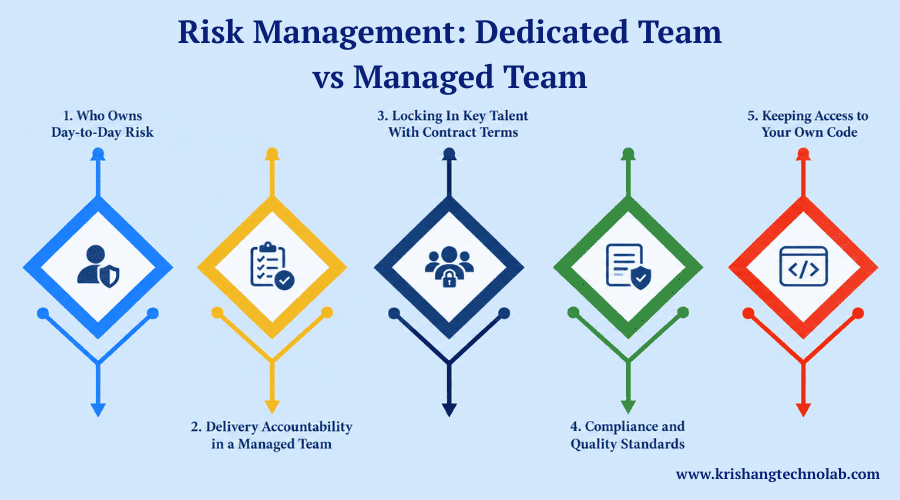
1. Who Owns Day-to-Day Risk
With a dedicated development team, you own priority calls and daily scheduling decisions. Missed deadlines therefore become your responsibility as much as the provider’s. This risk profile suits businesses confident in running their own delivery process. Companies without that confidence should weigh this point carefully before committing.
2. Delivery Accountability in a Managed Team
A managed team shifts delivery risk onto the provider instead of the client. The provider agrees to hit a defined outcome, so accountability sits with them. This structure works well when you lack the bandwidth to chase deadlines yourself. It also takes a bit of the risk management burden off internal staff.
3. Locking In Key Talent With Contract Terms
Contracts should always be dedicated to the senior developer and have a notice period. Without this clause, key talent could leave mid-project with barely any warning. Before you even begin to work on your idea you sign a non-disclosure or confidentiality agreement that protects it. Regardless of the distribution method you choose, these guidelines are applicable.
4. Compliance and Quality Standards
Managed teams typically bring provider-side quality checks and established best practices. This reduces compliance risk compared with assembling a team from independent freelancers. Dedicated teams can match this standard, but only with strong internal oversight. Ask a provider how they approach testing and code review before you sign.
5. Keeping Access to Your Own Code
No matter the model, always ask who owns and maintains the repository after engagement, one of several questions to ask before hiring developers. Ownership of code, staging environments, and passwords should transfer to you. This single question separates a trustworthy partner from a risky one. Clarify it in writing before any Managed vs dedicated development teams contract begins.
Dedicated Development Team vs Managed Team: How to Decide
Choosing between these two models becomes simpler once you answer five practical questions. The Dedicated Team vs. Managed Services decision often comes down to these factors, and thinking through Dedicated Team vs Managed Services this way points you toward one model or the other based on your current business situation.
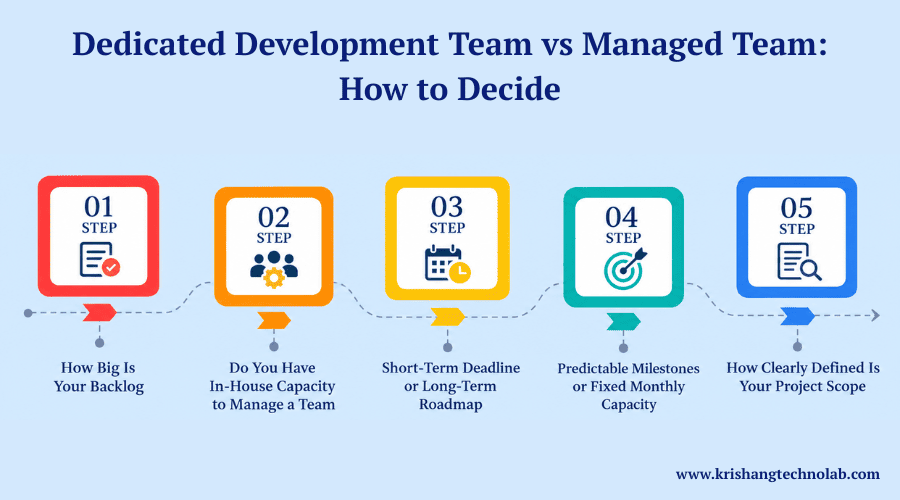
1. How Big Is Your Backlog
A steady, ongoing backlog favors a dedicated development team over a managed alternative. If work keeps arriving every week, fixed capacity delivers better long-term value, which is why many US businesses choose to hire dedicated developers in the USA. A single, defined project favors a managed team instead. Match your backlog size to the model before signing any contract.
2. Do You Have In-House Capacity to Manage a Team
Dedicated teams require someone internally to set priorities and manage the backlog. Without that capacity, daily coordination becomes a burden rather than a benefit. It helps to evaluate a dedicated developer before hiring so you know what oversight the role truly needs. Managed teams remove this requirement, since the provider handles scheduling and delivery.
3. Short-Term Deadline or Long-Term Roadmap
Managed teams tend to work better for short-term projects with a set deadline. A long-term roadmap that changes over time suits a dedicated dev team better, which is why many UK businesses hire dedicated developers in the UK for ongoing roadmaps. Ongoing product development rarely falls neatly into a milestone contract. Do not just pick by price.
4. Predictable Milestones or Fixed Monthly Capacity
If predictable, milestone-based costs matter most, a managed team fits your budget better. If you want a fixed monthly capacity regardless of the workload, you can hire a dedicated team. They both provide cost control, just via different methods. Review your cash flow carefully before locking into either contract type.
5. How Clearly Defined Is Your Project Scope
A clearly defined scope suits a dedicated development team working against a stable backlog. An unclear or evolving scope favors a managed team, or a short consulting phase first. Never reserve full-time capacity before your requirements are settled. Clarity on scope prevents wasted spend on either delivery model.
Final Verdict: Dedicated Development Team vs Managed Team
The dedicated and managed teams decision comes down to control, cost, and project scope. Neither model is inherently better, since each one solves a different business problem. A dedicated development team rewards companies with a steady backlog and internal management capacity. A managed team rewards companies that want progress without taking on daily coordination.
Before you sign any contract, consider the size of your backlog, your timetable, and your budget structure. Who owns delivery risk, who retains the code, and what happens when a senior developer leaves? These questions apply to both models and help prevent costly surprises down the road.
Cost should never be the sole factor driving this decision. The price advantage disappears quickly when engineers sit idle during a slow period. Match the model to how your business really operates by reviewing our full range of software development services, not just the rate card.
If you have a deadline and an unclear scope, start with a managed team or a short consulting phase first. A dedicated development team fits better if you already know how to run a backlog and need long-term continuity. Either way, get contract terms, ownership clauses, and risk management responsibilities in writing before work begins.
FAQs on Dedicated Development Team vs Managed Team
1. What is the difference between a dedicated development team and a managed team?
A dedicated development team is the one that provides you with dedicated engineers who are a part of your day-to-day workflow. A managed team, in contrast, outsources the delivery, staffing and accountability to a third-party provider. The key difference is in who establishes the priorities. One model keeps the control with you, the other gives the control to your partner.
2. Is a managed team the same as managed services?
Managed team and managed services are terms often used interchangeably. Managed services can also include larger IT functions such as network monitoring or cloud operations. Both models take the daily oversight off your shoulders. The provider will be responsible for delivery, staffing and technical decisions within an agreed scope and deadline.
3. Which is cheaper, a dedicated development team or a managed team?
The dedicated development team seems cheaper because pricing is fixed, but you still get billed monthly even if you don’t use them. When you have a managed team, you pay for milestones. This can reduce the total cost of smaller projects. If you have ongoing work, dedicated pricing is better. If you have a defined project, milestone-based managed contracts are better.
4. How is a dedicated team different from staff augmentation?
Staff augmentation is where you add individual engineers that you manage yourself to your existing team. A dedicated team comes in as a self-managed unit with its own delivery lead. Augmentation is about filling short term skills gaps and working under your supervision. Dedicated teams are about ownership of the product for the long term, not day to day involvement.
5. When should a startup choose a managed team over a dedicated team?
A managed team is the best choice for startups with one product to develop and a fixed deadline. The provider is responsible for staffing and end to end delivery. If you are a startup with a growing backlog and an internal product owner, you will gain more value by allocating a development team to long-term ongoing development work.
6. Who owns project risk in a dedicated team versus a managed team?
In a dedicated development team, you own scheduling risk and daily priority decisions yourself. In a managed team, the provider assumes delivery risk and works toward an agreed outcome. This change in accountability is why there tend to be more robust built-in compliance and quality checks on managed contracts.
7. Can a managed team convert into a dedicated development team later?
Yes, many companies start with a managed team for some defined project and later move into a dedicated development team once a backlog is predictable. This is often the case when the initial scope is successful and the ongoing work requires reserving full-time engineering capacity on a long-term basis.
8. What questions should you ask before signing a dedicated team or managed team contract?
Find out who the repository custodian is, who names the senior lead and what the notice period is. Define ownership of code and passwords after handover. The same questions apply whether you have a dedicated development team or a managed team and regardless of which pricing model you end up choosing.
Found this post helpful? Don't forget to share it with your network!